SmallRig Carbon Fiber Travel Tripod is our top choice for the Best Amateur Tripods for Photography thanks to its high-strength carbon fiber construction and fluid head that balances stability with a lightweight, travel-ready design.
The Victiv 78-inch Aluminum Camera Tripod serves as a versatile alternative for those needing extra height and monopod functionality, while the Amazon Basics Lightweight Camera Tripod offers a budget-friendly, entry-level solution for casual photographers who prioritize portability over heavy-duty load capacity.
Selecting the right support requires balancing weight, height, and head type based on your specific camera gear and shooting environment. Understanding how these factors influence your workflow ensures you invest in a tool that enhances your photography rather than hindering your mobility.
When you have selected your support, you may also want to explore Best Amateur DSLR Cameras to ensure your imaging system is fully optimized for your next project. If you are focusing on motion, our guide to the Best Amateur 4K Video Cameras provides complementary advice on pairing your tripod with high-resolution video equipment.
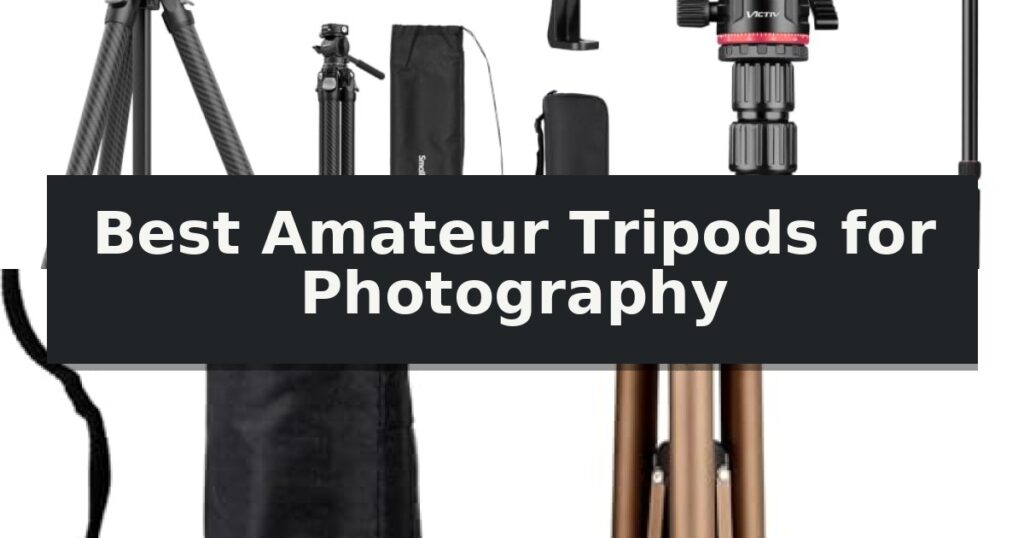
3 Best Amateur Tripods for Photography in 2026 Reviews
Quick Comparison
| Product | Best For | Key Strength | Score |
|---|---|---|---|
| SmallRig Carbon Fiber Travel Tripod | Best Overall | High-strength carbon fiber construction for an optimal strength-to-weight ratio. | 4.9 |
| Victiv 78-inch Aluminum Camera Tripod | Versatile Height for Landscapes | 3-in-1 functionality allows for quick conversion between tripod, monopod, and walking stick modes. | 4.7 |
| Amazon Basics Lightweight Camera Tripod | Budget-Friendly Starter Option | Ultra-lightweight aluminum design for easy portability. | 4.8 |
How We Chose
When evaluating the best amateur tripods for photography, we focus on the practical intersection of build quality and field utility. An experienced reviewer prioritizes how materials like carbon fiber or aluminum affect transport, how the head mechanism handles specific camera movements, and whether the locking systems provide the necessary security for your equipment during diverse shooting scenarios.
- Material construction and weight-to-stability ratio
- Maximum height and folded length for travel
- Head type and precision for panning or tilting
- Load capacity compatibility with standard camera systems
- Deployment speed and locking mechanism reliability
1 SmallRig Carbon Fiber Travel Tripod — Compact Stability for Travel
Achieving steady, cinematic camera movements while traveling requires gear that balances portability with structural integrity. The SmallRig Carbon Fiber Travel Tripod addresses this need by utilizing high-strength carbon fiber materials to maintain a lightweight profile of just 1.34kg without sacrificing the stability required for outdoor photography.
Designed for versatility, this tripod features a precision-engineered fluid head that supports up to 5kg of equipment. It offers smooth 360° panning and a tilt range of +90° to -70°, making it suitable for DSLRs, mirrorless cameras, or cages equipped with 1/4''-20 threaded holes. The inclusion of Arca-Swiss compatible quick-release plates allows for rapid transitions between handheld and tripod-mounted shooting.
The tripod's 4-section legs utilize lever locks for tool-less deployment, reaching a maximum working height of 161.5cm. For those needing unique angles, the 180° reversible center column enables ground-level macro photography, achieving a minimum height of 49.5cm. A detachable hook is also provided for attaching counterweights, which helps maintain balance in windy environments.
This system is built for the mobile videographer, folding down to a compact 51.5cm for easy transport. The kit includes a carrying bag, wrench, and smartphone holder, providing a comprehensive solution for various shooting scenarios.
Best for: Travel videographers who require a lightweight, compact carbon fiber tripod with fluid head capabilities for cinematic movement.
Skip if: Users who require a heavy-duty studio tripod for cinema-grade cameras exceeding the 5kg load capacity.
- High-strength carbon fiber construction for an optimal strength-to-weight ratio.
- Fluid video head provides smooth panning and tilting for professional-looking footage.
- 180° reversible center column allows for versatile low-angle and macro photography.
- Ultra-compact folding design makes it highly portable for travel.
- 5kg load capacity limits the use of heavier professional cinema rigs.
- Lever lock system requires manual adjustment compared to twist-lock alternatives.
2 Victiv 78-inch Aluminum Camera Tripod — Versatile Height for Landscapes
Reaching a maximum height of 78 inches, the Victiv 78-inch Aluminum Camera Tripod provides significant vertical reach for photographers needing elevated perspectives or landscape coverage. This versatile stand is engineered with a 3-in-1 design, allowing it to function as a standard tripod, a monopod, or a walking stick, which adds utility for travel and dynamic shooting environments.
The construction utilizes sturdy aluminum leg tubing with a 26mm diameter, supporting a maximum load capacity of 22 lbs while maintaining a base weight of 3.3 lbs. Stability is further enhanced by a spring-loaded retractable hook on the center column, enabling users to add external weight for increased grounding. The center column itself is reversible, facilitating low-angle and macro photography.
Equipped with a 360-degree metal ball head, the unit offers precise control for panning and tilting. The head features an upgraded, larger aluminum design intended to improve tightness and security for mounted equipment. The quick-release plate uses a standard 1/4-inch-20 screw mount, ensuring compatibility with a wide range of DSLR cameras, spotting scopes, binoculars, and compact camcorders.
For rapid deployment, the tripod employs a flip-lock leg system that allows for quick height adjustments. Each leg also includes integrated 1/4-inch threaded holes, providing mounting points for accessories like magic arms. The package includes a carrying case to assist with transport, making this a practical option for photographers who require a balance of height, portability, and multi-functional support.
Best for: Photographers and outdoor enthusiasts who require a tall, versatile tripod that can quickly convert into a monopod for travel or varied terrain.
Skip if: Users who prioritize ultra-lightweight carbon fiber materials or those who require a specific fluid head for professional-grade cinema panning.
- 3-in-1 functionality allows for quick conversion between tripod, monopod, and walking stick modes.
- High maximum height of 78 inches provides excellent reach for landscape and elevated shots.
- 22 lbs maximum load capacity supports a wide variety of heavy camera gear and spotting scopes.
- Integrated 1/4-inch accessory ports on each leg allow for the attachment of additional gear like magic arms.
- Aluminum construction is heavier than carbon fiber alternatives.
- Flip-lock design requires manual adjustment for each leg section compared to twist-lock systems.
3 Amazon Basics Lightweight Camera Tripod — Budget-Friendly Starter Option
Capturing steady shots while traveling requires gear that balances portability with functional stability. The Amazon Basics 50-inch Lightweight Portable Camera Tripod Stand addresses this need by utilizing a lightweight aluminum construction that weighs only 1.23 lbs, making it a practical companion for hiking or camping trips where every ounce counts.
This tripod features 3-section, lever-lock legs that allow for quick height adjustments ranging from 16.1 inches to 50 inches. For framing, the integrated 3-way head supports both tilt and swivel motions, enabling users to switch between portrait and landscape orientations. A built-in bubble level is included to assist with achieving accurate positioning on uneven terrain.
Usability is enhanced by the inclusion of a quick-release plate, which facilitates fast transitions when moving between handheld shooting and tripod-mounted setups. When the session is complete, the unit collapses to a compact 16.9 inches and includes a zippered storage bag for protected transport.
While designed for convenience, this tripod is intended for lighter equipment. It is not recommended for heavy, high-end DSLR cameras, long lenses, or large telescopes, as the total equipment weight should not exceed 4.4 pounds. This limitation ensures the stability of the lightweight frame during use.
Best for: Travelers and amateur photographers using lightweight cameras who prioritize portability and quick setup over heavy-duty stability.
Skip if: You are using heavy, high-end DSLR cameras or long lenses that exceed the 4.4-pound weight capacity.
- Ultra-lightweight aluminum design for easy portability.
- 3-way head with bubble level for versatile positioning.
- Quick-release plate for efficient camera mounting.
- Adjustable height with simple lever-lock legs.
- Limited weight capacity of 4.4 pounds.
- Not suitable for heavy professional gear or long lenses.
Best Amateur Tripods for Photography Buying Guide
Material and Build Quality
Carbon fiber is often preferred for travel because it provides a superior strength-to-weight ratio compared to aluminum. This material choice reduces vibrations and overall weight, making it easier to carry on long hikes or through busy urban environments.
Aluminum remains a reliable, cost-effective alternative for those who do not require the extreme weight savings of carbon fiber. While heavier, aluminum tripods offer robust durability and are often more resistant to accidental impacts during frequent travel.
Height and Portability
The maximum working height determines your ability to shoot at eye level without hunching over, which is crucial for comfort during long sessions. Always check the height with the center column fully extended to ensure it meets your specific needs.
Folded length is equally important for storage in backpacks or carry-on luggage. A tripod that collapses into a compact form factor allows for easier transport, ensuring you are more likely to bring it along for spontaneous shooting opportunities.
Head Functionality
Fluid heads are designed for smooth, cinematic panning and tilting, making them ideal for videography and tracking moving subjects. These heads provide consistent resistance, which helps prevent jerky movements during recording.
Ball heads offer faster, more intuitive positioning for still photography. By loosening a single knob, you can quickly adjust the camera angle in multiple directions, which is essential for capturing dynamic subjects or adjusting compositions on the fly.
Load Capacity and Stability
Every tripod has a maximum load capacity that should never be exceeded to maintain stability. Ensure your camera body, lens, and any attached accessories remain well within the manufacturer's specified weight limit to prevent tipping or sagging.
Stability features like center column hooks allow you to add counterweights, such as your camera bag, to lower the center of gravity. This is particularly useful in windy conditions or when using longer, heavier telephoto lenses.
Leg Locking Mechanisms
Lever locks allow for rapid deployment and are often easier to operate with gloves or in cold weather. They provide a clear visual indicator of whether the leg section is securely locked or unlocked.
Twist locks offer a more streamlined profile that is less likely to snag on clothing or foliage during transport. While they require a bit more practice to master, they are highly reliable and contribute to a more compact overall design.
Frequently Asked Questions
Do I need a carbon fiber or aluminum tripod?
Carbon fiber is lighter and absorbs vibrations better, making it ideal for travel. Aluminum is heavier but typically more affordable and durable for stationary use.
How much load capacity do I need?
You should choose a tripod with a load capacity at least 1.5 to 2 times the weight of your heaviest camera and lens combination to ensure maximum stability.
What is the benefit of a reversible center column?
A reversible center column allows you to mount the camera upside down between the legs, which is perfect for macro photography and getting low-angle shots near the ground.
Can I use a video tripod for still photography?
Yes, but video heads are optimized for smooth motion rather than the rapid, precise locking required for still photography. A ball head is generally better for stills.
What is an Arca-Swiss compatible plate?
This is a standardized quick-release system that allows you to easily swap your camera between different tripods, gimbals, and mounts without changing the plate on your camera.
Conclusion: Our Top Pick
Our top pick is SmallRig Carbon Fiber Travel Tripod. Choosing the right tripod depends on your specific balance of portability and the weight of your camera gear. For most travelers, prioritizing a lightweight carbon fiber model will yield the best results for long-term use.
Always verify the load capacity against your heaviest lens to ensure stability. Investing in a reliable support system early on will significantly improve the quality of your long-exposure and video work.