ELEGOO Conqueror Robot Tank Kit is our top choice for the Best Arduino Robotics Kits, offering a robust metal chassis and integrated FPV camera for immersive navigation. The ACEBOTT 4-in-1 Smart Robot Arm provides unmatched modular versatility for those wanting to switch between tank and robotic arm configurations. The Makeblock mBot Robot Kit serves as the most accessible entry point for beginners focused on simple, block-based coding projects.
Selecting a robotics kit involves balancing mechanical assembly with programming depth. While some kits prioritize ease of use for younger students, others offer advanced control boards and sensor arrays that grow with the user's technical skills. Evaluating these systems requires looking at how well they bridge the gap between basic block coding and professional-grade Arduino IDE environments.
The most effective kits provide clear documentation and modular hardware that allows for future upgrades. Whether you are interested in autonomous obstacle avoidance, line tracking, or complex robotic arm manipulation, the right kit should offer a stable platform for both learning and experimentation.
If you are new to the platform, our guide to the Best Arduino Kits for Beginners provides a great starting point for understanding basic circuits. For younger students, exploring the Best Arduino Kits for Kids can help identify models with the most intuitive assembly processes.
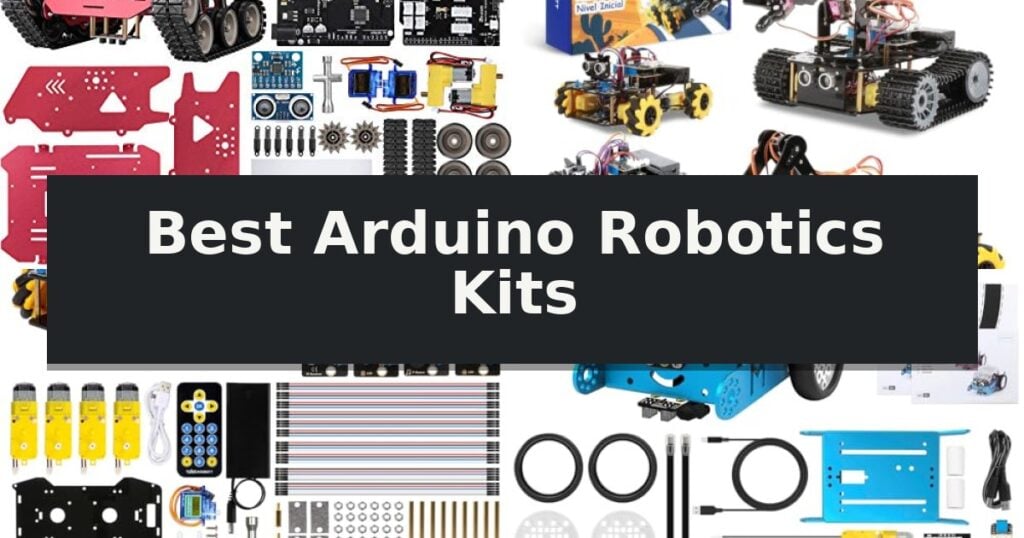
10 Best Arduino Robotics Kits in 2026 Reviews
Quick Comparison
| Product | Best For | Key Strength | Score |
|---|---|---|---|
| ELEGOO Conqueror Robot Tank Kit | Best Overall | Comprehensive no-solder kit including all necessary chassis, sensor, and control components. | 4.9 |
| ACEBOTT 4-in-1 Smart Robot Arm | Most Versatile Modular Build | 4-in-1 modular design allows for multiple robot configurations. | 4.8 |
| ACEBOTT Smart Robot Car Kit | Best for Omnidirectional Movement | Advanced ESP32 controller provides a robust foundation for programming. | 4.6 |
| Makeblock mBot Robot Kit | Easiest Entry for Beginners | Rapid assembly process allows for setup in approximately 15 minutes. | 4.3 |
| Makeblock mBot Ultimate Robot Kit | Advanced Multi-Model Engineering | 10-in-1 modular design allows for building a wide variety of robotic models. | 4.9 |
| LewanSoul miniArm Robot Kit | Precision Desktop Robotic Arm | Open-source platform compatible with Arduino programming. | 4.7 |
| ACEBOTT ESP32 Smart Robot Arm | Best Integrated Arm and Car | Omnidirectional movement via Mecanum wheels for 360-degree navigation. | 4.3 |
| ACEBOTT 5DOF Robot Arm Car | Best for Programmable Grabbing | Omnidirectional movement via 6cm Mecanum wheels. | 4.5 |
| LAFVIN Camera Smart Robot Car | Affordable FPV Learning Platform | Integrated ESP32-S3 module for wireless Wi-Fi control and video streaming. | 4.5 |
| LK COKOINO Robot Arm Kit | Best for Action Sequencing | Flexible 4-axis design with extensive range of motion. | 4.4 |
How We Chose
When evaluating the best Arduino robotics kits, we focus on the transition from basic assembly to complex, open-source programming. An effective kit must provide a durable mechanical foundation, reliable sensor integration, and clear, step-by-step documentation that allows users to move beyond pre-programmed modes into custom, self-developed logic.
- Controller compatibility and Arduino IDE integration
- Mechanical assembly complexity and chassis durability
- Sensor variety and expansion port availability
- Programming flexibility from block-based to text-based code
- Documentation quality and tutorial support
1 ELEGOO Conqueror Robot Tank Kit — Best for FPV Video Exploration
The ELEGOO Conqueror Robot Tank Kit provides a comprehensive platform for STEM education by combining a stainless-steel chassis with an UNO R3 control system. This kit is designed for users aged 10 and up, offering a hands-on approach to robotics that progresses from simple block-based programming to complex logic development within the Arduino IDE.
Performance is driven by an ESP32-WROVER Wi-Fi module that enables live FPV video streaming to a mobile device. The robot features an adjustable servo-mounted camera, allowing for dynamic viewing angles during operation. Users can navigate the tank through five distinct interactive modes, including obstacle avoidance, line tracking, and an auto-follow function.
This complete no-solder project kit includes all necessary hardware, such as the metal chassis, suspension components, tracks, and various sensors. The integration of an ultrasonic module and line-tracking sensors supports the creation of maze challenges and patrol routes, making it a versatile tool for both classroom environments and individual coding projects.
The system is powered by a 7.4 V battery and includes an IR remote for manual control, providing multiple ways to interact with the hardware. By transitioning from the ElegooKit app to the Arduino IDE, users can refine motor speed, sensor thresholds, and navigation logic, facilitating a scalable learning experience.
Best for: Students and hobbyists looking for a versatile, programmable robotics platform that supports both visual block coding and advanced Arduino IDE development.
Skip if: Users who require a pre-assembled robot or those who do not have access to a computer for programming and uploading code.
- Comprehensive no-solder kit including all necessary chassis, sensor, and control components.
- Five interactive modes including FPV driving, obstacle avoidance, and line tracking.
- Scalable programming options from beginner-friendly block coding to advanced Arduino IDE.
- Live FPV video streaming via an integrated ESP32-WROVER Wi-Fi module.
- Assembly required, which may be time-consuming for some users.
- Requires computer access for full functionality and code modification.
2 ACEBOTT 4-in-1 Smart Robot Arm — Most Versatile Modular Build
The ACEBOTT 4-in-1 Smart Robot Arm provides a highly adaptable platform for students and hobbyists by integrating a 5DOF robotic arm with a tank-style mobile base. This modular design allows users to configure the system as a robotic arm car, a standalone tank robot, or a combined robotic arm tank, facilitating diverse mechanical and coding experiments.
Powered by an ESP32 controller, the kit is fully compatible with Arduino and Scratch, making it a suitable choice for those learning to program hardware. The system supports both IR remote and smartphone app control (iOS and Android), providing flexible operation modes for indoor and outdoor environments. The inclusion of 16 story-based tutorials and HD assembly videos provides a structured path for beginners to master electronics and mechanics.
The chassis features rugged rubber tank treads designed to navigate varied surfaces including grass, gravel, and carpet. This drivetrain is engineered for stability, ensuring the robotic arm can effectively perform tasks such as grabbing, lifting, and placing objects while the base is in motion.
This kit serves as a comprehensive STEM tool for teens aged 12 to 16, offering a hands-on approach to exploring robotics and AI. By combining mechanical assembly with software development, it encourages independent problem-solving and innovation in a classroom or home setting.
Best for: Students and hobbyists aged 12-16 looking for a versatile, modular platform to learn coding and robotics through hands-on construction.
Skip if: Users seeking a pre-assembled, plug-and-play toy, as this kit requires significant time for assembly and programming.
- 4-in-1 modular design allows for multiple robot configurations.
- ESP32 controller offers compatibility with popular coding environments like Arduino and Scratch.
- Rugged rubber tank treads provide reliable traction on diverse outdoor and indoor surfaces.
- Includes 16 guided tutorials to support the learning process.
- Assembly required for all components, which may be time-consuming for some users.
- Requires coding knowledge to fully utilize the programmable features of the ESP32 controller.
3 ACEBOTT Smart Robot Car Kit — Best for Omnidirectional Movement
Mastering the fundamentals of robotics becomes an engaging, hands-on experience with the ACEBOTT Smart Robot Car Kit. Designed to bridge the gap between simple electronics and complex programming, this kit utilizes an advanced ESP32 controller board to guide students through 16 story-rich tutorials that demystify hardware and coding.
The core of this system is its omnidirectional Mecanum wheel design, which allows the chassis to execute 360-degree movements, including sideways drifting and diagonal travel. This mechanical flexibility enables the robot to navigate narrow paths and intricate road layouts with ease, supported by multi-way cruise and multi-direction obstacle avoidance sensors for autonomous operation.
Beyond its base mobility, the platform offers significant rich expandability through optional modules. Users can integrate camera, robotic arm, tank, or solar expansion packs to customize the robot for specific tasks like image recognition, voice control, or tracking modes. Control is handled via an intuitive App or IR remote, providing immediate feedback for various movement and interaction modes.
This kit serves as a comprehensive STEM education platform for teenagers and programming enthusiasts. By combining hardware assembly with software logic, it encourages users to develop problem-solving skills while exploring the practical applications of robotics technology.
Best for: Students and hobbyists looking for a versatile, expandable robotics platform that supports advanced omnidirectional movement and diverse sensor-based projects.
Skip if: Users who require a pre-assembled robot or those who do not have access to batteries, which are not included in the kit.
- Advanced ESP32 controller provides a robust foundation for programming.
- Omnidirectional Mecanum wheels allow for 360-degree movement and complex maneuvers.
- Rich expandability options include robotic arms, cameras, and tank tracks.
- Multi-direction obstacle avoidance and follow modes enable autonomous navigation.
- Batteries are not included, requiring a separate purchase for operation.
- Assembly and programming may present a learning curve for younger users without guidance.
4 Makeblock mBot Robot Kit — Easiest Entry for Beginners
The Makeblock mBot Robot Kit serves as a specialized entry point for young learners, designed to bridge the gap between simple block-based logic and functional robotics. By utilizing a modular, hardware-focused design, this kit allows users to assemble a fully operational robot in approximately 15 minutes. This rapid assembly process provides immediate, tangible results, which is essential for maintaining engagement while introducing foundational programming concepts.
Engineered to grow alongside the user, the kit facilitates a seamless transition from introductory block-based coding to more advanced Arduino environments. It includes resources for four distinct projects—such as line-following, obstacle avoidance, and remote control—which provide a structured path for developing technical competency. These projects are supported by visual, step-by-step instructions and troubleshooting tips, helping users navigate the complexities of robotics without unnecessary frustration.
Beyond its initial assembly, the kit functions as a comprehensive STEM tool that encourages logical thinking and iterative problem-solving. Because the platform provides instant feedback, users can observe the real-world impact of their code modifications in real time. This cycle of testing and refining is a core component of the learning experience, allowing students to move from imitation to independent creation.
The hardware is designed for durability, ensuring it remains functional through repeated use in educational settings. While the kit is highly effective for its intended age range of 8-12, its focus on structured educational projects means it is primarily optimized for learning rather than high-torque engineering or advanced hobbyist applications. This trade-off ensures the system remains accessible and manageable for beginners while providing a clear, evidence-based progression toward more complex programming environments.
Best for: Young learners ages 8-12 who are transitioning from block-based coding to Arduino-based robotics.
Skip if: Users seeking an advanced, high-torque robotics platform for complex engineering projects will find the educational focus of this kit too limiting.
- Rapid assembly process allows for setup in approximately 15 minutes.
- Supports a seamless transition from block-based coding to Arduino.
- Includes four distinct projects to teach core robotics concepts like obstacle avoidance.
- Provides comprehensive visual instructions and troubleshooting support.
- Limited to educational projects and may not satisfy advanced hobbyists.
5 Makeblock mBot Ultimate Robot Kit — Advanced Multi-Model Engineering
Transitioning from basic electronics to complex engineering requires a platform that scales with your growing technical proficiency. The Makeblock mBot Ultimate Robot Kit provides this versatility by offering a modular 10-in-1 building system that bridges the gap between simple block-based coding and advanced text-based programming.
At the core of this kit is the MegaPi control board, which serves as a robust foundation for diverse projects. It supports Arduino C and Python integration, allowing users to transition from the drag-and-drop mBlock software to professional-grade coding environments. This compatibility ensures that the hardware remains relevant as your programming skills evolve from basic logic to machine vision and autonomous navigation.
The physical construction utilizes industrial-grade aluminum alloy parts, which offer a balance of structural integrity and lightweight design. These components feature threaded grooves for precision assembly, ensuring that the robotic arm, tank, or other configurations remain stable during operation. The system is designed to drive multiple motors and servos in sync, providing the mechanical precision necessary for complex movements.
This platform is engineered for those who want to move beyond pre-built toys into custom robotics. By supporting both Arduino and Raspberry Pi integration, it allows for advanced sensor implementation and machine-vision projects. While it offers significant depth, users should note that the kit requires 6x AA batteries, which are not included, to power the motors and control board.
Best for: Aspiring engineers and coders aged 12 and up who want a modular platform that grows from simple block coding to advanced Arduino and Raspberry Pi projects.
Skip if: Users seeking a simple, out-of-the-box toy that requires no assembly or programming knowledge will find the construction and coding requirements of this kit excessive.
- 10-in-1 modular design allows for building a wide variety of robotic models.
- High-strength aluminum alloy construction ensures durability and precise assembly.
- Cross-platform compatibility with Arduino and Raspberry Pi for advanced project scaling.
- Supports both drag-and-drop and text-based coding environments.
- Requires 6x AA batteries which are not included in the package.
- Assembly time is required due to the modular, multi-model nature of the kit.
6 LewanSoul miniArm Robot Kit — Precision Desktop Robotic Arm
The LewanSoul miniArm Robot Kit provides a versatile entry point into robotics by utilizing an open-source architecture based on the Atmega328 platform. This desktop-sized robotic arm is designed for users interested in STEM education, coding, and secondary development, offering a 5-degree-of-freedom (5DOF) range of motion for precise control.
Engineered for flexibility, the kit features high-performance digital servos and a 6-channel knob controller, allowing for both real-time manual operation and offline action editing. The system supports app-based control, providing an accessible interface for programming and testing movement sequences without requiring complex external hardware setups.
A key differentiator for this model is its support for sensor expansion. The unit includes dedicated ports for integrating components such as an ESP32 Cam, ultrasonic sensors, touch sensors, and accelerometers. This modularity enables users to advance from basic movement to more complex tasks like sonic ranging and automated pose control through custom programming.
The kit is available in two configurations: a starter version and a standard version. The standard kit includes additional modules like the glowing ultrasonic sensor and ESP32 Cam, which are necessary for advanced sensing projects. Users should note that the physical footprint measures 13 x 5 x 8 inches, making it a compact addition to a workspace.
Best for: Students and hobbyists looking for an open-source, expandable robotic arm platform for learning Arduino programming and sensor integration.
Skip if: Users who require a pre-assembled, plug-and-play solution without any interest in coding, wiring, or secondary development.
- Open-source platform compatible with Arduino programming.
- Modular sensor expansion ports for advanced projects.
- Versatile control options including app and knob potentiometer support.
- High-precision digital servos for accurate movement.
- Starter kit lacks advanced sensors like the ESP32 Cam and ultrasonic modules.
- Requires assembly and technical knowledge for secondary development.
7 ACEBOTT ESP32 Smart Robot Arm — Best Integrated Arm and Car
The ACEBOTT ESP32 Smart Robot Arm integrates a 5-DOF robotic arm with an omnidirectional mobile base, providing a versatile platform for learning robotics and programming. By utilizing an ESP32 controller, this kit allows users to explore complex mechanical movements and autonomous navigation through a single, cohesive system.
The robotic arm features 5 high-quality metal gear servos, enabling precise control over the clamp, wrist, elbow, and base rotations. This mechanical flexibility allows the unit to perform tasks such as grabbing, lifting, and placing objects, which helps users understand the principles of degrees of freedom in robotics.
Mobility is managed by 6cm omnidirectional Mecanum wheels, which support 360-degree movement including sideways drifting and diagonal travel. The system is equipped with ultrasonic and infrared sensors to facilitate autonomous functions like obstacle avoidance, line tracking, and a follow mode, all of which can be managed via an app or infrared remote.
Designed for educational use, the kit includes a paper manual and pre-burned programs, allowing for immediate assembly and operation. The ACEBOTT ESP32 Smart Robot Arm is intended for teenagers and adults interested in STEM projects, offering a balance between mechanical assembly and software expansion without requiring external tutorial downloads.
Best for: Students and hobbyists over 12 years old looking for a comprehensive STEM kit that combines mobile robotics with a functional 5-DOF arm.
Skip if: Users who require a pre-assembled robot or those who do not have access to batteries, as the kit requires separate power sources.
- Omnidirectional movement via Mecanum wheels for 360-degree navigation.
- 5-DOF robotic arm with high-quality metal gear servos for precise object manipulation.
- Integrated sensor suite supporting autonomous obstacle avoidance and line tracking.
- ESP32-based controller providing a robust foundation for programming and expansion.
- Batteries not included, requiring separate purchase for operation.
- Assembly required from scratch, which may be challenging for younger beginners.
8 ACEBOTT 5DOF Robot Arm Car — Best for Programmable Grabbing
The ACEBOTT 5DOF Robot Arm Car provides a comprehensive introduction to robotics by combining a programmable 5-degree-of-freedom arm with a mobile, omnidirectional chassis. Powered by an ESP32 controller, this kit allows users to engage in complex tasks like grabbing, lifting, and placing objects while navigating diverse environments.
Designed for accessibility, the kit features uniform screws and a clear paper manual, ensuring that the assembly process is straightforward for beginners. Because the necessary programs come pre-burned, users can begin operating the robot immediately after construction without needing to download additional tutorials. This makes it a practical choice for hands-on STEM learning in both home and classroom settings.
The chassis is equipped with 6cm Mecanum wheels, which enable advanced movement patterns such as diagonal travel, drifting, and precise 360-degree turning. Control is flexible, offering both an IR remote and a dedicated mobile App (iOS/Android), allowing for intuitive command over the arm's positioning and the car's navigation.
As skills develop, the platform remains relevant through its expandable modular design. It supports various add-ons, including cameras, solar panels, and tank tracks, which facilitate further exploration into object tracking and multi-DOF control. This versatility helps bridge the gap between simple building sets and more advanced engineering projects.
Best for: Students and hobbyists aged 8-16 looking for a versatile, expandable platform to learn coding, mechanical assembly, and robotics control.
Skip if: Users who prefer a pre-assembled, ready-to-run robot or those who do not have the required batteries on hand to power the unit.
- Omnidirectional movement via 6cm Mecanum wheels.
- Pre-burned programs for immediate operation after assembly.
- Expandable architecture supporting modular add-ons like cameras and solar panels.
- Dual control options including mobile app and IR remote.
- Batteries not included, requiring separate purchase for operation.
- Modular add-ons such as cameras or tank tracks must be purchased separately.
9 LAFVIN Camera Smart Robot Car — Affordable FPV Learning Platform
Building a functional robot from the ground up offers a practical way to master embedded systems, and the LAFVIN Camera Smart Robot Car serves as a comprehensive entry point into this field. By integrating an ESP32-S3 module, this kit enables Wi-Fi connectivity for real-time video streaming, allowing users to pilot the vehicle through a first-person view (FPV) interface on mobile devices.
The platform is designed for educational exploration, featuring five intelligent operation modes including obstacle avoidance, line tracking, and object following. These capabilities are powered by a suite of sensors that utilize easy-to-connect interfaces, which helps streamline the assembly process for beginners while reducing the likelihood of wiring errors.
As an open-source learning platform, the kit provides access to a variety of free tutorials and code, supporting those who wish to modify or expand the robot's functionality. The DIY assembly requirement is central to the experience, encouraging users to develop logical thinking and technical focus as they construct the chassis and mount the pan-tilt camera system.
While the kit offers a robust set of features for learning, it requires a commitment to the assembly process and familiarity with the Arduino IDE ecosystem. It is a dedicated tool for those looking to bridge the gap between hardware construction and software programming in a controlled, project-based environment.
Best for: Beginners and students seeking a hands-on, open-source platform to learn robotics, Wi-Fi control, and sensor integration.
Skip if: Users who prefer a pre-assembled, plug-and-play toy rather than a DIY kit requiring assembly and programming.
- Integrated ESP32-S3 module for wireless Wi-Fi control and video streaming.
- Five intelligent operation modes provide diverse programming and sensor-based challenges.
- Easy-to-connect interfaces simplify the wiring process for beginners.
- Open-source ecosystem offers extensive free learning resources and code.
- Full self-assembly required, which may be time-consuming for some users.
- Requires familiarity with Arduino IDE for full customization and operation.
10 LK COKOINO Robot Arm Kit — Best for Action Sequencing
The LK COKOINO Robot Arm Kit offers a hands-on introduction to robotics by providing the essential hardware and tools required to assemble a functional 4-axis robotic arm. This kit is designed for those looking to explore electronics, programming, and mechanical design through a structured, step-by-step building process.
The arm features a flexible 4-axis design that allows for precise movement, including a 260° clip opening and 180° rotation capabilities for the wrist, elbow, and base. This range of motion enables the robot to grab and manipulate objects in various directions, providing a practical demonstration of mechanical control.
Beyond basic assembly, the kit includes a joystick controller for manual operation and a memory function that can record and repeat up to 170 distinct actions. This feature allows users to program sequences, bridging the gap between simple hardware assembly and introductory automation.
The kit is intended as an educational tool for teens and adults to develop skills in coding and electronics. Users should note that the kit requires two external batteries for power, which are not included in the package. Comprehensive assembly and programming tutorials are provided to assist with the setup process.
Best for: Beginners and students interested in learning the fundamentals of robotics, programming, and action sequencing.
Skip if: Users looking for a pre-assembled industrial-grade robotic arm or those who do not wish to perform manual assembly and battery setup.
- Flexible 4-axis design with extensive range of motion.
- Action memory function capable of recording 170 movements.
- Includes joystick controller for manual operation.
- Provides educational tutorials for assembly and programming.
- Batteries not included in the kit.
- Requires manual assembly of all components.
Best Arduino Robotics Kits Buying Guide
Controller and Coding Environment
The heart of any robotics kit is its microcontroller. Most kits utilize the standard UNO R3 or more advanced ESP32 boards, which are widely supported by the Arduino community. This compatibility ensures that you can easily find libraries and code examples to expand your robot's capabilities.
Beginners often start with visual, block-based programming environments like mBlock or custom app-based interfaces. As your skills advance, look for kits that allow you to transition seamlessly to the Arduino IDE, where you can write and upload your own C++ code to control motors and sensors directly.
Mechanical Design and Build Quality
Chassis material significantly impacts the longevity and performance of your robot. Stainless steel or high-strength aluminum alloy frames provide a stable base for heavy components like robotic arms or cameras, whereas plastic frames are often easier to assemble but may be less durable.
Consider the drivetrain carefully. Tracked systems, such as those found on tank-style kits, offer superior traction on uneven surfaces like carpet or gravel. Conversely, omnidirectional Mecanum wheels allow for advanced maneuvers like sideways drifting and precise rotation in tight spaces.
Sensors and Functional Expansion
A kit's potential for growth is defined by its sensor suite. Standard modules include ultrasonic sensors for obstacle avoidance and line-tracking arrays for path following. These sensors are essential for learning the basics of autonomous navigation and environmental interaction.
Look for kits that feature extra expansion ports. These allow you to add specialized hardware later, such as Wi-Fi modules for FPV video streaming, solar panels for power, or additional servos for more complex robotic arm movements.
Assembly and Documentation
The assembly process is a core component of the learning experience. Kits that include illustrated, step-by-step manuals or high-definition video tutorials help prevent common wiring errors and mechanical misalignments, especially for younger builders.
Check if the kit is solder-free. Most modern educational robotics kits use modular connectors and screw-based assembly, which makes them safer and more accessible for classroom settings or home projects where soldering equipment may not be available.
Power Management and Portability
Power requirements are often overlooked during the selection process. Most kits require external batteries, such as 7.4V packs or standard AA batteries, which are rarely included in the box. Always verify the battery type and quantity needed before starting your build.
Portability is also a factor if you plan to run your robot outdoors. Ensure that the chassis is compact enough for your intended environment and that the battery life is sufficient for your planned navigation or coding experiments.
Frequently Asked Questions
Do these kits require soldering?
Most modern Arduino robotics kits are designed for solder-free assembly, utilizing plug-and-play modules and screw-based connections to make them accessible for beginners.
Can I use these kits if I have no coding experience?
Yes, many kits include block-based programming software that allows you to control the robot's movements without writing complex code, helping you learn logic before moving to text-based programming.
Are batteries included with these kits?
Generally, no. Most robotics kits require you to purchase specific batteries, such as 7.4V Li-ion packs or AA batteries, separately.
Can I expand these robots with more sensors later?
Many of the kits listed feature expansion ports that allow you to add sensors like cameras, ultrasonic modules, or additional servos as your project requirements grow.
What is the difference between an UNO R3 and an ESP32 controller?
The UNO R3 is a classic, beginner-friendly board, while the ESP32 is more powerful and typically includes built-in Wi-Fi and Bluetooth capabilities, making it better for advanced projects like FPV video streaming.
Conclusion: Our Top Pick
Our top pick is ELEGOO Conqueror Robot Tank Kit. Choosing the right robotics kit depends on your current skill level and long-term goals. For those seeking a comprehensive, out-of-the-box experience with video capabilities, the ELEGOO Conqueror is a robust choice. If you prefer modularity and the ability to experiment with different mechanical configurations, the ACEBOTT series provides excellent flexibility.
Regardless of the model you choose, the primary value lies in the hands-on experience of building and programming. By starting with a well-documented kit, you can build a solid foundation in electronics and coding that will serve as a springboard for more complex engineering projects in the future.