Pica Toys 2.4GHz Wireless Remote Set is our top choice for the Best 2.4GHz Transmitter and Receiver Modules for Arduino, offering a straightforward, pre-paired solution for hobbyists who need immediate control functionality without complex programming.
Selecting the right wireless module requires balancing your project's specific communication requirements against the complexity of the hardware interface. While some modules prioritize raw signal power for long-range data transmission, others focus on simple, plug-and-play connectivity for basic remote control tasks.
Experienced builders often evaluate these components based on their integration method, such as SPI versus USB, and their compatibility with standard development boards. Understanding whether your project requires a simple remote-control link or a robust data-transceiver network is essential for selecting a reliable module.
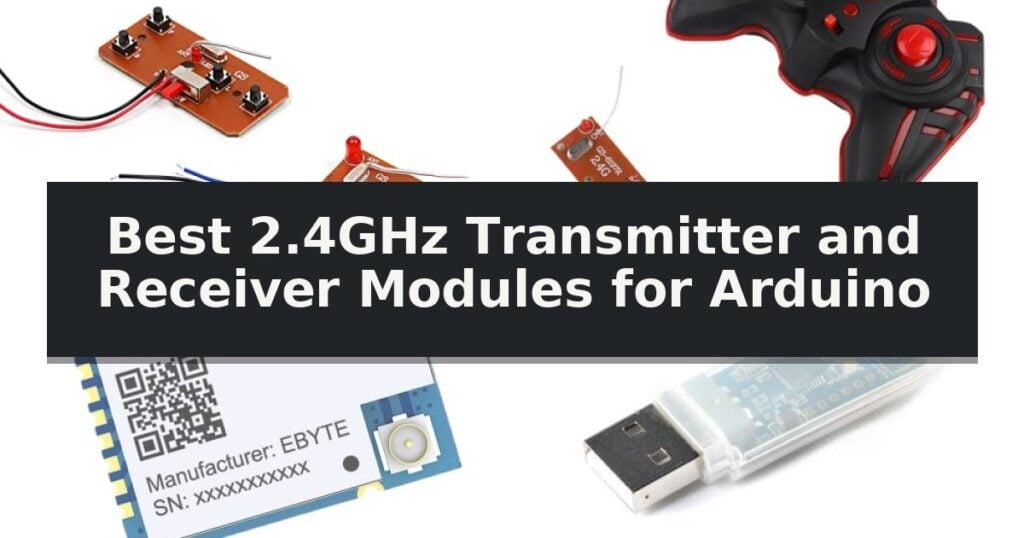
4 Best 2.4GHz Transmitter and Receiver Modules for Arduino in 2026 Reviews
Quick Comparison
| Product | Best For | Key Strength | Score |
|---|---|---|---|
| Pica Toys 2.4GHz Wireless Remote Set | Best Overall | Interference-free one-to-one connection for multi-user environments. | 4.9 |
| Generic 2.4GHz 4-Way Remote Module | Compact Choice for RC Projects | Complete 4-channel set includes both transmitter and receiver for immediate use. | 4.6 |
| EBYTE SI24R1 2.4GHz Wireless Module | High-Power Signal Performance | Integrated PA and LNA for improved transmission power and receiving sensitivity. | 4.3 |
| AYASOSO NRF24LU1 2.4GHz USB Module | Easiest USB Connectivity | Plug-and-play USB interface for immediate connectivity. | 4.3 |
How We Chose
To identify the best 2.4GHz transmitter and receiver modules for Arduino, we analyze the technical specifications and integration requirements of each component. By focusing on interface protocols, signal reliability, and power efficiency, we distinguish between modules designed for simple remote control and those intended for complex, high-performance data communication projects.
- Interface Compatibility: Assessing whether the module utilizes SPI, USB, or dedicated pin-headers for seamless connection to Arduino boards.
- Signal Range and Stability: Evaluating the reported transmission distance and the module's ability to maintain a connection in environments with potential interference.
- Ease of Integration: Determining if the hardware requires custom firmware or if it functions as a ready-to-use peripheral.
- Power Requirements: Analyzing the voltage and current needs to ensure compatibility with standard Arduino power outputs.
- Application Versatility: Categorizing modules based on their suitability for remote-operated vehicles, sensor networks, or general data acquisition.
1 Pica Toys 2.4GHz Wireless Remote Set — Best for Educational Robotics
The Pica Toys 2.4GHz Wireless Remote Set provides a dedicated control solution for small-scale robotics and STEAM-focused engineering projects. By utilizing a 2.4GHz frequency, this module ensures a stable, one-to-one connection that allows multiple units to operate simultaneously in the same space without signal interference.
Designed for intuitive operation, the transmitter features 4-button control for forward, backward, leftward, and rightward movement. The system includes integrated functional indicator lights for turning, which provides immediate visual feedback during operation. Both the remote and the receiver are equipped with physical power switches to manage battery consumption effectively when not in use.
This set offers a notable control range of up to 160 feet, making it suitable for larger classroom or workshop environments where students may need to maneuver their projects across a distance. The compact design, weighing approximately 0.11 pounds, ensures it remains lightweight enough for integration into small chassis or educational prototypes without adding significant bulk.
Because this system is designed for specific educational applications, it prioritizes ease of use over complex programming. It functions as a straightforward, plug-and-play interface for students aged 8 and up, facilitating the construction of remote-controlled vehicles or mechanical devices without requiring advanced coding knowledge.
Best for: Students and educators looking for a reliable, interference-free remote control system for STEAM-based robotics projects.
Skip if: Users requiring programmable microcontroller integration or advanced signal processing capabilities beyond basic directional control.
- Interference-free one-to-one connection for multi-user environments.
- Extended 160-foot control range for versatile project layouts.
- Includes functional turning indicator lights for enhanced project realism.
- Simple 4-button interface ideal for younger engineering students.
- Limited to basic directional control without advanced programming features.
- Lacks support for complex sensor integration or custom automation.
2 Generic 2.4GHz 4-Way Remote Module — Compact Choice for RC Projects
Integrating reliable wireless control into custom robotics or remote-operated vehicles requires a system that balances signal integrity with physical footprint. The Generic 2.4GHz 4-Way Remote Module provides a complete solution by bundling a dedicated transmitter and receiver board designed for immediate integration into DIY projects.
This Complete 4-Channel Set utilizes 2.4G wireless stability to maintain a responsive connection, effectively minimizing interference even when operating in environments where other wireless devices are present. The system is engineered for precise channel control, allowing hobbyists to manage four independent functions or movements simultaneously, which is essential for complex RC car or boat builds.
Physical integration is simplified by the compact and lightweight design of the modules. With a small footprint, these boards fit into tight chassis spaces without adding significant bulk to your model. The system offers wide compatibility across various DIY electronics platforms, though users must verify specific voltage requirements and dimensions before installation to ensure a proper fit within their unique hardware configuration.
When selecting components for custom builds, always prioritize verified electrical specifications over generic sizing. Because this module is designed for versatile DIY use, confirming that your power source aligns with the module's requirements is the most critical step in ensuring long-term operational stability.
Best for: Hobbyists building custom RC vehicles or robotics who require a compact, four-channel wireless control system for immediate integration.
Skip if: Users requiring long-range industrial-grade telemetry or those working with high-voltage systems that exceed the module's specified power ratings.
- Complete 4-channel set includes both transmitter and receiver for immediate use.
- 2.4G wireless stability minimizes signal interference.
- Compact and lightweight design suitable for space-constrained DIY projects.
- Precise channel control allows for four independent movement functions.
- Requires manual verification of voltage and dimensions before integration.
- Limited to DIY-scale applications rather than heavy-duty industrial use.
3 EBYTE SI24R1 2.4GHz Wireless Module — High-Power Signal Performance
Reliable wireless communication in custom electronics often hinges on signal integrity and range, which is where the EBYTE SI24R1 2.4GHz Wireless Module distinguishes itself. By integrating a dedicated power amplifier (PA) and low noise amplifier (LNA), this module significantly boosts transmission power to 100mW while enhancing sensitivity for more stable data links compared to standard transceiver setups.
Designed as a compact SMD wireless module, the EBYTE SI24R1 2.4GHz Wireless Module utilizes an industrial-grade high-precision 16MHz crystal to ensure consistent timing and frequency stability. This hardware configuration makes it a robust candidate for demanding environments where signal reliability is critical, such as industrial sensor arrays or complex security systems.
Because this is a specialized radio frequency transceiver, integration requires an MCU driver or a dedicated SPI debugging tool to interface with your controller. The module's versatility is highlighted by its wide range of potential applications, spanning from drone remote controls and wireless gaming peripherals to smart home automation and automotive industry projects.
When selecting this module, consider that it is a component-level device intended for developers who are comfortable with SPI communication protocols. Its high-power output and refined signal processing provide a clear technical advantage for long-range or high-interference environments, provided the project architecture supports the necessary driver implementation.
Best for: Developers and engineers building long-range wireless systems, drones, or industrial sensors that require high signal stability and power.
Skip if: Users seeking a plug-and-play solution without SPI programming experience or those who do not require the extended range provided by the integrated PA/LNA.
- Integrated PA and LNA for improved transmission power and receiving sensitivity.
- Industrial-grade 16MHz crystal for high-precision frequency stability.
- Compact SMD form factor suitable for space-constrained designs.
- Versatile application range including industrial, automotive, and consumer electronics.
- Requires SPI interface and MCU driver development for operation.
- Component-level design necessitates additional hardware integration.
4 AYASOSO NRF24LU1 2.4GHz USB Module — Easiest USB Connectivity
Integrating wireless communication into custom electronics often requires a balance between form factor and ease of use, which is where the AYASOSO NRF24LU1 2.4GHz USB Module excels. By utilizing a dedicated USB interface, this module eliminates the need for complex wiring or external serial adapters, offering a streamlined, plug-and-play solution for developers working with PCs, Raspberry Pi, and Arduino platforms.
At the heart of this device is the NRF24LU1 chip, which provides powerful 2.4GHz wireless communication capabilities. The module functions as an integrated transceiver solution, meaning it handles both data transmission and reception within a single, compact PCB design. This architecture is particularly beneficial for projects where space is at a premium, such as custom remote controls or small-scale sensor nodes.
The module is designed for versatility across a wide range of DIY electronics. Whether you are building a smart home interface, a data acquisition system, or a simple wireless link, the USB interface ensures that the hardware remains accessible and easy to integrate into prototypes. Its low power consumption profile further supports its use in battery-operated or energy-conscious applications.
While the module provides a straightforward path for 2.4GHz connectivity, it is best suited for users who prioritize rapid integration over highly specialized antenna configurations. The small, exposed PCB design is ideal for embedding into custom enclosures, though users should ensure the module is protected from physical stress during operation.
Best for: Developers and hobbyists seeking a compact, plug-and-play USB solution for short-range 2.4GHz wireless data transmission.
Skip if: Users requiring long-range communication or those needing external antenna connectors for high-gain signal applications.
- Plug-and-play USB interface for immediate connectivity.
- Integrated transceiver design reduces component count.
- Compact PCB footprint ideal for custom project embedding.
- Low power consumption suitable for efficient electronics.
- Exposed PCB design may require additional housing for protection.
- Limited to short-range communication applications.
Best 2.4GHz Transmitter and Receiver Modules for Arduino Buying Guide
Understanding Communication Protocols
Most 2.4GHz modules for Arduino communicate via the Serial Peripheral Interface (SPI). This protocol allows the microcontroller to send and receive data packets efficiently, which is critical for projects involving sensor networks or remote telemetry.
When choosing a module, verify that your Arduino board has available SPI pins. Some specialized modules may require additional libraries or specific pin configurations, so reviewing the documentation before integration is a standard practice for successful implementation.
Evaluating Transmission Range and Power
The effective range of a 2.4GHz module is often dictated by the presence of a power amplifier (PA) and a low-noise amplifier (LNA). Modules equipped with these components generally offer superior signal sensitivity and distance compared to standard transceiver chips.
For indoor projects or short-range remote control, basic modules are often sufficient. However, if your application involves outdoor robotics or long-distance data transmission, prioritizing a module with high-gain capabilities is necessary to prevent signal drops.
Simplifying Connectivity with USB
For users who prefer to avoid complex wiring, some 2.4GHz modules feature built-in USB interfaces. These units act as a bridge, allowing for direct communication between a computer and a wireless network without needing a dedicated microcontroller for every node.
This approach is particularly useful for rapid prototyping or data logging tasks. While these modules are convenient, they may be less suitable for embedded projects where space and weight are strictly limited.
Managing Signal Interference
Operating in the 2.4GHz band means sharing space with Wi-Fi and Bluetooth signals. High-quality modules often include features that allow for frequency hopping or channel selection to mitigate the risk of interference.
If you are operating multiple units in the same area, look for modules that support unique addressing or pairing. This ensures that your transmitter only communicates with its intended receiver, preventing accidental inputs or data corruption.
Form Factor and Integration
The physical size of a module can be a deciding factor for compact projects like RC cars or wearable electronics. SMD-mounted modules offer the smallest footprint but require more advanced soldering skills for integration.
Conversely, modules mounted on breakout boards provide easier access to pins via standard headers. Always check the physical dimensions of the module against your project enclosure to ensure a proper fit before finalizing your design.
Frequently Asked Questions
Do all 2.4GHz modules work with every Arduino board?
No, compatibility depends on the communication protocol (like SPI) and the voltage requirements of the module. Always check if your specific Arduino model supports the necessary logic levels.
Can I use these modules for long-range drone control?
While some modules have high-power amplifiers, standard 2.4GHz modules are generally intended for short-to-medium range projects. Specialized RC equipment is typically recommended for critical flight control.
Is programming knowledge required to use these modules?
Most transceiver modules require writing code to handle data packets. However, some remote-control sets are pre-programmed and function as simple switch-based systems.
How do I prevent interference between multiple projects?
Many modules allow you to set unique channel IDs or addresses in the code, which helps ensure that your transmitter only talks to the correct receiver.
What is the difference between a transmitter and a transceiver?
A transmitter only sends data, while a transceiver can both send and receive. Most modern 2.4GHz modules for Arduino are transceivers, allowing for two-way communication.
Conclusion: Our Top Pick
Our top pick is Pica Toys 2.4GHz Wireless Remote Set. Selecting the right 2.4GHz module depends on whether your project requires simple remote control or complex, two-way data transmission. By prioritizing interface compatibility and signal requirements, you can ensure a reliable connection for your Arduino-based builds.
Always verify the voltage and pin requirements before installation to protect your hardware. With the right module, you can effectively bridge the gap between your code and the physical world.