Creality K1C 3D Printer is our pick for the Best 3D Carbon Fiber Printer because it integrates a clog-free direct extruder and hardened nozzle specifically designed for abrasive material handling. The ELEGOO Centauri Carbon offers a rigid die-cast frame for high-speed stability, while the FLASHFORGE Creator 5 Pro provides industrial-grade multi-material capabilities for complex production workflows.
Selecting a machine for carbon fiber printing requires balancing high-temperature capabilities with structural rigidity. Because carbon fiber filaments are abrasive, the printer must feature a hardened steel nozzle and a robust extrusion system to prevent premature wear and frequent clogs during long print cycles.
Beyond the hardware, effective cooling and chamber stability are essential for managing the warping tendencies of reinforced materials. Experienced users should prioritize machines that offer automated calibration and reliable monitoring, as these features significantly reduce the trial-and-error process typically associated with advanced engineering filaments.
When selecting the right material for your project, it is helpful to explore the Best 1.75mm 3D Printer Filament to ensure you have the correct supplies for your specific printer.
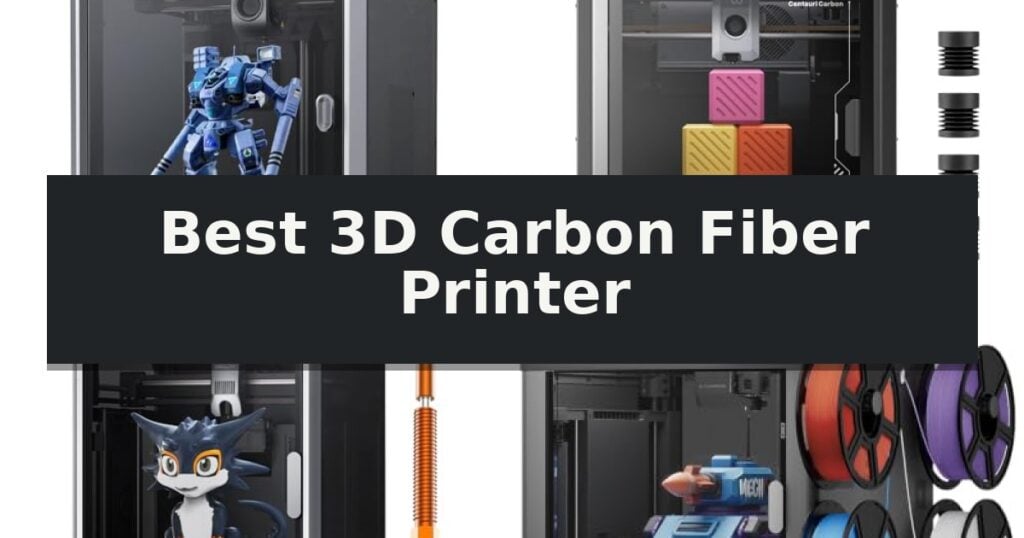
10 Best 3D Carbon Fiber Printer in 2026 Reviews
Quick Comparison
| Product | Best For | Key Strength | Score |
|---|---|---|---|
| Creality K1C 3D Printer | Best Overall | High-speed printing up to 600mm/s for rapid model completion. | 4.9 |
| ELEGOO Centauri Carbon 3D Printer | High-temp nozzle for reinforced materials | 320°C brass-hardened steel nozzle optimized for reinforced filaments | 4.8 |
| Creality K2 Combo 3D Printer | Multicolor printing with advanced materials | Multicolor printing support for up to 16 colors via CFS. | 4.6 |
| FLASHFORGE Creator 5 Pro 3D Printer | Industrial-grade multi-material production | Near-zero waste system using 4 independent toolheads and FlashSwap technology. | 4.7 |
| SUNLU PA6-CF20 Carbon Fiber Nylon Filament | High-strength industrial nylon blend | 20% Carbon Fiber reinforcement provides superior stiffness and strength. | 4.6 |
| Polymaker Fiberon PA612-CF15 Filament | Low moisture sensitivity for durability | 15% carbon fiber reinforcement provides high mechanical strength and rigidity for functional parts. | 4.8 |
| FLASHFORGE Carbon Fiber PETG Filament | Heat-resistant industrial grade | Carbon fiber reinforcement for improved strength and heat resistance. | 4.5 |
| ELEGOO Carbon Fiber PLA Filament | Rigid finish for functional parts | Superior mechanical strength and rigidity due to carbon fiber reinforcement. | 4.9 |
| Creality Hyper PLA-CF Filament | High-speed matte finish printing | 30% higher mechanical properties compared to standard PLA for improved strength. | 4.3 |
| ANYCUBIC Carbon Fiber PLA Filament | Enhanced rigidity for complex models | Enhanced rigidity and durability compared to standard PLA. | 4.8 |
How We Chose
To determine the best 3D carbon fiber printer, we evaluate machines based on their ability to handle abrasive, high-strength materials without sacrificing print quality. Our assessment focuses on the mechanical durability of the extrusion system, thermal management within the build chamber, and the precision of the motion architecture required for consistent, high-speed output.
- Hardened nozzle and extruder compatibility for abrasive filaments
- Maximum hotend temperature and thermal stability
- Chamber enclosure effectiveness for material warping prevention
- Motion system rigidity and high-speed precision
- Automated calibration and print monitoring features
1 Creality K1C 3D Printer — Optimized for abrasive carbon fiber
The Creality K1C 3D Printer distinguishes itself through a high-speed printing capability of up to 600mm/s and 20000mm/s² acceleration, significantly reducing production time for complex models. Designed to handle demanding materials, this unit features a clog-free direct extruder capable of 300℃ high-temperature printing, making it a robust choice for carbon fiber filament projects.
Engineered for efficiency, the printer arrives well-assembled and supports a plug-and-play setup that mirrors the simplicity of a smartphone boot-up process. Users benefit from comprehensive auto-calibration, including auto Z offset, auto leveling, and auto input shaping, which eliminates the need for manual paper-based leveling tests.
Thermal management is a core design priority, utilizing an upgraded cooling structure that includes a hotend fan to minimize heat creep, a part cooling fan for instant hardening, and an auxiliary chamber fan to reduce warping and stringing. These features work in tandem to refine layer texture and improve overall print quality on challenging overhangs.
For added reliability, the system integrates an observant AI camera that monitors for common issues such as spaghetti failure or foreign debris. This smart functionality supports real-time monitoring and time-lapse filming, providing users with visual oversight throughout the printing process.
Best for: Users requiring high-speed production and the ability to print with abrasive carbon fiber filaments.
Skip if: Users who prefer a larger build volume than the 8.66×8.66×9.84 inch capacity provided by this model.
- High-speed printing up to 600mm/s for rapid model completion.
- Clog-free direct extruder optimized for carbon fiber filaments.
- Automated calibration suite including auto-leveling and Z-offset.
- AI-integrated camera for real-time failure detection.
- Fixed build volume of 8.66×8.66×9.84 inches may limit large-scale projects.
2 ELEGOO Centauri Carbon 3D Printer — High-temp nozzle for reinforced materials
Achieving high-strength, heat-resistant prints requires hardware capable of handling advanced materials like carbon fiber reinforced filament. The ELEGOO Centauri Carbon 3D Printer is engineered for this specific demand, featuring a 320°C brass-hardened steel nozzle and an enclosed chamber that provides the necessary thermal environment for high-performance polymers.
Built on a CoreXY structure, this printer is designed for speed, reaching print speeds of up to 500 mm/s and acceleration of 20000 mm/s². To maintain precision at these velocities, it utilizes a rigid, integrated die-cast aluminum frame that minimizes vibrations, supported by automatic vibration compensation and pressure advance technology for consistent, high-quality results.
Usability is a core focus, as the unit arrives fully assembled and pre-calibrated, allowing for immediate use. The 256x256x256 mm build volume is managed via an intuitive touchscreen, while the built-in chamber camera and dual LED lighting provide real-time monitoring and time-lapse capabilities for remote management.
The printer includes an upgraded dual-sided plate featuring a PLA-specific surface designed for excellent adhesion and reduced warping. With its combination of high-speed mechanical architecture and material-ready components, it serves as a robust solution for creating lightweight, durable parts for automotive, drone, and athletic applications.
Best for: Users requiring a high-speed, enclosed 3D printer capable of handling carbon fiber reinforced filaments and other advanced materials right out of the box.
Skip if: Users who require a larger build volume than 256mm cubed or those who prefer to build and calibrate their own printer from a kit.
- 320°C brass-hardened steel nozzle optimized for reinforced filaments
- CoreXY structure enabling high-speed printing up to 500 mm/s
- Rigid die-cast aluminum frame for enhanced stability
- Fully assembled and pre-calibrated for immediate operation
- Built-in chamber camera for remote monitoring
- Fixed 256mm build volume may limit larger project requirements
3 Creality K2 Combo 3D Printer — Multicolor printing with advanced materials
The Creality K2 Combo 3D Printer distinguishes itself through its integrated CFS (Creality Filament System), which enables multicolor printing by supporting up to 16 colors when multiple units are daisy-chained. This system eliminates the need for manual post-print painting, streamlining the production of complex, multi-material models.
Engineered for high-speed output, the printer achieves speeds of up to 600mm/s. To maintain precision at these velocities, it utilizes a sturdy frame and a system of three step-servo motors located on the X/Y axis and the extruder. These motors provide dynamic torque adjustment in under a millisecond, which enhances extrusion consistency and print accuracy while keeping operational noise levels comparable to typing on a laptop.
Usability is prioritized through a 95% pre-assembled design, allowing for a near plug-and-play experience immediately after unpacking and screen installation. The unit features a 260 x 260 x 260 mm build volume and supports a wide range of materials, including PLA, PETG, ABS, PLA-CF, and PET, providing versatility for various user scenarios.
The machine incorporates advanced monitoring and calibration tools, including a Smart AI Camera for real-time observation of potential failures like spaghetti prints or idling. Additionally, the Smart Auto Leveling system probes only the specific bed area required for the target print, reducing setup time and increasing precision for each project.
Best for: Users who require high-speed, multicolor printing capabilities with advanced material support and automated monitoring.
Skip if: Users who have limited workspace and do not require multicolor printing or the specific advanced material compatibility of this unit.
- Multicolor printing support for up to 16 colors via CFS.
- High-speed performance reaching 600mm/s with dynamic torque adjustment.
- Smart AI Camera for real-time print monitoring.
- 95% pre-assembled for rapid setup.
- Large physical footprint due to the integrated CFS and 260mm build volume.
4 FLASHFORGE Creator 5 Pro 3D Printer — Industrial-grade multi-material production
The FLASHFORGE Creator 5 Pro 3D Printer utilizes four independent toolheads and a 7-second FlashSwap changer to significantly reduce material waste by eliminating the need for purge cycles. This industrial-grade system is designed for high-speed, multi-material production, offering a streamlined workflow for complex engineering projects.
Engineered for stability and precision, the printer features a CoreXY motion structure paired with precision linear rails and 1.5GT high-torque timing belts. This architecture supports rapid printing speeds up to 600mm/s while maintaining structural integrity. The fully enclosed frame includes an active heated chamber capable of reaching 65°C, which is essential for minimizing warping when working with advanced industrial filaments like ABS, PC, and PA.
Operational safety and environmental control are managed through a dual HEPA 13 and activated carbon filtration system, which captures fumes and ultrafine particles during the printing process. The machine also incorporates a continuous airflow system to ensure thermal stability within the chamber, providing a consistent environment for demanding print jobs.
User control is facilitated through automated toolhead offset calibration, vibration compensation, and dynamic flow calibration to ensure high-quality first layers. Integrated monitoring tools, including an HD chamber camera and remote management capabilities via Flash Studio, allow for real-time oversight and automated time-lapse generation, making it a robust choice for professional production environments.
Best for: Industrial engineering applications requiring high-speed, multi-material production with advanced filaments like ABS, PC, and PA.
Skip if: Users seeking a compact, entry-level printer for hobbyist projects or those without the space for an industrial-sized, fully enclosed production unit.
- Near-zero waste system using 4 independent toolheads and FlashSwap technology.
- 65°C active heated chamber prevents warping in advanced industrial filaments.
- High-speed CoreXY architecture supports printing up to 600mm/s.
- Dual HEPA 13 and activated carbon filtration for workspace safety.
- Large physical footprint may require significant dedicated workspace.
- Industrial-focused design may be overkill for simple, non-engineering 3D printing tasks.
5 SUNLU PA6-CF20 Carbon Fiber Nylon Filament — High-strength industrial nylon blend
Achieving high-performance industrial prints requires materials that can withstand significant mechanical stress and thermal extremes. The SUNLU PA6-CF20 Carbon Fiber Nylon Filament is engineered with a blend of 80% polyamide and 20% carbon fiber, specifically designed to provide enhanced stiffness and tensile strength for demanding engineering applications.
This filament is well-suited for functional parts such as gears, bicycle frames, and motor covers, thanks to its impressive heat resistance of up to 209°C. To maximize the structural integrity of your prints, the manufacturer recommends an annealing process at 80°C to 130°C for 5 to 12 hours after printing, which helps stabilize the material for high-temperature environments.
Precision is central to the design of this filament, which features a dimensional accuracy of +/- 0.03mm to ensure consistent extrusion across most 1.75mm FDM printers. Because carbon fiber is inherently abrasive, users should utilize hardened steel nozzles to prevent premature wear during the printing process.
Proper preparation is essential when working with this specialized material. The filament must be dried at 80°C for 24 hours or 110°C for 4 hours prior to use to ensure optimal layer adhesion and surface quality. Additionally, it is important to note that this material is not compatible with multi-color systems like the AMS, as its brittle nature can lead to breakage within the feed mechanism.
Best for: Industrial engineering applications requiring high heat resistance, torsional strength, and structural rigidity in functional parts.
Skip if: Users who require multi-color printing capabilities or those using standard brass nozzles that are susceptible to abrasion from carbon fiber reinforcement.
- 20% Carbon Fiber reinforcement provides superior stiffness and strength.
- High heat resistance up to 209°C for demanding environments.
- High dimensional accuracy of +/- 0.03mm for consistent printing.
- Vacuum-sealed packaging ensures the filament remains dry during transport.
- Not compatible with AMS or multi-color feeding systems due to brittleness.
- Requires hardened steel nozzles to mitigate abrasion.
- Mandatory pre-printing drying process required for best results.
6 Polymaker Fiberon PA612-CF15 Filament — Low moisture sensitivity for durability
Achieving structural integrity in functional 3D printed parts often requires materials that balance mechanical strength with environmental resilience. The Polymaker Fiberon PA612-CF15 Carbon Fiber Nylon Filament is engineered to address these demands by utilizing a long-chain PA612 nylon base reinforced with 15% carbon fiber, offering a distinct alternative to standard PA6 or PA12 filaments.
This material is specifically designed for applications requiring high rigidity, such as tooling, jigs, fixtures, and engineering prototypes. Its primary technical advantage lies in its lower moisture sensitivity compared to PA6-based nylons, which helps maintain consistent performance in environments where humidity levels fluctuate. When properly annealed at 100°C for 16 hours, the filament achieves a heat deflection temperature of 175°C at 0.45 MPa, providing reliable thermal stability for demanding service conditions.
To achieve optimal results, users must utilize an all-metal hotend capable of maintaining nozzle temperatures between 250°C and 300°C. Because of the abrasive nature of the carbon fiber reinforcement, a hardened steel or ruby nozzle is strictly required to prevent premature wear. While the material is less hygroscopic than other nylons, it remains sensitive to moisture; users must ensure the filament is stored below 20% relative humidity and dried at 100°C for 10 hours if printing issues like stringing or surface bubbles occur.
The Polymaker Fiberon PA612-CF15 Carbon Fiber Nylon Filament is a specialized engineering material that demands a well-tuned printer setup. By following the recommended printing parameters—including a 40–50°C build plate and keeping cooling fans off—users can produce high-strength components with improved dimensional stability.
Best for: Engineers and makers requiring rigid, dimensionally stable functional parts that maintain mechanical performance in varying humidity environments.
Skip if: Users without an all-metal hotend, hardened nozzle, or the capability to store and dry filament at high temperatures will find this material difficult to process.
- 15% carbon fiber reinforcement provides high mechanical strength and rigidity for functional parts.
- Lower moisture sensitivity compared to PA6 nylon ensures more predictable performance in changing humidity.
- High thermal resistance with a heat deflection temperature of 175°C after annealing.
- Suitable for a wide range of industrial applications including tooling, jigs, and fixtures.
- Requires hardened steel or ruby nozzles due to the abrasive carbon fiber content.
- Strict storage and drying requirements (100°C for 10 hours) are necessary to maintain print quality.
- Advanced hardware compatibility is mandatory, specifically an all-metal hotend.
7 FLASHFORGE Carbon Fiber PETG Filament — Heat-resistant industrial grade
Achieving high-strength, heat-resistant prints requires a material that balances structural integrity with ease of use. The FLASHFORGE Carbon Fiber PETG Filament is engineered with carbon fiber reinforcement, which enhances the material's overall rigidity and thermal resistance compared to standard PETG. This makes it a specialized choice for users looking to produce functional components such as drones, industrial tools, and automotive parts.
Reliability during the printing process is supported by a clog-resistant manufacturing process. Each spool is thoroughly dried for 24 hours before being vacuum-sealed with desiccant to prevent moisture absorption, which helps maintain consistent extrusion quality. The filament features a dimensional accuracy of +/- 0.02mm, providing the precision necessary for complex industrial applications.
Usability is addressed through an automatic winding system that minimizes tangling and potential line breakage during long print jobs. With enhanced flowability, this 1.75mm filament is designed to be compatible with 99% of FDM 3D printers on the market. The material maintains the characteristic impact resistance of PETG while gaining the structural benefits of carbon fiber, offering a versatile solution for demanding 3D printing projects.
When selecting a material for industrial-grade 3D printing, it is important to consider the trade-off between rigidity and flexibility. Because this filament utilizes carbon fiber reinforcement, it is significantly stiffer than standard PETG. While this is ideal for structural frames and tools, it may not be the appropriate choice for parts that require high elasticity or bending capabilities.
Best for: Users needing to print rigid, heat-resistant industrial parts like tools, frames, or automotive components on standard FDM printers.
Skip if: Users who require a flexible or highly elastic material, as the carbon fiber reinforcement significantly increases rigidity.
- Carbon fiber reinforcement for improved strength and heat resistance.
- High dimensional accuracy of +/- 0.02mm for precise prints.
- Clog-resistant manufacturing and moisture-free vacuum sealing.
- Automatic winding to prevent tangles and line breakage.
- Increased rigidity may not be suitable for applications requiring material flexibility.
8 ELEGOO Carbon Fiber PLA Filament — Rigid finish for functional parts
Achieving high structural integrity in 3D printed components often requires specialized materials, and the ELEGOO Carbon Fiber PLA Filament is engineered specifically for this purpose. By reinforcing standard PLA with carbon fiber, this filament provides increased strength and rigidity, making it a practical choice for functional parts that must withstand impact.
Beyond its mechanical benefits, this material is designed for consistent production. It features a diameter of 1.75mm with a tight tolerance of +/- 0.02mm, which promotes smooth, reliable feeding through the extruder. To maintain this consistency, the filament is vacuum-sealed and dried prior to packaging, which helps prevent issues like bubbles or clogs during the printing process.
The filament also excels in finish quality, offering improved layer adhesion that results in a smoother surface with minimal visible layer lines. This makes it suitable for complex designs where both aesthetic detail and structural durability are required. Because of the abrasive nature of carbon fiber, it is recommended to use a hardened steel nozzle to ensure longevity of your printer's hardware.
The spool is machine-wound with precision-coiled layers to reduce the risk of tangling, allowing for longer, uninterrupted print sessions. It maintains wide compatibility with most common 1.75mm FDM 3D printers, providing a versatile solution for users looking to upgrade their material selection for more demanding applications.
Best for: Users needing to print durable, rigid, and impact-resistant functional components on standard 1.75mm FDM 3D printers.
Skip if: Users who do not have a hardened steel nozzle, as the abrasive carbon fiber content can cause premature wear on standard brass nozzles.
- Superior mechanical strength and rigidity due to carbon fiber reinforcement.
- High dimensional accuracy of +/- 0.02mm for consistent extrusion.
- Improved layer adhesion for cleaner surface finishes.
- Precision-coiled winding to prevent filament tangling.
- Requires a hardened steel nozzle to prevent wear during the printing process.
9 Creality Hyper PLA-CF Filament — High-speed matte finish printing
Achieving high-speed printing without sacrificing structural integrity requires a material that balances flow with mechanical resilience. The Creality Hyper PLA-CF Filament is engineered specifically for this demand, offering a matte finish and a composition that boasts 30% higher mechanical properties than standard PLA. This includes improved flexural strength, flexural modulus, and impact strength, making it a functional choice for parts requiring higher structural bearing capacity.
Designed for versatility, this filament features a dimensional accuracy of ±0.03mm, verified through two-way laser diameter measurement. This precision ensures consistent flow rates, which is critical when operating at high speeds between 50-300mm/s. The material is formulated with higher tensile strength than ABS and increased toughness compared to traditional PLA, providing a reliable middle ground for users who need durable prints without the complexities of more exotic materials.
Compatibility is a primary focus, as the Creality Hyper PLA-CF Filament is designed to work with most 1.75mm FDM printers, including popular models like the Ender 3 series, K1, and K1C. Beyond performance, the manufacturer emphasizes environmental considerations by utilizing paper trays and eco-friendly packaging to reduce carbon emissions, aligning high-performance printing with more sustainable material handling.
While the filament offers significant mechanical upgrades, users should ensure their printer is capable of handling carbon fiber-reinforced materials, which can be more abrasive than standard PLA. The matte finish provides a professional, non-reflective aesthetic, ideal for functional prototypes or end-use parts where surface appearance is as important as the underlying material strength.
Best for: Users seeking a high-speed, durable filament that offers superior mechanical strength and a professional matte finish for functional 3D printed parts.
Skip if: Users who do not have an FDM printer capable of handling carbon fiber-reinforced filament or those who require a glossy, non-matte surface finish.
- 30% higher mechanical properties compared to standard PLA for improved strength.
- High-speed printing capability ranging from 50-300mm/s.
- Dimensional accuracy of ±0.03mm for consistent, smooth extrusion.
- Environmentally conscious packaging with paper trays.
- Carbon fiber reinforcement may increase wear on standard brass nozzles compared to non-filled filaments.
10 ANYCUBIC Carbon Fiber PLA Filament — Enhanced rigidity for complex models
Achieving high-precision results in additive manufacturing often requires specialized materials that balance structural integrity with aesthetic finish. The ANYCUBIC Carbon Fiber PLA Filament is engineered to provide enhanced rigidity and dimensional stability, making it a distinct choice for users focused on mechanical prototypes and high-stress display pieces.
This filament incorporates carbon fiber infusion, which significantly improves the material's resistance to deformation and warping compared to standard PLA. The resulting prints exhibit a unique matte texture that minimizes the visibility of layer lines, providing a professional appearance straight from the printer without the need for post-processing steps like sanding or polishing.
Designed for accessibility, the ANYCUBIC Carbon Fiber PLA Filament is optimized for standard FDM desktop printers. It is engineered to be virtually clog-proof when used with a hardened steel nozzle, ensuring a consistent and smooth extrusion process. The material also features ultra-low shrinkage, which contributes to high success rates for complex assemblies that require precise tolerances.
For users operating within the Anycubic ecosystem, the filament includes an intelligent identification chip. This feature integrates with the ACE Pro system to automatically recognize printing parameters, streamlining the setup process and improving overall workflow efficiency.
Best for: Users requiring high-rigidity mechanical prototypes or display models with a clean, matte aesthetic.
Skip if: Users who do not have a hardened steel nozzle, as the abrasive nature of carbon fiber-infused filaments can accelerate wear on standard brass nozzles.
- Enhanced rigidity and durability compared to standard PLA.
- Matte texture reduces visible layer lines for a premium finish.
- Low shrinkage properties ensure high dimensional accuracy.
- Intelligent identification chip for seamless integration with compatible hardware.
- Requires a hardened steel nozzle to prevent premature wear during printing.
Best 3D Carbon Fiber Printer Buying Guide
Hardened Extrusion Systems
Carbon fiber filaments contain abrasive particles that quickly degrade standard brass nozzles. A printer optimized for these materials must include a hardened steel or ruby-tipped nozzle to maintain dimensional accuracy and prevent frequent maintenance.
The extruder assembly also requires reinforced gears and a high-torque motor to grip the filament securely. This prevents slipping and ensures consistent flow, which is critical when printing with stiffer, more brittle composite materials.
Thermal Management and Enclosures
Printing with carbon fiber-reinforced nylon or PETG often requires elevated temperatures to ensure proper layer adhesion. A fully enclosed chamber is necessary to maintain a stable ambient temperature, which significantly reduces the risk of warping and internal stress in the finished part.
Effective cooling systems are equally important for managing the transition from liquid to solid state. Specialized air ducts and auxiliary fans help refine layer texture and improve the structural integrity of overhangs and bridges.
Structural Rigidity and Motion
High-speed printing with carbon fiber requires a rigid frame to minimize vibrations that can manifest as ghosting or layer misalignment. Die-cast aluminum or heavy-duty steel frames provide the necessary stability for rapid acceleration.
Linear rails and high-quality timing belts ensure that the print head moves with precision even at high speeds. This mechanical stability is vital for maintaining the tight tolerances required for functional engineering prototypes.
Automation and Calibration
Advanced filaments often have specific bed adhesion requirements that make manual leveling difficult. Automated bed leveling and Z-offset calibration ensure a perfect first layer, which is the foundation for successful prints with difficult materials.
Input shaping and vibration compensation are essential for high-speed performance. These automated features analyze the printer's motion and adjust settings to eliminate resonance, ensuring that high-speed prints remain accurate and clean.
Monitoring and Reliability
Because carbon fiber prints are often used for critical applications, real-time monitoring is a valuable feature. Integrated AI cameras can detect failures like spaghetti, debris, or layer shifts, allowing users to pause prints and save material.
Remote management capabilities allow for oversight of long-duration prints. This connectivity ensures that users can intervene quickly if issues arise, maximizing the success rate of complex and expensive engineering projects.
Frequently Asked Questions
Do I need a special nozzle for carbon fiber filament?
Yes, carbon fiber is highly abrasive and will wear down standard brass nozzles very quickly. You must use a hardened steel or ruby-tipped nozzle to ensure longevity and consistent print quality.
Is an enclosure necessary for printing carbon fiber?
While not strictly required for all carbon fiber-infused filaments, an enclosure is highly recommended. It helps maintain a stable chamber temperature, which is crucial for preventing warping and ensuring strong layer bonding.
Can I use standard PLA settings for carbon fiber PLA?
Carbon fiber PLA generally prints similarly to standard PLA, but you should expect higher stiffness and a matte finish. Always verify the manufacturer's recommended temperature and speed settings, as the carbon fiber content can affect flow characteristics.
How do I prevent clogs when using carbon fiber filament?
Clogs are often caused by heat creep or improper extrusion temperatures. Ensure your printer has an all-metal hotend and that you are printing within the manufacturer's recommended temperature range for the specific filament.
What are the common applications for carbon fiber 3D prints?
Carbon fiber prints are ideal for functional parts that require high strength, rigidity, and heat resistance. Common uses include automotive components, drone frames, jigs, fixtures, and mechanical prototypes.
Conclusion: Our Top Pick
Our top pick is Creality K1C 3D Printer. Choosing the right 3D printer for carbon fiber requires prioritizing mechanical durability and thermal control. The Creality K1C stands out for its integrated approach to handling abrasive materials, making it a reliable choice for those focused on functional, high-strength parts.
For users with specific needs, such as industrial-grade multi-material production or high-speed stability, the alternatives from ELEGOO and FLASHFORGE offer specialized features that cater to advanced engineering workflows. Evaluate your specific material requirements and production volume to select the machine that best fits your technical goals.