Casio fx-CG100 ClassWiz Graphing Calculator is our pick for the Best 3D Graphing Calculators because it combines high-resolution color visualization with robust 3D graphing support for complex geometric shapes. For those prioritizing a modern, intuitive interface, the NumWorks Graphing Calculator offers a streamlined experience, while the Texas Instruments TI-89 Titanium remains a reliable choice for users requiring specialized symbolic math and legacy hardware compatibility.
Selecting a calculator for advanced mathematics requires balancing visual clarity with computational power. Modern devices now integrate color displays that make interpreting three-dimensional planes and spheres significantly easier than on traditional monochrome screens. Beyond simple plotting, the ability to perform matrix operations and run scripts directly on the device provides a distinct advantage for students and professionals working in STEM fields.
When evaluating these tools, consider how the interface impacts your workflow during exams or complex problem-solving sessions. Features like natural textbook display and exam-mode switching are essential for academic environments, while programming capabilities like MicroPython support deeper algorithmic understanding. Choosing the right model depends on whether you prioritize modern ease-of-use or the specialized symbolic processing power required for advanced engineering and calculus.
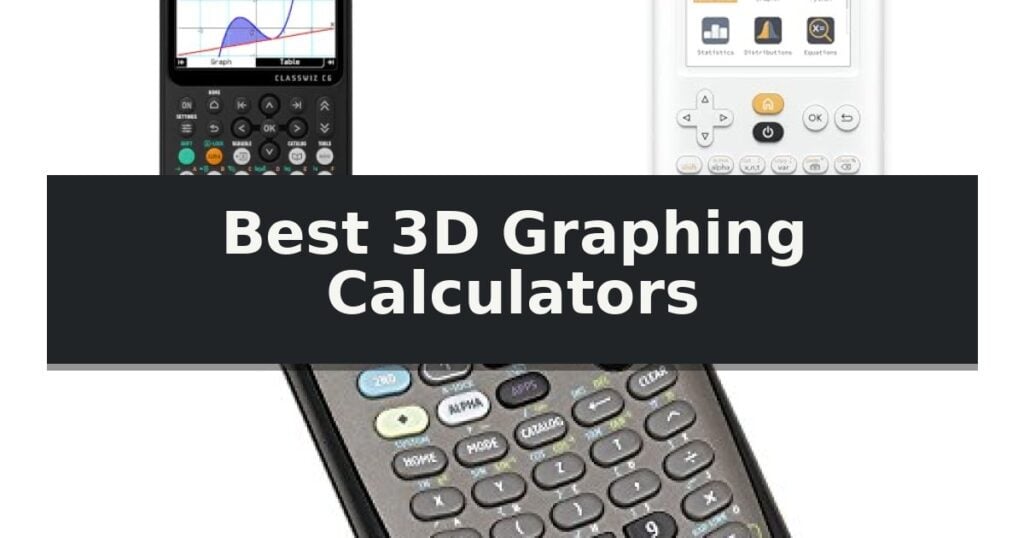
3 Best 3D Graphing Calculators in 2026 Reviews
Quick Comparison
| Product | Best For | Key Strength | Score |
|---|---|---|---|
| Casio fx-CG100 ClassWiz Graphing Calculator | Best Overall | High-resolution color display with 3D graphing support for spheres, cylinders, and planes. | 4.9 |
| NumWorks Graphing Calculator | Intuitive Modern Interface | High-resolution color screen for clear visualization of graphs. | 4.8 |
| Texas Instruments TI-89 Titanium Calculator | Symbolic Math Powerhouse | Advanced CAS functionality for symbolic and numeric math | 4.6 |
How We Chose
To identify the most effective tools for advanced mathematical visualization, we evaluate graphing calculators based on their ability to render complex 3D data clearly and accurately. An experienced reviewer prioritizes the balance between computational depth, such as symbolic algebra, and the practical usability of the interface during high-stakes testing or intensive study sessions.
- Display resolution and color depth for clear 3D visualization
- Capability to plot multiple 3D functions simultaneously
- Availability of advanced mathematical functions and symbolic processing
- Ease of navigation and interface intuitiveness
- Compliance with standardized testing requirements
- Programming language support and data transfer options
1 Casio fx-CG100 ClassWiz Graphing Calculator — Advanced 3D Visualization
Visualizing complex mathematical concepts requires more than just a standard scientific tool, and the Casio fx-CG100 ClassWiz Graphing Calculator addresses this with a high-resolution, backlit LCD capable of rendering 3D graphs. By supporting the visualization of spheres, cylinders, and planes in over 65,000 colors, this device allows for a more intuitive approach to analyzing data and graph transformations.
Beyond its graphical capabilities, the calculator is built for versatility in academic environments. It features a Natural Textbook Display that presents expressions and results as they appear in standard curriculum materials, reducing the cognitive load for students. The interface utilizes a tab-based menu and glyph-based keys, which are designed to streamline navigation and data entry during intensive sessions.
For students beginning their journey into computer science, the inclusion of MicroPython integration provides a practical entry point for learning to code directly on the hardware. This feature supports algorithmic thinking and can be easily managed via USB data transfer. Furthermore, the device is equipped with a dedicated Exam Mode, ensuring compliance with standardized testing requirements for AP, SAT, PSAT, and ACT assessments.
The physical design maintains a familiar layout for those transitioning from simpler scientific models, ensuring that the learning curve remains manageable. With its flush-gloss panel and enhanced contrast, the display remains legible under various lighting conditions, making it a reliable companion for both classroom instruction and independent study.
Best for: Students and professionals who require advanced 3D visualization, Python programming capabilities, and exam-compliant hardware for STEM coursework.
Skip if: Users who do not require 3D graphing or programming features may find a standard scientific calculator more cost-effective and simpler to operate.
- High-resolution color display with 3D graphing support for spheres, cylinders, and planes.
- MicroPython integration for accessible programming and algorithmic learning.
- Exam-approved functionality with a secure mode-switching feature.
- Natural Textbook Display for improved comprehension of mathematical expressions.
- Advanced feature set may be excessive for users only needing basic scientific calculations.
2 NumWorks Graphing Calculator — Intuitive Modern Interface
Navigating complex mathematical concepts requires a tool that balances power with accessibility, and the NumWorks Graphing Calculator addresses this by offering an intuitive, modern interface designed to grow with students from middle school through college. Unlike traditional devices that rely on dense, multi-layered menus, this calculator prioritizes a streamlined experience that simplifies navigation for both basic and advanced functions.
The hardware is built around a vibrant high-resolution color screen with a 320×240 pixel display, which significantly enhances the visualization of complex graphs and data sets. This visual clarity is paired with a compact, lightweight design, weighing just under half a pound, making it a portable solution for students who need to transition between classrooms or study environments frequently.
Versatility is a core component of the device, as it supports multiple languages including English, French, Dutch, Portuguese, Italian, German, and Spanish. To ensure consistent operation, the unit is powered via a USB-C charging cable, moving away from the reliance on disposable batteries found in many legacy models. This design choice reflects a modern approach to classroom technology, focusing on ease of use and long-term utility.
While the calculator is engineered for a wide range of academic levels, its primary strength lies in its ability to present information clearly without overwhelming the user. The combination of a high-resolution display and a simplified operating system makes it a practical choice for those who need a reliable, contemporary tool for graphing and computation.
Best for: Students ranging from middle school to college who require an intuitive, modern interface for graphing and mathematical computation.
Skip if: Users who require specific legacy software compatibility or physical features not present in this modern, streamlined design.
- High-resolution color screen for clear visualization of graphs.
- Intuitive and easy-to-use interface that reduces learning curves.
- USB-C charging capability for modern, convenient power management.
- Multi-language support including English, Spanish, and several European languages.
- Compact size may feel small for users accustomed to larger, traditional graphing calculators.
3 Texas Instruments TI-89 Titanium Calculator — Symbolic Math Powerhouse
Navigating complex mathematical problems requires a tool that balances computational speed with advanced symbolic processing. The TI-89 Titanium CAS Graphing Calculator Texas Instruments distinguishes itself through its Computer Algebra System (CAS), which allows for both numeric and symbolic manipulation of expressions, making it a specialized instrument for students and professionals in calculus, algebra, and statistics.
Engineered for efficiency, the device features 188 KB of RAM and 2.7 MB of flash memory, providing ample storage for custom programs, complex functions, and data sets. The interface is centered around a large 100 x 160 pixel display, which supports split-screen views to allow users to observe graphs and tables simultaneously. This visual flexibility is essential for analyzing function behavior in real-time.
Connectivity remains a core strength of this model, utilizing USB on-the-go technology to facilitate file sharing between calculators or direct connection to a PC. Beyond standalone computation, the unit is compatible with the CBL 2 system, CBR 2 motion sensor, and Vernier EasyLink or EasyTemp systems. These integrations enable the collection and analysis of real-world data, expanding the calculator's utility beyond theoretical math into practical laboratory environments.
The hardware is designed for rigorous academic and professional use, featuring comprehensive matrix operations including inverse, determinant, and transpose functions. Whether handling real or complex numbers, the TI-89 Titanium CAS Graphing Calculator Texas Instruments provides the necessary processing power to execute elementary row operations and reduced row echelon forms, backed by a 1-year manufacturer warranty.
Best for: Students and professionals requiring advanced symbolic math capabilities and data collection integration for calculus, algebra, and engineering coursework.
Skip if: Users who require a color display or a touchscreen interface, as this model utilizes a traditional monochrome screen and button-based navigation.
- Advanced CAS functionality for symbolic and numeric math
- Large 100 x 160 pixel display with split-screen capability
- USB on-the-go connectivity for PC and peripheral integration
- Extensive compatibility with data collection sensors and systems
- Monochrome display lacks the color-coding features found in newer graphing calculators
Best 3D Graphing Calculators Buying Guide
Visualizing Three-Dimensional Data
The primary advantage of a 3D graphing calculator is its ability to represent spatial relationships that are difficult to visualize on paper. High-resolution color screens allow users to distinguish between multiple intersecting planes, cylinders, and spheres, which is critical for understanding multivariable calculus and linear algebra.
When shopping, look for models that offer high contrast and clear rendering. A device that can handle complex transformations and rotations of 3D objects provides a much better learning experience than one that struggles with lag or pixelated output.
Computational Power and Symbolic Math
Advanced math often requires more than just graphing; it demands symbolic manipulation. Calculators with Computer Algebra Systems (CAS) can solve equations, factor expressions, and perform calculus operations in their exact, symbolic form rather than just providing decimal approximations.
While symbolic power is essential for engineering and physics, ensure the device remains user-friendly. A powerful calculator is only effective if you can access its advanced functions quickly through an intuitive menu system or well-labeled keys.
Standardized Testing Compatibility
Many students require a calculator that is permitted for use on exams like the SAT, ACT, or AP tests. Manufacturers often include specific 'Exam Modes' that restrict certain features, such as computer algebra or programming, to ensure compliance with testing regulations.
Always verify the current testing board requirements before purchasing. A device that is approved for your specific exam ensures you can practice with the same tool you will use on test day, which is vital for maintaining speed and accuracy.
Programming and STEM Integration
Modern calculators increasingly serve as entry points into coding. Devices that support languages like MicroPython allow students to write scripts to automate repetitive calculations or simulate mathematical models, bridging the gap between pure math and computer science.
Consider how easily you can transfer data or programs to and from the device. USB connectivity or built-in file management systems are important for students who need to share work or update their calculator's software as they progress through their curriculum.
Ergonomics and Interface Design
The physical design of a calculator, including the layout of the keypad and the responsiveness of the buttons, significantly affects your efficiency. A familiar, logical key arrangement reduces the learning curve and helps prevent input errors during long calculation sessions.
Look for a device that feels comfortable to hold and has a screen that is easy to read from various angles. A well-designed interface that uses icons or tab-based menus can make navigating complex settings much faster than older, text-heavy operating systems.
Frequently Asked Questions
Can all graphing calculators plot 3D functions?
No, 3D graphing is a specialized feature found primarily on newer, high-end color graphing calculators. Older models are typically limited to 2D plotting.
Is a CAS calculator necessary for high school math?
A Computer Algebra System (CAS) is generally more powerful than required for standard high school courses and may be restricted on certain exams. Check your specific curriculum requirements.
How do I know if a calculator is allowed for my exam?
Check the official website of the testing organization, such as the College Board for AP and SAT exams, to see their list of approved calculator models.
Are color screens worth the extra cost?
For 3D graphing and complex statistics, color screens are highly beneficial as they allow you to differentiate between multiple functions or data sets visually.
Can I update the software on my graphing calculator?
Many modern graphing calculators allow for firmware updates via a USB connection to a computer, which can add features or improve system stability over time.
Conclusion: Our Top Pick
Our top pick is Casio fx-CG100 ClassWiz Graphing Calculator. Choosing the right graphing calculator depends on your specific academic or professional needs, particularly regarding 3D visualization and symbolic math capabilities. Models like the Casio fx-CG100 offer a modern balance of color-rich graphics and programming utility, making them excellent for students navigating advanced STEM coursework.
Before making a final decision, verify that your chosen model meets the specific requirements for any standardized tests you plan to take. By prioritizing a device with a clear interface and the necessary computational power, you ensure a tool that will remain useful throughout your mathematical journey.