iSANMATE ASA Filament is our top recommendation for the Best 3D Printer Filament for Outdoor Use because it provides a balanced combination of high UV resistance and structural thermal stability. For users prioritizing high-speed printing capabilities, ERYONE ASA Filament offers optimized flow characteristics, while Polymaker ASA Filament serves as a robust alternative for those requiring maximum impact resistance in demanding mechanical applications.
Selecting the right material for external environments requires moving beyond standard plastics. While PLA is common for indoor projects, it lacks the necessary resistance to solar radiation and thermal cycling. Experienced users look for materials that maintain dimensional accuracy and mechanical integrity after prolonged exposure to the elements.
The primary challenge with outdoor-rated filaments is their tendency to warp during the printing process. Successful projects often depend on using an enclosure to manage ambient temperatures, ensuring that the material cools at a controlled rate to prevent layer separation or cracking in the final part.
For those designing specific mechanical components, our guide on the Best 3D Printer Filament for Functional Parts provides additional insights into material selection for high-stress environments. If you are looking for broader material characteristics, you can also explore our Best 3D Printer Filament overview to compare these outdoor options against standard indoor materials.
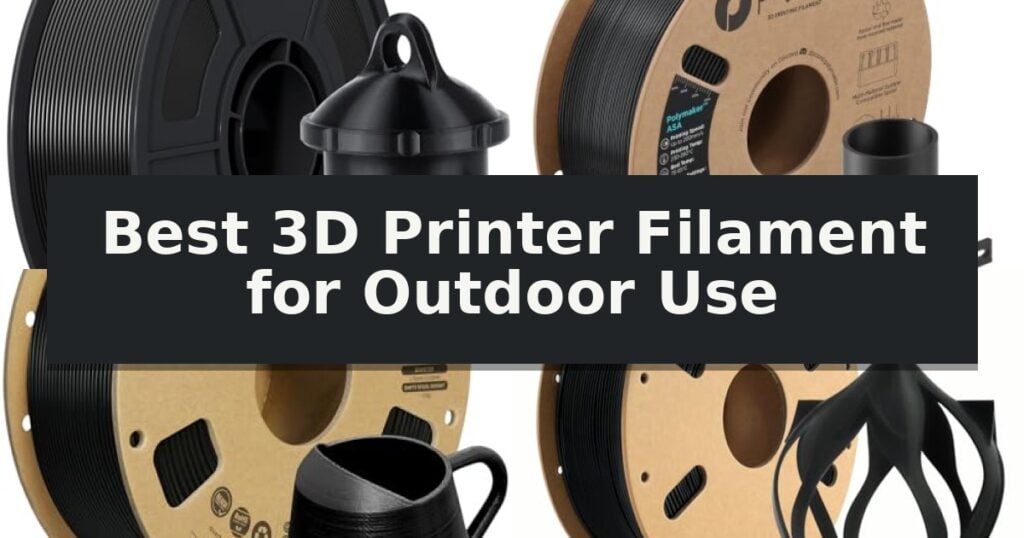
10 Best 3D Printer Filament for Outdoor Use in 2026 Reviews
Quick Comparison
| Product | Best For | Key Strength | Score |
|---|---|---|---|
| iSANMATE ASA Filament | Best Overall | Exceptional UV and weather resistance for long-term outdoor durability. | 4.9 |
| Polymaker ASA Filament | High Heat and Impact Resistance | UV and weather resistant for long-term outdoor exposure. | 4.4 |
| OVERTURE ASA Filament | Excellent Weathering Stability | Excellent UV and weather resistance for outdoor durability. | 4.8 |
| ERYONE ASA Filament | High-Speed Outdoor Printing | Excellent UV and weather resistance for long-term outdoor durability. | 4.9 |
| IEMAI ASA Filament | Reliable Sunlight and Rain Protection | Superior UV and weather resistance for outdoor longevity. | 4.6 |
| SUNLU ASA Filament | Tough Mechanical Outdoor Components | High UV, rain, and heat resistance for outdoor durability. | 4.5 |
| iSANGHU ASA Filament | Extreme Weather and Heat Tolerance | Superior UV and weather resistance compared to standard ABS. | 4.8 |
| YXPOLYER ASA Filament | Tested for Long-Term Sun Exposure | Superior UV and weather resistance tested for over 2,000 hours of sun exposure. | 4.4 |
| Creality PETG Filament | Strong Toughness for Outdoor Use | High impact and temperature resistance for outdoor durability. | 4.4 |
| COMTREE Bamboo PETG Filament | Water and UV Resistant Refill | Enhanced UV and water resistance for outdoor durability | 4.5 |
How We Chose
When evaluating the best 3D printer filament for outdoor use, we prioritize materials that resist environmental degradation. An experienced reviewer focuses on thermal stability and UV-blocking additives, which prevent brittleness and color fading. We assess how these filaments perform under stress and their compatibility with standard FDM printing environments to ensure long-term reliability.
- UV and Weather Resistance ratings
- Thermal deflection temperature thresholds
- Dimensional accuracy and tolerance consistency
- Ease of printing and warping mitigation
- Mechanical impact and toughness properties
1 iSANMATE ASA Filament — Durable UV-Resistant Outdoor Parts
When selecting material for functional outdoor components, the iSANMATE ASA Filament provides a specialized solution engineered for high-stress environments. Unlike standard materials, this filament is specifically formulated to resist UV radiation and harsh weather conditions, preventing the common issues of color degradation and material breakage that often plague outdoor prints.
The iSANMATE ASA Filament features a dimensional accuracy of +/- 0.02mm, ensuring that your functional parts maintain precise tolerances. It operates within a printing temperature range of 240°C – 270°C and requires a hot bed temperature of 80°C – 100°C, making it a robust choice for users who need mechanical and thermal stability in their final prints.
For optimal results, this material performs best in an enclosed 3D printer environment, which helps mitigate risks of warping or cracking during the cooling process. The manufacturer also recommends applying glue to the print bed to ensure proper adhesion, reflecting the professional-grade nature of this high-performance thermoplastic.
Each spool is delivered in vacuum-sealed packaging with desiccant to maintain material integrity and prevent moisture contamination. Should you encounter technical challenges, the brand provides dedicated support with a 24-hour guaranteed response time to assist with your printing configurations.
Best for: Users requiring durable, UV-resistant functional parts for long-term outdoor exposure.
Skip if: Users operating open-frame 3D printers without an enclosure, as this material is prone to warping in uncontrolled environments.
- Exceptional UV and weather resistance for long-term outdoor durability.
- High dimensional accuracy of +/- 0.02mm for precise functional parts.
- Vacuum-sealed packaging ensures the filament remains free of moisture and dust.
- Wide printing temperature range of 240°C to 270°C for versatile printer compatibility.
- Requires an enclosed printer to prevent warping and cracking.
- Adhesion support such as glue is recommended for the print bed.
2 Polymaker ASA Filament — High Heat and Impact Resistance
When selecting the Best 3D Printer Filament for Outdoor Use, environmental resilience is the primary technical requirement. The Polymaker ASA Filament addresses this by utilizing Acrylonitrile Styrene Acrylate, a material engineered specifically to withstand prolonged exposure to the elements without the degradation common in standard PLA or ABS.
This filament is explicitly designed for UV & Weather Resistance, making it a reliable choice for functional outdoor components such as RC plane parts or automotive accessories. Beyond its environmental stability, the material maintains high mechanical integrity, offering high heat resistance up to 100°C (212°F) and significant impact resistance for demanding real-world applications.
For successful printing, the Polymaker ASA Filament requires specific thermal management, with a recommended nozzle temperature of 250°C and a bed temperature of 90°C. Because the material is prone to warping on larger geometries, the manufacturer advises using an enclosed printer to maintain consistent ambient temperatures during the build process.
The material is characterized by its strength and rigidity, ensuring that functional prototypes, brackets, and replacement parts retain their shape and structural performance over time. By providing a combination of environmental durability and mechanical toughness, it serves as a specialized solution for users moving beyond indoor-only 3D printing projects.
Best for: Users requiring durable, UV-resistant functional parts for outdoor environments like automotive accessories or RC components.
Skip if: Users without an enclosed 3D printer, as the material requires controlled thermal conditions to prevent warping on large prints.
- UV and weather resistant for long-term outdoor exposure.
- High heat resistance up to 100°C.
- High toughness and impact resistance for mechanical parts.
- Reliable layer adhesion for structural integrity.
- Requires an enclosed printer to prevent warping on large parts.
- Higher printing temperatures necessitate specific hardware capabilities.
3 OVERTURE ASA Filament — Excellent Weathering Stability
Selecting the right material for 3D printing functional parts that endure external conditions requires a filament capable of resisting environmental degradation. The OVERTURE ASA Filament is engineered specifically for this purpose, utilizing a formulation that provides robust UV and weather resistance to prevent the material breakdown often seen with standard plastics when exposed to sunlight and moisture.
Beyond its environmental resilience, this filament offers significant mechanical advantages. It features high impact strength and maintains structural stability in fluctuating temperatures, with a heat resistance threshold reaching up to 96°C. These properties make it a reliable choice for components intended for long-term outdoor deployment where thermal expansion or contraction might otherwise compromise a print.
The manufacturing process prioritizes print reliability through a patented clog-free formula and rigorous quality control. Each spool is produced with an advanced CCD diameter measuring system, ensuring a consistent 1.75mm diameter with a dimensional accuracy of +/- 0.02 mm. To maintain this precision, the filament is thoroughly dried for 24 hours and vacuum-sealed in resealable foil packaging before shipping.
Compatibility is a central design focus, allowing the OVERTURE ASA Filament to integrate with most consumer and industrial FDM printers. While the material is highly capable, users should ensure their printer setup can accommodate the specific temperature requirements of ASA to achieve optimal layer adhesion and surface finish. The product includes a 1-year shelf life for unopened spools, provided they are stored according to manufacturer recommendations.
Best for: Users needing durable, UV-resistant 3D printed parts for long-term outdoor applications.
Skip if: Users who lack an FDM printer capable of handling the specific temperature and enclosure requirements necessary for successful ASA printing.
- Excellent UV and weather resistance for outdoor durability.
- High heat resistance up to 96°C.
- Strict dimensional accuracy of +/- 0.02 mm.
- Patented clog-free formula for consistent extrusion.
- Requires specific printer settings and environment management for optimal results.
- Limited to a 1-year shelf life for unopened spools.
4 ERYONE ASA Filament — High-Speed Outdoor Printing
Outdoor 3D printing demands materials that can withstand environmental stressors without degrading, and the ERYONE ASA Filament is engineered specifically for these rigorous conditions. Unlike standard PLA, this filament provides UV and weather resistance, ensuring that printed functional parts maintain their structural integrity and appearance when exposed to sunlight, heat, and moisture.
Designed for efficiency, this High-Speed ASA Filament supports printing speeds of up to 200mm/s when paired with a compatible high-speed printer. Its formulation features optimized fluidity, which promotes consistent material flow and smoother extrusion. These characteristics help minimize common printing issues such as clogging and warping, even during rapid production cycles.
Achieving high-quality results requires attention to the printing environment. The manufacturer recommends using an enclosed 3D printer to maintain a stable temperature and prevent drafts, which is critical for improving layer adhesion and dimensional stability in large or complex parts. Proper preparation, including thorough drying before use, is essential for optimal performance.
To ensure reliability from the start, each spool arrives pre-dried and vacuum-sealed with desiccant. This packaging protects the material from moisture absorption during transit and storage. Once opened, the filament should be kept in a dry box or a resealable moisture-proof bag to preserve its extrusion quality and prevent the formation of bubbles during the printing process.
Best for: Users needing durable, weather-resistant functional parts for outdoor applications like signage, marine components, or automotive accessories.
Skip if: Users without an enclosed 3D printer, as the material requires a stable, draft-free environment to prevent warping and ensure proper layer adhesion.
- Excellent UV and weather resistance for long-term outdoor durability.
- Supports high-speed printing up to 200mm/s.
- Includes pre-dried and vacuum-sealed packaging to prevent moisture contamination.
- Optimized for consistent material flow and reduced warping.
- Requires an enclosed 3D printer for best results.
- Demands strict moisture control during storage after opening.
5 IEMAI ASA Filament — Reliable Sunlight and Rain Protection
Selecting the right material for outdoor 3D printing requires balancing structural integrity with environmental resilience. The IEMAI ASA 3D Printer Filament 1.75mm is engineered specifically to withstand harsh conditions, offering excellent UV and weather resistance that prevents the degradation often seen in standard materials when exposed to sunlight and rain.
Beyond its environmental durability, this filament provides high heat resistance and impact strength, making it a practical choice for functional components like automotive accessories, equipment housings, and brackets. The material maintains its shape and mechanical properties under stress, ensuring that prototypes and fixtures remain functional rather than becoming brittle over time.
Precision is central to the manufacturing of this filament, which features a +/- 0.02mm dimensional accuracy. This strict diameter control facilitates consistent feeding through the extruder, which is critical for long-duration prints. The filament is neatly wound to minimize tangling, further reducing the risk of interruptions during complex projects.
For optimal results, users should utilize an enclosed chamber to manage temperature and minimize warping. The filament is compatible with most high-temperature-capable FDM printers, such as the Bambu Lab X1 and P1S series or Creality K1 series. Each spool arrives vacuum sealed with desiccant, ensuring the material remains free of moisture and dust until it is ready for use.
Best for: Users needing durable, UV-resistant functional parts for long-term outdoor exposure.
Skip if: Users without an enclosed FDM 3D printer or those who cannot maintain the required high nozzle temperatures.
- Superior UV and weather resistance for outdoor longevity.
- High impact strength and heat tolerance for functional hardware.
- Consistent +/- 0.02mm dimensional accuracy for reliable extrusion.
- Vacuum-sealed packaging to prevent moisture contamination.
- Requires an enclosed chamber to prevent warping during the printing process.
- High nozzle temperature requirements (240-270°C) limit compatibility with basic printers.
6 SUNLU ASA Filament — Tough Mechanical Outdoor Components
When selecting the Best 3D Printer Filament for Outdoor Use, prioritizing material resistance to environmental stressors is essential for long-term structural integrity. The SUNLU ASA Filament is engineered specifically for these demanding conditions, offering superior resistance to UV radiation, rain, and heat compared to standard PLA or ABS materials.
This 1.75mm diameter filament features a tight dimensional accuracy of +/- 0.02mm, which supports consistent extrusion and wide compatibility across most FDM 3D printers. The material is designed to provide high strength and toughness, making it a practical choice for functional mechanical parts that must withstand exposure to the elements without degrading or losing shape.
Usability is enhanced by the inclusion of a 3rd generation high-temperature resistant spool, which features a multi-hole design to facilitate thorough drying and improved compatibility with AMS and AMS LITE systems. Each spool includes integrated weight and temperature scales for better material management during long print jobs.
To achieve optimal results, the manufacturer recommends a nozzle temperature range of 230-260°C and a bed temperature between 80-120°C. The filament is supplied in vacuum-sealed packaging to ensure it remains moisture-free from the factory to your printer, preventing common issues like clogging or bubbling during the printing process.
Best for: Users requiring durable, weather-resistant mechanical parts for outdoor applications.
Skip if: Users who primarily print indoor decorative items or those who lack a printer capable of maintaining high bed temperatures.
- High UV, rain, and heat resistance for outdoor durability.
- Superior strength and toughness compared to PLA and ABS.
- High dimensional accuracy of +/- 0.02mm for reliable printing.
- Upgraded 3rd generation spool design compatible with AMS systems.
- Requires high nozzle and bed temperatures which may not be suitable for all entry-level printers.
7 iSANGHU ASA Filament — Extreme Weather and Heat Tolerance
When selecting materials for outdoor applications, the primary challenge is maintaining structural integrity against environmental degradation. The iSANGHU ASA Filament addresses this by utilizing a material composition that provides UV and weathering resistance ten times more potent than standard ABS, ensuring parts remain functional when exposed to rain, cold, and seawater.
Beyond its environmental resilience, this filament offers significant thermal stability, capable of withstanding temperatures up to 100°C (212°F). Its mechanical properties, including high impact resistance, make it a suitable candidate for functional outdoor hardware such as junction boxes, car grilles, and construction profiles.
Precision is maintained through an advanced CCD diameter measuring system, which ensures a strict tolerance of 1.75 +/- 0.02 mm. This consistency facilitates reliable feeding during the printing process. The material is designed to produce a distinctive matte finish, providing a smooth, high-quality aesthetic for finished components.
To ensure optimal material quality, each spool undergoes a 24-hour drying process before being vacuum-sealed with desiccants. Proper storage in the provided moisture-free packaging is recommended after use to preserve printing performance. For best results, users should utilize an enclosure and a print bed temperature between 90°C and 120°C to mitigate warping.
Best for: Users requiring durable, UV-resistant functional parts for long-term outdoor exposure.
Skip if: Users without an enclosure-equipped 3D printer, as the material requires specific thermal management to prevent warping.
- Superior UV and weather resistance compared to standard ABS.
- High thermal tolerance up to 100°C.
- Strict 1.75 +/- 0.02 mm diameter tolerance for consistent extrusion.
- Includes moisture-free vacuum packaging to maintain material integrity.
- Requires an enclosure to prevent warping during the printing process.
- Higher recommended print temperature (260°C – 280°C) may not be compatible with all entry-level hotends.
8 YXPOLYER ASA Filament — Tested for Long-Term Sun Exposure
When selecting the Best 3D Printer Filament for Outdoor Use, the primary challenge is ensuring your prints can withstand environmental stressors like intense UV radiation and temperature fluctuations. The YXPOLYER ASA Filament addresses these concerns with a specialized formulation tested to endure over 2,000 hours of direct sunlight exposure without significant discoloration.
Engineered for both structural integrity and ease of use, this material maintains its shape and performance in temperatures up to approximately 96 °C. This makes it a practical choice for functional outdoor components such as RC plane parts or automotive accessories. The filament is designed for smooth flow and reliable layer bonding, which helps achieve high-quality results even on larger print projects.
Usability is a key focus, as the material features a low-odor formulation that improves the printing experience in indoor settings. It is also optimized for compatibility with automated systems, featuring a heat-resistant PC spool that resists deformation during long print cycles. The manufacturer notes that the filament works with default settings on specific high-performance printers, reducing the need for extensive manual tuning.
The distinctive olive drab color is intended to blend into natural environments, serving as a functional aesthetic for outdoor gear. By focusing on dimensional stability and reduced warping, this ASA filament provides a durable solution for users who require parts that can survive the rigors of summer heat and rain.
Best for: Users needing durable, UV-resistant functional parts for outdoor applications like RC models or automotive accessories.
Skip if: Users who primarily print indoor decorative items and do not require high-temperature or UV-resistant material properties.
- Superior UV and weather resistance tested for over 2,000 hours of sun exposure.
- High heat stability maintaining structural integrity up to 96 °C.
- Enhanced formulation designed for reduced warping and better dimensional stability.
- AMS-compatible spool built with heat-resistant materials for reliable operation.
- Specialized material requires higher printing temperatures compared to standard PLA.
9 Creality PETG Filament — Strong Toughness for Outdoor Use
Selecting the right material for outdoor 3D printing requires a balance of environmental resilience and structural integrity. The Creality PETG Filament is engineered to bridge the gap between the ease of use found in PLA and the mechanical robustness of ABS, making it a viable candidate for functional prints exposed to the elements.
This filament is characterized by its high impact resistance and excellent temperature resistance, which are critical for parts that must maintain their shape under varying thermal conditions. The material is designed with low shrinkage properties, helping to ensure that complex geometries remain dimensionally accurate during the cooling process. With a stated accuracy of +/- 0.02mm, it provides the precision necessary for parts that require tight tolerances.
Beyond its mechanical properties, the Creality PETG Filament offers a high degree of transparency and a glossy finish, which is useful for aesthetic applications like outdoor lampshades or display enclosures. The material is noted for being odorless and non-toxic, providing a more comfortable printing experience. Its inherent weather and chemical resistance further supports its utility in outdoor environments, provided the prints are managed correctly.
Compatibility is a key strength, as this filament is designed to work with most popular FDM 3D printers, including the Creality Ender and CR series, as well as models from ELEGOO and Anycubic. To maintain the integrity of the filament, the manufacturer recommends storage in a dry, ventilated environment, away from direct sunlight and high humidity, which helps prevent moisture absorption that can degrade print quality.
Best for: Users seeking a durable, weather-resistant material for functional outdoor prints that require a balance of strength and dimensional accuracy.
Skip if: You require a material with extreme heat deflection temperatures beyond what standard PETG can handle or if you lack a dry storage environment to protect the filament from moisture.
- High impact and temperature resistance for outdoor durability.
- Low shrinkage ensures high dimensional accuracy.
- Wide compatibility with most FDM 3D printers.
- Odorless and non-toxic printing process.
- Requires careful storage in dry conditions to prevent moisture-related print issues.
10 COMTREE Bamboo PETG Filament — Water and UV Resistant Refill
Selecting the Best 3D Printer Filament for Outdoor Use requires a material that balances structural integrity with environmental resilience. The COMTREE Bamboo PETG Basic Refill Filament addresses this by utilizing an upgraded formula that provides PLA-level strength while maintaining the inherent toughness of PETG, ensuring printed parts remain functional under stress without becoming brittle.
Engineered specifically for durability, this filament offers improved resistance to water, UV, and temperature fluctuations. These properties make it a practical choice for creating outdoor accessories, garden tools, and functional household hardware like wall hooks or brackets. The material is designed to handle higher loads than standard filaments, providing a reliable solution for long-term outdoor exposure.
Usability is enhanced through the inclusion of RFID technology, which allows compatible printers to automatically detect and apply the correct printing parameters. This integration simplifies the setup process, reducing the risk of configuration errors. Additionally, the refined formulation is engineered to reduce stringing and produce smoother surface finishes, which helps in achieving cleaner, more professional-looking results.
To ensure optimal performance, users should follow specific maintenance guidelines. The filament should be dried thoroughly if exposed to humidity levels above 50% for more than 72 hours to maintain print quality. Furthermore, because the material adheres strongly to PEI plates, users should allow the build plate to cool completely before removing the model to prevent surface damage.
Best for: Users seeking a durable, UV-resistant material for functional outdoor prints that require both high strength and impact toughness.
Skip if: Users who prefer traditional spooled filaments or those who do not have an AMS-compatible printer system that can utilize the embedded RFID parameters.
- Enhanced UV and water resistance for outdoor durability
- RFID-enabled for automated printer parameter configuration
- Reduced stringing for improved surface finish quality
- High-strength formula matching PLA-level rigidity with PETG toughness
- Requires drying if exposed to high humidity for extended periods
- Strong adhesion to PEI plates requires careful removal after cooling
Best 3D Printer Filament for Outdoor Use Buying Guide
Understanding ASA vs. PETG
ASA (Acrylonitrile Styrene Acrylate) is widely considered the gold standard for outdoor applications due to its inherent resistance to UV rays and heat. It is chemically similar to ABS but specifically engineered to withstand long-term sunlight exposure without yellowing or becoming brittle.
PETG is a viable alternative that offers easier printing characteristics and good water resistance. While it may not match the extreme UV stability of ASA, it is often sufficient for less demanding outdoor environments and provides excellent layer adhesion for structural components.
The Importance of Thermal Resistance
Outdoor parts are frequently subjected to direct sunlight, which can cause surface temperatures to rise significantly. Filaments with a high heat deflection temperature are essential to ensure that your prints do not deform or lose their shape during hot summer months.
Most high-quality ASA filaments are rated to withstand temperatures up to 100°C. This thermal headroom is critical for automotive accessories or garden equipment that might sit in a parked car or under direct sun for extended periods.
Managing Print Environment Constraints
ASA is notoriously difficult to print on open-frame machines due to its high shrinkage rate. An enclosed printer is highly recommended to maintain a stable ambient temperature, which prevents the edges of your part from lifting off the build plate.
If you do not have an enclosure, you may need to use brim settings in your slicer or apply specialized bed adhesives. These measures help secure the first layer and minimize the internal stresses that lead to warping during the cooling process.
Dimensional Accuracy and Consistency
For functional parts, the precision of the filament diameter is non-negotiable. A tolerance of +/- 0.02mm ensures that your extruder maintains a consistent flow rate, which is vital for achieving strong, airtight layers that can withstand rain and wind.
Always check that your spool is vacuum-sealed with desiccant upon arrival. Moisture absorption can lead to bubbling and poor layer bonding, which significantly weakens the structural integrity of parts intended for external use.
Mechanical Toughness for Functional Parts
Outdoor components often serve a mechanical purpose, such as brackets, housings, or clips. Look for filaments that emphasize impact resistance and toughness, as these materials are better equipped to handle physical stress without snapping.
Properly tuned print settings, such as increased wall counts and infill density, can further enhance the durability of your outdoor prints. Balancing these settings with the material's natural properties will result in a part that lasts for years rather than months.
Frequently Asked Questions
Does ASA filament require a special printer?
While ASA can be printed on many standard FDM printers, an enclosure is strongly recommended to prevent warping. You also need a printer capable of reaching nozzle temperatures between 240°C and 270°C.
Can I use PLA for outdoor projects?
PLA is generally not recommended for outdoor use. It has a low heat deflection temperature and will likely deform in direct sunlight, and it is not formulated to resist UV-induced degradation over time.
How should I store my ASA filament?
ASA is hygroscopic, meaning it absorbs moisture from the air. Store your filament in a dry box or a sealed bag with desiccant packs when not in use to maintain its printing quality.
Is PETG better than ASA for outdoor use?
PETG is easier to print and has good water resistance, but ASA is superior for long-term UV exposure and high-heat environments. Choose ASA if the part will be in direct sunlight for most of the day.
Why does my ASA print keep warping?
Warping is usually caused by uneven cooling. Ensure your printer is enclosed, keep the cooling fan speed low or off, and ensure your bed is properly leveled and cleaned with an appropriate adhesive.
Conclusion: Our Top Pick
Our top pick is iSANMATE ASA Filament. Choosing the right filament for outdoor use is a trade-off between environmental resilience and ease of printing. ASA remains the top choice for parts that must endure harsh sunlight and high temperatures, provided you have the equipment to manage its thermal requirements.
For simpler projects where extreme heat resistance is less critical, PETG offers a more accessible path to durable results. By matching the material properties to your specific environmental conditions, you can ensure your 3D printed parts provide long-lasting, reliable service.