Ugee Funbox 3D Printer is our pick for the Best 3D Printer for Education thanks to its comprehensive safety certifications and integrated STEM-focused curriculum tools. For those prioritizing advanced AI-driven design capabilities, the AOSEED X-MAKER JOY AI+ 3D Printer serves as a strong alternative, while the Flashforge Adventurer 5M 3D Printer offers a robust solution for environments requiring high-speed rapid prototyping.
Selecting a 3D printer for an educational setting requires balancing student accessibility with operational safety. Unlike hobbyist machines that may require extensive manual calibration or open-frame designs, educational models prioritize enclosed structures, HEPA filtration, and intuitive software interfaces to ensure a seamless experience for younger users.
Effective classroom tools must also support the transition from passive consumption to active creation. By focusing on machines that offer pre-tested model libraries and guided design apps, educators can foster spatial reasoning and engineering skills without the technical barriers often associated with traditional 3D printing workflows.
When you are ready to expand your technical knowledge, our guide on the Best 3D Printer for Beginners provides additional context on hardware fundamentals. For those specifically focusing on pedagogical applications, we also cover the Best 3D Printer for Learning to help you integrate these tools into your lesson plans.
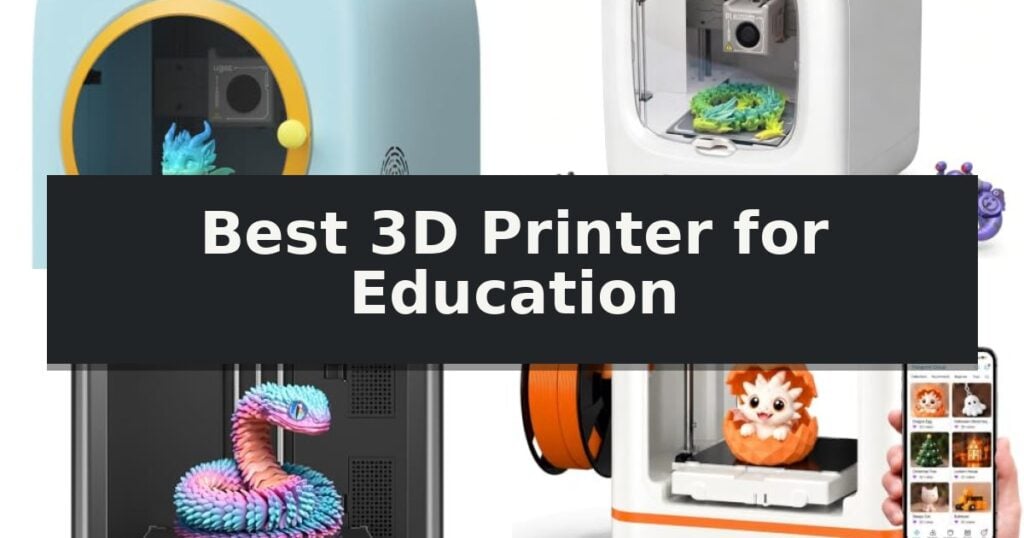
10 Best 3D Printer for Education in 2026 Reviews
Quick Comparison
| Product | Best For | Key Strength | Score |
|---|---|---|---|
| Ugee Funbox 3D Printer | Best Overall | UL GREENGUARD certified with H12 HEPA and carbon filtration for air safety. | 4.9 |
| AOSEED X-MAKER JOY AI+ 3D Printer | Best AI-Powered Creative Tool | AI-powered design tools allow for model creation via voice or image prompts. | 4.9 |
| Flashforge Adventurer 5M 3D Printer | Fastest for Rapid Prototyping | 600mm/s high-speed printing for rapid project turnaround. | 4.9 |
| Entina Tina2C 3D Printer | Easiest Setup for Beginners | Fully assembled design enables 5-minute setup. | 4.3 |
| Hephi3d Tina2C 3D Printer | Best Value for STEM Learning | Fully assembled and factory-preset for 5-minute setup. | 4.5 |
| XZN Mini M1S 3D Printer | Compact Pick for Tight Spaces | Fully assembled out of the box for immediate use | 4.3 |
| Creality K2 Combo 3D Printer | Advanced Multi-Color Printing | Multi-color printing capability with up to 16 colors via linked CFS units. | 4.8 |
| Generic Portable 3D Printer | Budget-Friendly Entry Point | Compact footprint ideal for small desks and classrooms. | 4.4 |
| Gonetre 3D Printer | Simple Controls for Students | Fast heating nozzle reaches operating temperatures in 5 minutes. | 4.5 |
| LICAEVEY 3D Printer | Reliable Desktop Learning Tool | Fully assembled construction allows for immediate use out of the box. | 4.4 |
How We Chose
Evaluating the best 3D printer for education requires a focus on reliability, safety, and pedagogical value. We prioritize machines that minimize setup time and maintenance, ensuring that the technology remains a tool for learning rather than a source of technical frustration. Our assessment centers on how well each device supports independent student exploration.
- Safety compliance including enclosed designs and air filtration systems
- Ease of setup and maintenance for non-technical users
- Integration with educational software and STEM-focused model libraries
- Print reliability and consistency for classroom environments
- Speed and noise levels appropriate for shared learning spaces
1 Ugee Funbox 3D Printer — Safest Choice for Classrooms
Introducing the Ugee Funbox 3D Printer, a specialized creative tool designed to turn a child's room into a hands-on STEM laboratory. This device stands out with its UL GREENGUARD certification and a fully enclosed body, ensuring that safety and air quality remain a priority for home and classroom environments.
The printer is engineered for immediate use, arriving 100% assembled and pre-calibrated with patented leveling-free technology to ensure consistent results without manual adjustments. It connects via WiFi 6 and integrates with the UFun App, allowing users to browse over 12,000 print-tested models or utilize AI-powered engines that convert text, photos, and voice inputs into printable 3D objects.
Performance is balanced with a focus on a quiet environment, operating at below 46dB while achieving print speeds up to 500 mm/s. The unit includes a built-in HD camera for monitoring progress and creating time-lapse videos, while the H12 HEPA and activated carbon filters work to capture up to 99.5% of ultrafine particles during the printing process.
Designed for users aged 8 and up, the Ugee Funbox 3D Printer supports educational development through 15 themed studios and guided video courses. While it is a single-color printer, it encourages engineering skills by requiring users to assemble multi-part projects, fostering fine motor skills and spatial reasoning.
Best for: Students and children aged 8 and older who want a safe, AI-assisted introduction to 3D design and engineering.
Skip if: Users who require multi-color printing capabilities or a large-format build volume for professional-grade manufacturing.
- UL GREENGUARD certified with H12 HEPA and carbon filtration for air safety.
- Zero calibration required with pre-assembled, leveling-free technology.
- AI-powered creation tools that convert photos and text into 3D models.
- Whisper-quiet operation under 46dB suitable for bedroom use.
- Single-color printing requires manual assembly for multi-colored projects.
- Adult supervision is strictly required due to hot surfaces during operation.
2 AOSEED X-MAKER JOY AI+ 3D Printer — Best AI-Powered Creative Tool
Integrating modern technology into the classroom or home studio, the AOSEED X-MAKER JOY AI+ 3D Printer simplifies the additive manufacturing process with its AI-powered design tools. By utilizing voice, text, or image prompts, users can generate custom 3D models without needing traditional CAD software skills, making it a highly accessible entry point for students and beginners.
This printer is engineered for safety and convenience, featuring an enclosed, pinch-resistant design and a leveling-free platform that removes the complexity of manual calibration. With upgraded printing speeds reaching peaks of 400 mm/s, it allows for rapid prototyping of small toy projects in as little as 20 minutes, keeping engagement high during educational sessions.
Connectivity is a core focus, as the unit supports one-tap printing via a mobile app and includes a built-in camera for real-time monitoring and automatic time-lapse creation. The system also includes filament runout detection to prevent failed prints, ensuring a smoother experience when working on longer educational projects.
The AOSEED X-MAKER JOY AI+ 3D Printer arrives as a comprehensive kit, bundled with 8 spools of PLA filament, a magnetic build plate, and essential tools. While it is limited to single-color printing—requiring multi-part assembly for complex color designs—its robust library of over 20,000 pre-tested models provides an extensive resource for immediate creative exploration.
Best for: Students and families seeking a safe, AI-assisted 3D printing experience with minimal setup and high-speed output.
Skip if: Users who require multi-color printing capabilities or a large build volume for industrial-scale projects.
- AI-powered design tools allow for model creation via voice or image prompts.
- Leveling-free platform and enclosed design enhance safety and ease of use.
- High-speed printing capabilities reduce wait times for small projects.
- Comprehensive starter kit includes 8 spools of filament and necessary tools.
- Single-color printing limitation requires manual assembly for multi-colored designs.
3 Flashforge Adventurer 5M 3D Printer — Fastest for Rapid Prototyping
Integrating advanced engineering into the classroom, the FLASHFORGE Adventurer 5M 3D Printer stands out for its 600mm/s high-speed printing capability, which significantly reduces wait times for student projects. By utilizing a CoreXY all-metal structure, this printer maintains high precision even during rapid prototyping, ensuring that educational models are produced with consistent quality.
The printer prioritizes ease of use with one-click automatic bed leveling, removing the need for manual adjustments that often frustrate beginners. Its 280°C direct drive extruder and 3-second detachable nozzle system allow for quick maintenance and the ability to experiment with various nozzle sizes, ranging from 0.25mm to 0.8mm, to accommodate different project requirements.
Efficiency is further enhanced by a 35-second warm-up time to 200°C and a dual-sided PEI platform that simplifies the removal of finished prints. For classroom management, the Flash Studio app provides real-time monitoring and remote settings adjustments, allowing educators to oversee multiple print jobs effectively from a mobile device.
Designed for versatility, the FLASHFORGE Adventurer 5M 3D Printer balances high-performance specifications with a user-friendly interface. While its compact footprint fits well on lab benches, the inclusion of vibration compensation and dual-fan cooling ensures that high-speed output remains stable and reliable for diverse learning environments.
Best for: Educational settings requiring rapid prototyping and high-throughput printing with minimal manual setup.
Skip if: Users who require a larger build volume than 220x220x220mm or those who prefer a fully enclosed chamber for specialized high-temperature materials.
- 600mm/s high-speed printing for rapid project turnaround.
- One-click automatic bed leveling for simplified operation.
- 3-second detachable nozzle system for easy maintenance.
- Real-time app monitoring via Flash Studio for remote oversight.
- 220x220x220mm build volume may limit the size of larger educational models.
- Open-frame design lacks the environmental control of fully enclosed printers.
4 Entina Tina2C 3D Printer — Easiest Setup for Beginners
The Entina Tina2C 3D Printer is engineered for immediate use, arriving fully assembled with factory presets that allow beginners to initiate their first print in approximately five minutes. This compact desktop unit removes the barrier of complex assembly, making it a practical choice for those exploring 3D printing in home or educational environments.
Designed with accessibility in mind, the printer integrates with the Poloprint Cloud app, providing access to a library of over 3,500 ready-to-print models and 25+ DIY projects. Users can manage printing tasks via 2.4GHz WiFi connectivity or utilize offline printing through a TF card. The system also features AI-powered tools within the app, such as text-to-3D and photo-to-3D conversion, to assist users without prior modeling experience.
Technical features include automatic bed leveling to improve first-layer adhesion and a power-loss recovery function that allows for print resumption after unexpected interruptions. The build area measures 3.9 x 3.9 x 3.9 inches, and the unit is equipped with a flexible magnetic print bed designed to simplify the removal of finished projects. Maintenance is further streamlined by a quick-swap nozzle system.
For those interested in advanced workflows, the hardware maintains compatibility with standard slicing software like Cura and Simplify3D. The device operates with a focus on quiet performance and includes built-in LED lighting, making it suitable for placement on desks or in shared learning spaces without causing significant distraction.
Best for: Beginners and students seeking a plug-and-play 3D printing experience with app-based model access.
Skip if: Users requiring a large build volume for industrial-scale projects or complex, multi-material printing capabilities.
- Fully assembled design enables 5-minute setup.
- Automatic bed leveling reduces manual calibration requirements.
- WiFi and app control provide access to thousands of pre-made models.
- Power-loss recovery protects print progress during interruptions.
- Flexible magnetic build plate allows for easy print removal.
- Small 3.9-inch build volume limits the size of individual projects.
- Limited to single-material printing compared to advanced professional machines.
5 Hephi3d Tina2C 3D Printer — Best Value for STEM Learning
Introducing the Hephi3d Tina2C 3D Printer, a compact device engineered for rapid deployment in educational and home environments. This unit arrives fully assembled and factory-preset, allowing users to initiate their first print within five minutes of unboxing. Its design prioritizes accessibility, featuring auto-leveling capabilities that remove the need for complex manual calibration.
The printer integrates seamlessly with modern workflows through APP and WiFi control, enabling users to manage projects directly from a smartphone or tablet. Educators and students gain access to a library of over 3500 ready-to-print models, with daily updates provided. For those interested in customization, the system includes 25+ DIY design modules and an AIGC photo-generation function that converts images into 3D printable files.
Technical flexibility is a hallmark of this model, as it is fully open-source with no software lock-in. Users can operate the machine using industry-standard software like Cura or Wiibuilder via PC, or utilize the USB-type C and TF card inputs for offline printing. The hardware includes a 3s fast-release hotend for simplified maintenance and a resume printing function to protect progress during power interruptions.
Designed for quiet operation, the Hephi3d Tina2C 3D Printer is suitable for classroom or home use where noise reduction is a factor. The package includes a comprehensive starter kit featuring a spool of PLA filament and essential tools, ensuring that users have all necessary components to begin STEM learning projects immediately.
Best for: Students and beginners seeking an out-of-the-box, easy-to-use 3D printing solution for STEM learning and home projects.
Skip if: Users requiring a large build volume or advanced industrial-grade features will find the compact size of this mini printer limiting.
- Fully assembled and factory-preset for 5-minute setup.
- Auto-leveling bed simplifies the printing process for beginners.
- WiFi and APP control provide convenient remote management.
- Open-source compatibility allows use with Cura and other standard slicers.
- Resume printing feature prevents material waste during power outages.
- Compact build volume limits the size of individual print projects.
- Mini printer form factor may not support complex professional-grade engineering materials.
6 XZN Mini M1S 3D Printer — Compact Pick for Tight Spaces
Integrating additive manufacturing into a classroom setting requires equipment that balances ease of use with reliable output. The XZN Mini M1S 3D Printer addresses this by arriving fully assembled, allowing educators to transition from unboxing to printing without complex mechanical calibration.
Designed with a focus on speed and precision, this unit achieves a top speed of 250mm/s while maintaining a 0.01mm precision level. The inclusion of one-button auto-leveling and one-touch filament loading removes common technical hurdles, making the machine accessible for students and beginners who are new to the 3D printing workflow.
The hardware features a PEI heated bed to facilitate easy model removal and an automatic nozzle cleaning system to maintain consistent print quality over time. As a fully open-source device, it provides flexibility for educational environments looking to integrate custom software or hardware modifications.
To support long-term use, the manufacturer includes a 12-month free repair service and lifetime technical support. While the printer is compact, it remains versatile; users can utilize the included TF card to print a custom holder if they wish to accommodate larger 1kg filament spools.
Best for: Classrooms and home environments needing a compact, ready-to-use printer that minimizes setup time for beginners.
Skip if: Users requiring a large-format build volume for industrial-scale prototypes will find the mini form factor restrictive.
- Fully assembled out of the box for immediate use
- One-button auto-leveling simplifies the setup process
- High-speed printing up to 250mm/s
- PEI heated bed ensures reliable adhesion and easy removal
- Small build volume requires printing a custom holder for standard 1kg filament spools
7 Creality K2 Combo 3D Printer — Advanced Multi-Color Printing
The Creality K2 Combo 3D Printer streamlines complex fabrication through its integrated CFS (Color Filament System), which enables multi-color printing by supporting up to 16 colors when four units are linked. This system eliminates the need for manual post-print painting, offering a significant efficiency gain for educational projects requiring visual distinction or multi-material prototypes.
Designed for immediate integration into a classroom or lab, the unit features a 95% pre-assembled build that allows for a near plug-and-play experience. The hardware is built around a sturdy frame and utilizes 3 step-servo motors on the X/Y axis and extruder, which adjust torque dynamically in under a millisecond. This precision engineering supports a high 600mm/s printing speed while maintaining extrusion consistency.
Operational usability is enhanced by a Smart AI Camera that provides real-time monitoring to detect common issues like spaghetti failures or idling. Furthermore, the Smart Auto Leveling system probes only the specific area of the bed required for the active print, reducing setup time. The printer also incorporates step-servo motors and dynamically balanced fans to maintain a noise level comparable to typing on a laptop, making it suitable for shared learning environments.
With a build volume of 260 x 260 x 260 mm, the device accommodates a wide range of project sizes. It supports diverse material types, including PLA, PETG, ABS, PLA-CF, and PET, providing the flexibility needed for various engineering and design curricula.
Best for: Educational settings requiring reliable, multi-color printing and high-speed output for diverse engineering projects.
Skip if: Users who require a compact, entry-level machine for simple, single-material prints may find the advanced multi-color system and larger footprint unnecessary.
- Multi-color printing capability with up to 16 colors via linked CFS units.
- High-speed performance reaching 600mm/s with dynamic torque adjustment.
- Smart AI monitoring and targeted auto-leveling for reduced setup and failure rates.
- Ultra-quiet operation suitable for classroom environments.
- Larger footprint compared to standard single-extruder desktop printers.
- Advanced feature set may exceed the requirements of basic introductory 3D printing courses.
8 Generic Portable 3D Printer — Budget-Friendly Entry Point
Introducing the Generic Portable 3D Printer, a compact FDM solution designed to simplify the entry into additive manufacturing for students and hobbyists. Its 100x100x100mm build volume is specifically tailored for small workspaces, making it a practical addition to classrooms or home desks where space is at a premium.
This printer prioritizes accessibility through a modular design that requires quick assembly. Users are supported by a comprehensive resource package, including a Quick Start Guide and step-by-step video tutorials that cover bed leveling, filament loading, and initial operation. The inclusion of a 12V Type-C power adapter and essential tools ensures that the setup process remains straightforward.
Performance is driven by stable FDM technology paired with a 0.4mm nozzle, capable of achieving a layer thickness between 0.05mm and 0.3mm. The system offers versatile material support, allowing for the use of both standard PLA and flexible TPU filaments. A removable build plate is integrated into the design to facilitate easier model removal once printing is complete.
The unit arrives as a complete kit, bundled with 10m of PLA filament, an 8GB TF card with a reader, and an illustrated manual. By providing these components upfront, the manufacturer aims to eliminate hidden costs for beginners. While the device is built for portability and ease of use, users should note the 60-day replacement warranty covers non-human damage, emphasizing the importance of following the provided instructional guides.
Best for: Students, beginners, and hobbyists requiring a compact, easy-to-assemble printer for small-scale STEM projects.
Skip if: Users who require a large build volume or advanced features like auto-leveling and high-speed printing will find this entry-level model too restrictive.
- Compact footprint ideal for small desks and classrooms.
- Comprehensive support with included video tutorials and guides.
- Versatile filament support including both PLA and flexible TPU.
- All-in-one package containing all necessary tools and starter materials.
- Limited build volume of 100x100x100mm restricts print size.
- Manual assembly required for initial setup.
9 Gonetre 3D Printer — Simple Controls for Students
Introducing the Gonetre 3D Printer, a compact machine specifically engineered to simplify the entry into additive manufacturing for students and beginners. Unlike complex industrial units, this device prioritizes accessibility through a straightforward, key-based control system that allows users to start, stop, and manage prints without navigating intricate software menus.
The printer features a compact 4 x 4 x 4in build volume and is equipped with an all-metal nozzle designed to maintain optimal temperatures, which helps reduce common printing errors. It supports both PLA and TPU filaments, capable of achieving high layer resolutions of up to 0.05mm for detailed educational models. The system is built from robust ABS material, ensuring the unit remains durable enough for regular use in classrooms or makerspaces.
Efficiency is a core design focus, with a fast heating capability that allows the nozzle to reach 180°C in just 5 minutes. This minimizes wait times, keeping students engaged during hands-on projects. The machine is designed for ease of use; users simply load gcode files onto a memory card to begin, bypassing the need for complex slicing software experience.
By supporting both pre-loaded model files and custom designs downloaded online, this printer encourages experimentation and spatial learning. The intuitive interface, featuring dedicated load and unload keys, ensures that the focus remains on the creative process rather than technical troubleshooting, making it a practical tool for fostering 3D perception in an educational setting.
Best for: Students and beginners who need a compact, easy-to-operate 3D printer for classroom or home-based educational projects.
Skip if: Users requiring a large build volume or advanced features like auto-leveling and complex connectivity will find the 4-inch print area and manual controls too restrictive.
- Fast heating nozzle reaches operating temperatures in 5 minutes.
- Intuitive key-based controls eliminate the need for complex slicing software.
- High layer resolution of up to 0.05mm for detailed results.
- Compact, robust design suitable for classroom environments.
- Limited build volume of 4 x 4 x 4 inches restricts the size of projects.
- Manual material loading and unloading requires more user interaction than automated systems.
10 LICAEVEY 3D Printer — Reliable Desktop Learning Tool
Introducing the LICAEVEY 3D Printer, a compact and accessible machine designed to simplify the entry into additive manufacturing for students and beginners. This unit arrives fully assembled and features a straightforward, key-based control system that allows users to start, stop, and manage print jobs without needing complex software expertise.
Engineered for educational environments, this printer utilizes a frequency division multiplexing process and is constructed from robust ABS material to ensure longevity in busy classrooms or home workshops. The device features an all-metal nozzle capable of reaching 180°C in just five minutes, which provides the consistent heating required for reliable PLA filament extrusion.
The printer offers a build volume of 4 x 4 x 4 inches, making it a space-efficient tool for small-scale projects. It supports high layer resolutions of up to 0.05mm, allowing for accurate model production. By utilizing a simple memory card interface for Gcode files, the system removes the technical barriers often associated with 3D slicing, letting users focus on spatial design and hands-on experimentation.
This machine is a practical choice for those prioritizing ease of use and rapid setup. While its compact size is ideal for desktop placement, users should note the specific material compatibility and build volume constraints when planning larger or more complex educational projects.
Best for: Beginners and students seeking a compact, pre-assembled, and easy-to-operate 3D printer for educational projects.
Skip if: Users who require a large build volume or advanced features like multi-material support and complex software integration will find this entry-level model too limiting.
- Fully assembled construction allows for immediate use out of the box.
- Rapid heating nozzle reaches operational temperatures in five minutes.
- Intuitive key-based controls eliminate the need for complex slicing software.
- Compact footprint fits easily into classrooms and home workspaces.
- Limited build volume of 4 x 4 x 4 inches restricts the size of print projects.
- Specific material support limited to PLA and TPU filaments.
Best 3D Printer for Education Buying Guide
Safety and Environmental Standards
In a classroom, safety is the primary consideration. Look for printers that feature fully enclosed build chambers to prevent accidental contact with hot components and anti-pinch mechanisms on doors.
Air quality is equally vital. Models that incorporate HEPA and activated carbon filtration are essential for reducing exposure to ultrafine particles and odors, especially in confined or poorly ventilated learning spaces.
Ease of Use and Setup
Educational environments benefit from plug-and-play functionality. Machines that arrive pre-assembled and pre-calibrated allow students to begin printing almost immediately, reducing the need for constant adult intervention.
Automatic bed leveling is a critical feature that ensures consistent first-layer adhesion. This technology eliminates the most common point of failure in 3D printing, allowing students to focus on their designs rather than troubleshooting.
Software and Curriculum Integration
The best educational printers provide more than just hardware; they offer a ecosystem of software that encourages learning. Look for apps that include guided video courses or STEM-based design modules.
AI-powered tools that convert drawings or text into 3D models can help bridge the gap for younger students who are not yet proficient in complex CAD software, making the creative process more accessible.
Reliability and Maintenance
Classroom printers face frequent use, making durability a key factor. Features like quick-swap nozzles and modular components allow for easy maintenance without requiring specialized tools or long periods of downtime.
Consider the availability of replacement parts and the openness of the filament system. Standardized 1.75mm PLA filament support ensures that schools can source materials affordably and reliably.
Performance and Noise Levels
While speed is often marketed as a primary benefit, it must be balanced with noise management. A printer that operates quietly is necessary for maintaining a productive classroom environment where students can study and collaborate.
High-speed printing is beneficial for rapid prototyping, but consistency and precision at lower speeds are often more important for educational projects that require high detail and structural integrity.
Frequently Asked Questions
Are these 3D printers safe for elementary school students?
Yes, models designed for education typically include enclosed chambers, cool-touch exteriors, and safety certifications like UL GREENGUARD to ensure they are safe for use in classrooms with adult supervision.
Do I need to know how to design 3D models to use these printers?
No, most educational printers come with apps that offer massive libraries of pre-tested models and AI tools that can turn simple drawings or text prompts into printable 3D objects.
What type of filament is best for school use?
PLA (Polylactic Acid) is the standard for schools because it is non-toxic, biodegradable, and does not require a heated chamber to print effectively, making it the safest and easiest choice.
How much maintenance do these printers require?
Modern educational 3D printers are designed for minimal maintenance. Features like auto-leveling and quick-swap nozzles significantly reduce the time required to keep the machine running smoothly.
Can these printers be used for advanced engineering projects?
Yes, many of these printers support standard slicing software like Cura, allowing students to progress from using simple apps to learning advanced design and printing techniques as their skills improve.
Conclusion: Our Top Pick
Our top pick is Ugee Funbox 3D Printer. Choosing the right 3D printer for an educational setting involves prioritizing safety, ease of use, and software that actively supports the learning process. By selecting a machine that minimizes technical barriers, educators can effectively integrate 3D printing into their curriculum to inspire creativity and engineering thinking.
Whether you need a highly automated, safe device for younger students or a faster machine for older students working on rapid prototyping, the current market offers reliable options that turn complex technology into an accessible, hands-on learning experience.