AOSEED X-Maker Joy AI 3D Printer is our top choice for the Best 3D Printers for Students because it combines a fully enclosed, kid-safe design with an intuitive AI-driven interface that simplifies complex modeling tasks.
Selecting the right hardware for a student requires balancing ease of use with the potential for long-term learning. While some models prioritize raw speed, others focus on safety features like HEPA filtration or pre-calibrated systems that allow students to focus on design rather than mechanical troubleshooting.
For those seeking a more budget-conscious entry point, the Creality Ender 3 V3 SE offers a robust, reliable platform for students ready to learn manual calibration and maintenance. Meanwhile, the UGEE Funbox provides a highly curated, safety-certified environment ideal for younger students or classroom settings where air quality and pinch-prevention are paramount.
For educators looking to integrate technology into the classroom, our guide on the Best 3D Printer for Education provides additional insights into managing multiple machines. If you are new to the hobby, you may also find our recommendations for the Best 3D Printer for Beginners helpful for understanding basic maintenance.
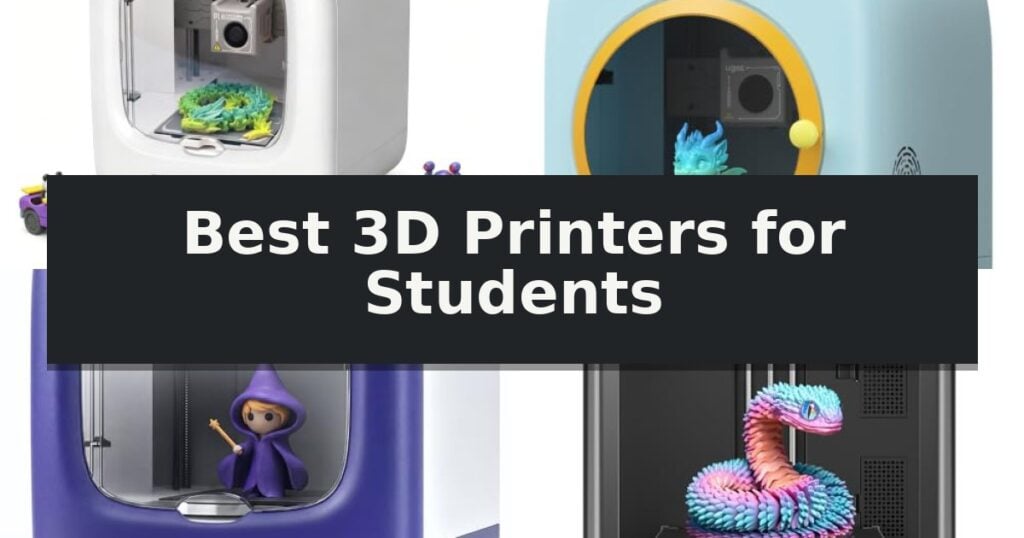
10 Best 3D Printers for Students in 2026 Reviews
Quick Comparison
| Product | Best For | Key Strength | Score |
|---|---|---|---|
| AOSEED X-Maker Joy AI 3D Printer | Best Overall | AI-powered model generation via voice, text, or image prompts. | 4.9 |
| UGEE Funbox 3D Printer | Safest Choice for Classrooms | UL GREENGUARD certified with a fully enclosed, anti-pinch, and anti-scald design. | 4.8 |
| Magic Jimmy 3D Printer | Easiest for Independent Learning | Fully enclosed design ensures maximum safety for younger users. | 4.9 |
| FLASHFORGE Adventurer 5M 3D Printer | Fastest for Rapid Prototyping | 12X ultra-fast printing with 600mm/s travel speed. | 4.6 |
| Creality Ender 3 V3 SE 3D Printer | Best Value for Students | Fast 250mm/s print speed for efficient project completion. | 4.8 |
| Entina Tina2C 3D Printer | Most Compact Desktop Pick | Fully assembled design enables 5-minute setup. | 4.3 |
| XZN Mini M1S 3D Printer | Quickest Setup for Beginners | Fully assembled design allows for immediate use. | 4.5 |
| Generic Portable 3D Printer | Best Budget-Friendly Option | Modular assembly with clear video guidance for quick setup. | 4.4 |
| Curenoxium Portable 3D Printer | Includes Starter Filament Kit | Includes 4-color starter filament kit for immediate use. | 4.6 |
| Creality K2 Combo 3D Printer | Advanced Multicolor Printing | Multicolor printing capability with up to 16-color support via CFS units. | 4.9 |
How We Chose
To identify the best 3D printers for students, we evaluate machines based on their ability to transition from a plug-and-play experience to more advanced creative projects. We prioritize safety, reliability, and software accessibility, ensuring that each model supports the educational journey without requiring constant technical intervention.
- Safety certification and enclosure design for classroom or home use
- Ease of setup and reliance on automated leveling systems
- Integration with educational software and model libraries
- Print speed and consistent extrusion quality for functional parts
- Connectivity options for remote monitoring and app-based control
1 AOSEED X-Maker Joy AI 3D Printer — Best AI-Powered Creative Tool
Integrating advanced technology into the classroom or home studio, the AOSEED X-Maker Joy AI 3D Printer simplifies the transition from concept to physical object. This unit distinguishes itself with an AI-powered creative suite that allows users to generate custom 3D models through voice, text, or image prompts, removing the traditional barrier of complex CAD design software.
Engineered for efficiency and safety, the printer features an enclosed, pinch-resistant design and a leveling-free platform, making it accessible for beginners. It supports impressive print speeds, reaching peaks of 400mm/s, which allows smaller projects to be completed in approximately 20 minutes. The inclusion of filament runout detection and a quick-release nozzle further streamlines maintenance and reduces the likelihood of failed prints.
The device is built for connectivity, utilizing fast Wi-Fi and dedicated app control compatible with iOS, Android, and Windows. A built-in camera enables real-time monitoring of print progress and the automatic creation of time-lapse videos, providing a practical way to document the creative process. The system also offers access to a library of over 20,000 human-reviewed models, ensuring a steady stream of project inspiration.
This all-in-one creative starter kit arrives ready to use, bundled with eight spools of PLA filament, a magnetic build plate, and essential tools. While the printer is optimized for single-color output, it provides a robust foundation for STEM learning and personalized DIY projects, backed by a 12-month warranty with an available extension.
Best for: Students and families seeking an intuitive, AI-assisted 3D printing experience with minimal setup and high-speed output.
Skip if: Users who require multi-color printing capabilities or a large build volume for industrial-scale projects will find this compact, single-extruder model limiting.
- AI-powered model generation via voice, text, or image prompts.
- High-speed printing with peak capabilities of 400mm/s.
- Leveling-free platform and enclosed design for enhanced safety and ease of use.
- Comprehensive starter kit including 8 spools of filament and necessary tools.
- Single-color printing only; multi-color projects require assembly of separate parts.
- Compact build volume may restrict the size of larger individual components.
2 UGEE Funbox 3D Printer — Safest Choice for Classrooms
Introducing 3D printing to a student's workspace requires a balance of safety, ease of use, and creative potential. The UGEE Funbox 3D Printer addresses these needs with a fully enclosed design and UL GREENGUARD certification, ensuring that the learning environment remains free from harmful fumes and accessible for younger users.
This printer is engineered for immediate engagement, arriving 100% pre-calibrated to eliminate the technical hurdles often associated with hobbyist machines. Students can utilize the UFun App for one-tap control, while the AI-powered creation engines allow them to transform simple sketches, photos, or voice prompts into physical objects, fostering a direct connection between imagination and engineering.
Performance is prioritized through a fast 500mm/s print speed that allows for quick project turnaround without sacrificing the 0.05mm precision required for detailed models. Despite this speed, the unit maintains a whisper-quiet operation below 46dB, making it suitable for use in bedrooms or quiet study areas. The inclusion of a built-in HD camera further enhances the experience by enabling students to monitor progress and create time-lapse videos of their builds.
Beyond the hardware, the UGEE Funbox 3D Printer serves as a comprehensive STEM tool. With access to over 12,000 expert-curated models and guided video courses, it teaches spatial reasoning and design thinking. The open filament system supports standard 1.75mm PLA, providing a cost-effective way for students to explore complex assembly and multi-part construction while developing essential fine motor skills.
Best for: Students aged 8 and up who need a safe, pre-calibrated, and AI-assisted introduction to 3D design and engineering.
Skip if: Advanced users seeking multi-material, multi-color printing capabilities or a larger build volume for industrial-scale projects.
- UL GREENGUARD certified with a fully enclosed, anti-pinch, and anti-scald design.
- Zero-calibration setup allows for immediate use right out of the box.
- AI-powered software simplifies the conversion of photos and text into 3D models.
- High-speed printing up to 500mm/s with quiet operation under 46dB.
- Single-color printing requires manual assembly for multi-colored projects.
- Requires adult supervision for users under the age of 8 due to hot surfaces.
3 Magic Jimmy 3D Printer — Easiest for Independent Learning
Introducing 3D printing to a classroom or home environment requires a balance of safety, ease of use, and creative engagement. The Magic Jimmy 3D Printer distinguishes itself with a fully enclosed child-safe design, ensuring that all hot components and moving parts remain inaccessible during operation, making it a suitable choice for younger students.
This printer is designed for immediate use, arriving fully assembled with no manual setup required. Students can begin their projects by connecting to WiFi and loading the included PLA filament. The system supports independent learning through a library of 12,000+ toy models and STEM projects, while also allowing for the import of custom STL files from external platforms.
Technical capabilities include fast printing speeds of up to 400mm/s, allowing small models to be completed in as little as 20 minutes. The device integrates AI-powered design tools such as AI Craft and AI MiniMe, which enable children to transform sketches, text, or photos into 3D printable objects. A built-in camera further enhances the experience by recording time-lapse videos of the printing process.
While the unit is built for durability and safety, users should note that it is strictly compatible with non-toxic PLA filament. The magnetic build plate simplifies the removal of finished prints, though the overall footprint is compact, measuring approximately 13.7 by 13.15 inches, which is ideal for desktop placement in schools or home offices.
Best for: Students and children seeking an intuitive, safe, and AI-assisted introduction to 3D design and fabrication.
Skip if: Advanced users or engineers who require compatibility with high-temperature filaments like ABS or PETG, or those needing a larger build volume for complex mechanical parts.
- Fully enclosed design ensures maximum safety for younger users.
- AI-powered tools simplify the creation of custom 3D models from sketches and photos.
- Fast printing speeds reduce wait times for small projects.
- Ready-to-use out of the box with no assembly required.
- Limited to PLA filament only, restricting material versatility.
- Compact build volume may not accommodate larger, multi-part engineering projects.
4 FLASHFORGE Adventurer 5M 3D Printer — Fastest for Rapid Prototyping
For students balancing tight academic schedules with the need for rapid prototyping, the FLASHFORGE Adventurer 5M 3D Printer provides a high-performance solution engineered to minimize production downtime. Its robust CoreXY structure supports impressive travel speeds of up to 600mm/s and acceleration of 20000mm/s², which significantly shortens the time required to iterate on class projects or complex personal designs. This speed capability is a critical asset for engineering students who need to move quickly from a digital model to a physical prototype.
Efficiency is central to this model, featuring a 32mm³/s high-flow nozzle that reaches 200°C in just 35 seconds. The 3S detachable nozzle system allows for rapid maintenance or nozzle swaps, while the 280°C direct drive extruder provides the versatility to work with a wide range of materials. To ensure consistent output, the printer includes fully automatic bed leveling, which removes the need for manual calibration and helps maintain reliable first-layer adhesion across every print job.
The machine is designed for the modern workspace, incorporating vibration compensation to maintain structural integrity and surface quality even during high-speed operation. Users can manage their workflow through real-time app monitoring via Flash Studio, allowing for remote status checks and setting adjustments from anywhere. The dual-sided PEI platform offers a durable, flexible surface that simplifies the removal of finished prints, making it a practical and user-friendly choice for busy academic environments where time and ease of use are paramount.
While the printer offers substantial speed and reliability, it is important to note the hardware constraints. The fixed build volume of 220x220x220mm is well-suited for most student projects, but it may present a trade-off for those requiring large-scale fabrication. This design choice prioritizes a compact footprint and structural rigidity, ensuring that the machine remains stable at high speeds without taking up excessive desk space.
Best for: Students who require rapid prototyping and high-speed printing for engineering or design projects.
Skip if: Users who require a build volume larger than 220x220x220mm or those who do not prioritize high-speed printing capabilities.
- 12X ultra-fast printing with 600mm/s travel speed.
- Fully automatic bed leveling for consistent first layers.
- Quick 3-second nozzle changes for easy maintenance.
- Remote monitoring via mobile app integration.
- Fixed build volume of 220x220x220mm may limit larger project scales.
5 Creality Ender 3 V3 SE 3D Printer — Best Value for Students
The Creality Ender 3 V3 SE 3D Printer streamlines the entry into additive manufacturing by prioritizing rapid assembly and automated calibration. Designed to minimize the technical barriers often associated with desktop printing, this model integrates a CR Touch Auto Leveling system alongside automatic Z-offset calibration to ensure a consistent first layer without requiring manual bed adjustments.
Performance is driven by a 250mm/s high-speed printing capability, supported by a 2500mm/s² acceleration rate. This allows for efficient production of functional parts and prototypes. The hardware configuration features a Sprite Direct Drive Extruder, which is engineered to provide reliable filament feeding across various materials, including PLA, PETG, and TPU.
Structural stability is maintained through a dual synchronized Z-axis lead screw system paired with precision Y-axis linear shafts. This arrangement is intended to mitigate Z-wobble and vibration, promoting accurate layer alignment during extended print cycles. To support a quieter workspace, the unit is equipped with a 32-bit silent mainboard.
Usability is further enhanced by the inclusion of a flexible PC spring steel build plate, which facilitates the removal of finished prints with minimal physical effort. The machine is designed for straightforward maintenance and operation, making it a practical choice for students needing a reliable tool for academic or personal projects.
Best for: Students seeking a reliable, fast, and easy-to-assemble 3D printer for academic projects and prototyping.
Skip if: Users requiring a larger build volume or advanced features like multi-material printing and enclosure-integrated air filtration.
- Fast 250mm/s print speed for efficient project completion.
- CR Touch Auto Leveling simplifies the initial setup process.
- Sprite Direct Drive Extruder supports a variety of filament types.
- Silent 32-bit mainboard reduces operating noise.
- Manual assembly required despite the simplified design.
- Limited build volume compared to professional-grade industrial printers.
6 Entina Tina2C 3D Printer — Most Compact Desktop Pick
The Entina Tina2C 3D Printer streamlines the introduction to additive manufacturing by arriving fully assembled with factory presets, allowing users to begin their first project in as little as 5 minutes. This compact device eliminates the need for complex calibration through its auto-leveling system, which helps maintain consistent first-layer adhesion for reliable results.
Designed for accessibility, the printer integrates with the Poloprint Cloud app to provide access to over 3,500 ready-to-print models and 25+ DIY projects. Users can manage their workflow via 2.4GHz WiFi connectivity or offline using a TF card. The app further simplifies the creative process by offering AI-powered tools for text-to-3D and photo-to-3D conversions, making it suitable for those without prior modeling experience.
The hardware features a flexible magnetic print bed that allows for easy removal of finished parts with a simple bend, alongside a quick-swap nozzle that reduces maintenance downtime. For those looking to advance their skills, the unit maintains compatibility with standard slicing software like Cura and Simplify3D, supporting more complex, custom design workflows.
With a footprint optimized for desks and learning environments, this quiet-operating printer includes built-in LED lighting and a power-loss recovery function to protect prints during unexpected interruptions. Its 3.9 x 3.9 x 3.9-inch build volume is tailored for small-scale STEM projects and creative home use.
Best for: Students and beginners seeking a compact, plug-and-play 3D printer for STEM projects and creative hobbyist activities.
Skip if: Users requiring a large build volume for industrial-scale parts or those who prefer a DIY kit-based assembly experience.
- Fully assembled design enables 5-minute setup.
- Auto-leveling technology simplifies initial calibration.
- WiFi-enabled app control with access to 3,500+ pre-made models.
- Flexible magnetic build plate for easy print removal.
- Small 3.9-inch build volume limits the size of individual projects.
- Limited to specific software workflows for advanced customization.
7 XZN Mini M1S 3D Printer — Quickest Setup for Beginners
The XZN Mini M1S 3D Printer streamlines the entry into additive manufacturing by arriving fully assembled, allowing users to begin printing immediately out of the box. Designed with a focus on accessibility for students and beginners, this compact unit features one-button auto-leveling and one-touch filament loading, which remove the technical hurdles often associated with initial printer setup.
Despite its small footprint, the printer delivers professional-grade precision at 0.01mm and supports a high top speed of 250mm/s. The inclusion of a PEI heated bed facilitates easier model removal, while an automatic nozzle cleaning system works to maintain consistent print quality during operation. The device is fully open-source, providing a flexible platform for those interested in exploring the mechanics of 3D printing.
Connectivity is managed via WiFi, and the printer comes as a complete starter kit including a roll of test PLA filament and an SD card. For users needing to utilize larger 1kg filament spools, the manufacturer provides a pre-sliced file on the included TF card to print a compatible spool holder, ensuring the hardware remains adaptable as project needs grow.
The manufacturer supports the hardware with a 12-month free repair service and lifetime professional technical support. This combination of automated maintenance features and a ready-to-use design makes the XZN Mini M1S 3D Printer a practical choice for home or school environments where rapid deployment and ease of use are prioritized.
Best for: Students and beginners who require a compact, fully assembled 3D printer that minimizes setup time through automated leveling and filament loading.
Skip if: Users who need to print large-scale objects or require native compatibility with 1kg filament spools without first printing a custom holder.
- Fully assembled design allows for immediate use.
- One-button auto-leveling simplifies the calibration process.
- High-speed printing capability up to 250mm/s.
- PEI heated bed ensures easy model removal.
- Requires printing a custom holder to accommodate standard 1kg filament spools.
- Compact size limits the dimensions of printable projects.
8 Generic Portable 3D Printer — Best Budget-Friendly Option
The Generic Portable 3D Printer simplifies the entry into additive manufacturing by providing a modular assembly design supported by comprehensive, step-by-step video tutorials. Designed specifically for compact environments like student desks or classrooms, this machine offers a 100x100x100mm build volume that balances functionality with a minimal physical footprint.
Engineered for versatility, the unit utilizes stable FDM technology and is compatible with both PLA and flexible TPU filaments. The 0.4mm nozzle supports precise layer thicknesses ranging from 0.05mm to 0.3mm, allowing for detailed output on small-scale projects. Users can easily remove finished models thanks to the included removable build plate.
The printer arrives as a complete, ready-to-use package, eliminating hidden costs by including a 10m starter PLA filament, an 8GB TF card with a reader, and a 12V Type-C power adapter. The foolproof setup process is further assisted by an illustrated manual and online troubleshooting guides, ensuring that beginners can begin printing shortly after assembly.
With its lightweight 2.2-pound construction, this device is highly portable and suitable for those who need to move their equipment between study spaces. While it is optimized for educational and hobbyist use, its straightforward operation makes it a practical tool for learning the fundamentals of 3D design and fabrication.
Best for: Students and beginners who need a compact, easy-to-assemble 3D printer for small-scale STEM projects and hobbyist creations.
Skip if: Users requiring a large build volume for industrial-sized prototypes or those who prefer a fully pre-assembled, plug-and-play machine without any modular setup.
- Modular assembly with clear video guidance for quick setup.
- Versatile filament compatibility including PLA and flexible TPU.
- Compact 100x100x100mm build volume ideal for small workspaces.
- Complete starter kit including filament, TF card, and tools.
- Limited build volume restricts the size of individual print projects.
- Modular design requires manual assembly before initial use.
9 Curenoxium Portable 3D Printer — Includes Starter Filament Kit
The Curenoxium Portable 3D Printer stands out for its remarkably compact 100x100x100mm build volume, making it an accessible entry point for students looking to explore additive manufacturing in home or school environments. This lightweight unit simplifies the initial learning curve by arriving with a comprehensive starter kit, including four 200g rolls of PLA filament in distinct colors.
Engineered for straightforward operation, the device utilizes FDM technology with a 0.4mm nozzle to produce prints with adjustable layer thickness ranging from 0.05mm to 0.3mm. It supports both PLA and TPU materials, offering versatility for various classroom projects or hobbyist designs. The inclusion of a removable platform facilitates easier model removal, which is a significant benefit for users who are new to managing build surfaces.
Connectivity is handled via TF card for offline printing, ensuring that students can manage their projects without needing a constant tether to a computer. The printer is compatible with Windows and Mac systems using CURA software, providing a standard workflow for slicing models. With a printing speed of 40mm/s and a stable 12V power supply, it maintains consistent performance for smaller-scale prints.
While the printer is designed for ease of use, its compact size naturally limits the scale of projects it can accommodate. The 180-230°C nozzle temperature range is optimized for standard filaments, and the 180-day replacement policy for quality issues provides a baseline of support for educational settings.
Best for: Students and beginners who require a compact, easy-to-use 3D printer for small-scale educational or hobby projects.
Skip if: Users who need to print large-scale models or require advanced features like heated beds or high-speed industrial performance.
- Includes 4-color starter filament kit for immediate use.
- Compact and portable design ideal for small desks or classrooms.
- Removable platform simplifies the model removal process.
- Easy offline printing via TF card connectivity.
- Limited 100x100x100mm build volume restricts project size.
- Basic feature set lacks advanced capabilities found in larger units.
10 Creality K2 Combo 3D Printer — Advanced Multicolor Printing
The Creality K2 Combo 3D Printer streamlines complex projects by integrating a 4-spool CFS (Color Filament System), which enables automated switching between up to 16 colors for multicolor prints without the need for manual post-process painting. This capability allows students and makers to produce intricate, multi-material designs in a single build cycle, significantly reducing the labor involved in finishing models.
Engineered for high-speed production, this unit achieves printing speeds of 600mm/s while maintaining precision through a sturdy frame and step-servo motors on the X and Y axes. These motors dynamically adjust torque in under a millisecond to ensure extrusion consistency and print accuracy. This technical integration helps maintain high-quality output even when pushing the machine to its maximum speed limits, a critical factor for users managing tight project deadlines.
Designed for immediate use, the printer arrives 95% pre-assembled, allowing for a quick setup process that minimizes downtime. The 260 x 260 x 260 mm build volume accommodates a wide range of materials, including PLA, PETG, ABS, and carbon-fiber-reinforced filaments like PLA-CF and PET, providing the versatility needed for academic or hobbyist engineering tasks.
Operational convenience is enhanced by Smart Auto Leveling, which probes only the specific area required for the print to save time. Additionally, an integrated AI camera provides real-time monitoring to detect common issues such as spaghetti failures or idling, while the Silent Mode utilizes dynamically balanced fans to keep noise levels comparable to laptop typing. This makes the unit suitable for shared environments like dorms or small studio spaces where excessive noise would be disruptive.
Best for: Students and makers who require a high-speed, multicolor printing solution with minimal assembly and advanced monitoring features.
Skip if: Users who have limited desk space or do not require multicolor capabilities may prefer a more compact, single-extruder printer.
- Multicolor printing capability with up to 16-color support via CFS units.
- High-speed performance reaching 600mm/s with precise torque adjustment.
- Out-of-the-box setup due to 95% pre-assembly.
- Integrated AI camera for real-time print monitoring and failure detection.
- Large physical footprint may be challenging for smaller student workspaces.
- Complexity of multicolor systems requires additional space for multiple CFS units.
Best 3D Printers for Students Buying Guide
Safety and Enclosure Requirements
For student environments, an enclosed printing chamber is essential to protect users from hot nozzles and moving parts. These designs also help contain the heat generated during the printing process, making them safer for bedrooms or shared study areas.
Beyond physical protection, look for printers that utilize non-toxic PLA filament. Some advanced models also incorporate HEPA filtration systems to manage ultrafine particles, which is a critical consideration for indoor air quality in smaller rooms.
Ease of Setup and Calibration
Students often benefit from printers that arrive fully assembled or require minimal setup. Automatic bed leveling is a non-negotiable feature for beginners, as it eliminates the frustration of manual adjustments and ensures a successful first layer every time.
Pre-calibrated systems allow students to start their first project within minutes of unboxing. This immediate gratification is vital for maintaining interest in STEM subjects and encourages consistent use of the machine.
Software and Model Accessibility
The best educational printers provide access to curated libraries of models that are pre-tested for printability. This reduces the likelihood of failed prints and helps students learn the fundamentals of 3D geometry and design.
Look for platforms that offer AI-powered design tools, such as text-to-3D or photo-to-3D conversion. These features allow students to bridge the gap between their imagination and a physical object without needing advanced CAD skills initially.
Connectivity and Monitoring
Wi-Fi connectivity and dedicated mobile apps significantly improve the student experience by allowing for remote monitoring and print management. A built-in camera is particularly useful, as it enables students to watch their creations take shape without hovering over the machine.
These digital features also facilitate the creation of time-lapse videos, which can be shared for educational presentations or personal portfolios. Reliable app integration ensures that students can manage their projects from a tablet or smartphone.
Speed and Performance Trade-offs
While high-speed printing is an attractive specification, it often comes at the cost of complexity or noise. For students, a balance between speed and quiet operation is usually preferable to ensure the printer does not disrupt study or sleep.
Consider whether the printer uses proprietary filament or an open system. Open systems allow for more flexibility and lower long-term costs, but proprietary systems may offer a more streamlined, error-free experience for younger users.
Frequently Asked Questions
Do these printers require a computer to operate?
Most modern student-focused printers can be operated entirely through a smartphone app or a built-in touchscreen, though a computer is still useful for advanced slicing and custom design work.
Is it safe to keep these printers in a bedroom?
Yes, provided you choose an enclosed model and use PLA filament, which is generally considered safe for home use. Always ensure the room has adequate ventilation.
Can students use these printers for school projects?
Absolutely. These machines are designed to support STEM learning and can produce everything from simple geometric shapes to complex, functional prototypes for engineering or art projects.
What is the difference between an open and enclosed printer?
An enclosed printer hides the moving parts and hot components, making it safer for children. An open printer is typically more accessible for maintenance and repairs but requires more supervision.
How long does it take to print a typical student project?
Small models can be completed in as little as 15 to 20 minutes on high-speed models, while more complex or larger items may take several hours.
Conclusion: Our Top Pick
Our top pick is AOSEED X-Maker Joy AI 3D Printer. Choosing the right 3D printer for a student depends on their age and technical comfort level. For those prioritizing safety and ease of use, enclosed, AI-assisted models provide the most seamless introduction to the world of additive manufacturing.
Regardless of the model chosen, the value lies in the creative process. By selecting a machine that matches the student's current skill level while offering room for growth, you provide a powerful tool for developing design thinking and problem-solving skills.