AOSEED X-MAKER AI+ 3D Printer is our top choice for the Best 3D Printers for Schools because its fully enclosed design and integrated AI-assisted software provide a secure, intuitive environment for students to transition from digital concepts to physical models.
The Entina Tina2 Plus serves as a robust alternative for high-speed project turnarounds, while the Flashforge Adventurer 5M offers a more advanced, high-performance CoreXY structure for older students engaged in complex engineering tasks.
Selecting hardware for educational environments requires balancing ease of use with the durability needed for repeated student interaction. We prioritize machines that minimize maintenance downtime and maximize safety through enclosed structures and automated calibration.
When planning your lab, you may also want to explore the Best 3D Printer for Kids to find options specifically tailored for younger age groups. For older students, our guide on the Best 3D Printers for Students provides additional insights into more advanced, high-performance machines.
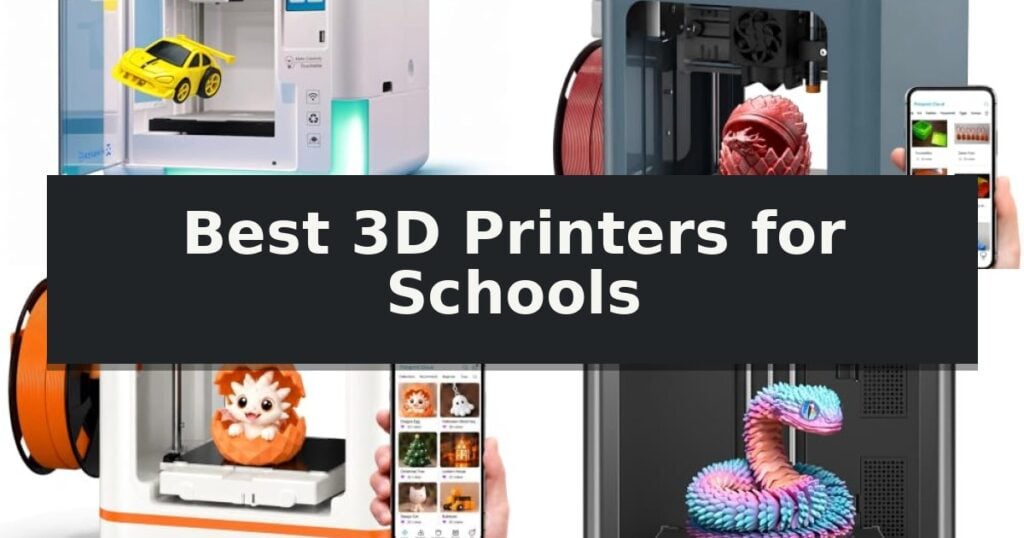
10 Best 3D Printers for Schools in 2026 Reviews
Quick Comparison
| Product | Best For | Key Strength | Score |
|---|---|---|---|
| AOSEED X-MAKER AI+ 3D Printer | Best Overall | Fully enclosed safety design protects students from hot and moving parts. | 4.9 |
| Entina Tina2 Plus 3D Printer | Fast Printing for School Projects | Fully assembled out of the box for immediate use. | 4.8 |
| Entina Tina2C 3D Printer | Compact Pick for Tight Spaces | 5-minute setup with factory presets and pre-assembly. | 4.4 |
| FLASHFORGE Adventurer 5M 3D Printer | High-Speed CoreXY Performance | One-Click Automatic Printing removes the need for manual bed leveling. | 4.3 |
| Flashforge Adventurer 5M 3D Printer for Beginners | Reliable Choice for Makerspaces | 600mm/s hyper-speed printing significantly reduces wait times for student projects. | 4.9 |
| Creality K2 Combo 3D Printer | Multicolor Printing for Creative Labs | Multicolor printing capability with support for up to 16 colors. | 4.5 |
| HEPHI3D TINA2C 3D Printer | Easiest to Maintain for Beginners | Fully assembled and factory-preset for immediate use. | 4.9 |
| XZN Mini M1S 3D Printer | Complete Starter Kit for Students | Fully assembled and ready for immediate use out of the box. | 4.7 |
| Magic Jimmy 3D Printer | AI-Powered Learning Tool | Fully enclosed design ensures safety by isolating hot components. | 4.4 |
| HEPHI3D TINA2 Plus 3D Printer | Fast Setup for STEM Education | Fully assembled design allows for immediate classroom deployment. | 4.7 |
How We Chose
When selecting the best 3D printers for schools, we focus on machines that prioritize safety and reliability. An experienced reviewer evaluates these units based on their ability to withstand frequent use, the simplicity of their interface for students of varying skill levels, and the inclusion of features that reduce manual calibration and maintenance.
- Safety and Enclosure: Evaluating the presence of fully or partially enclosed frames to protect students from hot components and moving parts.
- Ease of Setup and Operation: Assessing the out-of-the-box experience, including pre-assembly status, auto-leveling capabilities, and intuitive software interfaces.
- Print Speed and Efficiency: Comparing travel speeds and acceleration metrics to ensure projects are completed within standard class periods.
- Educational Ecosystem: Reviewing the availability of curated model libraries, STEM-focused design tools, and app-based management systems.
- Maintenance Requirements: Examining the ease of nozzle replacement, build plate accessibility, and overall mechanical reliability for shared-use environments.
1 AOSEED X-MAKER AI+ 3D Printer — Safe Enclosed Design for Classrooms
Introducing 3D printing into a classroom requires equipment that prioritizes safety and ease of use without sacrificing technical capability. The AOSEED X-MAKER AI+ 3D Printer stands out by utilizing a fully enclosed design that keeps moving parts and hot components safely away from students, making it a reliable choice for educational environments.
Designed for rapid iteration, this printer achieves print speeds up to 400mm/s, allowing small projects to be completed in as little as 20 minutes. This speed helps maintain student engagement during short class periods. The unit is leveling-free and ready to use out of the box, removing the technical barriers often associated with manual calibration.
The printer integrates advanced software tools, including an AI assistant and specialized modules like AI Doodle, which allows students to generate 3D models from voice, text, or images. With a curated digital catalog of 12,000+ models and creator courses, it provides a comprehensive platform for STEM learning for students aged 9–16.
Operating at under 50 dB, the device is quiet enough to function in a classroom or shared study space without causing noise disruption. It features one-touch nozzle replacement and a magnetic build plate for easy maintenance, ensuring that teachers can focus on instruction rather than troubleshooting hardware.
Best for: Educational settings and home STEM learning where safety, ease of use, and rapid model creation are the primary requirements.
Skip if: Users who require a large-format build volume for industrial-sized prototypes or those who prefer open-frame printers for manual hardware customization.
- Fully enclosed safety design protects students from hot and moving parts.
- High-speed printing (up to 400mm/s) reduces wait times for classroom projects.
- AI-integrated software simplifies the model creation process for younger students.
- Leveling-free operation ensures the printer is ready to use without complex setup.
- Enclosed footprint may limit the maximum size of print projects compared to open-frame alternatives.
2 Entina Tina2 Plus 3D Printer — Fast Printing for School Projects
Integrating additive manufacturing into a classroom environment requires equipment that prioritizes safety and ease of use. The Entina Tina2 Plus 3D Printer distinguishes itself by arriving fully assembled, allowing educators to begin projects immediately without the need for complex calibration or setup.
Designed for high-speed output, this printer achieves speeds up to 250mm/s, which is essential for maintaining momentum during school projects. The inclusion of a 40-second fast-heat ceramic hotend further reduces downtime, ensuring that students spend more time creating and less time waiting for the machine to reach operating temperature.
The printer features a partially enclosed frame that enhances safety by shielding high-temperature components from direct contact, making it a suitable choice for supervised classroom settings. Its compact footprint ensures it fits comfortably on standard school desks while still offering a practical build volume for DIY models and STEM learning.
Connectivity is streamlined through WiFi and app control via the Poloprint Cloud, providing access to a library of over 3,500 printable models. For added reliability, the system incorporates auto-leveling and a dual Z-axis structure, which work together to improve print consistency and reduce the likelihood of failed projects during student use.
Best for: Educators and students seeking a compact, pre-assembled 3D printer for STEM projects that requires minimal setup.
Skip if: Users who require a large-format build volume for industrial-sized prototypes or those who prefer a fully open-frame design for specific mechanical modifications.
- Fully assembled out of the box for immediate use.
- Fast 250mm/s printing capability for efficient project turnaround.
- Partially enclosed frame enhances safety for classroom environments.
- WiFi and app-based control simplifies access to a large model library.
- Compact build volume may limit the size of larger educational projects.
- Partially enclosed design may restrict access for complex manual maintenance compared to fully open printers.
3 Entina Tina2C 3D Printer — Compact Pick for Tight Spaces
Introducing 3D printing into a classroom environment requires equipment that prioritizes simplicity and safety, and the Entina Tina2C 3D Printer is engineered specifically for these needs. This fully assembled, plug-and-play unit allows students and educators to begin their first print in as little as 5 minutes, removing the technical barriers often associated with complex assembly or manual calibration.
The printer features automatic bed leveling, which is a critical advantage for school settings as it ensures consistent first-layer adhesion without requiring students to perform manual adjustments. To further support a seamless learning experience, the device includes power-loss recovery, allowing prints to resume after unexpected interruptions, and a flexible magnetic build plate that simplifies the removal of finished projects with a gentle bend.
Connectivity and ease of use are central to its design, utilizing the Poloprint Cloud app to provide access to over 3500 ready-to-print models and 25+ DIY projects. This ecosystem allows students to explore STEM concepts through AI-powered tools like text-to-3D and photo-to-3D, even without prior modeling experience. The unit also supports traditional workflows via Cura and Simplify3D compatibility for more advanced users.
Designed for quiet operation, the Entina Tina2C 3D Printer fits easily into learning spaces with its compact footprint and built-in LED lighting. While the 3.9 x 3.9 x 3.9-inch build volume is modest, it is well-suited for small-scale creative projects and hands-on classroom activities where space is at a premium.
Best for: This printer is best for classrooms and home learning environments that require a compact, easy-to-use, and fully assembled device for introducing students to STEM and 3D printing.
Skip if: Skip this model if you require a large build volume for printing substantial prototypes or architectural models, as the 3.9-inch cubic capacity is limited to smaller projects.
- 5-minute setup with factory presets and pre-assembly.
- Automatic bed leveling for consistent print quality.
- Poloprint Cloud app provides access to thousands of ready-to-print models.
- Quiet operation suitable for classroom and desktop environments.
- Flexible magnetic build plate for easy print removal.
- Limited build volume of 3.9 x 3.9 x 3.9 inches restricts the size of projects.
- Small form factor may not be suitable for advanced engineering or large-scale modeling tasks.
4 FLASHFORGE Adventurer 5M 3D Printer — High-Speed CoreXY Performance
The FLASHFORGE Adventurer 5M 3D Printer streamlines classroom workflows through its One-Click Automatic Printing system, which eliminates manual bed leveling to ensure consistent, reliable first-layer adhesion for every project. Designed for high-paced educational environments, this machine leverages a CoreXY all-metal structure to achieve travel speeds of up to 600mm/s, significantly reducing wait times during rapid prototyping sessions.
Efficiency is further enhanced by the printer's 3S detachable nozzle system, allowing for rapid 3-second swaps to accommodate different project requirements. The unit features a high-flow 32mm³/s nozzle and reaches a 200°C operating temperature in just 35 seconds, minimizing downtime between student assignments. Its 280°C direct drive extruder provides the thermal capacity necessary to handle a variety of standard filament types.
For classroom management and remote oversight, the FLASHFORGE Adventurer 5M 3D Printer integrates with the Flash Studio app. This allows educators to monitor print progress, adjust settings, and receive status alerts from a mobile device, facilitating a more seamless and interactive learning experience. The inclusion of a dual-sided PEI platform ensures that finished prints are easy to remove, reducing the physical effort required by students.
The printer balances high-speed performance with precision, utilizing vibration compensation to maintain print quality even at maximum acceleration. With a build volume of 220x220x220mm, it offers sufficient space for most school-based creative projects while maintaining a manageable footprint for shared laboratory or classroom spaces.
Best for: Educational settings requiring high-speed, reliable printing with minimal manual setup for students and teachers.
Skip if: Users who require a larger build volume than 220x220x220mm or those who prefer a fully enclosed printing chamber for advanced material compatibility.
- One-Click Automatic Printing removes the need for manual bed leveling.
- CoreXY structure supports high-speed printing up to 600mm/s.
- 3S detachable nozzle allows for quick maintenance and nozzle size changes.
- Real-Time App Monitoring enables remote oversight of classroom projects.
- Open-frame design may not be suitable for all specialized high-temperature filaments.
- Standard 0.4mm nozzle requires additional purchases for specialized 0.25mm or 0.8mm applications.
5 Flashforge Adventurer 5M 3D Printer for Beginners — Reliable Choice for Makerspaces
The Flashforge Adventurer 5M 3D Printer for Beginners distinguishes itself through a high-speed Klipper engine capable of reaching 600mm/s print speeds with 20,000mm/s² acceleration. This performance is supported by a 50W ceramic heater that reaches 200°C in just 35 seconds, making it a viable tool for classrooms where rapid prototyping and quick iteration are essential.
Built with an industrial-grade CoreXY frame and dual linear rails, the unit is engineered to reduce resonance by 63% compared to standard bed-slingers. This structural rigidity allows for ±0.1 mm dimensional accuracy, ensuring that functional parts and engineering prototypes meet consistent standards during continuous operation.
Usability in a school environment is enhanced by auto-bed leveling with 25-point detection and pressure-sensor compensation. The MagSwitch PEI build plate allows for removal in three seconds, while the Nozzle X quick-change system enables nozzle swaps in under 15 seconds, minimizing downtime between different student projects.
The printer offers a flexible ecosystem for educational settings. It includes a built-in filament sensor and remote monitoring via the Flashforge App. Users can also transition from the base unit to a fully enclosed system by utilizing provided designs to print panels, allowing for a temperature-controlled environment as curriculum needs evolve.
Best for: Educational makerspaces and classrooms requiring fast, reliable prototyping with minimal maintenance downtime.
Skip if: Users who require a pre-assembled, fully enclosed unit out of the box without the need for DIY panel installation.
- 600mm/s hyper-speed printing significantly reduces wait times for student projects.
- Industrial-grade CoreXY frame provides high dimensional accuracy and stability.
- Nozzle X quick-change system allows for rapid nozzle swaps in under 15 seconds.
- Auto-bed leveling with 25-point detection ensures consistent first-layer adhesion.
- Requires DIY assembly of panels if a fully enclosed environment is desired.
6 Creality K2 Combo 3D Printer — Multicolor Printing for Creative Labs
The Creality K2 Combo 3D Printer introduces a high-speed, multicolor printing solution for educational environments, featuring a 600mm/s printing speed and a CFS (Color Filament System) that supports up to 16 colors when multiple units are linked. Designed for immediate classroom integration, this system arrives 95% pre-assembled, allowing for a near plug-and-play experience once the screen is installed.
Engineered for precision and consistency, the printer utilizes 3 step-servo motors on the extruder and X/Y axes. These motors dynamically adjust torque in under a millisecond, which supports high-speed output without sacrificing accuracy. The 260 x 260 x 260 mm build volume provides sufficient space for a wide range of student projects, while the next-gen direct drive extruder ensures compatibility with diverse materials including PLA, PETG, ABS, and carbon-fiber-reinforced filaments.
Classroom usability is enhanced by Smart Auto Leveling, which probes only the specific area required for the print to save time. Integrated AI camera monitoring provides real-time oversight to detect common issues like spaghetti failures or idling, helping to reduce wasted material during long print jobs. To maintain a productive learning environment, the machine operates with ultra-quiet printing modes, utilizing dynamically balanced fans and silent motor technology to keep noise levels comparable to a laptop keyboard.
The Creality K2 Combo 3D Printer balances advanced automation with a robust design, making it a versatile tool for technical labs. By automating leveling and offering multi-material capabilities, it reduces the maintenance burden on instructors while providing students with access to complex, professional-grade additive manufacturing workflows.
Best for: Educational labs and classrooms requiring high-speed, multicolor printing capabilities with minimal setup time.
Skip if: Users who require a significantly larger build volume or those who do not have a need for multicolor printing functionality.
- Multicolor printing capability with support for up to 16 colors.
- 600mm/s high-speed printing for rapid project completion.
- 95% pre-assembled design for quick out-of-the-box setup.
- AI-integrated camera for real-time print monitoring and failure detection.
- Requires additional CFS units to reach the maximum 16-color capacity.
- Fixed build volume of 260mm may limit larger-scale project requirements.
7 HEPHI3D TINA2C 3D Printer — Easiest to Maintain for Beginners
Introducing the HEPHI3D TINA2C 3D Printer, a compact device designed to get users printing in as little as five minutes right out of the box. This unit arrives fully assembled and factory-preset, removing the complex setup hurdles often associated with entry-level additive manufacturing equipment.
The printer prioritizes accessibility through auto-leveling technology and one-tap printing capabilities. Users can access a library of over 3,500 ready-to-print models via a dedicated app, which also supports AIGC and photo generation to convert ideas into 3D objects. For those interested in STEM education, the platform includes specific learning modules and over 25 customizable DIY design components.
Flexibility remains a core focus, as the machine is fully open-source and compatible with standard software like Cura or Wiibuilder. Connectivity options include Wi-Fi, USB-C, and TF card support, ensuring that users are not locked into a single ecosystem. The hardware features a 3s fast-release hotend and a resume-printing function to safeguard projects against power interruptions.
Designed for home and classroom environments, the printer operates with silent printing technology to minimize noise. It includes a comprehensive starter kit with PLA filament and essential tools, making it a practical choice for those beginning their journey into 3D design and fabrication.
Best for: Beginners and students seeking a plug-and-play 3D printing experience with integrated educational resources.
Skip if: Users who require a large build volume for industrial-scale projects or advanced professional-grade hardware.
- Fully assembled and factory-preset for immediate use.
- Auto-leveling functionality simplifies initial setup.
- Open-source compatibility allows for flexible software choices.
- Includes a comprehensive starter kit with filament and tools.
- Compact build volume may limit the size of printable projects.
8 XZN Mini M1S 3D Printer — Complete Starter Kit for Students
The XZN Mini M1S 3D Printer arrives fully assembled, allowing students and beginners to bypass complex setup steps and begin projects immediately. This compact unit is engineered for efficiency, featuring a high-speed printing capability of up to 250mm/s while maintaining 0.01mm precision for detailed educational models.
Designed with classroom usability in mind, the printer includes one-button auto-leveling to simplify maintenance and ensure consistent first-layer adhesion. The integration of a PEI heated bed facilitates easy removal of finished prints, while the automatic nozzle cleaning system helps maintain print quality across multiple sessions without manual intervention.
Operation is streamlined through features like one-touch filament loading, which reduces the technical barrier for younger users. The printer is fully open-source, offering flexibility for various learning environments. For those requiring larger spool capacities, the included SD card contains a pre-sliced file to print a compatible 1kg spool holder.
The XZN Mini M1S 3D Printer is a practical choice for schools seeking a reliable, low-maintenance entry point into additive manufacturing. Its compact footprint and out-of-the-box readiness make it well-suited for shared workspaces where space and setup time are limited.
Best for: Students and beginners in classroom settings who require a compact, pre-assembled printer with simplified maintenance features.
Skip if: Users who require a large build volume or advanced industrial-grade features beyond the capabilities of a mini-format printer.
- Fully assembled and ready for immediate use out of the box.
- High-speed printing up to 250mm/s with professional-grade precision.
- Simplified maintenance via one-button auto-leveling and automatic nozzle cleaning.
- User-friendly operation with one-touch filament loading.
- Small build size requiring a printed adapter for standard 1kg filament spools.
- Compact footprint limits the scale of projects compared to larger industrial printers.
9 Magic Jimmy 3D Printer — AI-Powered Learning Tool
Integrating 3D printing into the classroom requires hardware that balances safety with intuitive operation, and the Magic Jimmy 3D Printer addresses this by offering a fully enclosed, child-safe design. By keeping all hot components and moving parts behind a secure barrier, this unit allows students to observe the printing process through a transparent chamber without direct exposure to high-temperature elements.
The printer is designed for immediate classroom deployment, arriving fully assembled and ready for use without requiring tools or manual setup. Once connected to WiFi, users can access a library of over 12,000 toy models and STEM projects. For more advanced creative tasks, the printer features AI-powered design tools such as AI Craft, which converts sketches or text into 3D models, and AI MiniMe, which transforms photos into printable figurines.
Performance is optimized for educational environments, with print speeds reaching up to 400mm/s. A built-in camera allows students to monitor progress and automatically records time-lapse videos of their creations, providing a visual record of the design-to-print workflow. The system utilizes a magnetic build plate to simplify the removal of finished prints, reducing the risk of damage or injury during the retrieval process.
Designed to foster spatial reasoning and creative problem-solving, the Magic Jimmy 3D Printer is built specifically for educational engagement. It relies exclusively on non-toxic PLA filament, ensuring a safer environment for indoor use. With new models added to the library weekly, the system provides a scalable resource for ongoing STEM projects and independent student exploration.
Best for: Classrooms and home learning environments seeking a safe, AI-integrated 3D printing solution that is ready to use out of the box.
Skip if: Users who require a large build volume or the ability to print with advanced, high-temperature engineering filaments will find this compact, PLA-only system too restrictive.
- Fully enclosed design ensures safety by isolating hot components.
- AI-powered software enables students to generate custom models from sketches or photos.
- Fast print speeds up to 400mm/s minimize wait times for student projects.
- Ready-to-use out of the box with no assembly required.
- PLA-only filament compatibility limits the variety of materials available for advanced projects.
- Compact build size may restrict the scale of larger 3D printing assignments.
10 HEPHI3D TINA2 Plus 3D Printer — Fast Setup for STEM Education
Integrating 3D printing into a classroom environment requires equipment that prioritizes ease of use and rapid deployment. The HEPHI3D TINA2 Plus 3D Printer is designed for this specific need, arriving fully assembled and ready to operate within five minutes of unboxing. This out-of-the-box functionality eliminates the complex calibration often associated with entry-level hardware, making it a practical choice for educators who need to focus on lesson plans rather than machine maintenance.
Performance is driven by a focus on efficiency, featuring a 250mm/s high-speed printing capability that significantly reduces wait times for student projects. To maintain print quality at these speeds, the unit incorporates a 10,000rpm high-speed fan for rapid cooling and a 3s quick-release hotend. These technical specifications ensure that models cool quickly, minimizing the risk of deformation during the printing process.
Connectivity and accessibility are central to its design, utilizing the Poloprint Cloud app for smart wireless printing. This allows students or teachers to slice models and upload files directly from tablets or phones. For more advanced STEM applications, the printer remains fully open source and maintains compatibility with standard software like Cura, PrusaSlicer, and Kiri, providing a bridge between simple one-tap printing and more complex CAD workflows.
The physical footprint is optimized for crowded classroom desks, featuring a compact design that maximizes workspace without sacrificing core features. The inclusion of an 80℃ max adjustable heat bed and a 40-second fast-heating filament system ensures the machine is ready for immediate use, while the two-year warranty on main parts provides long-term support for institutional investments.
Best for: Educators and students seeking a compact, fully assembled 3D printer that supports both simple wireless app-based printing and advanced open-source software workflows.
Skip if: Users requiring a large build volume for industrial-scale prototypes or those who need a machine capable of handling specialized, high-temperature engineering filaments.
- Fully assembled design allows for immediate classroom deployment.
- 250mm/s high-speed printing reduces project turnaround time by up to 75%.
- Wireless app control via Poloprint Cloud simplifies the printing workflow for students.
- Open-source compatibility supports diverse educational software like Cura and PrusaSlicer.
- Compact build volume limits the size of individual projects.
- High-speed cooling requirements may necessitate careful monitoring of complex geometries.
Best 3D Printers for Schools Buying Guide
Prioritizing Safety in the Classroom
Safety is the primary concern when introducing 3D printing to a school environment. Enclosed printers are highly recommended as they prevent students from accidentally touching the hot nozzle or moving mechanical parts during the printing process.
Beyond physical barriers, consider the materials used. Using non-toxic PLA filament is standard practice in schools, as it is safer to handle and produces fewer fumes compared to other industrial-grade plastics.
The Importance of Auto-Leveling
Manual bed leveling is a common source of frustration and print failure for beginners. Printers equipped with automatic bed leveling sensors significantly reduce the time required to prepare the machine for a new print.
In a classroom setting, this feature ensures that students can focus on their designs rather than spending valuable learning time troubleshooting the first layer of their prints.
Software and Connectivity
Modern educational 3D printers often include dedicated apps or cloud-based platforms that simplify the slicing and printing workflow. These tools allow students to send files wirelessly, which is essential for managing multiple users in a single classroom.
Look for systems that offer a library of pre-tested models. This allows younger students to start with successful prints immediately, building confidence before they move on to designing their own custom projects.
Speed and Project Turnaround
Classroom time is limited, so print speed is a critical factor. High-speed printers can finish small models in under 30 minutes, allowing multiple students to use the same machine during a single lesson.
While speed is important, it must be balanced with print quality. Ensure the printer maintains dimensional accuracy at higher speeds so that functional parts or intricate models remain usable for educational purposes.
Maintenance and Reliability
School printers will see heavy use, making mechanical reliability paramount. Features like quick-swap nozzles and magnetic, flexible build plates make it easy for teachers to perform routine maintenance without specialized tools.
Consider the long-term support and warranty provided by the manufacturer. A printer that is easy to service locally or has a responsive support team will remain a viable educational asset for much longer.
Frequently Asked Questions
Are enclosed 3D printers safer for younger students?
Yes, enclosed printers physically isolate the hot nozzle and moving parts, which is a critical safety feature for elementary and middle school classrooms.
Do I need to teach students how to design 3D models from scratch?
Not necessarily. Many printers for schools come with apps that offer AI-assisted design tools or large libraries of pre-made models, allowing students to learn the basics of 3D printing before diving into complex CAD software.
How often do school 3D printers require maintenance?
Routine maintenance, such as cleaning the build plate and checking for nozzle clogs, should be performed periodically. Printers with quick-swap nozzles and auto-leveling significantly reduce the frequency and difficulty of these tasks.
Can these printers use different types of filament?
Most school-focused printers are optimized for PLA, which is the safest and easiest material to use. Some models support more advanced materials, but these often require specific ventilation or temperature controls.
What is the benefit of a magnetic, flexible build plate?
A magnetic, flexible build plate allows students to remove finished prints by simply bending the sheet, which is much safer and easier than using metal scrapers on a fixed bed.
Conclusion: Our Top Pick
Our top pick is AOSEED X-MAKER AI+ 3D Printer. Choosing the right 3D printer for a school depends on the age of the students and the specific goals of the curriculum. For younger learners, prioritize safety-focused, enclosed models with intuitive app integration that encourages creative exploration.
For older students or engineering-focused labs, look for machines that offer higher speeds and more robust mechanical structures. Regardless of the choice, selecting a printer with reliable auto-leveling and easy maintenance will ensure the technology remains a productive tool in the classroom.