HP 14 Laptop is our pick for the Best 8GB RAM Laptops for Students because it balances a compact, portable form factor with the reliable processing power needed for daily academic tasks.
For students prioritizing screen real estate, the NIAKUN 15.6 Windows Laptop offers a larger display for multitasking, while the HP 14 Student Laptop serves as a highly portable alternative for those frequently moving between lecture halls and libraries.
Selecting a laptop for school requires balancing memory capacity with portability and battery longevity. While 8GB of RAM provides a stable baseline for multitasking across browser tabs and office applications, students should also consider how display size and physical weight impact their daily commute to campus.
When choosing the right form factor for your studies, you may want to explore our guide on the Best 14-Inch Laptops for College Students to see how different screen sizes impact portability. If you are specifically looking for a larger workspace, our breakdown of the Best 15.6-Inch Laptops for Students provides further insight into balancing screen real estate with daily mobility.
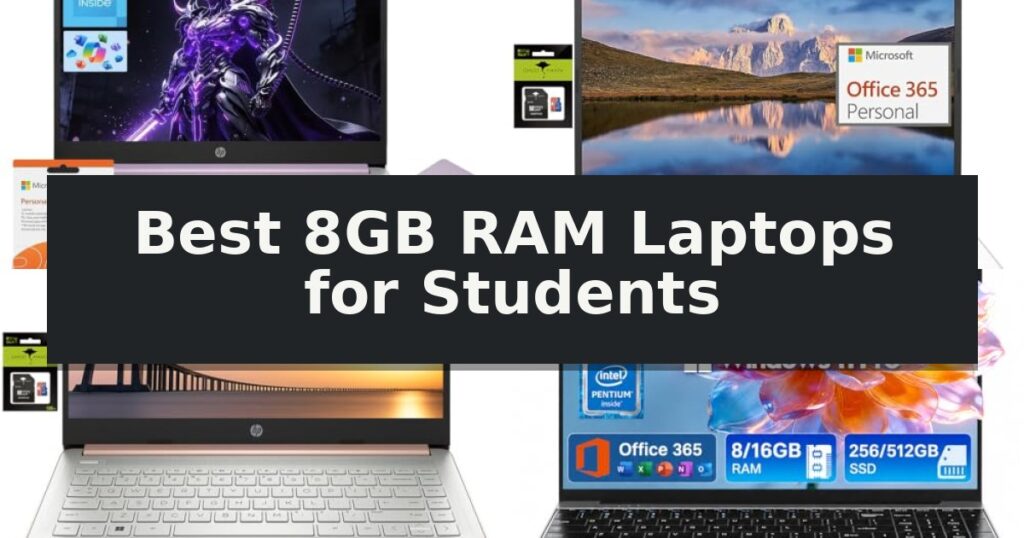
10 Best 8GB RAM Laptops for Students in 2026 Reviews
Quick Comparison
| Product | Best For | Key Strength | Score |
|---|---|---|---|
| HP 14 Laptop | Best Overall | Includes 1-year Office 365 subscription for immediate productivity. | 4.9 |
| HP 14 Student Laptop | Ultra-Portable for Campus Life | Ultra-portable and lightweight design for easy campus transport. | 4.7 |
| HP 14 Stream Laptop | Lightweight Build for Easy Carrying | 8GB of high-bandwidth RAM for smooth multitasking. | 4.3 |
| NIAKUN 15.6 Windows Laptop | Flexible Hinge for Group Projects | 180-degree hinge facilitates easy content sharing in group settings. | 4.8 |
| Acer 15.6 Touch Chromebook | Responsive Screen for Interactive Learning | Responsive touchscreen display for interactive navigation. | 4.7 |
| HP 15.6 FHD Laptop | Reliable Performance for Research Papers | Lightweight 3.64 lb design for easy portability. | 4.6 |
| HYYUO 15.6 Laptop | Privacy Features for Secure Studying | 15.6-inch FHD IPS display provides clear, wide-angle visuals. | 4.4 |
| HP 17 FHD Laptop | Expansive Display for Multitasking | Expansive 17.3-inch FHD IPS display with wide viewing angles. | 4.6 |
| HP 14 Ultralight Laptop | Budget-Friendly for Remote Classes | Ultra-lightweight design for easy transport between classes. | 4.6 |
| HP 14 Ultrabook Laptop | Stylish Finish for Modern Students | Lightweight 3.11 lb design for easy portability. | 4.6 |
How We Chose
When evaluating the best 8GB RAM laptops for students, we focus on practical performance metrics that directly influence daily academic workflows. An experienced reviewer assesses how these machines handle multitasking, their physical footprint in a backpack, and the reliability of their connectivity for modern classroom environments.
- Processor efficiency for handling academic software and web-based research tools.
- Physical portability, including weight and dimensions, for campus mobility.
- Display quality and screen size relative to document editing and study needs.
- Connectivity options such as USB-C, HDMI, and wireless standards for peripherals.
- Storage type and capacity for managing course materials and local files.
1 HP 14 Laptop — Compact Design for Daily Studies
The HP 14 Laptop is a purpose-built computing tool designed to handle the daily requirements of academic life through a familiar and reliable notebook format. By integrating an Intel Processor N150, this machine provides the necessary processing power for standard research, document drafting, and web-based study sessions, ensuring students have a stable platform for their coursework.
Portability remains a central design priority for this model, which features a manageable footprint measuring 21 by 14 by 3 inches. This compact size allows it to fit easily into crowded dorm desks or backpacks, making it a practical choice for students who move between classrooms and study spaces. The inclusion of 8GB of RAM supports efficient multitasking, allowing users to keep multiple educational applications and browser tabs open simultaneously without significant slowdowns.
To enhance digital productivity, the device comes with a 1-year subscription to Office 365 and built-in Copilot AI, providing immediate access to essential word processing and organizational tools. Connectivity is handled by WiFi 6, which offers the stable network performance required for participating in online lectures or collaborating on cloud-based group projects. These features collectively ensure that the laptop remains relevant for modern, connected learning environments.
Operating on Windows 11, the laptop provides a current, intuitive interface for managing files and digital media throughout the academic year. The unique Honey Lavender finish adds a distinct aesthetic touch, differentiating it from standard office-grade hardware. While it is optimized for everyday computing, users should note that the 128GB UFS storage capacity is best suited for documents and light media, potentially requiring external storage solutions for larger file collections.
Best for: Students requiring a dedicated, portable laptop for everyday academic tasks, research, and document management.
Skip if: Users who require high-performance hardware for intensive video editing, 3D rendering, or demanding gaming applications.
- Includes 1-year Office 365 subscription for immediate productivity.
- Equipped with WiFi 6 for stable and fast network connectivity.
- Features Copilot AI integration to assist with study tasks.
- Compact 14-inch form factor suitable for student workspaces.
- Limited 128GB UFS storage capacity may require external drives for large files.
- Processor is optimized for everyday computing rather than heavy-duty tasks.
2 HP 14 Student Laptop — Ultra-Portable for Campus Life
Balancing academic demands with a tight budget requires hardware that prioritizes efficiency and portability. The HP 14 Student Laptop addresses these needs by integrating an Intel Celeron processor designed for reliable daily tasks, such as document editing, web research, and video streaming. Its compact footprint and lightweight build make it a practical companion for transitioning between lecture halls and study spaces.
The device features a 14-inch HD display with a micro-edge bezel, which maximizes the screen-to-body ratio for a more immersive viewing experience during online classes. To support multitasking, the system is equipped with 8GB of high-bandwidth DDR4 memory, allowing for smoother navigation across multiple browser tabs and productivity applications. The storage configuration includes 64GB of eMMC storage supplemented by a 128GB Ghost Manta SD card, providing a functional balance for essential files.
Connectivity is streamlined through a variety of ports, including a USB 3.1 Type-C port, two USB 3.1 Type-A ports, an HDMI output, and a dedicated microSD slot. This selection ensures compatibility with common peripherals and external displays without requiring additional adapters. The laptop also comes with a one-year subscription to Office 365, providing immediate access to standard productivity software.
Designed for the mobile student, the HP 14 Student Laptop maintains a slim profile that fits easily into standard backpacks. While it is optimized for everyday academic and remote work tasks, the inclusion of Windows 11 S mode focuses on security and performance. This machine serves as a versatile, entry-level solution for students seeking a straightforward, reliable tool for their educational journey.
Best for: Students and remote workers who need a lightweight, portable device for essential productivity tasks like web research and document editing.
Skip if: Users who require high-performance processing for video editing, heavy gaming, or professional-grade software development will find the Intel Celeron processor insufficient.
- Ultra-portable and lightweight design for easy campus transport.
- 8GB of high-bandwidth RAM to support multitasking across browser tabs.
- Versatile port selection including USB Type-C and HDMI.
- Micro-edge display provides a maximized viewing area in a compact frame.
- Limited internal storage capacity, relying on eMMC and an SD card.
- Entry-level processor performance is restricted to basic productivity and streaming.
3 HP 14 Stream Laptop — Lightweight Build for Easy Carrying
Balancing academic workloads and daily tasks requires a reliable machine that handles essential applications without unnecessary bulk. The HP 14" Laptop Stream Ultral Light for Students and Business is designed for portability, weighing approximately 5.07 pounds and featuring a slim 0.71-inch profile, making it a practical choice for students moving between classrooms or study spaces.
Performance is driven by the Intel Celeron N4120 processor, which utilizes four cores and four threads to manage multitasking. This is supported by 8GB of high-bandwidth DDR4 memory, providing the capacity needed to keep multiple browser tabs and office applications running simultaneously. The 14-inch HD BrightView display features a micro-edge design, which minimizes bezels to provide a cleaner viewing area for research and document editing.
Connectivity is well-integrated for a student environment, offering a variety of ports including USB 3.1 Type-C, two USB 3.1 Type-A ports, and an HDMI output for external displays. Storage is handled by a 128GB eMMC drive, supplemented by an included 128GB Ghost Manta SD card to expand capacity for coursework and media files.
The device ships with Windows 11 Home in S mode, which prioritizes security and performance for standard student tasks. Users retain the flexibility to switch out of S mode if they require specific software not available in the Microsoft Store, ensuring the laptop can adapt as academic requirements evolve.
Best for: Students who need a lightweight, portable laptop for word processing, web research, and light multitasking.
Skip if: Users who require high-performance hardware for video editing, heavy gaming, or professional-grade software development.
- 8GB of high-bandwidth RAM for smooth multitasking.
- Ultra-lightweight and thin design for easy transport.
- Versatile port selection including USB-C and HDMI.
- Expandable storage via the included 128GB SD card.
- Limited internal storage capacity requiring reliance on the included SD card.
- Entry-level processor not intended for intensive computing tasks.
4 NIAKUN 15.6 Windows Laptop — Flexible Hinge for Group Projects
The NIAKUN 15.6 Windows Laptop distinguishes itself with a versatile 180-degree hinge design, allowing the screen to lay completely flat for collaborative work or group study sessions. This feature, combined with an integrated webcam and microphone, makes it a practical tool for students who frequently engage in team projects or video-based learning.
Engineered for daily academic and professional tasks, the device is powered by an Intel Pentium processor and 8GB of RAM. This configuration is intended to provide efficient multitasking for common applications, web browsing, and office productivity software. Users benefit from the inclusion of Windows 11 Pro and Office 365, which are pre-installed to support immediate use without additional setup.
Portability is a central focus of the design, with the chassis measuring 0.8 inches in thickness and weighing 3.53 lbs. The 15.6-inch IPS display offers a 1920×1080 resolution, providing a wide viewing angle for streaming or reviewing documents. Connectivity options include two USB 3.0 ports, a Mini HDMI port, and a Micro TF card slot for expandable storage.
To support mobility, the laptop features a 5000mAh battery rated for up to 6 hours of mixed use. The manufacturer provides a 2-year warranty and a 6-month return policy, alongside 24/7 online support, offering a structured safety net for students managing their hardware needs throughout the academic year.
Best for: Students and professionals who require a portable, ready-to-use device for collaborative work and general office productivity.
Skip if: Users who need high-performance hardware for intensive tasks like video editing, 3D rendering, or heavy gaming will find the Intel Pentium processor limiting.
- 180-degree hinge facilitates easy content sharing in group settings.
- Pre-installed Windows 11 Pro and Office 365 allow for immediate productivity.
- Lightweight and thin profile enhances portability for students on the move.
- Comprehensive support package including a 2-year warranty and 24/7 assistance.
- 6-hour battery life may require access to power outlets during long school days.
- Intel Pentium processor is optimized for basic tasks rather than demanding computational workloads.
5 Acer 15.6 Touch Chromebook — Responsive Screen for Interactive Learning
The Acer 15.6” FHD Touch Chromebook serves as a versatile tool for students, centered around a 15.6-inch Full HD anti-glare touchscreen display. This high-resolution interface allows for intuitive navigation through digital coursework and research, providing clear visuals for document editing and academic reading. By integrating an Intel Processor N50 capable of reaching speeds up to 3.4 GHz, the laptop is engineered to handle standard educational applications and browser-based tasks with consistent responsiveness.
Performance is bolstered by 8GB of DDR5 RAM, which facilitates efficient multitasking across multiple browser tabs and educational platforms. This memory standard is a significant upgrade for students who frequently switch between research materials, video lectures, and writing assignments. While the 128GB eMMC storage provides a baseline for essential file management, the Chrome OS environment is optimized for cloud-based workflows, ensuring that students can maintain a secure and streamlined study routine without relying heavily on massive local storage.
Connectivity remains a core strength of this device, featuring a comprehensive suite of ports including two USB-C 3.2 Gen1 ports, two USB-A 3.2 Gen1 ports, and an HDMI output. This hardware selection eliminates the need for cumbersome adapters when connecting to external monitors, projectors, or various peripherals during presentations. The inclusion of these ports ensures that the laptop remains a practical hub for diverse academic environments, from library study sessions to classroom project demonstrations.
Designed with portability in mind, the unit measures 0.73 inches in height and weighs approximately 3.68 pounds, making it a manageable choice for students moving between campus locations. The device is backed by a 1-year limited warranty, offering a foundational level of support. A notable trade-off for this portable, cloud-centric design is the reliance on Chrome OS, which limits the installation of traditional desktop software, requiring users to verify that their specific academic software is compatible with web-based applications.
Best for: Students who prioritize a responsive touchscreen interface and versatile port connectivity for research and presentations.
Skip if: Users who require a high-capacity local storage drive for large media files or specialized software not compatible with Chrome OS.
- Responsive touchscreen display for interactive navigation.
- DDR5 RAM provides efficient multitasking capabilities.
- Versatile connectivity with multiple USB-C and USB-A ports.
- Full HD resolution enhances clarity for reading and document editing.
- Limited 128GB eMMC storage may require cloud-based file management.
- Chrome OS restricts the installation of traditional desktop software.
6 HP 15.6 FHD Laptop — Reliable Performance for Research Papers
Navigating a heavy course load requires hardware that balances responsiveness with portability, and the HP 15.6 FHD Laptop 2026 Edition is engineered specifically to meet these academic demands. At its core, the Intel N100 processor paired with 8GB of RAM provides the necessary overhead to manage multiple browser tabs, research databases, and web-based productivity suites simultaneously without significant friction.
Designed for the mobile student, this device weighs only 3.64 lbs, making it a practical choice for transit between campus locations or coffee shops. The 15.6-inch anti-glare display is a key feature for long study sessions, as it is specifically engineered to minimize eye strain. Its slim profile ensures it fits easily into standard backpacks, while the full-size keyboard with a numeric keypad offers a familiar, efficient layout for students frequently handling spreadsheets or data entry.
Connectivity and storage are optimized for modern academic workflows. The integration of WiFi 6 technology ensures the stable bandwidth required for consistent video conferencing and online coursework. Furthermore, the 256GB internal SSD facilitates rapid boot times and quick application loading, ensuring the system is ready for immediate use. The laptop comes pre-installed with Windows 11 Home and includes lifetime access to Office for the web, providing a comprehensive, out-of-the-box solution for document creation and research.
While this model excels in web-based productivity, users should consider the trade-offs inherent in its configuration. The 256GB SSD provides sufficient space for documents and schoolwork, but it may become a limitation for those who maintain extensive local media libraries. Additionally, the 90-day limited warranty is shorter than the standard coverage offered on many new consumer electronics, which is a factor to weigh when considering long-term hardware support.
Best for: Students and home office users requiring a lightweight, reliable device for web-based research, document creation, and video conferencing.
Skip if: Users who require high-performance hardware for intensive tasks like video editing, 3D rendering, or gaming will find the processor and storage capacity insufficient.
- Lightweight 3.64 lb design for easy portability.
- Intel N100 processor handles multitasking for web-based apps.
- 15.6-inch anti-glare display reduces eye fatigue.
- WiFi 6 connectivity ensures stable online performance.
- 256GB SSD may limit users with large local media libraries.
- 90-day limited warranty is shorter than many new-device standards.
7 HYYUO 15.6 Laptop — Privacy Features for Secure Studying
The HYYUO 15.6 Laptop is a practical choice for students and professionals who prioritize a balance between screen real estate and portability. Its 15.6-inch FHD IPS display delivers sharp visuals and wide viewing angles, which is essential for tasks like document editing and web research. By utilizing an IPS panel, the screen maintains color consistency even when viewed from off-center angles, a significant benefit during collaborative study sessions or group project reviews.
Performance is driven by a Pentium Gold 6500Y processor capable of reaching speeds up to 3.4GHz. This hardware, paired with 8GB of RAM and a 256GB SSD, provides the responsiveness needed for daily multitasking, such as running multiple browser tabs alongside productivity software. The inclusion of an SSD ensures faster boot times and quicker file access compared to traditional mechanical drives, which helps maintain efficiency during busy academic or work schedules.
Design considerations focus on both security and mobility. The device features a built-in privacy webcam cover, allowing users to physically block the camera lens when not in use. With a thickness of only 0.78 inches and a weight of 3.5 pounds, the laptop is engineered for easy transport between classrooms, offices, and home environments. This slim profile does not sacrifice connectivity, as the chassis includes dual Type-C ports and additional peripheral inputs, supporting a versatile workspace for external monitors and accessories.
While the hardware is well-suited for standard office and academic tasks, users should note the trade-offs inherent in this configuration. The 256GB SSD provides a solid foundation for documents and essential applications, though it may require external storage solutions for users with extensive media libraries. Similarly, the processor is optimized for daily productivity rather than high-end graphical rendering or intensive computational workloads, making this device a specialized tool for focused, everyday tasks.
Best for: Students and office workers who need a lightweight, portable device for multitasking and document-heavy tasks.
Skip if: Users who require high-end graphical processing power or extensive storage for large media libraries will find the 256GB SSD and processor limitations restrictive.
- 15.6-inch FHD IPS display provides clear, wide-angle visuals.
- 8GB RAM and 256GB SSD ensure smooth multitasking and responsive file access.
- Built-in privacy webcam cover enhances user security.
- Dual Type-C ports offer flexible connectivity for modern peripherals.
- Pentium Gold 6500Y processor is optimized for daily tasks rather than intensive computing.
- 256GB storage capacity may require external drives for large file collections.
8 HP 17 FHD Laptop — Expansive Display for Multitasking
The HP 17 FHD Laptop offers a substantial 17.3-inch display, providing an expansive workspace that is particularly useful for students managing multiple documents or research tabs simultaneously. This model is engineered to balance performance and utility, featuring an AMD Ryzen 5 7520U processor and 8GB of high-bandwidth RAM to facilitate smooth multitasking during academic sessions.
Equipped with a 256GB PCIe NVMe SSD, the system ensures rapid boot times and efficient file access. To address storage needs for large projects or media libraries, the package includes an additional 500GB external drive. The integration of Windows 11 Pro provides a secure environment, utilizing hardware-based isolation and encryption to protect student data.
Designed for versatility, the laptop includes a comprehensive bundle featuring a wireless mouse, earbuds, and essential cables, making it a ready-to-use solution for remote learning or classroom environments. The 178-degree wide-viewing angle IPS display ensures consistent image quality, while the built-in 720p HD camera and dual array microphones are optimized for video conferencing and online coursework.
While the large form factor provides a comfortable viewing experience, it is worth noting that the 17.3-inch chassis is designed primarily for stationary or semi-stationary use rather than high-mobility environments. The inclusion of a numeric keypad and a full suite of productivity accessories makes this a practical choice for students who prioritize screen real estate and out-of-the-box functionality.
Best for: Students who require a large, high-resolution display and extensive bundled accessories for home-based study and multitasking.
Skip if: Students who prioritize extreme portability and a lightweight form factor for frequent travel between classes.
- Expansive 17.3-inch FHD IPS display with wide viewing angles.
- Comprehensive accessory bundle including wireless peripherals and external storage.
- Fast PCIe NVMe SSD for efficient system performance.
- Windows 11 Pro security features for data protection.
- Large 17.3-inch form factor may be less convenient for students needing high portability.
- Stationary-focused design limits use in tight or mobile environments.
9 HP 14 Ultralight Laptop — Budget-Friendly for Remote Classes
The HP 14 Ultralight Laptop serves as a specialized tool for students and remote workers who prioritize portability and connectivity for daily academic tasks. Weighing just 3.24 pounds, this device is built for mobility, featuring a 14-inch micro-edge HD display that minimizes bezel size to maximize screen real estate for multitasking.
Under the hood, the laptop is powered by an Intel Celeron N4120 processor, which utilizes four cores and four threads to balance performance and power consumption. With 8GB of high-bandwidth DDR4 memory, it is capable of managing multiple browser tabs and office applications simultaneously, ensuring a responsive experience during webinars or research sessions.
Connectivity is a primary focus of this design, as it includes a versatile array of ports: a USB 3.1 Type-C port, two USB 3.1 Type-A ports, an HDMI output, and a dedicated microSD slot. This selection allows for easy integration with external monitors and peripherals, supporting seamless multi-monitor setups for complex workflows.
The system comes with 64GB of eMMC storage, supplemented by an additional 128GB via Micro SD, providing sufficient space for essential documents and educational software. It arrives with Windows 11 Home in S mode, which can be switched to standard Windows 11 for broader application compatibility, and includes a 1-year subscription to Office 365.
Best for: Students and remote professionals needing a lightweight, highly portable device for web-based research, document editing, and video conferencing.
Skip if: Users requiring high-performance computing for video editing, 3D rendering, or heavy gaming, as the Celeron processor and eMMC storage are optimized for basic productivity tasks.
- Ultra-lightweight design for easy transport between classes.
- Versatile port selection including USB-C, HDMI, and microSD.
- 8GB of high-bandwidth RAM to support multitasking.
- Micro-edge display provides an expansive viewing experience.
- Limited internal storage capacity requiring reliance on external or cloud solutions.
- Entry-level processor not intended for intensive creative or gaming workloads.
10 HP 14 Ultrabook Laptop — Stylish Finish for Modern Students
The HP 14 Ultrabook Laptop distinguishes itself for students through a specialized tranquil pink matte finish that extends across the keyboard deck, offering a distinct aesthetic for those prioritizing a modern, fashionable workspace. Designed for portability, this device weighs just 3.11 lbs, making it a practical choice for transitioning between classrooms or study areas without adding significant bulk to a backpack.
Under the hood, the laptop utilizes an Intel Processor N150 with four cores and a 3.6GHz turbo boost frequency, supported by 8GB of DDR4 RAM. This configuration is engineered for standard academic tasks, including web browsing, document creation, and streaming online lectures. The integration of Windows 11 Home in S mode provides a streamlined environment that emphasizes security by restricting application installations to those verified by Microsoft, which helps maintain system stability.
Visual clarity is managed by a 14-inch anti-glare display featuring micro-edge bezels and a 250-nit brightness rating. To support remote learning, the hardware includes an HP True Vision 720p HD camera paired with dual microphones and a physical privacy shutter. Connectivity options are comprehensive for a compact machine, incorporating WiFi 6 for high-speed wireless networking, Bluetooth 5.4, and a versatile port selection including USB-C and HDMI 1.4b for external display support.
The device balances daily utility with privacy-conscious features, such as a dedicated mic mute key and a camera privacy shutter. While the 128GB UFS storage is sufficient for essential academic files and documents, users with extensive media libraries may need to consider cloud storage or external drives. This model is an efficient, lightweight solution for students who require a reliable, secure machine for daily coursework and virtual collaboration.
Best for: Students and home users who prioritize a lightweight, stylish design and secure computing environment for daily academic tasks and remote learning.
Skip if: Users who require significant local storage capacity for large media files or those needing high-performance hardware for intensive tasks like video editing or gaming.
- Lightweight 3.11 lb design for easy portability.
- Integrated privacy features including a camera shutter and mic mute key.
- Modern connectivity with WiFi 6 and Bluetooth 5.4.
- Anti-glare display to reduce eye strain during extended study sessions.
- Limited 128GB UFS storage capacity for large file collections.
- Windows 11 Home in S mode restricts software installation to Microsoft-verified apps.
Best 8GB RAM Laptops for Students Buying Guide
Balancing Memory and Multitasking
For most students, 8GB of RAM is the sweet spot for running multiple applications simultaneously. This capacity allows you to keep several browser tabs open for research while simultaneously running word processing software and video conferencing tools without significant slowdowns.
While higher RAM configurations exist, they often come at a premium that may not be necessary for standard coursework. Sticking to 8GB ensures you have enough overhead for typical student tasks while keeping the overall cost of the device within a reasonable range.
Portability and Campus Mobility
A student laptop is rarely stationary, making weight and physical dimensions critical factors. Models weighing under 4 pounds are generally easier to carry in a standard backpack throughout a full day of classes and library sessions.
Consider the chassis design when evaluating portability. Laptops with slim profiles and durable hinges are better suited for the rigors of being moved frequently, ensuring the device remains protected while you navigate between different campus locations.
Display Considerations for Study
The choice between a 14-inch and a 15.6-inch display often comes down to a trade-off between screen space and portability. A 15.6-inch screen is advantageous for side-by-side document viewing or spreadsheets, but it increases the overall footprint of the laptop.
If you frequently work in bright environments like coffee shops or near windows, look for anti-glare display coatings. These features help reduce eye strain during long study sessions, which is a common concern for students spending hours reading or writing on their devices.
Connectivity and Peripheral Support
Modern student life involves connecting to various peripherals, from external monitors in study rooms to printers and flash drives. Ensure your chosen model includes a mix of USB-A and USB-C ports, as well as an HDMI output for presentations.
Wireless connectivity is equally important for reliable access to campus networks and video calls. Laptops featuring Wi-Fi 6 technology provide more stable and faster connections, which is essential for attending remote lectures or uploading large assignments.
Storage Solutions and Cloud Integration
With the increasing reliance on cloud-based platforms like Google Drive or OneDrive, local storage needs have shifted. While 128GB or 256GB of storage is standard for 8GB RAM laptops, consider how much space you need for offline files and local applications.
Some models offer expandable storage options via microSD slots or external drives. This flexibility allows you to manage your storage needs as your course requirements evolve, preventing the need to replace your entire machine when space runs low.
Frequently Asked Questions
Is 8GB of RAM enough for college students?
Yes, 8GB of RAM is generally sufficient for standard academic tasks such as web research, word processing, and video streaming. It allows for smooth multitasking across several open applications.
Should I prioritize RAM or storage when buying a student laptop?
Both are important, but 8GB of RAM is the minimum recommended for smooth performance. If you are on a budget, you can often supplement limited internal storage with external drives or cloud services.
Are 14-inch laptops better than 15.6-inch laptops for students?
14-inch laptops are typically more portable and easier to fit into smaller bags, making them ideal for students who move between classes frequently. 15.6-inch models are better if you prefer more screen space for multitasking.
Can I upgrade the RAM in these student laptops later?
It depends on the specific model. Many thin-and-light student laptops have soldered RAM, meaning it cannot be upgraded. Always check the specific product specifications before purchasing if you anticipate needing more memory.
Do these laptops come with software for students?
Many student-focused laptops include a subscription to productivity suites like Microsoft Office 365, which is essential for creating documents and presentations for class.
Conclusion: Our Top Pick
Our top pick is HP 14 Laptop. Choosing the right laptop depends on your specific academic needs, whether you prioritize a lightweight design for mobility or a larger screen for extensive research. By focusing on the 8GB RAM baseline and considering your daily workflow, you can find a reliable tool that supports your studies effectively.
Take time to assess the connectivity and storage options of your preferred model to ensure it fits your existing peripherals and file management habits. With the right balance of these features, your laptop will serve as a dependable companion throughout your educational journey.