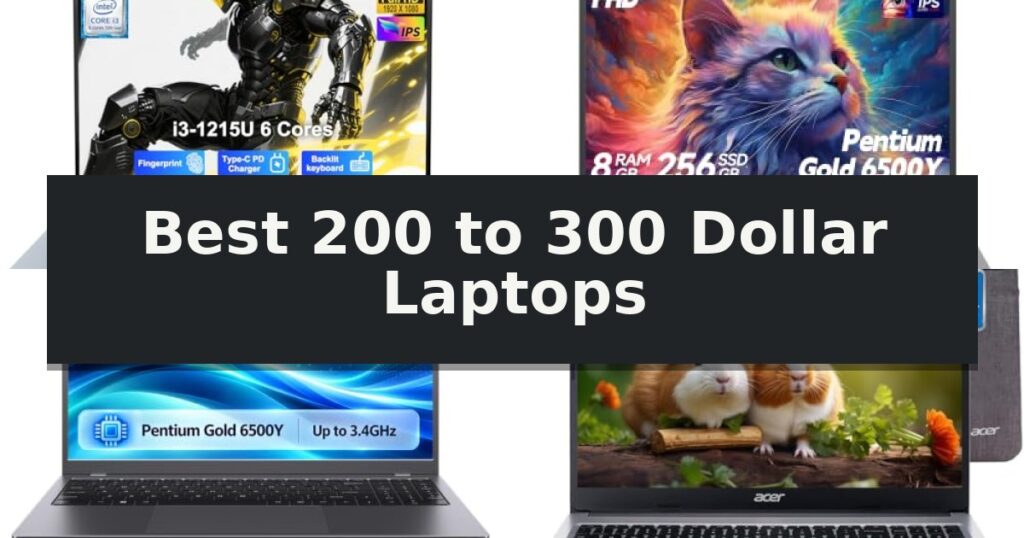
NIMO 15.6-inch IPS FHD Laptop is our top choice for the Best 200 to 300 Dollar Laptops, offering a balanced combination of a 12th Gen Intel processor and a high-resolution display that handles multitasking better than most entry-level alternatives. For those prioritizing a compact form factor, the BLUEING 14-inch Laptop provides a versatile 180-degree hinge, while the KINOBUC 15.6-inch FHD Laptop serves as a quiet, reliable option for students needing consistent performance for daily coursework.
When shopping in this price range, the primary challenge is balancing processing power with build quality. While many budget models rely on older chips, selecting a device with at least an Intel i3 or a modern Pentium Gold processor ensures that web browsing and document editing remain responsive. Buyers should prioritize systems that include at least 8GB of RAM to prevent system slowdowns during routine tasks.
Display quality and physical design also play a significant role in long-term usability. Opting for an IPS panel provides better viewing angles and color accuracy compared to standard TN screens, which is essential for extended study or work sessions. Additionally, features like backlit keyboards and physical privacy shutters add practical value, making a budget laptop feel more capable for professional or academic environments.
If you are looking for a device specifically for presentations and office software, our guide to the Best 14-Inch Laptops for PowerPoint offers additional insights on screen size and portability.
4 Best 200 to 300 Dollar Laptops in 2026 Reviews
Quick Comparison
| Product | Best For | Key Strength | Score |
|---|---|---|---|
| NIMO 15.6-inch IPS FHD Laptop | Best Overall | Dual-fan cooling system prevents thermal throttling during heavy tasks. | 4.9 |
| BLUEING 14-inch Laptop | Versatile 180-Degree Lay-Flat Design | 180-degree lay-flat hinge for flexible viewing angles. | 4.5 |
| KINOBUC 15.6-inch FHD Laptop | Quiet Thermal Design for Students | Physical privacy shutter for the webcam | 4.9 |
| Acer Chromebook 315 | Long 12.5-Hour Battery Life | 12.5-hour battery life for extended daily use. | 4.3 |
How We Chose
Selecting the right laptop in this budget category requires a focus on practical hardware specifications that directly impact daily productivity. We evaluate these devices based on their ability to handle common office and academic tasks without significant lag, prioritizing display quality, memory capacity, and the versatility of available ports to ensure the hardware remains functional for your specific needs.
- Processor efficiency and generation for multitasking stability
- RAM capacity to ensure smooth operation of modern web browsers
- Display panel technology and resolution for visual clarity
- Portability, including weight and chassis thickness
- Connectivity options for peripherals and external displays
1 NIMO 15.6-inch IPS FHD Laptop — Powerful 12th Gen Intel Performance
Finding a reliable machine on a budget requires balancing performance with essential features. The NIMO 15.6-inch IPS FHD Laptop distinguishes itself with a 12th Gen Intel Core i3-1215U processor and a dual-fan cooling system, a combination rarely seen in this price bracket that helps maintain consistent speeds during multitasking.
Designed for portability, this device features a slim 19.2mm profile and weighs under 1.7kg, making it a practical choice for students or professionals on the move. The 15.6-inch FHD IPS display includes a 180-degree lay-flat hinge, which simplifies screen sharing during collaborative study sessions or business presentations.
Security and convenience are integrated through a built-in fingerprint sensor for quick access and a physical webcam privacy shutter for added peace of mind. The inclusion of a backlit keyboard ensures that productivity remains uninterrupted in low-light environments, such as late-night study halls or during travel.
Connectivity is handled by Wi-Fi 6 and Bluetooth 5.2, providing stable wireless performance for streaming and video conferencing. The laptop also supports 65W Type-C fast charging, allowing users to power up efficiently using a versatile charger that can often be shared with other mobile devices.
Best for: Students and home business users who need a portable, secure, and well-cooled machine for daily productivity tasks.
Skip if: Users requiring high-end dedicated graphics for intensive gaming or professional-grade video editing will find the integrated hardware limitations restrictive.
- Dual-fan cooling system prevents thermal throttling during heavy tasks.
- 180-degree lay-flat hinge provides versatile viewing angles.
- Integrated fingerprint sensor and physical privacy shutter enhance security.
- 65W Type-C fast charging offers convenient, modern power delivery.
- 128GB SSD storage may require external drives for large media libraries.
2 BLUEING 14-inch Laptop — Versatile 180-Degree Lay-Flat Design
Finding reliable computing power on a budget requires balancing essential features with cost-effective hardware. The BLUEING 14-inch Laptop addresses this by integrating a Pentium Gold 6500Y processor capable of reaching speeds up to 3.4GHz, providing a responsive foundation for daily office tasks and web-based workflows.
The device features a 14-inch FHD IPS display with a 1920 x 1080 resolution and 100% sRGB color gamut, offering a clear visual workspace for document editing or media consumption. Its 180-degree lay-flat hinge design adds a layer of physical versatility, allowing the screen to sit flush against a desk surface for collaborative viewing or specific ergonomic setups.
Storage and connectivity are prioritized through an 8GB RAM configuration paired with a 256GB M.2 2280 SATA SSD. Users requiring additional capacity can utilize the integrated TF card slot to expand storage by up to 512GB. The inclusion of a USB-C full-function jack, two USB 3.2 ports, and HDMI output ensures compatibility with various peripherals and external monitors.
Security and portability remain central to its design, highlighted by a manual privacy slider for the integrated HD camera. Weighing approximately 2.87 pounds with a 38Wh lithium-polymer battery, the laptop is built for mobility. The system also supports dual-band 2.4G/5G WiFi and Bluetooth 5 for stable wireless communication.
Best for: Students and professionals needing a portable, budget-friendly device for document management, web browsing, and light office productivity.
Skip if: Users requiring high-performance hardware for intensive video editing, 3D rendering, or modern gaming will find the Pentium Gold processor and integrated graphics insufficient.
- 180-degree lay-flat hinge for flexible viewing angles.
- 100% sRGB color gamut on a 1080p FHD IPS display.
- Manual privacy slider for the built-in HD camera.
- Expandable storage via a dedicated TF card slot.
- Pentium Gold processor limits performance for heavy multitasking or demanding software.
- 256GB base storage may require external expansion for large media libraries.
3 KINOBUC 15.6-inch FHD Laptop — Quiet Thermal Design for Students
Finding a reliable computer on a strict budget requires balancing essential processing power with everyday utility. The KINOBUC 15.6-inch FHD Laptop addresses this by utilizing an efficient Pentium Gold 6500Y processor, which provides the necessary speed for document editing, web browsing, and online learning without the high power consumption of more intensive systems.
This model features a 15.6-inch FHD IPS display, offering a 1920×1080 resolution that ensures clear text and wide viewing angles for spreadsheets or video calls. The integration of a four-speaker system enhances the audio experience, making it a functional choice for both productivity tasks and home entertainment.
Designed for multitasking, the device includes 8GB of RAM and a 256GB SSD, facilitating quick startup times and responsive file access. Users needing additional capacity can utilize the TF card slot to expand storage, providing flexibility for school or work files.
The chassis is built with a quiet thermal design, making it suitable for shared environments like libraries or classrooms. With a weight of 3.41 pounds and a thin 0.6-inch profile, it remains portable for students or professionals moving between locations. Connectivity is supported by dual Type-C ports, multiple USB-A ports, and an HDMI output, reducing the need for external adapters.
Security and privacy are addressed through a built-in webcam with a physical shutter and a Kensington lock slot for added peace of mind in public spaces. The unit comes with a 1-year manufacturer warranty, providing a foundational level of support for daily computing needs.
Best for: Students and professionals needing a portable, quiet device for document editing, web browsing, and video conferencing.
Skip if: Users requiring high-performance hardware for gaming, video editing, or resource-heavy professional software.
- Physical privacy shutter for the webcam
- Expandable storage via integrated TF card slot
- Quiet thermal design suitable for shared workspaces
- Versatile port selection including dual USB-C and HDMI
- Limited processing power relative to high-performance gaming laptops
- Moderate battery life of 5-6 hours may require charging during long days
4 Acer Chromebook 315 — Long 12.5-Hour Battery Life
Finding reliable computing hardware on a strict budget often leads to compromises in screen size or battery longevity, but the Acer Chromebook 315 addresses these concerns with a focus on practical workspace and endurance. Designed for users who prioritize long-term productivity, this laptop balances essential processing power with a design that accommodates both school and professional environments.
The Acer Chromebook 315 is built around an Intel Celeron N4020 Dual-Core Processor, which provides the necessary speed for handling content-rich webpages and smooth video playback. Its 15.6-inch HD display features an anti-glare coating and a narrow 0.37-inch bezel, maximizing the available screen real estate while minimizing distractions in brightly lit rooms.
Usability is enhanced through thoughtful hardware additions, including an integrated numeric keypad that simplifies data entry tasks. The device is equipped with 4GB of RAM and 64GB of eMMC storage, providing a stable foundation for the Chrome OS ecosystem. Connectivity remains a priority, with the inclusion of two USB-C 3.1 ports, two USB-A 3.1 ports, and a dedicated headphone jack.
Portability and power management are central to its design, offering up to 12.5 hours of battery life on a single charge. This extended runtime allows for consistent work sessions without the constant need for a power outlet, supported by reliable Wi-Fi and Bluetooth integration for secure, wireless connectivity.
Best for: Students and professionals who require a large screen and long battery life for web-based tasks and document management.
Skip if: Users who need to run resource-heavy desktop applications or require significant local storage capacity for large media files.
- 12.5-hour battery life for extended daily use.
- 15.6-inch anti-glare display provides a spacious workspace.
- Integrated numeric keypad improves data entry efficiency.
- Versatile port selection including USB-C and USB-A.
- 4GB RAM may limit heavy multitasking performance.
- 64GB eMMC storage is limited for large local file collections.
Best 200 to 300 Dollar Laptops Buying Guide
Processor Performance in Budget Laptops
In the 200 to 300 dollar price bracket, processor choice is the most critical factor for performance. Look for 12th Gen Intel Core i3 or modern Pentium Gold chips, which offer enough speed for web browsing, video conferencing, and document editing.
Avoid older, entry-level processors that may struggle with modern web standards. A more efficient chip not only provides a smoother user experience but often contributes to better thermal management and battery life during extended use.
Memory and Storage Considerations
Memory, or RAM, is the backbone of multitasking. We recommend 8GB of RAM as the minimum requirement for a modern Windows or general-purpose laptop to keep multiple browser tabs and applications running simultaneously without freezing.
Storage speed is equally important. An SSD is significantly faster than older eMMC storage, leading to quicker boot times and faster file access. While 128GB or 256GB is standard at this price, ensure the device supports external expansion if you have large media libraries.
Display Quality and Ergonomics
A 15.6-inch or 14-inch Full HD (1920×1080) IPS display is the gold standard for this category. IPS panels offer superior color reproduction and wider viewing angles, which reduces eye strain during long study or work sessions.
Ergonomic features like a backlit keyboard and a comfortable trackpad are often overlooked but vital for productivity. A backlit keyboard is particularly useful for working in dim environments, such as libraries or during travel.
Portability and Build Design
For students and professionals on the move, weight and thickness are key. A laptop that weighs under 4 pounds is generally considered portable enough for daily commutes between classes or offices.
Check for a durable chassis design, such as a 180-degree lay-flat hinge, which adds versatility for sharing screens during group projects or presentations. Slim profiles also make it easier to slide the device into standard backpacks.
Connectivity and Privacy Features
Modern connectivity is essential for a versatile workspace. Ensure your laptop includes a mix of USB-A and USB-C ports, along with an HDMI output for connecting to external monitors or projectors.
Privacy is a growing concern, so look for models that include a physical webcam shutter or a fingerprint sensor. These features provide peace of mind and faster, more secure access to your system in public spaces.
Frequently Asked Questions
Is 8GB of RAM enough for a student laptop?
Yes, 8GB of RAM is sufficient for most student tasks, including word processing, research, and video meetings, provided you are not running resource-intensive creative software.
Can I upgrade the storage on these laptops?
Many budget laptops allow for storage expansion via a TF card slot or an accessible M.2 SSD bay, but you should verify the specific model's upgrade path before purchasing.
What is the benefit of an IPS display?
An IPS display provides better color accuracy and wider viewing angles compared to standard screens, making it easier to read text and view images from different positions.
Are these laptops suitable for gaming?
These laptops are designed for productivity and general use; they are not intended for modern gaming and will likely struggle with high-performance titles.
Do these laptops come with a warranty?
Most manufacturers in this category offer a 1-year or 2-year limited warranty, which covers hardware defects under normal operating conditions.
Conclusion: Our Top Pick
Our top pick is NIMO 15.6-inch IPS FHD Laptop. Choosing the right laptop within the 200 to 300 dollar range comes down to prioritizing the features that matter most to your daily workflow. By focusing on a capable processor, at least 8GB of RAM, and a high-quality display, you can secure a machine that reliably handles your academic or professional responsibilities.
While budget constraints require some trade-offs, the current market offers several strong contenders that provide excellent value. Evaluate your specific needs for portability and connectivity to select the model that best fits your lifestyle.