HP 14 Laptop is our pick for the Best Affordable Laptops for Students because it balances essential processing power with a portable design and a helpful Microsoft 365 subscription. The WISESWAN 15.6 Laptop serves as a strong alternative for students who prioritize a larger screen and backlit keyboard for late-night study sessions. For those needing a dedicated, cloud-focused device, the Lenovo Flagship Chromebook offers intuitive touchscreen navigation and a lightweight build.
Selecting a student laptop requires balancing performance, portability, and long-term utility. We focus on devices that handle common academic tasks like web research, document creation, and video conferencing without unnecessary bloat. Our evaluation prioritizes hardware reliability, battery longevity, and connectivity options that ensure you stay productive throughout a busy day on campus or at home.
For students specifically focused on higher education, exploring a Best Affordable Laptop for College Students can provide more tailored insights into balancing coursework demands with budget constraints.
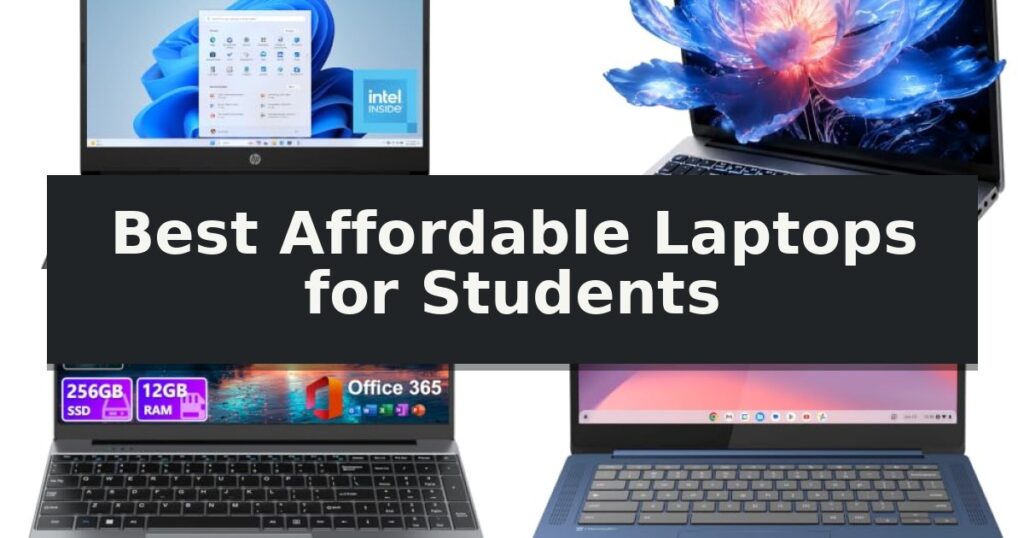
10 Best Affordable Laptops for Students in 2026 Reviews
Quick Comparison
| Product | Best For | Key Strength | Score |
|---|---|---|---|
| HP 14 Laptop | Best Overall | Fast-charging battery reaches 50% capacity in about 45 minutes. | 4.9 |
| WISESWAN 15.6 Laptop | Backlit Keyboard for Night Study | 12GB RAM provides smooth multitasking for office and educational applications. | 4.5 |
| DRKAKO 15.6 Laptop | 180-Degree Lay-Flat Hinge | 180-degree lay-flat hinge for easy screen sharing. | 4.7 |
| Lenovo Flagship Chromebook | Intuitive Touchscreen Navigation | 14-inch Full HD IPS touchscreen for clear, interactive visuals. | 4.5 |
| HP 14 Chromebook | Long-Lasting Battery Life | Long-lasting battery life rated for up to 14 hours of use. | 4.6 |
| HP Chromebook 14 Laptop | Fast Charging Capability | Up to 14 hours of battery life for all-day productivity. | 4.9 |
| HP 14 Ultra-Light Laptop | Includes Expandable SD Storage | Long battery life rated for up to 12 hours with fast charging support. | 4.9 |
| HP 2027 Essential Laptop | Integrated Copilot AI Assistant | Integrated Copilot AI for streamlined academic assistance. | 4.8 |
| HP 2027 Everyday Laptop | Portable Design in Unique Colors | Ultra-portable 3.24 lb design for easy campus transport. | 4.7 |
| Dell Chromebook 3100 | Compact and Durable Build | Compact and lightweight design for easy portability. | 4.3 |
How We Chose
When evaluating the best affordable laptops for students, we focus on practical performance metrics that directly impact daily academic workflows. An experienced reviewer examines how processor speed, memory capacity, and battery endurance translate into real-world reliability, ensuring that students can manage assignments and online classes without technical interruptions or excessive costs.
- Processor efficiency for multitasking
- Battery life duration for all-day campus use
- Display quality and anti-glare features
- Connectivity options including USB-C and Wi-Fi standards
- Portability and overall chassis weight
1 HP 14 Laptop — Includes Microsoft 365 Subscription
Balancing academic requirements with a tight budget often necessitates a machine that prioritizes essential functionality over unnecessary extras. The HP 14 Laptop addresses this need by combining a portable, slim-bezel design with core components capable of handling everyday student tasks like research, word processing, and video conferencing.
At the heart of this device is the Intel N150 processor, which provides the necessary performance for multitasking across creative applications and web-based learning tools. The integration of Intel Graphics ensures that visuals remain clear, while the 128 GB Universal Flash Storage offers faster data access speeds and improved power efficiency compared to traditional storage solutions. This combination is designed to keep the system responsive during daily use.
Usability is enhanced by several practical features, including a HP True Vision HD Camera that utilizes advanced noise reduction to maintain clarity during virtual classes, even in challenging lighting conditions. The inclusion of HP Fast Charge technology allows the battery to reach a 50% charge in approximately 45 minutes, providing flexibility for students moving between lecture halls or study spaces. Additionally, the keyboard features one-touch access to Microsoft Copilot, offering immediate assistance for productivity tasks.
The micro-edge HD display maximizes the viewing area by minimizing bezels, which creates an immersive environment for multimedia consumption or managing multiple windows simultaneously. With Windows 11 Home pre-installed, the laptop benefits from built-in security features designed to protect against malware and phishing. The package also includes a 1-year Microsoft 365 Personal subscription, providing immediate access to essential office software for academic projects.
Best for: Students requiring a lightweight, portable machine for basic research, document creation, and virtual learning.
Skip if: Users who require extensive local storage for large media files or high-performance hardware for intensive video editing and gaming.
- Fast-charging battery reaches 50% capacity in about 45 minutes.
- Slim-bezel HD display provides an expansive viewing area in a compact form factor.
- Integrated Microsoft Copilot button for quick access to AI-driven productivity tools.
- Includes a 1-year Microsoft 365 Personal subscription for immediate academic utility.
- Limited 128 GB storage capacity may require reliance on cloud storage for large files.
- 4 GB of RAM is sufficient for light multitasking but may struggle with memory-intensive applications.
2 WISESWAN 15.6 Laptop — Backlit Keyboard for Night Study
The WISESWAN 15.6 Laptop is built for students who need a reliable machine for daily coursework, featuring a backlit keyboard that supports late-night study sessions. This device balances portability and screen real estate, weighing just 3.6 lbs while offering a 15.6-inch Full HD anti-glare display for comfortable viewing during long lectures or research tasks.
Under the hood, the laptop is powered by an Intel Core i3 processor with 12GB of RAM and a 256GB SSD, providing sufficient overhead for multitasking between office software, web browsing, and video conferencing. The inclusion of WiFi 6 and Bluetooth 5.2 ensures stable connectivity, which is essential for attending online classes or accessing cloud-based educational resources from campus locations.
Designed with student productivity in mind, the chassis includes a variety of ports, such as 3 x USB 3.0, HDMI 2.1, and a Type-C port that supports PD3.0 fast charging. For those who require extra storage for large projects or media files, the built-in TF card slot allows for expansion up to 2TB, providing a flexible solution for growing digital libraries.
The integrated battery provides approximately 7 hours of mixed-use life on a single charge, allowing for a full day of academic activity without constant tethering to a power outlet. Its thin-bezel design and compact form factor make it a practical choice for students who need to move frequently between the library, classrooms, and home.
Best for: Students requiring a portable, budget-friendly laptop for general academic tasks, online classes, and research.
Skip if: Users who require high-performance hardware for intensive tasks like 3D rendering, video editing, or professional gaming.
- 12GB RAM provides smooth multitasking for office and educational applications.
- Backlit keyboard enhances usability in low-light environments.
- WiFi 6 connectivity ensures high-speed, stable wireless performance.
- Expandable storage via TF card slot supports up to 2TB of additional space.
- 7-hour battery life may require a charger for very long days on campus.
- Intel UHD Graphics 620 is limited to basic tasks and is not suitable for heavy gaming or creative design work.
3 DRKAKO 15.6 Laptop — 180-Degree Lay-Flat Hinge
The DRKAKO 15.6 Laptop distinguishes itself with a versatile 180-degree lay-flat hinge, a design choice that simplifies screen sharing during group study sessions or presentations. This device is engineered for students who need a balance of portability and functionality, weighing just 3.66 lbs and measuring 0.79 inches thin for easy transport between classes and home.
Under the hood, the laptop features a J4105 quad-core processor paired with 12GB of DDR4 RAM, providing the necessary overhead for web browsing, streaming educational content, and managing document-heavy workloads. Storage is handled by a 256GB SSD, which facilitates faster startup times and file access compared to traditional hard drives. For those requiring more space, the system supports expansion up to a 2TB SSD or 1TB via microSD.
Visuals are rendered on a 15.6-inch FHD IPS display with a 1920×1080 resolution. The inclusion of ultra-narrow bezels maximizes the active screen area, creating an immersive environment for reading digital textbooks or attending online lectures. The display is complemented by a 53.2Wh battery, rated for up to 6 hours of use, ensuring it can handle a typical block of study time without needing a constant power connection.
Connectivity is robust for a student-focused machine, featuring dual-band Wi-Fi 5 for stable video calls and a comprehensive port selection including USB 3.2, USB-C (supporting data, video, and charging), and a Mini HDMI port. The laptop also comes with a one-year subscription to Office 365 pre-installed, offering immediate access to Word, Excel, and PowerPoint, alongside an integrated AI assistant to help with drafting essays and summarizing research.
Best for: Students who require a portable, budget-friendly device for document editing, web research, and collaborative study sessions.
Skip if: Users who perform high-intensity tasks like video editing or gaming will find the J4105 processor and integrated graphics insufficient for their needs.
- 180-degree lay-flat hinge for easy screen sharing.
- 12GB RAM provides better multitasking than standard entry-level laptops.
- Pre-installed Office 365 subscription saves on initial setup costs.
- Expandable storage options up to 2TB SSD.
- 6-hour battery life may require a charger for full-day campus use.
- J4105 processor is limited to basic productivity and web tasks.
4 Lenovo Flagship Chromebook — Intuitive Touchscreen Navigation
The Lenovo Flagship Chromebook features a 14-inch Full HD touchscreen, providing a high-resolution 1920 x 1080 display that utilizes IPS technology for wide viewing angles. This device is designed for students and remote learners, incorporating an integrated 720p HD webcam with a privacy shutter and a dual-array microphone to support online classes and video conferencing.
At the core of this laptop is the 8-core MediaTek Kompanio 520 processor, which is engineered to balance performance with power efficiency. The system includes 4GB of RAM and 64GB of eMMC storage, providing a streamlined environment for multitasking across browser tabs and educational applications within the Chrome OS ecosystem.
Portability is a key design focus, as the unit measures 13.23 inches by 8.7 inches by 0.73 inches and weighs approximately 2.86 pounds. Connectivity options include Wi-Fi 6 and Bluetooth 5.1, alongside a selection of ports such as USB-A 3.2 Gen 1, USB-C 3.2 Gen 1, a microSD card reader, and a 3.5mm headphone/microphone combo jack.
This laptop offers a secure and simple computing experience, leveraging the built-in protection and cloud backup features of Chrome OS. With its energy-efficient LED backlight and responsive touch interface, it serves as a practical tool for students requiring a lightweight, connected device for daily academic tasks.
Best for: Students who need a lightweight, portable laptop for web-based coursework, video calls, and cloud-based document management.
Skip if: Users who require high-performance hardware for intensive software applications or significant local storage capacity beyond 64GB.
- 14-inch Full HD IPS touchscreen for clear, interactive visuals.
- Integrated 720p HD webcam with a physical privacy shutter.
- Wi-Fi 6 connectivity for fast and reliable network access.
- Lightweight and slim design at 2.86 lbs for easy transport.
- Limited 64GB eMMC storage may require reliance on cloud services.
- 4GB RAM is sufficient for basic multitasking but may struggle with heavy workloads.
5 HP 14 Chromebook — Long-Lasting Battery Life
Students requiring a reliable machine for daily coursework will find the HP 14 Chromebook a practical choice, centered around its efficient Intel Celeron N4120 processor. This quad-core chip is designed to balance power consumption with performance, allowing users to manage multiple browser tabs and educational applications simultaneously without significant slowdowns.
The device is built with a focus on portability and longevity, featuring a lightweight 3.35-pound frame that measures just 0.72 inches in height. This slim profile makes it easy to transport between classes or study sessions, while the integrated 14-hour battery life ensures the laptop remains operational throughout a full day of lectures and research without needing a power outlet.
Connectivity is well-supported for a modern academic environment, including both USB-A and USB-C ports for peripheral compatibility, along with an HDMI output for connecting to external monitors or projectors during presentations. The inclusion of a built-in webcam facilitates remote learning and video conferencing, while the Chrome OS environment provides a streamlined interface for web-based productivity.
While the 64GB eMMC storage is modest, it is typical for this class of device, encouraging the use of cloud-based storage solutions. The HP 14 Chromebook offers a straightforward, functional design that prioritizes essential connectivity and consistent battery performance for students who primarily work within a web-centric ecosystem.
Best for: Students who primarily rely on web-based applications and cloud storage for their daily academic tasks.
Skip if: Users who require significant local storage capacity or need to run specialized, resource-heavy desktop software.
- Long-lasting battery life rated for up to 14 hours of use.
- Quad-core processor provides reliable multitasking for educational apps.
- Versatile connectivity including USB-C and HDMI ports.
- Portable, slim design weighing only 3.35 pounds.
- Limited local storage with 64GB eMMC capacity.
6 HP Chromebook 14 Laptop — Fast Charging Capability
The HP Chromebook 14 Laptop is engineered for students who require a reliable, portable machine for daily academic tasks and multimedia consumption. Featuring a quad-core Intel Celeron N4120 processor, this device balances power efficiency with the performance needed to manage multiple assignments simultaneously.
Designed with mobility in mind, the laptop features a 14-inch micro-edge, anti-glare HD display that minimizes distractions. Its thin and lightweight construction allows for easy transport between classrooms or study sessions, while the integrated HP Fast Charge technology provides a practical solution for busy schedules, reaching a 50% charge in approximately 45 minutes.
Beyond its core processing capabilities, the device supports versatile connectivity through its 802.11a/b/g/n/ac Wi-Fi and Bluetooth combo. The inclusion of a full-size keyboard with a multi-touch touchpad—supporting four-finger gestures—enhances navigation efficiency for research and document creation.
Sustainability and longevity are integrated into the hardware, evidenced by its ENERGY STAR certification and EPEAT Silver registration. With up to 14 hours of battery life, it is built to sustain long periods of use without constant access to power outlets, making it a functional choice for students navigating a full day of coursework.
Best for: Students who prioritize long battery life, portability, and fast-charging capabilities for a full day of academic work.
Skip if: Users who require high-performance hardware for intensive video editing, professional gaming, or software that is not compatible with the Chrome OS environment.
- Up to 14 hours of battery life for all-day productivity.
- HP Fast Charge technology for rapid power replenishment.
- Lightweight and thin design optimized for portability.
- Multi-touch touchpad supporting advanced gesture navigation.
- 64 GB eMMC storage may be limited for users with large local file libraries.
- 1366 x 768 HD display resolution is standard and may not meet high-definition visual requirements for some users.
7 HP 14 Ultra-Light Laptop — Includes Expandable SD Storage
Balancing academic requirements with a limited budget often leads students to seek reliable, entry-level hardware. The HP 14 Ultra-Light Laptop addresses this by providing a dedicated, light-workload configuration that includes a one-year subscription to Microsoft 365, ensuring immediate access to essential productivity tools like Word, Excel, and PowerPoint.
Driven by an Intel Celeron N4500 processor and Intel UHD Graphics, this device is engineered for daily tasks such as online classes, remote learning, and streaming. It features 4GB of DDR4 RAM and a combined 128GB of storage, utilizing both eMMC and an included SD card to manage files and media efficiently. The system runs on Windows 11 Home in S mode, prioritizing security and performance for educational environments.
The 14-inch micro-edge display incorporates anti-glare technology and a 62.5% sRGB color gamut for comfortable viewing during extended study sessions. Connectivity is well-supported with Wi-Fi 6E and Bluetooth 5.4, alongside a versatile port selection including USB-C 3.2 Gen 1, two USB-A ports, and an HDMI 1.4b output that supports external monitor expansion up to FHD resolution.
Portability and endurance are central to its design, weighing only 3.24 pounds with a battery life rated for up to 12 hours. The inclusion of HP fast charge technology helps minimize downtime, while the integrated HP True Vision HD camera facilitates clear video conferencing for group projects or virtual meetings.
Best for: Students requiring a lightweight, budget-friendly device for basic productivity, online coursework, and remote learning.
Skip if: Users who need high-performance computing for intensive tasks like video editing, 3D rendering, or running demanding software suites.
- Long battery life rated for up to 12 hours with fast charging support.
- Versatile connectivity including Wi-Fi 6E, USB-C, and HDMI for dual-monitor setups.
- Portable design weighing just 3.24 pounds for easy transport between classes.
- Included software with a one-year Microsoft 365 subscription.
- Limited processing power restricted to entry-level, light-workload tasks.
- 4GB RAM capacity may constrain heavy multitasking.
8 HP 2027 Essential Laptop — Integrated Copilot AI Assistant
The HP 2027 Essential Laptop simplifies daily academic workflows by integrating a dedicated Copilot key, providing immediate access to AI-powered assistance for research and writing tasks. This 14-inch device is built for students who prioritize portability, weighing just 3.24 lbs and featuring a micro-edge bezel design that maximizes screen real estate within a compact footprint.
Performance is driven by an Intel N150 4-core processor and 4GB of LPDDR5-4800 RAM, tailored for essential productivity such as web browsing, document editing, and video conferencing. The laptop includes 128GB of UFS storage and comes with a 1-year Microsoft 365 Personal subscription, ensuring students have immediate access to necessary office software right out of the box.
Connectivity remains a priority for modern learning environments, with the inclusion of Wi-Fi 6 and Bluetooth 5.4 for reliable wireless performance. The port selection is versatile, featuring a USB Type-C 10Gbps port with DisplayPort 1.2 support, two USB Type-A ports, and an HDMI 1.4b output, allowing for easy connection to external monitors or peripherals.
Designed for long study sessions, the unit offers up to 11 hours of video playback or 7.5 hours of mixed usage. The integrated HP True Vision 720p HD camera, paired with AI-enhanced noise reduction for the dual-array microphones, ensures clear communication during online lectures and group projects.
Best for: Students seeking a lightweight, portable device for web-based research, document creation, and online classes.
Skip if: Users requiring high-performance computing for video editing, 3D rendering, or heavy multitasking will find the 4GB of RAM and 128GB storage insufficient.
- Integrated Copilot AI for streamlined academic assistance.
- Wi-Fi 6 and Bluetooth 5.4 for modern, reliable connectivity.
- Ultra-portable design weighing only 3.24 lbs.
- 1-year Microsoft 365 Personal subscription included.
- Limited 4GB RAM may restrict heavy multitasking.
- 128GB UFS storage provides minimal space for large local file libraries.
9 HP 2027 Everyday Laptop — Portable Design in Unique Colors
Balancing academic demands with a tight budget requires gear that prioritizes efficiency and portability. The HP 2027 Everyday Laptop addresses this by combining a lightweight 3.24 lb frame with a reliable Intel N150 quad-core processor, making it a capable companion for students managing document editing, web research, and virtual lectures.
Performance is driven by 4GB of LPDDR5 RAM and 128GB of UFS storage, which facilitate quick boot times and responsive multitasking for essential school applications. The inclusion of Windows 11 Home with integrated Microsoft Copilot AI provides a modern interface for productivity, while the bundled 1-year Microsoft 365 Personal subscription ensures immediate access to Word, Excel, and PowerPoint.
Designed for the modern classroom and study space, the laptop features a 14-inch HD micro-edge anti-glare display that minimizes distractions. Connectivity is well-rounded, offering Wi-Fi 6 for stable online access, a USB Type-C port with DisplayPort support, and a multi-format SD card reader for flexible storage expansion.
Communication and longevity are key for long study sessions. The HP True Vision 720p HD camera, paired with AI Noise Reduction, ensures clear video calls, while the battery supports up to 11 hours of video playback. The Honey Lavender finish provides a distinct aesthetic, rounding out a package that balances functional utility with a portable, student-friendly design.
Best for: Students and remote learners needing a portable, budget-friendly device for basic productivity and online coursework.
Skip if: Users requiring high-performance computing for video editing, 3D rendering, or heavy multitasking will find the 4GB RAM and entry-level processor insufficient.
- Ultra-portable 3.24 lb design for easy campus transport.
- Up to 11 hours of battery life for all-day productivity.
- Includes 1-year Microsoft 365 subscription for immediate school utility.
- Wi-Fi 6 and Bluetooth 5.4 for reliable, fast connectivity.
- Limited 4GB RAM may restrict heavy multitasking.
- 128GB storage capacity is modest and may require cloud or external expansion.
10 Dell Chromebook 3100 — Compact and Durable Build
The Dell Chromebook 3100 is engineered for students who require a highly portable and reliable device for daily academic tasks. Weighing just 2.85 pounds and featuring an 11.6-inch display, this laptop is designed to fit easily into backpacks, making it a practical choice for moving between classrooms, libraries, and study spaces. Its compact form factor ensures that it does not take up excessive desk space, which is often a premium in shared educational environments.
Operating on the Chrome OS platform, this device is optimized for web-based workflows, including research, cloud-based document editing, and collaborative projects. It is powered by a Celeron N4020 processor paired with 4 GB of RAM, providing sufficient processing power for standard student applications and multitasking within a browser-based environment. The inclusion of Intel HD Graphics supports clear visual output for educational media and presentations.
The device features 16 GB of flash memory, which emphasizes a reliance on cloud storage solutions rather than large local files. This design choice encourages students to utilize web-based storage, ensuring that their work remains accessible across different devices. For connectivity, the unit includes an English (US) keyboard and integrated Bluetooth, allowing for the easy pairing of essential peripherals such as wireless mice or headphones to enhance the user experience.
As a renewed unit, the Dell Chromebook 3100 offers a budget-conscious entry point into mobile computing, backed by a 90-day limited warranty. Its durable construction is well-suited for the rigors of student life, providing a functional balance between essential performance and portability. This laptop serves as a dedicated tool for those who prioritize a streamlined, cloud-focused computing experience for their coursework.
Best for: Students who require a lightweight, portable device primarily for web-based research and cloud-based document editing.
Skip if: Users who need significant local storage capacity or those who require specialized software that is not compatible with Chrome OS.
- Compact and lightweight design for easy portability.
- Chrome OS provides a streamlined, user-friendly interface.
- Integrated Bluetooth for convenient peripheral connectivity.
- Limited 16 GB flash memory requires reliance on cloud storage.
- 11.6-inch screen size may be restrictive for complex multitasking.
Best Affordable Laptops for Students Buying Guide
Balancing Performance and Price
Affordable laptops often utilize entry-level processors designed for light productivity rather than heavy creative software. These chips are highly effective for web-based research, word processing, and managing multiple browser tabs, which covers the majority of a student's daily requirements.
Buyers should look for at least 4GB of RAM to ensure smooth operation. While higher memory counts are beneficial, budget-conscious students can maximize their experience by closing unused background applications and utilizing cloud-based storage solutions.
Portability and Build Quality
A student laptop needs to survive the commute between classrooms, libraries, and dorms. Lightweight designs, typically under 3.5 pounds, are essential for maintaining comfort when carrying a backpack all day.
Durability is equally important, though often overlooked in lower price brackets. Look for models with solid hinges and scratch-resistant finishes that can withstand the rigors of daily handling and frequent transport.
Display and Ergonomics
Screen quality significantly impacts eye comfort during long study sessions. Anti-glare coatings and micro-edge bezels help reduce eye strain and provide a more immersive workspace, even on smaller 14-inch displays.
Keyboard and trackpad responsiveness are critical for typing long essays. We recommend checking for a comfortable key travel distance and a multi-touch trackpad that supports intuitive gestures for easier navigation.
Connectivity and Expansion
Modern students rely on various peripherals, from external monitors to flash drives. A laptop with a mix of USB-A and USB-C ports, along with an HDMI output, offers the best flexibility for connecting to campus equipment.
Wi-Fi 6 compatibility is a major advantage for students, as it provides more stable and faster connections in crowded campus environments where many devices compete for bandwidth.
Operating System Considerations
Choosing between Windows and Chrome OS depends on your specific academic software needs. Windows 11 offers full compatibility with traditional desktop applications, which is often necessary for specialized coursework.
Chrome OS is an excellent, secure alternative for students who live primarily in the browser. It is generally faster on entry-level hardware and provides seamless integration with Google Workspace tools.
Frequently Asked Questions
Do I need a high-end processor for college work?
For most undergraduate studies, an entry-level processor is sufficient. You only need high-end hardware if your major requires specialized software like video editing, 3D modeling, or heavy data analysis.
Is 4GB of RAM enough for a student laptop?
4GB is the baseline for basic productivity. It is adequate for word processing, streaming lectures, and web browsing, provided you do not keep dozens of browser tabs open simultaneously.
What is the benefit of a Chromebook over a Windows laptop?
Chromebooks are typically more affordable, have faster boot times, and are highly secure because they rely on cloud-based applications. They are ideal if your school work is primarily web-based.
How long should a student laptop battery last?
Aim for a laptop that offers at least 7 to 8 hours of battery life. This ensures you can get through most of your classes without needing to carry a charger or hunt for an outlet.
Can I expand the storage on these affordable laptops?
Many affordable laptops include an SD card reader or microSD slot, which is a cost-effective way to expand your storage for documents and media without needing an expensive internal drive upgrade.
Conclusion: Our Top Pick
Our top pick is HP 14 Laptop. Finding the right laptop for your studies does not have to break your budget. By focusing on core features like portability, battery life, and reliable connectivity, you can secure a machine that supports your academic goals without unnecessary expenses.
Prioritize your specific workflow needs when making your final choice. Whether you require the versatility of Windows or the simplicity of Chrome OS, the current market offers several capable options that provide excellent value for students.