The Lenovo Yoga 7i 2-in-1 Laptop is our top choice for the Best 2-in-1 Laptops for Students, offering a premium OLED display and robust performance for demanding academic workloads. The Dell Inspiron 14 2-in-1 Laptop serves as a powerful alternative for those prioritizing AMD-based multitasking, while the Acer Chromebook Spin 314 provides a fast-starting, budget-friendly option for cloud-focused learners.
Selecting a convertible laptop for school requires balancing physical durability with the processing power needed for research, writing, and multimedia projects. Students should prioritize devices that transition smoothly between tablet and laptop modes without sacrificing keyboard comfort or screen clarity.
Portability is a critical factor for navigating campus life, as is the ability to connect to external displays and peripherals during long study sessions. Our evaluation focuses on these practical requirements to ensure your chosen device supports your specific academic needs throughout the semester.
For a broader look at portable computing, our guide to Best Laptops for Students offers additional insights into selecting the right hardware for your academic career.
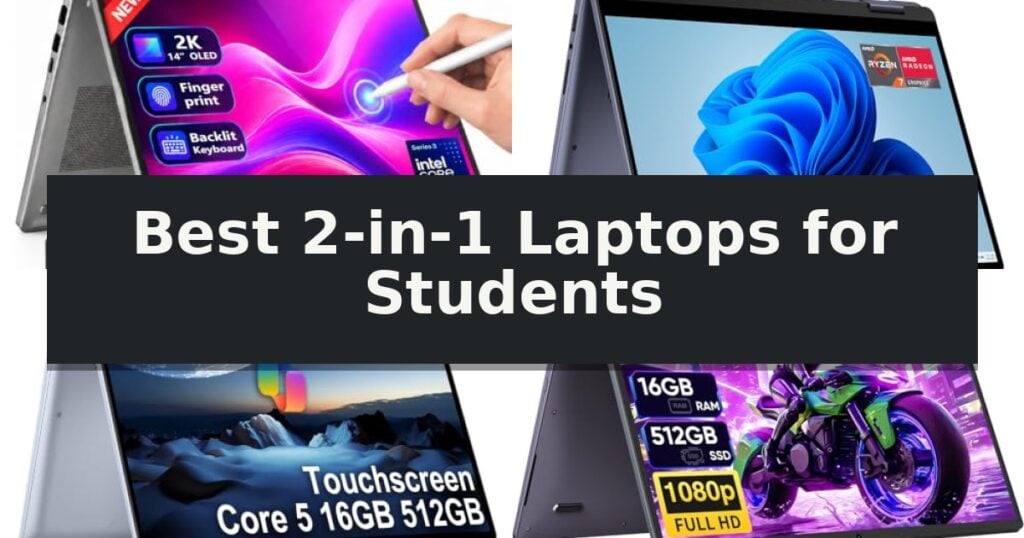
10 Best 2-in-1 Laptops for Students in 2026 Reviews
Quick Comparison
| Product | Best For | Key Strength | Score |
|---|---|---|---|
| Lenovo Yoga 7i 2-in-1 Laptop | Best Overall | 360-degree hinge design for multi-mode versatility. | 4.9 |
| Dell Inspiron 14 2-in-1 Laptop | Powerful Ryzen Performance for Multitasking | 360° hinge provides exceptional versatility for different study environments. | 4.8 |
| Dell Inspiron 14 7440 | Reliable Daily Productivity | x360 degree hinge enables four distinct usage modes. | 4.5 |
| Tylvx 15.6-inch 2-in-1 Laptop | Spacious Screen for Note-Taking | 360° hinge allows for four distinct usage modes. | 4.3 |
| Acer Chromebook Spin 314 | Fast Startup for Busy Schedules | 360-degree convertible design allows for flexible use in tight spaces like desks or transit. | 4.5 |
| Lenovo Chromebook 2-in-1 | Durable Design for Campus Life | Versatile 2-in-1 design allows for easy switching between laptop and tablet modes. | 4.3 |
| HP Chromebook 14 x360 Plus | Versatile Modes for Collaborative Study | 360-degree hinge allows for four distinct usage modes. | 4.6 |
| Lenovo IdeaPad Flex 3i Chromebook | Compact Build for Easy Portability | Versatile 360-degree hinge allows for seamless transitions between laptop, tablet, and presentation mo… | 4.5 |
| HP Chromebook x360 14 | Simple Cloud-Based Workflow | Flexible 2-in-1 design with a 14-inch FHD IPS touchscreen. | 4.6 |
| QAZIPO 2-in-1 Tablet Laptop | Ultra-Portable Detachable Design | Detachable magnetic keyboard for flexible mode switching | 4.9 |
How We Chose
When evaluating the best 2-in-1 laptops for students, we focus on the practical intersection of versatility and reliability. An experienced reviewer assesses how well these machines handle daily academic tasks, prioritizing responsive touch interfaces, efficient multitasking hardware, and the physical build quality necessary to withstand the rigors of a student's mobile lifestyle.
- Processing power and multitasking capability
- Display resolution and touch responsiveness
- Battery longevity for full-day campus use
- Build quality and hinge durability
- Connectivity options for external peripherals
1 Lenovo Yoga 7i 2-in-1 Laptop — Premium OLED Display for Creators
The Lenovo Yoga 7i 2-in-1 Laptop features a versatile 360-degree hinge that allows for seamless transitions between laptop, tablet, tent, and stand modes, providing flexibility for diverse study environments. This 2026 model is built with a durable aluminum chassis and weighs just 3.08 lbs, making it a portable choice for students who need to move between classrooms and libraries.
Equipped with the Intel Ultra 5 Series 3 processor, this device utilizes a 6-core architecture with a 4.4GHz boost clock to handle multitasking. It integrates an Intel Graphics engine and a 40 TOPS NPU, which provides hardware acceleration for modern productivity applications and AI-driven tasks. The system includes 16GB of RAM and a 512GB SSD to manage data-intensive coursework.
Visuals are rendered on a 14-inch WUXGA OLED touchscreen with a resolution of 1920 x 1200. The display offers 400 nits of brightness and a 60Hz refresh rate, ensuring sharp detail and color accuracy for creative projects or media consumption. The inclusion of a 5MP front-facing camera with a privacy shutter and a fingerprint reader adds layers of security and convenience for daily use.
Connectivity is supported by Wi-Fi 7 and Bluetooth technology, alongside two Thunderbolt 4 ports for high-speed data transfer and external display output. The device also features an HDMI 2.1 port and a microSD card reader. With a battery life rated for up to 16 hours and Rapid Charge support, the laptop is engineered to sustain long study sessions without frequent power interruptions.
Best for: Students who require a lightweight, versatile device with a high-quality OLED display for both academic productivity and creative media tasks.
Skip if: Users who require dedicated high-end discrete graphics for intensive 3D rendering or gaming, as this model relies on integrated graphics.
- 360-degree hinge design for multi-mode versatility.
- 14-inch WUXGA OLED touchscreen with 400 nits brightness.
- Wi-Fi 7 and dual Thunderbolt 4 ports for fast connectivity.
- 16-hour battery life with Rapid Charge support.
- Integrated graphics may limit performance in specialized professional 3D applications.
2 Dell Inspiron 14 2-in-1 Laptop — Powerful Ryzen Performance for Multitasking
Transitioning between intense study sessions and creative projects requires hardware that keeps pace with your workflow. The Dell Inspiron 14 2-in-1 Laptop addresses this need through a versatile 360° hinge design, allowing you to fluidly shift between laptop, tablet, tent, and stand modes depending on your immediate task.
Under the hood, this device is built for efficiency, utilizing the latest AMD Ryzen 8000 Series processors paired with DDR5 memory. This combination provides the necessary overhead for multitasking, whether you are managing multiple research tabs or running productivity software. The inclusion of a 1TB SSD ensures ample storage for large academic files and media libraries.
Visual comfort and workspace optimization are central to the user experience. The 16:10 aspect ratio display offers a taller screen profile compared to standard displays, providing more vertical room for document editing and note-taking. To support long hours of screen time, the integrated Dell ComfortView software actively works to reduce blue light emissions.
Communication and connectivity are also prioritized for the modern student environment. The laptop features AI-enabled video chat tools, including auto-framing and eye-contact correction, which help maintain professional engagement during virtual lectures or group projects. Additionally, the system includes Wi-Fi 6E for high-speed wireless connectivity and comes with a 1-year onsite service warranty for hardware support.
Best for: Students who require a highly adaptable device for both intensive academic research and multimedia consumption.
Skip if: Users who prioritize a dedicated, high-performance workstation for heavy 3D rendering or professional-grade video editing may find a traditional laptop form factor more suitable.
- 360° hinge provides exceptional versatility for different study environments.
- 16:10 aspect ratio display increases vertical screen space for productivity.
- AI-enabled video chat features enhance remote learning engagement.
- 1TB SSD offers significant storage capacity for academic files.
- 3.77-pound weight may be noticeable during long commutes compared to ultra-lightweight tablets.
- Active pen is an optional accessory and not included as a standard component.
3 Dell Inspiron 14 7440 — Reliable Daily Productivity
The Dell Inspiron 14 7440 distinguishes itself with a versatile x360 degree hinge, allowing users to transition between laptop, yoga, flip, and tablet modes for varied academic and creative workflows. This flexibility is supported by a 14-inch WUXGA touchscreen display featuring ComfortView technology, designed to provide a clear interface for students managing research, streaming, or collaborative projects.
Under the hood, the device is powered by an Intel Core 5 120U processor with 10 cores and 12 threads, paired with 16GB of DDR5 RAM. This configuration is engineered to handle multitasking across multiple applications, while the 512GB PCIe NVMe M.2 SSD provides storage for documents and media. The system is rated for up to 10.20 hours of battery life, catering to long days on campus.
Connectivity is a priority for modern academic environments, and this model includes two USB Type-C 3.2 Gen 2 ports, two USB 3.2 Gen 1 Type-A ports, an HDMI 1.4 port, and an SD-card slot. The inclusion of Wi-Fi 6E AX211 ensures stable wireless performance, while the integrated 1080p webcam and backlit keyboard facilitate remote learning and late-night study sessions.
While the device offers significant utility, users should note that the HDMI 1.4 port is limited to 1080p resolution at 60Hz. Those requiring higher resolution output for external monitors should utilize the USB Type-C port, which supports up to 4K at 60Hz. This 2-in-1 laptop balances performance and portability, weighing approximately 2.91 pounds.
Best for: Students and creators who require a versatile, portable device that transitions easily between traditional typing tasks and tablet-based interaction.
Skip if: Users who require high-resolution external display support via HDMI or those who prefer a dedicated graphics card for intensive gaming or professional-grade video rendering.
- x360 degree hinge enables four distinct usage modes.
- 16GB DDR5 memory provides efficient multitasking capabilities.
- Versatile connectivity including multiple USB-C and USB-A ports.
- Integrated 1080p webcam for clear video conferencing.
- HDMI 1.4 port is limited to 1080p output.
- 250 nits display brightness may be challenging in direct sunlight.
4 Tylvx 15.6-inch 2-in-1 Laptop — Spacious Screen for Note-Taking
Balancing academic demands with creative projects requires a versatile tool that can transition from a traditional workstation to a digital canvas. The Tylvx 15.6-inch 2-in-1 Laptop addresses this need with an innovative 360° hinge, allowing users to switch between laptop, tablet, tent, and stand modes depending on the task at hand.
Under the hood, this device is equipped with 16GB of RAM and a 512GB SSD, providing the necessary overhead for smooth multitasking across multiple browser tabs and document editing applications. The 15.6-inch Full HD touchscreen offers a spacious interface for note-taking or sketching, while the Intel Core m3-8100Y processor handles standard daily academic tasks and streaming requirements.
Designed with a distinct Deep Purple chassis, the laptop offers a modern aesthetic that separates it from standard office-focused hardware. It includes a 38Wh battery intended for all-day use, supported by a comprehensive array of connectivity options including 3x USB 3.0 ports, an HDMI output, and a Type-C data port to ensure compatibility with various peripherals.
Running on Windows 11, the system provides a touch-optimized environment right out of the box. With its combination of a large display and flexible form factor, this model serves as a practical companion for students who require a single machine for both intensive typing sessions and creative digital work.
Best for: Students who need a large-screen, versatile 2-in-1 device for note-taking, digital art, and general academic multitasking.
Skip if: Users who require high-performance processing power for specialized engineering software or heavy video rendering tasks.
- 360° hinge allows for four distinct usage modes.
- 16GB RAM supports efficient multitasking.
- Spacious 15.6-inch FHD touchscreen enhances note-taking and creative work.
- Comprehensive connectivity including USB 3.0 and HDMI ports.
- Intel m3-8100Y processor is limited to basic daily tasks.
- 3.59-pound weight may be less portable than smaller ultrabooks.
5 Acer Chromebook Spin 314 — Fast Startup for Busy Schedules
The Acer Chromebook Spin 314 is engineered for versatility, featuring a 360-degree hinge that allows students to transition between a traditional laptop, a presentation stand, or a tablet. This flexibility is supported by an antimicrobial Corning Gorilla Glass multi-touch display, providing a durable and responsive interface for academic tasks, note-taking, or creative projects.
Powered by an Intel Core i3-N305 processor and 8GB of LPDDR5 memory, this device is built to handle multitasking across browser tabs and educational applications. The integration of ChromeOS ensures a rapid startup time of under 10 seconds, while automatic background updates keep the software current without interrupting the user's workflow.
Connectivity is a priority for modern learning environments, with the inclusion of Wi-Fi 6E for high-speed, stable network access across multiple bands. The laptop also features a Full HD facial auto-exposure camera equipped with a blue glass lens and a privacy shutter, ensuring clear video quality for remote lectures or collaborative group calls.
Designed for portability, the unit includes a protective sleeve and offers a range of ports, including USB Type-C with DisplayPort support, two USB 3.2 Gen 1 Type-A ports, and an HDMI 1.4 output. The 14-inch WUXGA matte display provides a 16:10 aspect ratio, offering additional vertical screen space that can be beneficial for reading documents and managing research materials.
Best for: Students who require a versatile, fast-booting device for web-based research, video conferencing, and collaborative academic work.
Skip if: Users who rely on specialized Windows or macOS software that is not compatible with the ChromeOS ecosystem.
- 360-degree convertible design allows for flexible use in tight spaces like desks or transit.
- Fast startup performance and automatic background updates minimize downtime.
- Wi-Fi 6E connectivity ensures reliable access to high-speed networks.
- Antimicrobial Corning Gorilla Glass provides enhanced screen durability.
- Limited local storage of 128GB eMMC may require reliance on cloud-based solutions.
- ChromeOS limitations restrict the installation of traditional desktop software.
6 Lenovo Chromebook 2-in-1 — Durable Design for Campus Life
Balancing academic demands with a busy schedule requires hardware that adapts to your environment, and the Lenovo Chromebook 2-in-1 is engineered specifically for this versatility. Featuring a flexible 2-in-1 design, this device allows students to transition seamlessly between laptop, tent, and tablet modes, making it suitable for typing research papers, attending virtual lectures, or sketching out creative ideas on the go.
At just 0.69 inches thick and weighing only 3.3 lbs, this laptop is built for portability without sacrificing durability. It meets military-grade durability standards, ensuring it can withstand the rigors of campus life. The unit is powered by an Intel N150 CPU and includes 128GB of UFS storage, allowing for a boot time of under 10 seconds so you can start working immediately.
Visuals and audio are handled by a 14-inch WUXGA IPS touchscreen display paired with audio tuned by Waves MaxxAudio. For privacy-conscious users, the device includes a physical shutter on the FHD webcam, providing a simple way to secure your camera when not in use. The integration of Google Gemini directly into the home screen offers an AI-driven assistant to help with planning, writing, and learning tasks.
Connectivity is robust for a compact machine, featuring two USB-C ports, two USB-A ports, and an HDMI port. This selection ensures you can easily connect to external monitors, projectors, or peripherals without needing a collection of adapters. With built-in Google apps and a focus on secure, fast performance, it serves as a reliable tool for students managing a diverse workload.
Best for: Students who need a lightweight, versatile, and durable device for multitasking, note-taking, and research on campus.
Skip if: Users requiring high-performance hardware for intensive video editing, 3D rendering, or specialized software that is incompatible with the ChromeOS ecosystem.
- Versatile 2-in-1 design allows for easy switching between laptop and tablet modes.
- Military-grade durability ensures the device can handle the physical demands of student life.
- Fast boot time of under 10 seconds improves daily efficiency.
- Comprehensive port selection including USB-C, USB-A, and HDMI for easy peripheral connectivity.
- Limited 4GB RAM may restrict performance when running many browser tabs or complex applications simultaneously.
7 HP Chromebook 14 x360 Plus — Versatile Modes for Collaborative Study
The HP Chromebook 14 x360 Plus offers a versatile 360-degree hinge that allows students to transition between laptop, tent, stand, and tablet modes, making it a flexible tool for diverse academic environments. Built to withstand daily use, this device has passed rigorous MIL-STD 810H testing, ensuring it remains reliable during transport and intensive study sessions.
Under the hood, the laptop is powered by an Intel N150 processor and 4GB of LPDDR5 memory, providing the necessary performance for document editing, web research, and video streaming. With 128GB of UFS storage, students have ample space for local files, while the ChromeOS ecosystem facilitates seamless cloud integration and access to a wide library of educational applications.
The 14-inch WUXGA (1920×1200) touchscreen features narrow borders and an anti-glare coating, which helps minimize eye strain during long hours of screen time. For remote collaboration, the integrated FHD camera with temporal noise reduction ensures clear video quality, while Wi-Fi 6 and Bluetooth 5.4 provide stable wireless connectivity for online classes and peripheral devices.
Designed for portability and efficiency, this model includes a fast-charging battery and a lightweight chassis. The inclusion of USB-C and USB-A ports ensures compatibility with various accessories, making it a practical choice for K-12 students and home learners who require a reliable, all-in-one computing solution.
Best for: Students and families requiring a durable, multi-mode device for research, online classes, and daily productivity tasks.
Skip if: Users who require high-performance hardware for intensive tasks like video editing or professional-grade creative software will find the 4GB memory limitation restrictive.
- 360-degree hinge allows for four distinct usage modes.
- MIL-STD 810H durability testing ensures reliable performance.
- FHD touchscreen with anti-glare coating reduces eye strain.
- Wi-Fi 6 and Bluetooth 5.4 for fast, stable connectivity.
- 4GB of memory may limit heavy multitasking capabilities.
- 128GB storage capacity is relatively modest for large media libraries.
8 Lenovo IdeaPad Flex 3i Chromebook — Compact Build for Easy Portability
Transitioning between intensive study sessions and casual media consumption requires hardware that adapts to the task at hand. The Lenovo IdeaPad Flex 3i Chromebook utilizes a x360 degree hinge to facilitate multiple configurations, including a dedicated tablet mode for intuitive interaction and a flip mode optimized for video streaming.
Under the hood, this device is powered by the Intel N100 processor with four cores reaching up to 3.4GHz, paired with 4GB LPDDR5 RAM. This hardware combination is engineered to handle everyday academic tasks, online classes, and standard multitasking. Storage is managed through a 128GB configuration, split between 64GB eMMC and a 64GB SD card, providing space for essential documents and applications.
The visual experience is centered on a 12.2" WUXGA (1920 x 1200) IPS touchscreen, which features 300 nits brightness and TÜV Rheinland Low Blue Light certification to assist with extended viewing comfort. For remote collaboration, the laptop includes an HD 720p webcam equipped with a physical privacy shutter, alongside integrated stereo speakers.
Connectivity remains a priority for modern workflows, featuring USB-C, two USB-A ports, an HDMI 1.4 output, and a microSD card reader. The device supports external displays up to 4K resolution and utilizes Wi-Fi 6 and Bluetooth 5.3 for stable wireless performance. With a battery life rated for up to 12 hours, it is designed to support a full day of academic activity on the ChromeOS platform.
Best for: Students who require a versatile, lightweight device for daily coursework, online classes, and media consumption.
Skip if: Users who require high-performance computing for intensive video editing, complex software development, or heavy multitasking beyond standard web-based applications.
- Versatile 360-degree hinge allows for seamless transitions between laptop, tablet, and presentation modes.
- TÜV Rheinland Low Blue Light certified display enhances comfort during long study sessions.
- Integrated privacy shutter provides physical security for the webcam.
- Wi-Fi 6 and Bluetooth 5.3 support ensures modern, stable wireless connectivity.
- 4GB RAM may limit performance when running many browser tabs or demanding applications simultaneously.
- Fixed storage capacity relies on a combination of eMMC and SD card, which is less efficient than high-speed SSD storage.
9 HP Chromebook x360 14 — Simple Cloud-Based Workflow
For students balancing academic workloads with daily entertainment, the HP Chromebook x360 14 offers a versatile 2-in-1 design that transitions seamlessly between a traditional laptop for typing assignments and a tablet-style configuration for streaming or note review. Its 14-inch FHD IPS touchscreen provides a clear, detailed display, while the flexible hinge allows for multiple viewing angles suitable for presentations or shared media.
Powered by an Intel Processor N100 and 4GB of DDR4 RAM, this device is optimized for web-first workflows. It is engineered to handle everyday tasks such as online classes, document creation, and video meetings with efficiency. The integration of Chrome OS ensures a fast startup and simplified file management, relying on cloud storage via Google Drive to keep essential projects accessible.
Connectivity is well-supported for classroom and home environments, featuring Wi-Fi 6 and Bluetooth for wireless peripherals. The inclusion of USB-C, USB-A, and HDMI ports provides practical options for connecting external displays, storage devices, or standard classroom accessories. Additionally, the camera system includes temporal noise reduction and a privacy shutter to support clear video communication during remote learning sessions.
Designed with sustainability in mind, the chassis incorporates ocean-bound and post-consumer recycled plastics, alongside recycled aluminum. With a battery life rated for up to 11 hours, the unit is built to sustain a full day of use. It represents a straightforward, reliable choice for those whose primary needs revolve around browser-based applications and cloud-integrated productivity.
Best for: Students and home users who prioritize a web-first workflow, cloud-based productivity, and versatile viewing angles for schoolwork and streaming.
Skip if: Users who require Windows-only software, heavy-duty creative applications, or high-performance gaming capabilities.
- Flexible 2-in-1 design with a 14-inch FHD IPS touchscreen.
- Long battery life rated for up to 11 hours of use.
- Versatile connectivity including USB-C, HDMI, and Wi-Fi 6.
- Sustainable construction using recycled materials and ocean-bound plastic.
- Limited 4GB RAM may restrict heavy multitasking.
- 64GB eMMC storage is primarily intended for cloud-based workflows rather than large local file storage.
10 QAZIPO 2-in-1 Tablet Laptop — Ultra-Portable Detachable Design
Balancing the portability of a tablet with the productivity of a laptop is a common challenge for students who need to transition between lecture halls and study spaces. The QAZIPO 2-in-1 Tablet Laptop addresses this by featuring a detachable magnetic leather case keyboard, allowing users to switch between a typing-focused workstation and a lightweight, handheld tablet for reading or streaming.
At the core of this device is the Intel Pentium Gold Processor 6500Y, which supports speeds up to 3.4GHz to handle multitasking across browser tabs, office software, and video conferencing. The system is equipped with 8GB of RAM and a 256GB SSD, providing the memory and storage capacity necessary for managing academic documents, media libraries, and quick application boot times.
Visuals are delivered through a 10.1-inch Full HD IPS touchscreen with a 16:10 aspect ratio, designed for precise document editing and clear presentation viewing. The device maintains a slim profile at just 0.4 inches thick and weighs only 1.3 lbs, making it a practical choice for students who prioritize a compact, aluminum alloy chassis that fits easily into a backpack.
Connectivity is managed through a versatile array of ports, including two USB-C ports—one of which supports power delivery—a USB 3.0 port, and a Micro HDMI output. This allows for external monitor connections and the use of legacy peripherals. The device also includes a 2MP front camera for virtual meetings and a 5MP rear camera for capturing notes or spontaneous media.
Best for: Students and professionals who require a highly portable, detachable device for light multitasking, note-taking, and remote learning.
Skip if: Users who require high-performance hardware for intensive tasks like 3D rendering, complex programming, or professional-grade video editing.
- Detachable magnetic keyboard for flexible mode switching
- Ultra-portable 1.3 lb design with a durable aluminum chassis
- Full HD IPS touchscreen for clear document and media viewing
- Versatile connectivity including USB-C with PD charging support
- 10.1-inch display size may feel cramped for extensive split-screen multitasking
- Processor performance is optimized for light office and student tasks rather than heavy computational workloads
Best 2-in-1 Laptops for Students Buying Guide
Balancing Performance and Portability
Students often need a device that is light enough to carry between lecture halls but powerful enough to handle multiple browser tabs and research applications simultaneously. Look for processors that offer a balance of speed and power efficiency to ensure the laptop remains responsive without draining the battery too quickly.
Weight is a significant consideration for those walking across campus. A device weighing around three pounds or less is generally ideal for portability, allowing you to keep your bag light while maintaining a screen size large enough for comfortable document editing.
Display Quality for Research and Media
The screen is your primary interface for reading, writing, and viewing lecture materials. High-resolution displays with good brightness levels help reduce eye strain during long study sessions, while OLED or high-quality IPS panels provide better color accuracy for creative work.
Touchscreen responsiveness is essential for 2-in-1 devices, especially if you plan to use a stylus for note-taking. Ensure the display has an anti-glare coating if you frequently work in brightly lit libraries or outdoor environments.
The Importance of Hinge and Build Durability
A 2-in-1 laptop relies on its hinge to switch between modes, making this component a critical point of failure. Look for models constructed with durable materials like aluminum that can withstand the repetitive motion of flipping from laptop to tablet mode.
Consider how the device feels in tablet mode. A well-designed convertible should feel balanced and secure, with a hinge that holds its position firmly without wobbling during touch interaction or stylus use.
Connectivity and Peripheral Support
Campus environments often require connecting to various external devices, including projectors, monitors, and external storage. A selection of ports, such as USB-C with Thunderbolt support and HDMI, provides the flexibility needed for presentations and expanded workstations.
Wireless connectivity is equally important. Modern standards like Wi-Fi 6 or 6E ensure stable internet access in crowded campus networks, which is vital for online research and participating in virtual classes.
Operating System Considerations
Choosing between Windows and ChromeOS depends on your specific software requirements. Windows offers full compatibility with desktop applications and creative suites, making it a versatile choice for most college majors.
ChromeOS is often more streamlined and secure, focusing on web-based apps and cloud storage. This can be an excellent, cost-effective solution for students whose work is primarily conducted through browsers and Google Workspace tools.
Frequently Asked Questions
Is a 2-in-1 laptop better than a traditional laptop for students?
A 2-in-1 laptop offers greater versatility, allowing you to use it as a tablet for note-taking or reading, which can be more convenient than a traditional laptop for certain academic tasks.
How much RAM do I need for a student laptop?
For most students, 8GB of RAM is the minimum for smooth multitasking, but 16GB is recommended if you plan to run more demanding software or keep many browser tabs open simultaneously.
Do I need a stylus for my 2-in-1 laptop?
A stylus is highly recommended if you intend to use your 2-in-1 for handwritten notes, sketching, or annotating documents, as it provides a more natural input method than a mouse or trackpad.
Are Chromebooks suitable for all students?
Chromebooks are excellent for students who rely on web-based tools and cloud storage. However, if your coursework requires specific Windows-only software, a Windows-based 2-in-1 laptop would be a more appropriate choice.
How can I extend the battery life of my laptop during the day?
You can extend battery life by adjusting screen brightness, closing unnecessary background applications, and using power-saving modes provided by the operating system.
Conclusion: Our Top Pick
Our top pick is Lenovo Yoga 7i 2-in-1 Laptop. Choosing the right 2-in-1 laptop involves balancing your specific academic requirements with the portability needed for campus life. By focusing on display quality, processing power, and build durability, you can find a device that serves as a reliable partner throughout your studies.
Whether you opt for a high-performance Windows machine or a streamlined Chromebook, ensure the device supports your workflow. Investing in a convertible that meets these practical needs will provide a more efficient and enjoyable learning experience.