Bambu Lab P1S 3D Printer is our top choice for the Best 3D Printer for Engineering Students, offering a fully enclosed design that supports a wide range of advanced filaments for complex academic projects. The FLASHFORGE Creator 5 Pro 3D Printer follows as a robust option for those requiring industrial-grade multi-material capabilities, while the FLASHFORGE Adventurer 5M 3D Printer serves as an efficient, high-speed solution for students focused on rapid prototyping.
Engineering students require reliable hardware that balances precision with the ability to handle diverse material properties. Whether you are printing functional mechanical components or intricate prototypes, the ability to maintain consistent build quality and manage material compatibility is essential for academic success.
Selecting the right machine involves evaluating how well a printer integrates into a student workspace. Factors such as build volume, ease of maintenance, and the ability to handle specialized filaments like ABS or ASA often dictate the long-term utility of the device for engineering coursework.
For those just starting their technical journey, exploring the Best 3D Printer for Learning can provide additional context on selecting equipment that balances ease of use with educational growth.
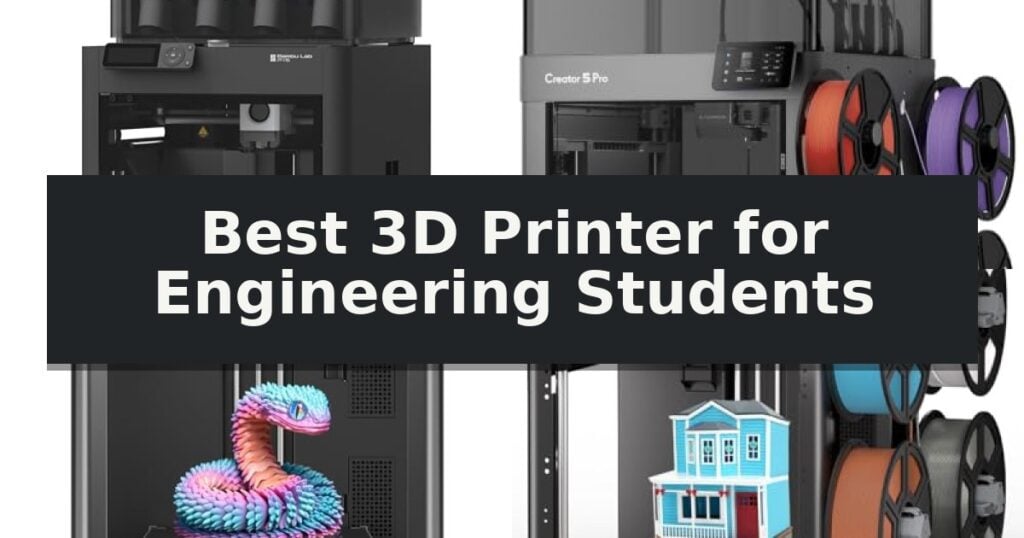
5 Best 3D Printer for Engineering Students in 2026 Reviews
Quick Comparison
| Product | Best For | Key Strength | Score |
|---|---|---|---|
| Bambu Lab P1S 3D Printer | Best Overall | High-speed printing capabilities up to 500mm/s. | 4.9 |
| FLASHFORGE Creator 5 Pro 3D Printer | Industrial-Grade Multi-Material Engineering | 4-toolhead system with rapid FlashSwap technology minimizes material waste. | 4.7 |
| FLASHFORGE Adventurer 5M 3D Printer | Rapid Prototyping for Students | 600mm/s high-speed printing for rapid prototyping. | 4.3 |
| FLASHFORGE AD5X 3D Printer | Versatile Multi-Color Engineering Tool | Multi-color printing capability for complex assemblies. | 4.6 |
| Bambu Lab A1 mini 3D Printer | Compact Desk-Friendly Engineering | Full-auto calibration eliminates manual bed leveling and z-offset adjustments. | 4.8 |
How We Chose
When evaluating 3D printers for engineering students, we focus on technical reliability and the ability to produce functional parts. An experienced reviewer prioritizes machines that offer consistent thermal control, high-speed output, and broad material support, ensuring that the hardware can keep pace with the rigorous demands of engineering design and rapid prototyping workflows.
- Material compatibility and support for advanced filaments like ABS, ASA, and PC.
- Print speed and acceleration capabilities for rapid iterative prototyping.
- Enclosure design and thermal stability for minimizing warping in functional parts.
- Ease of maintenance, including nozzle swap systems and automated calibration.
- Connectivity and software integration for remote monitoring and model management.
1 Bambu Lab P1S 3D Printer — High-Speed Multi-Material Prototyping
Engineering students require reliable hardware that bridges the gap between digital design and physical reality, and the Bambu Lab P1S Combo is engineered to facilitate this transition with its CoreXY high-speed architecture. By achieving print speeds of up to 500mm/s and 20000 mm/s² acceleration, this machine significantly reduces the lead time for iterative prototyping, allowing students to test mechanical assemblies or form factors in a fraction of the time required by standard desktop printers.
The Bambu Lab P1S Combo utilizes a fully enclosed design, which is essential for maintaining the stable thermal environment needed to print advanced engineering materials like ABS, ASA, and PC. This enclosure prevents warping and ensures structural integrity for functional parts. Furthermore, the inclusion of automatic bed leveling simplifies the preparation process, ensuring that every print starts with a consistent, reliable first layer without the need for manual calibration.
For complex projects, the integrated Bambu Lab AMS (Automatic Material System) enables multi-color and multi-material printing with up to 16 colors. This feature is particularly useful for engineering students who need to print support structures using dissolvable or breakaway materials, or for creating color-coded assemblies that improve the visualization of internal components. The system is compatible with a wide range of filaments including PLA, PETG, and TPU, offering the flexibility required for diverse academic projects.
Designed for efficiency, the system offers a 15-minute setup process, allowing students to dedicate their time to design and engineering rather than machine maintenance. While the printer is highly capable, it is important to note that it is not recommended for carbon or glass fiber reinforced polymers, which can cause excessive wear on the nozzle and extrusion system. This trade-off is a critical consideration for students planning to work with specialized composite materials.
Best for: Engineering students who need to rapidly prototype functional parts using advanced materials and multi-material assemblies.
Skip if: Users who primarily work with carbon or glass fiber reinforced polymers, as these materials are not recommended for this printer.
- High-speed printing capabilities up to 500mm/s.
- Enclosed chassis supports advanced engineering filaments.
- Multi-material support via the integrated AMS unit.
- Automatic bed leveling for consistent print quality.
- Not recommended for carbon or glass fiber reinforced polymers.
2 FLASHFORGE Creator 5 Pro 3D Printer — Industrial-Grade Multi-Material Engineering
The FLASHFORGE Creator 5 Pro 3D Printer distinguishes itself through a high-efficiency 4-toolhead system equipped with a 7-second FlashSwap changer, which eliminates the need for traditional filament flushing. This design choice significantly reduces material waste and operational overhead, making it a practical solution for engineering students who require rapid, multi-material prototyping without constant maintenance or excessive purge cycles.
Built for demanding industrial applications, the printer features a fully enclosed frame with an active heated chamber capable of reaching 65°C. This thermal control is critical for preventing warping when working with advanced engineering materials such as ABS, PC, and PA. The internal environment is kept stable by a continuous airflow system, while a dual HEPA 13 and activated carbon system ensures that ultrafine particles and fumes are effectively trapped during operation.
Mechanical stability is achieved through a CoreXY motion structure integrated with precision linear rails and 1.5GT high-torque timing belts. This architecture supports high-speed printing up to 600mm/s while maintaining structural accuracy and minimizing ghosting. The system also includes automated toolhead offset calibration, vibration compensation, and dynamic flow calibration to ensure consistent, high-quality output across complex prints.
User control is facilitated through the Flash Studio software, allowing for remote monitoring and management via desktop or mobile devices. The inclusion of an HD chamber camera enables real-time progress tracking and the automatic generation of time-lapse videos, providing students with the tools necessary to document and analyze their design iterations efficiently.
Best for: Engineering students requiring high-speed, multi-material prototyping with advanced thermal control for industrial-grade filaments.
Skip if: Users who require a compact, entry-level printer for simple PLA projects and lack the workspace for an industrial-sized, enclosed unit.
- 4-toolhead system with rapid FlashSwap technology minimizes material waste.
- Active heated chamber up to 65°C supports advanced engineering filaments like PC and PA.
- CoreXY architecture enables high-speed printing up to 600mm/s without sacrificing accuracy.
- Dual HEPA 13 filtration system prioritizes workspace safety by trapping fumes and particles.
- Large footprint and industrial design may be oversized for standard student dorm or home office setups.
- High-performance features represent a significant investment compared to basic hobbyist 3D printers.
3 FLASHFORGE Adventurer 5M 3D Printer — Rapid Prototyping for Students
Engineering students often require rapid iteration cycles to bring complex mechanical designs from concept to physical reality. The FLASHFORGE Adventurer 5M 3D Printer addresses this need with a high-performance CoreXY all-metal structure capable of reaching travel speeds of 600mm/s and acceleration of 20000mm/s². This hardware configuration is specifically engineered to reduce production cycles, allowing for faster prototyping during demanding academic projects.
Efficiency is central to the design of the FLASHFORGE Adventurer 5M 3D Printer, which features a 35-second warm-up time to 200°C and a high-flow 32mm³/s nozzle. The system incorporates fully automatic bed leveling, which eliminates the need for manual adjustments and ensures consistent first-layer adhesion. For students working with diverse materials, the 280°C direct drive extruder provides the thermal range necessary for various filaments, while the 3S detachable nozzle allows for quick swaps between 0.25mm and 0.8mm sizes.
The printer integrates modern workflow tools, including real-time app monitoring via Flash Studio, which enables remote status alerts and setting adjustments. To maintain print quality during high-speed operations, the unit utilizes vibration compensation and a dual-fan cooling system. The 220x220x220mm print volume provides sufficient space for most student-led engineering components, supported by a dual-sided PEI platform designed for easy part removal.
While the machine is optimized for speed and precision, users should note that it requires a dedicated workspace to accommodate its 17.64-inch height and 22-pound footprint. The combination of its rigid metal frame and automated features makes it a robust tool for academic environments where reliable, repeatable output is prioritized over manual calibration.
Best for: Engineering students who prioritize rapid prototyping speeds and automated calibration for academic projects.
Skip if: Users who require a significantly larger build volume than 220x220x220mm or those with limited desk space for a 22-pound unit.
- 600mm/s high-speed printing for rapid prototyping.
- Fully automatic bed leveling for consistent first layers.
- 3S detachable nozzle system for quick maintenance.
- Remote monitoring via Flash Studio app.
- 22-pound weight requires a stable, dedicated surface.
- Fixed build volume may limit larger-scale engineering assemblies.
4 FLASHFORGE AD5X 3D Printer — Versatile Multi-Color Engineering Tool
Precision and versatility are essential when prototyping complex mechanical assemblies, and the FLASHFORGE AD5X 3D Printer addresses these needs with its Advanced Multi-Color Printing Technology. By allowing users to integrate up to four colors into a single build, this machine enables the creation of multi-material or color-coded parts that are critical for visualizing complex engineering designs.
Engineered for high-throughput environments, the printer achieves a maximum printing speed of 600mm/s and an acceleration of 20,000mm/s. This performance is supported by a reliable all-metal Core XY structure, which provides the necessary rigidity to minimize vibrations during rapid movements, ensuring that dimensional accuracy is maintained even at high speeds.
Workflow efficiency is further enhanced by the Intelligent Filament System (IFS). This feature automates filament management by detecting and refilling material, which reduces manual intervention during long-duration prints. With a build volume of 220 x 220 x 220mm and support for flexible materials like TPU, the unit offers the adaptability required for diverse engineering applications, from functional prototypes to intricate components.
The integration of a 300°C nozzle expands the range of compatible materials, allowing students to experiment with more advanced filaments beyond standard PLA. Combined with fully automatic leveling, the system simplifies the setup process, letting users focus on design iteration rather than machine calibration.
Best for: Engineering students who require high-speed prototyping, multi-color material capabilities, and automated filament management for complex mechanical designs.
Skip if: Users who require a significantly larger build volume than 220mm cubed or those who do not need multi-color printing capabilities may find more cost-effective single-extruder options.
- Multi-color printing capability for complex assemblies.
- High-speed performance up to 600mm/s.
- Intelligent Filament System for automated material management.
- All-metal Core XY structure for enhanced stability.
- Fixed build volume of 220 x 220 x 220mm may limit larger-scale projects.
5 Bambu Lab A1 mini 3D Printer — Compact Desk-Friendly Engineering
Precision and reliability are non-negotiable when prototyping complex mechanical designs, and the Bambu Lab A1 mini 3D Printer is engineered to streamline this workflow for students. By integrating full-auto calibration and active flow rate compensation, this machine removes the manual guesswork often associated with first-layer adhesion and extrusion consistency, allowing users to focus on iterative design rather than machine maintenance.
The Bambu Lab A1 mini 3D Printer is built for a modern workspace, featuring a compact footprint that fits easily on a crowded desk while maintaining a quiet operation of ≤48 dB. This makes it a practical choice for shared dorms or study environments where noise levels are a concern. The inclusion of the LED Lamp Kit further expands its utility, enabling students to print functional, decorative housing for custom electronics projects.
Connectivity is central to the user experience, as the printer integrates with the Bambu Handy app and the MakerWorld model library. This ecosystem provides immediate access to a vast repository of ready-to-print files, which is particularly useful for rapid prototyping or testing mechanical assemblies. The ready-to-use nature of the hardware ensures that students can transition from unboxing to their first print with minimal setup time.
While the Bambu Lab A1 mini 3D Printer excels in ease of use and speed, its compact build is specifically optimized for smaller-scale components. It offers a seamless bridge between digital design and physical realization, providing a reliable platform for students to test their engineering concepts through high-speed, high-quality output.
Best for: Engineering students who need a compact, low-maintenance printer for rapid prototyping and small-scale mechanical design projects.
Skip if: Students who require a large build volume for printing full-scale prototypes or large-format structural components will find the build area too restrictive.
- Full-auto calibration eliminates manual bed leveling and z-offset adjustments.
- Active flow rate compensation ensures consistent extrusion quality during high-speed printing.
- Quiet operation (≤48 dB) makes it suitable for use in shared living or study spaces.
- Integrated ecosystem with the Bambu Handy app and MakerWorld library simplifies model sourcing and print management.
- Compact build volume limits the size of individual parts that can be printed in one piece.
Best 3D Printer for Engineering Students Buying Guide
Material Versatility and Enclosures
Engineering projects often demand materials beyond standard PLA, such as PETG, ABS, or ASA, which require stable thermal environments to prevent warping. An enclosed printer is essential for maintaining the ambient temperature needed to ensure these materials bond correctly.
Students should look for printers that explicitly support high-temperature filaments and feature a chamber designed to retain heat. This capability allows for the creation of durable, functional parts that can withstand mechanical stress during testing.
Rapid Prototyping Speed
The ability to iterate quickly is a cornerstone of the engineering design process. Printers with high acceleration and travel speeds allow students to move from a digital model to a physical prototype in a fraction of the time required by standard machines.
While speed is a significant advantage, it must be balanced with structural rigidity. CoreXY motion systems are often preferred in this category because they provide the stability necessary to maintain precision even when printing at high velocities.
Automated Calibration and Reliability
Manual bed leveling can be a significant source of frustration and failed prints. Modern engineering-focused printers utilize automated systems to ensure the first layer is perfect every time, which is critical for parts that require high dimensional accuracy.
Reliability also extends to the extruder and hotend assembly. Features like vibration compensation and dynamic flow calibration help maintain print quality, reducing the need for constant supervision or post-processing of parts.
Maintenance and Workflow Efficiency
Engineering students often have limited time, making maintenance efficiency a key consideration. Systems that allow for quick nozzle changes or simplified filament loading can significantly reduce downtime between projects.
Look for machines that offer clear, accessible interfaces and robust software ecosystems. The ability to monitor prints remotely or manage a queue of files directly from a computer or mobile app streamlines the transition from design to production.
Workspace Integration
A printer's physical footprint and noise level are important for students working in shared dorms or small studio spaces. Compact designs that do not sacrifice build volume are highly desirable for limited desk environments.
Safety features, such as HEPA filtration or enclosed frames, are also worth considering if the printer will be used in a living area. These additions help manage fumes and particles, creating a more comfortable and safe environment for long-term use.
Frequently Asked Questions
Do engineering students need a multi-color printer?
While not strictly necessary for structural parts, multi-color or multi-material capabilities can be useful for printing assemblies with support structures in different materials, which makes removing supports from complex geometries much easier.
Is an enclosed printer necessary for PLA?
No, PLA prints well in open-frame printers. However, an enclosure is highly recommended if you plan to print with materials like ABS, ASA, or PC, which are prone to warping in open-air environments.
How important is print speed for school projects?
High print speed is very beneficial for engineering students who need to test multiple iterations of a design quickly. It allows for faster feedback loops during the development phase of a project.
Can these printers handle flexible materials like TPU?
Most modern direct-drive printers can handle TPU, but it is important to check the specific printer's capabilities. Direct-drive extruders are generally more reliable for flexible filaments than Bowden-style systems.
What is the benefit of a CoreXY motion system?
CoreXY systems are designed for high-speed, high-precision printing. By keeping the print bed stationary on the Z-axis and moving the print head on the X and Y axes, they reduce inertia and vibration, leading to better print quality at higher speeds.
Conclusion: Our Top Pick
Our top pick is Bambu Lab P1S 3D Printer. Choosing the right 3D printer for engineering studies depends on your specific focus, whether that involves rapid prototyping of mechanical parts or working with specialized, high-strength materials. Prioritizing thermal stability and ease of use will ensure your machine remains a productive tool throughout your academic career.
By focusing on printers that offer robust motion systems and reliable automated features, you can spend more time refining your designs and less time troubleshooting hardware. Select a model that fits your workspace constraints while providing the technical capabilities required for your upcoming projects.