Flashforge Adventurer 5M 3D Printer is our pick for the Best 3D Printer Under $300 because it combines a high-speed CoreXY structure with automated leveling for consistent, reliable output.
Selecting an entry-level machine requires balancing raw performance with the practical realities of maintenance and setup. While budget models often sacrifice build volume or speed, current options have bridged this gap by incorporating features previously reserved for professional-grade hardware.
Experienced buyers should prioritize machines that offer stable motion systems and direct-drive extruders, as these components directly influence the quality of the first layer and the ability to handle diverse filament types. Evaluating these printers involves looking past marketing claims to identify which systems offer the most consistent, repeatable results for your specific workspace.
If you are specifically looking for educational tools, our guide on the Best 3D Printer for Students provides additional insights into machines optimized for classroom and home learning environments.
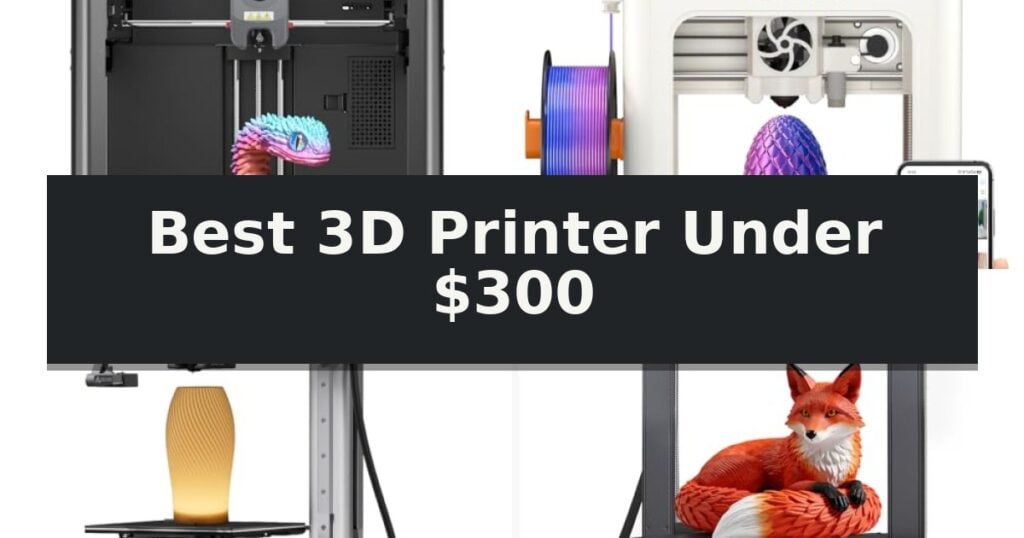
8 Best 3D Printer Under $300 in 2026 Reviews
Quick Comparison
| Product | Best For | Key Strength | Score |
|---|---|---|---|
| Flashforge Adventurer 5M 3D Printer | Best Overall | 600mm/s high-speed printing for rapid project completion. | 4.9 |
| Hephi3d TINA2C 3D Printer | Easiest Out-of-Box Setup | Fully assembled and factory-preset for 5-minute setup. | 4.3 |
| Bambu Lab A1 mini 3D Printer | Best Beginner Ecosystem | Full-auto calibration eliminates manual bed leveling. | 4.8 |
| Creality Ender 3 V3 SE 3D Printer | Reliable High-Speed Value | High-speed printing up to 250mm/s for efficient project completion. | 4.7 |
| ELEGOO Centauri 2 3D Printer | Smooth High-Temp Performance | High-speed printing up to 500 mm/s with CoreXY stability. | 4.5 |
| Hephi3d TINA2 Plus 3D Printer | Compact High-Speed Printing | Fully assembled design for immediate use. | 4.3 |
| Ugee Funbox 3D Printer | Safest for Kids and Schools | Pre-calibrated, tool-free setup allows for immediate use. | 4.6 |
| Generic Portable 3D Printer | Ultra-Compact Desktop Pick | Ultra-compact design ideal for small workspaces and classrooms. | 4.9 |
How We Chose
When evaluating the best 3D printer under $300, we focus on the practical intersection of speed, reliability, and user-friendly automation. An experienced reviewer separates high-performing models from basic hobbyist units by examining the structural rigidity, the precision of the motion system, and the consistency of the automated calibration tools that define the daily user experience.
- Print speed and acceleration capabilities for rapid prototyping.
- Automated bed leveling and Z-offset calibration efficiency.
- Extruder type and maximum nozzle temperature for material compatibility.
- Build volume dimensions relative to the overall machine footprint.
- Connectivity options including app integration and remote monitoring.
1 Flashforge Adventurer 5M 3D Printer — Fastest for Rapid Prototyping
The FLASHFORGE Adventurer 5M 3D Printer distinguishes itself through a high-speed CoreXY structure capable of reaching travel speeds of 600mm/s. This design choice, paired with 20000mm/s² acceleration, is engineered to significantly reduce production cycles for rapid prototyping tasks.
Efficiency is central to the unit's operation, featuring a 35-second warm-up time to 200°C and a high-flow 32mm³/s nozzle. Users can perform maintenance quickly thanks to the 3-second detachable nozzle system, which supports various sizes ranging from 0.25mm to 0.8mm to accommodate different project requirements.
To ensure consistent output, the printer utilizes fully automatic bed leveling, which eliminates the need for manual adjustments and helps maintain a reliable first layer. The inclusion of a dual-sided PEI platform further simplifies the removal of finished prints, while the 280°C direct drive extruder provides the thermal capacity needed for a variety of filament types.
Integration with the Flash Studio app allows for real-time monitoring and remote setting adjustments, providing a level of oversight that is useful for longer print jobs. The all-metal structure is designed to support stable operation even at high speeds, and the dual-fan cooling system works to manage temperature during complex extrusions.
Best for: Makers and professionals who prioritize high-speed output and rapid prototyping over large-format build volumes.
Skip if: Users who require a massive build area beyond the 220x220x220mm capacity or those who prefer a fully enclosed chamber for specialized high-temperature materials.
- 600mm/s high-speed printing for rapid project completion.
- Fully automatic bed leveling for consistent first-layer adhesion.
- 3-second detachable nozzle for quick and easy maintenance.
- Remote monitoring via the Flash Studio app.
- 220x220x220mm build volume may be restrictive for large-scale parts.
- Open-frame design lacks the environmental control of a fully enclosed printer.
2 Hephi3d TINA2C 3D Printer — Easiest Out-of-Box Setup
The Hephi3d TINA2C 3D Printer is designed to minimize the barrier to entry for home users by arriving fully assembled and factory-preset for immediate use. This compact device allows beginners to begin their first print within five minutes of unboxing, thanks to its integrated auto-leveling system and included starter kit.
Functionality is centered around accessibility, featuring one-tap printing via a dedicated app that provides access to a library of over 3,500 ready-to-print models. Users can manage their projects through Wi-Fi connectivity, or utilize USB-C and TF card inputs for offline operation. The printer is built on an open-source framework, ensuring compatibility with standard slicing software like Cura and Wiibuilder for those who wish to customize their workflow.
For creative flexibility, the accompanying app includes AIGC and photo-generation tools that convert concepts into 3D models. The hardware is optimized for home environments with silent printing capabilities and a 3s fast-release hotend for simplified maintenance. Safety features include an auto-detect bed function and a resume-printing mode to protect progress during power interruptions.
Measuring approximately 9.84 inches in height and 8.27 inches in length, this unit is intended for space-constrained environments. It serves as a versatile tool for STEM learning and personalized DIY projects, supported by a 2-year manufacturer warranty.
Best for: Beginners and home users seeking a compact, plug-and-play 3D printing experience with app-based controls.
Skip if: Users requiring a large build volume for industrial-scale projects or those who prefer advanced manual calibration over automated factory presets.
- Fully assembled and factory-preset for 5-minute setup.
- Integrated auto-leveling simplifies the initial print process.
- Wi-Fi and app control provide convenient remote management.
- Open-source compatibility allows for flexible software choices.
- Compact build volume may limit the size of individual print projects.
3 Bambu Lab A1 mini 3D Printer — Best Beginner Ecosystem
Transitioning from manual settings to a streamlined digital workflow is the primary advantage of the Bambu Lab A1 mini 3D Printer, which prioritizes ease of use through full-auto calibration and active flow rate compensation. By removing the need for tedious manual adjustments, this machine allows users to focus on the creative output rather than the mechanics of the printing process.
The printer is engineered for a quiet environment, operating at ≤48 dB, making it suitable for placement in home offices or shared workspaces. Its compact footprint ensures it fits on most desks, while the Bambu Handy app and MakerWorld model library provide a cohesive, connected ecosystem that simplifies file management and remote monitoring.
Included with this specific package is an LED Lamp Kit, which encourages users to print functional, decorative lighting fixtures directly. This addition highlights the machine's utility for DIY projects and personalized gifts, bridging the gap between technical 3D printing and home décor applications.
While the Bambu Lab A1 mini 3D Printer excels in accessibility and speed, its compact design means it is intended for smaller-scale projects. It provides a reliable, high-speed printing experience that minimizes troubleshooting, ensuring that beginners can achieve consistent results with minimal technical intervention.
Best for: Beginners and hobbyists who want a compact, quiet, and user-friendly 3D printer that integrates seamlessly with a digital model library.
Skip if: Users who require a large build volume for printing oversized functional parts or industrial-scale prototypes will find the A1 mini's compact size limiting.
- Full-auto calibration eliminates manual bed leveling.
- Active flow rate compensation ensures consistent print quality.
- Quiet operation at ≤48 dB is ideal for home use.
- Integrated ecosystem with MakerWorld library and Bambu Handy app.
- Compact build volume limits the size of individual prints.
4 Creality Ender 3 V3 SE 3D Printer — Reliable High-Speed Value
Achieving consistent print quality while maintaining high production speeds is a common challenge for those entering the world of additive manufacturing. The Creality Ender 3 V3 SE 3D Printer addresses this by integrating a high-speed printing capability of up to 250mm/s, supported by a robust 2500mm/s² acceleration rate to streamline the completion of functional parts and prototypes.
The hardware configuration is built for reliability and ease of use. It features a Sprite Direct Drive Extruder, which is engineered to provide smooth filament feeding for a variety of materials including PLA, PETG, and TPU. To ensure structural stability during operation, the printer utilizes dual synchronized Z-axis lead screws paired with precision Y-axis linear shafts, a design choice that helps minimize vibration and Z-wobble for more accurate layer alignment.
Usability is a primary focus for this model, evidenced by its straightforward assembly process and integrated CR Touch Auto Leveling system. This feature, combined with automatic Z-offset calibration, simplifies the initial setup and helps users achieve a reliable first layer without extensive manual intervention. The inclusion of a 32-bit silent mainboard further enhances the user experience by reducing operational noise.
Maintenance and workflow efficiency are supported by the flexible PC spring steel build plate, which allows for the quick removal of finished prints with minimal effort. With its combination of high-speed performance and user-friendly calibration tools, this machine offers a capable entry point for those seeking the Best 3D Printer Under $300.
Best for: Beginners and hobbyists who require a fast, reliable, and easy-to-calibrate 3D printer for everyday projects.
Skip if: Users who require a massive build volume or a fully enclosed chamber for advanced engineering-grade materials.
- High-speed printing up to 250mm/s for efficient project completion.
- CR Touch Auto Leveling and automatic Z-offset for simple setup.
- Sprite Direct Drive Extruder for consistent material compatibility.
- 32-bit silent mainboard for reduced operating noise.
- Open-frame design lacks the environmental control of an enclosed chamber.
- Manual assembly required, though simplified by the design.
5 ELEGOO Centauri 2 3D Printer — Smooth High-Temp Performance
Achieving high-speed production without sacrificing precision is the primary focus of the ELEGOO Centauri 2 3D Printer. This machine utilizes a CoreXY system capable of reaching print speeds up to 500 mm/s and 20,000 mm/s² acceleration, significantly reducing wait times for prototypes and complex models.
The printer is engineered for a streamlined user experience, featuring full auto calibration and smart pre-print checks that handle setup automatically. Users can manage their workflow through the ELEGOO Matrix app for remote monitoring or use the 5-inch touchscreen for direct control, ensuring the device remains accessible for both beginners and experienced makers.
To maintain consistent quality at high velocities, the unit incorporates vibration compensation and precise extrusion control. The hardware is built around a rigid aluminum frame and includes a 350°C high-temp nozzle, allowing for versatility with various filament types while maintaining sharp edges and clean surface finishes.
Maintenance is simplified through thoughtful design choices, including a magnetic printhead cover, a nozzle wiper, and a semi-automatic belt tensioner. These features work together to keep the printer running reliably, while the 256x256x256mm build volume provides ample space for everyday projects.
Best for: Makers seeking a high-speed, beginner-friendly 3D printer with automated setup and remote monitoring capabilities.
Skip if: Users requiring a significantly larger build volume than 256mm cubed or those who prefer manual calibration controls over automated systems.
- High-speed printing up to 500 mm/s with CoreXY stability.
- Full auto calibration simplifies the setup process for all skill levels.
- 350°C high-temp nozzle supports a wide range of materials.
- Integrated smart features including remote app monitoring and vibration compensation.
- Fixed build volume of 256x256x256mm may limit larger-scale projects.
- CoreXY architecture requires a larger footprint than entry-level bed-slingers.
6 Hephi3d TINA2 Plus 3D Printer — Compact High-Speed Printing
The Hephi3d TINA2 Plus 3D Printer distinguishes itself with a fully assembled design that allows users to begin printing within five minutes of unboxing. This compact machine removes the barrier of complex initial setup, making it a practical choice for those seeking an immediate, out-of-the-box experience.
Engineered for efficiency, the printer supports high-speed printing up to 250mm/s, with a recommended speed of 150mm/s to reduce project time by approximately 75%. It features a 3s quick-release hotend and a 40S fast heating filament system, supported by a 10,000rpm fan to ensure rapid cooling during high-speed operation.
Connectivity is a core focus, as the unit includes WiFi-APP control via the Poloprint Cloud, enabling users to slice and upload models directly from a phone or tablet. The printer also offers a 3000+ model library and one-tap AI/photo model generation, simplifying the creative process for beginners and students.
For those who prefer manual control or advanced customization, the Hephi3d TINA2 Plus 3D Printer is fully open source and compatible with major slicing software such as Cura, PrusaSlicer, and Simplify 3D. It includes an 80℃ max adjustable heat bed and provides USB connectivity for professional users to transfer custom commands.
Best for: Beginners and students who require a compact, easy-to-use printer that supports wireless cloud-based model management.
Skip if: Users who require a large build volume for industrial-scale projects or complex professional engineering applications.
- Fully assembled design for immediate use.
- High-speed printing capabilities up to 250mm/s.
- WiFi-APP control with integrated cloud library.
- Open source compatibility with standard slicing software.
- Compact footprint limits the maximum size of printable models.
7 Ugee Funbox 3D Printer — Safest for Kids and Schools
Introducing 3D printing to a child's creative routine is simplified by the Ugee Funbox 3D Printer, which arrives fully assembled and pre-calibrated for immediate use. This device is specifically engineered for younger users, featuring a fully enclosed body with an anti-pinch door and cool-touch exterior to ensure safety during operation.
The printer is built for performance and convenience, capable of reaching print speeds up to 500mm/s while maintaining a quiet operating volume of below 46dB. It integrates a built-in HD camera for live monitoring and time-lapse creation, allowing users to track their progress via the UFun App. The system utilizes H12 HEPA and activated carbon filters to capture ultrafine particles, supporting a cleaner environment during the printing process.
Designed as a comprehensive STEM learning tool, the Ugee Funbox 3D Printer provides access to over 12,000 expert-curated models and features AI-powered creation engines that convert text, photos, or voice inputs into printable 3D objects. The inclusion of 15 themed studios and guided video courses helps users develop spatial reasoning and design thinking skills through hands-on projects.
While the unit is optimized for single-color PLA printing, it encourages creative assembly by allowing users to print multi-part models in different colors. The open filament system is compatible with standard 1.75mm PLA, offering flexibility in material choice. This printer serves as a practical entry point for those seeking a safe, feature-rich 3D printing experience for home or classroom settings.
Best for: Children ages 8 and up who want an easy-to-use, safe, and AI-assisted introduction to 3D design and printing.
Skip if: Users who require multi-color printing in a single pass or those looking for a large-format printer for professional-grade engineering prototypes.
- Pre-calibrated, tool-free setup allows for immediate use.
- UL GREENGUARD certified with HEPA filtration for safety.
- AI-powered design tools simplify the creation of custom models.
- Enclosed, child-safe design minimizes risks during operation.
- Single-color printing requires manual assembly for multi-color projects.
- Strict age requirement of 8+ years necessitates adult supervision.
8 Generic Portable 3D Printer — Ultra-Compact Desktop Pick
Desktop fabrication requires a balance of accessibility and precision, and the Generic Portable 3D Printer addresses this by offering a 100x100x100mm build volume in an ultra-compact frame. This machine is engineered for those who need a dedicated workspace for small-scale projects without committing to a large, complex setup.
The printer utilizes stable FDM technology and features a removable build plate to simplify the process of detaching finished models. Compatibility with both PLA and flexible TPU filaments allows for a range of creative outputs, while the 0.4mm nozzle supports a layer thickness of 0.05-0.3mm for detailed results.
Assembly is designed to be straightforward, relying on a modular setup supported by step-by-step video tutorials and a Quick Start Guide. The package includes essential components such as a 12V Type-C power adapter, an 8GB TF card with reader, and a starter supply of 10m PLA filament, ensuring users have the necessary tools to begin printing shortly after unboxing.
This unit is built for efficiency in constrained environments. Its small footprint makes it a practical choice for classrooms, hobbyist desks, or STEM learning stations where space is at a premium. Users should note that the 60-day replacement warranty covers non-human damage, providing a baseline of support for this entry-level device.
Best for: Beginners, students, and hobbyists requiring a compact, easy-to-assemble 3D printer for small-scale projects in limited desk spaces.
Skip if: Users who require a large build volume for complex, full-sized mechanical parts or professional-grade industrial applications.
- Ultra-compact design ideal for small workspaces and classrooms.
- Versatile filament compatibility including both PLA and flexible TPU.
- Foolproof setup supported by comprehensive video tutorials.
- Complete starter package with no hidden costs for essential accessories.
- Limited 100mm build volume restricts the size of printable objects.
- Short 60-day warranty period compared to larger industrial models.
Best 3D Printer Under $300 Buying Guide
The Importance of Motion Systems
The motion system is the backbone of any 3D printer, determining how quickly and accurately the print head moves across the build plate. A CoreXY structure, often found in higher-performing budget models, allows for significantly faster print speeds and higher acceleration without sacrificing the structural stability needed for clean, sharp edges.
Conversely, simpler motion systems may be prone to vibration at higher speeds, which can manifest as ghosting or layer misalignment on your finished parts. When choosing your machine, consider whether your primary goal is rapid prototyping or if you prioritize the absolute highest surface finish at slower, more conservative speeds.
Automated Calibration Benefits
Modern budget printers have largely moved toward fully automatic bed leveling and Z-offset calibration. This feature is critical for beginners, as it eliminates the tedious manual process of leveling the build plate, which is the most common cause of failed first layers and print adhesion issues.
While automated systems are highly convenient, they rely on sensors that require occasional maintenance to remain accurate. Ensure the model you select provides clear instructions for sensor care, as a malfunctioning leveling probe can lead to nozzle crashes or inconsistent print quality over time.
Extruder Design and Material Versatility
The extruder is responsible for pushing filament through the nozzle, and its design dictates which materials you can successfully print. A direct-drive extruder is generally superior for handling flexible materials like TPU, as it provides a shorter, more controlled path for the filament compared to Bowden-style setups.
Additionally, check the maximum nozzle temperature of the unit. A higher temperature threshold allows for a broader range of advanced filaments, though most entry-level users will primarily work with PLA and PETG. Ensure the hotend is easily accessible, as nozzle changes are a routine part of printer maintenance.
Build Volume and Workspace Constraints
Before purchasing, measure your available workspace, including the clearance needed for the printer's moving parts. While a larger build volume is tempting, it often results in a larger footprint that may not fit on a standard desk or shelf.
Consider the type of projects you intend to create. If you are primarily printing small figurines, mechanical parts, or STEM learning models, a compact machine with a smaller build volume may be more efficient and easier to maintain than a larger, more cumbersome unit.
Connectivity and Software Ecosystems
Many modern printers now include Wi-Fi connectivity and dedicated mobile apps, allowing you to monitor progress and adjust settings remotely. This is a significant advantage for long prints, as it provides peace of mind and the ability to intervene if a print fails.
Beyond hardware, consider the software ecosystem. Some manufacturers provide proprietary slicers that are optimized for their specific machines, while others offer full compatibility with open-source software like Cura. Open-source compatibility is often preferred by users who want more granular control over their print parameters.
Frequently Asked Questions
Do I need to assemble these printers myself?
Most modern budget 3D printers arrive partially assembled, requiring only a few steps to connect the main frame and secure the print head. Some compact models come fully assembled and are ready to print within minutes.
Can I use any filament with these printers?
Most printers in this price range are designed for 1.75mm PLA filament. While many can handle PETG and TPU, you should always check the manufacturer's specifications regarding nozzle temperature and build plate requirements before using specialty materials.
How often do I need to level the bed?
With automatic bed leveling, you rarely need to perform manual adjustments. However, it is good practice to run the calibration cycle before starting a new project to ensure the nozzle height is perfectly set for the current build surface.
Are these printers safe for home use?
These printers are generally safe when used as directed, but they do involve high temperatures and moving parts. It is recommended to operate them in a well-ventilated area and keep them away from small children and pets during operation.
What happens if the power goes out during a print?
Many of the models listed feature power-loss recovery, which allows the printer to resume the job from where it left off once power is restored. This is a valuable feature for preventing wasted filament on long prints.
Conclusion: Our Top Pick
Our top pick is Flashforge Adventurer 5M 3D Printer. Choosing the right 3D printer under $300 depends on balancing your need for speed and build volume against the convenience of automated features. Models like the Flashforge Adventurer 5M offer a robust, high-speed experience, while other compact options prioritize ease of use for beginners and students.
Focus on the specific features that align with your intended use case, such as remote monitoring or material versatility. By prioritizing a stable motion system and reliable auto-leveling, you can ensure a productive and enjoyable 3D printing experience without exceeding your budget.