Canon EOS Rebel T7 DSLR Camera is our top choice for the Best Canon Camera for Students, offering a reliable 24.1-megapixel sensor and intuitive controls that help beginners master manual photography fundamentals.
Selecting the right camera for academic use requires balancing image quality with the portability needed to carry gear across campus. Students often prioritize systems that allow for lens expansion, ensuring their equipment can grow alongside their developing technical skills.
While mirrorless systems provide modern advantages like compact bodies and advanced autofocus, traditional DSLRs remain a staple for those seeking an optical viewfinder experience. We focus on models that provide a clear path for learning exposure settings and composition without unnecessary complexity.
For those looking to expand their knowledge, our guide on Best Cameras for Photography Students provides additional context on choosing gear for academic success.
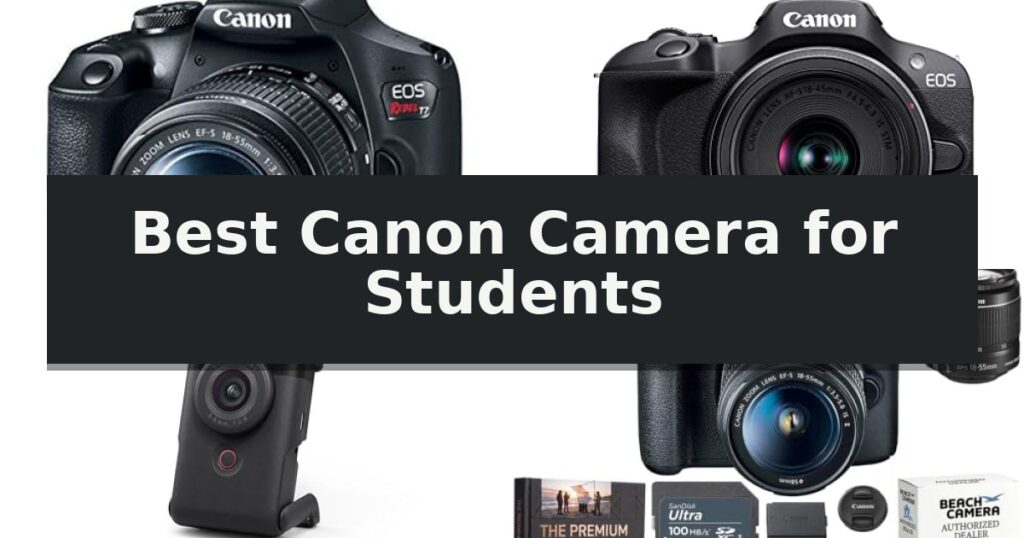
10 Best Canon Camera for Students in 2026 Reviews
Quick Comparison
| Product | Best For | Key Strength | Score |
|---|---|---|---|
| Canon EOS Rebel T7 DSLR Camera | Best Overall | High-resolution 24.1 Megapixel sensor for detailed image capture. | 4.9 |
| Canon EOS R100 Mirrorless Camera | Compact Modern Mirrorless Learning Tool | Compact and lightweight body design for excellent mobility. | 4.8 |
| Canon PowerShot V10 Vlogging Camera | Pocket-Sized Choice for Student Creators | Ultra-portable, pocket-sized design ideal for students on the move. | 4.4 |
| Canon EOS Rebel T7 Double Lens Kit | Versatile Zoom Range for Campus Life | Versatile dual-lens bundle covering wide-angle to telephoto focal lengths. | 4.3 |
| Canon PowerShot SX740 HS Digital Camera | High-Zoom Travel Pick for Students | 40x optical zoom provides exceptional reach in a compact body. | 4.9 |
| Canon EOS Rebel T6 DSLR Camera | Budget-Friendly DSLR for Beginners | Built-in Wi-Fi and NFC for convenient image sharing. | 4.3 |
| Canon PowerShot ELPH 360 HS Camera | Ultra-Portable Point and Shoot | Ultra-compact design for easy portability. | 4.9 |
| Canon AE-1 35mm SLR Camera | Classic Analog Experience for Learners | Full manual control for educational skill development. | 4.9 |
| Canon EOS Rebel T3i DSLR Camera | Reliable Entry-Level Film Foundation | Manual video controls for creative flexibility. | 4.3 |
| Canon EOS Rebel G Film Camera | Affordable Introduction to Film | Versatile shooting modes including full manual control for educational purposes. | 4.8 |
How We Chose
When evaluating the best camera for students, we prioritize practical utility over marketing specifications. An effective student camera must bridge the gap between automatic convenience and manual creative control. We assess each model based on its ability to teach core photographic principles while remaining durable and portable enough for daily academic life.
- Sensor size and resolution for print-ready image quality
- Lens system compatibility for future skill expansion
- Ease of manual control access for learning exposure
- Portability and weight for daily campus transport
- Connectivity features for quick file transfer and sharing
1 Canon EOS Rebel T7 DSLR Camera — Ideal Starter for Photography Students
Mastering the fundamentals of photography requires gear that balances manual control with accessible technology, and the Canon EOS Rebel T7 DSLR Camera provides a reliable foundation for those learning the craft. This camera centers on a 24.1 Megapixel CMOS (APS-C) sensor, which delivers the high-resolution detail necessary for students to analyze their compositions and lighting choices effectively.
Designed for versatility, the system features a 9-Point AF system with AI Servo AF to assist in tracking moving subjects, a critical skill for developing photographers. The inclusion of an Optical Viewfinder offers approximately 95% viewing coverage, allowing students to frame their shots naturally while learning to manage exposure settings manually.
Connectivity is integrated through built-in Wi-Fi and NFC technology, enabling quick transfer of images to compatible devices for review or sharing. Furthermore, the camera supports the EOS Utility Webcam Beta Software, allowing it to function as a high-quality webcam, which adds utility beyond still photography for students who need to participate in remote learning or video projects.
The kit includes an EF-S 18-55mm f/3.5-5.6 IS II lens, providing a standard focal range suitable for a variety of academic assignments. As students progress, they can expand their capabilities by utilizing the wide array of compatible Canon EF and EF-S lenses, ensuring the camera remains a relevant tool as their technical skills grow.
Best for: Students seeking a dedicated DSLR platform to learn manual exposure, composition, and lens-based photography techniques.
Skip if: Users who prioritize a compact, pocketable form factor or those who require advanced 4K video recording capabilities.
- High-resolution 24.1 Megapixel sensor for detailed image capture.
- Versatile lens compatibility with the extensive Canon EF and EF-S ecosystem.
- Built-in Wi-Fi and NFC for streamlined file sharing.
- Educational utility via webcam software integration.
- Optical viewfinder coverage is limited to approximately 95%.
- Fixed screen design lacks the articulation found in more advanced models.
2 Canon EOS R100 Mirrorless Camera — Compact Modern Mirrorless Learning Tool
The Canon EOS R100 Mirrorless Camera serves as a streamlined entry point for students, featuring a 24.1 megapixel CMOS (APS-C) sensor that delivers high-resolution imagery with natural bokeh. Its design prioritizes portability, standing as the smallest and lightest body within the EOS R series, which helps when moving between classrooms or field locations.
Equipped with the DIGIC 8 image processor, this camera supports 4K video recording at 24 fps and Full HD at 60 fps, while also offering high-speed HD capture at 120 fps. The integration of Dual Pixel CMOS AF provides coverage across 143 zones, utilizing human face and eye detection to maintain focus on subjects during both still photography and video production.
For students focused on versatility, the system includes animal and vehicle detection capabilities, enhancing its utility for diverse shooting environments. The camera supports continuous shooting at up to 6.5 shots per second in One-Shot AF mode, allowing for quick adjustments when capturing dynamic scenes.
Connectivity is managed through built-in Wi-Fi and Bluetooth, facilitating the transfer of media for quick editing or sharing. While it provides a robust feature set for those learning the fundamentals of mirrorless systems, users should note that it is designed specifically for portability and entry-level ease of use, which may influence accessory compatibility compared to higher-tier professional models.
Best for: Students seeking a lightweight, portable mirrorless camera for learning photography and video fundamentals.
Skip if: Users requiring advanced professional video features like higher 4K frame rates or specialized external connectivity ports.
- Compact and lightweight body design for excellent mobility.
- Dual Pixel CMOS AF with human, animal, and vehicle detection.
- 24.1 megapixel CMOS sensor for high-quality image detail.
- Versatile video options including 4K at 24 fps and 120 fps HD.
- Entry-level feature set may lack advanced professional-grade video tools.
- Fixed-screen design limits some creative angles compared to articulating displays.
3 Canon PowerShot V10 Vlogging Camera — Pocket-Sized Choice for Student Creators
The Canon PowerShot V10 Vlogging Camera is built for creators who need a pocket-sized powerhouse that balances high-quality video with extreme portability. Weighing just 0.47 pounds, this device integrates a 15.2-megapixel 1-inch back-illuminated CMOS sensor, providing significant low-light performance in a form factor that fits easily into a student's bag.
Designed for versatility, the camera features an innovative adaptable built-in stand that folds forward or backward, allowing for hands-free shooting in various environments without needing external tripods. The fixed 19mm wide-angle lens is optimized for capturing expansive scenes or tight interior spaces, while the retractable flip-LCD screen ensures you can frame your shots accurately while recording.
Audio quality is addressed through a sophisticated three-microphone system, including two stereo mics and a center mic dedicated to background noise reduction. For those looking to elevate their content, the device supports 4K video recording at 30 fps and Full HD at 60 fps, complemented by 14 built-in movie color filters to adjust the mood of your footage instantly.
Connectivity and usability are streamlined for modern workflows with a USB-C charging port, micro-HDMI output, and an external mic auxiliary port. With recent firmware updates, users can utilize three distinct image stabilization modes—IS Off, IS On, and IS Enhanced—to maintain steady footage during handheld recording sessions.
Best for: Students and content creators who require a highly portable, all-in-one camera for vlogging and social media content creation.
Skip if: Users who require interchangeable lenses or advanced manual zoom capabilities for professional cinematography or long-distance photography.
- Ultra-portable, pocket-sized design ideal for students on the move.
- Integrated adaptable built-in stand for hands-free shooting.
- High-quality 1-inch CMOS sensor for superior low-light performance.
- Advanced three-microphone system for clear audio capture.
- Fixed 19mm wide-angle lens limits zoom flexibility for distant subjects.
4 Canon EOS Rebel T7 Double Lens Kit — Versatile Zoom Range for Campus Life
Capturing campus life or creative projects requires a reliable imaging tool that balances portability with professional-grade control. The Canon EOS Rebel T7 DSLR Camera with 2 Lens Kit provides a comprehensive foundation for students by pairing a high-resolution sensor with a versatile dual-lens system, ensuring you are equipped for both wide-angle landscapes and distant subjects.
At the heart of this system is a 24.1 Megapixel CMOS (APS-C) sensor paired with the DIGIC 4+ image processor, which together manage image quality across a broad ISO range of 100-6400. The inclusion of the EF-S 18-55mm IS II and EF 75-300mm III lenses allows for significant focal length flexibility, making it suitable for everything from classroom documentation to outdoor photography. The 9-point AF system with AI Servo AF helps maintain focus on moving subjects, while the Full HD 1080p video recording capability supports multimedia coursework.
Designed for connectivity, the camera features built-in Wi-Fi and NFC, enabling seamless remote shooting and wireless printing directly from mobile devices. The 3.0-inch LCD screen with 920,000 dots provides a clear interface for menu navigation and image review, while the optical viewfinder offers approximately 95% coverage for traditional framing. The bundle also includes a 64GB SanDisk Ultra SDHC memory card and a protective shoulder bag, ensuring you have the essential accessories to begin shooting immediately.
While this DSLR offers robust manual control, users should note that the continuous shooting speed is capped at 3.0 fps. This makes it an excellent choice for learning the fundamentals of photography and videography, though it may be less suited for high-speed action sequences compared to specialized sports cameras.
Best for: Students seeking a comprehensive, all-in-one photography kit that covers a wide zoom range for academic and creative projects.
Skip if: Students who prioritize high-speed burst photography or a compact, mirrorless form factor for extreme portability.
- Versatile dual-lens bundle covering wide-angle to telephoto focal lengths.
- Built-in Wi-Fi and NFC for convenient remote shooting and mobile connectivity.
- High-resolution 24.1 Megapixel sensor for detailed image capture.
- Includes essential accessories like a 64GB memory card and shoulder bag.
- Limited continuous shooting speed of 3.0 fps.
- Larger physical footprint compared to modern mirrorless alternatives.
5 Canon PowerShot SX740 HS Digital Camera — High-Zoom Travel Pick for Students
For students balancing a busy academic schedule with creative pursuits, the Canon PowerShot SX740 HS Digital Camera offers a versatile, pocket-sized solution for capturing high-quality imagery without the bulk of a traditional DSLR. Its standout feature is the 40x optical zoom lens, which provides a 24–960mm equivalent range, allowing users to photograph everything from expansive campus landscapes to distant subjects during field trips or events.
Equipped with a 20.3MP CMOS sensor and the DIGIC 8 image processor, this camera is engineered to produce sharp, vibrant photos even in challenging lighting conditions. The internal processing helps minimize noise, ensuring that your projects or personal memories maintain clarity and rich color depth regardless of the environment.
Beyond still photography, the device excels in content creation with 4K UHD video recording at 30p. This capability is enhanced by 5-axis stabilization, which helps maintain smooth footage when shooting handheld. Whether you are filming a travel vlog or documenting a project, the stabilization technology compensates for minor movements to keep your video steady.
Connectivity is streamlined through integrated Wi-Fi and Bluetooth, enabling students to transfer files directly to a smartphone via the Canon Camera Connect app. This feature simplifies the workflow for sharing content to social media or cloud storage. The included bundle, which features a 64GB memory card and a carrying bag, provides a convenient, ready-to-use package for those on the go.
Best for: Students who need a highly portable, versatile camera for both long-range photography and high-resolution 4K video recording.
Skip if: Users who require interchangeable lenses or manual control over advanced optical settings will find a dedicated mirrorless or DSLR system more suitable.
- 40x optical zoom provides exceptional reach in a compact body.
- 4K UHD video capability with 5-axis stabilization for smooth handheld recording.
- Wireless connectivity via Wi-Fi and Bluetooth for efficient file transfers.
- Comprehensive bundle includes a 64GB memory card and carrying bag.
- Fixed lens design limits the creative flexibility offered by interchangeable lens systems.
6 Canon EOS Rebel T6 DSLR Camera — Budget-Friendly DSLR for Beginners
Capturing sharp images for photography assignments or creative projects requires a reliable foundation, and the Canon EOS Rebel T6 Digital SLR Camera Kit provides a versatile starting point for students. This camera centers on an 18.0 MP APS-C CMOS sensor paired with the DIGIC 4+ image processor, ensuring high-resolution output suitable for learning the fundamentals of exposure and composition.
The camera includes a high-performance optical viewfinder that allows for precise framing, which is essential for developing manual focusing skills. For those transitioning from smartphone photography, the 3.0-inch 920k-dot LCD monitor offers a clear interface for reviewing shots and navigating settings. The inclusion of Scene Intelligent Auto mode simplifies the process for beginners, while the 9-point AF system with a center cross-type point provides reliable focus tracking for various subjects.
Connectivity is integrated directly into the body, featuring built-in Wi-Fi with NFC to facilitate the transfer of images to compatible devices. Students can also utilize the Full HD 1080p video recording at 30 fps for multimedia projects. With an ISO range of 100-6400, expandable to 12800, the camera maintains functionality across diverse lighting environments, from bright classrooms to dimly lit interiors.
The kit comes equipped with an EF-S 18-55mm f/3.5-5.6 IS II lens, providing a standard focal length range that covers everything from wide-angle landscapes to tight portraits. This combination of a capable sensor, intuitive controls, and essential accessories makes the Canon EOS Rebel T6 Digital SLR Camera a practical tool for academic and personal photographic development.
Best for: Students seeking an entry-level DSLR to learn manual photography controls and composition techniques.
Skip if: Users requiring 4K video recording or high-speed burst rates beyond 3 fps will find this model limiting for advanced cinematography or sports photography.
- Built-in Wi-Fi and NFC for convenient image sharing.
- Optical viewfinder supports traditional photography learning.
- 18.0 MP APS-C sensor delivers high-resolution images.
- Included 18-55mm lens provides immediate versatility for various subjects.
- 3 fps continuous shooting is limited for fast-action subjects.
- 1080p video resolution lacks the detail of modern 4K standards.
7 Canon PowerShot ELPH 360 HS Camera — Ultra-Portable Point and Shoot
Capturing campus life or documenting study sessions requires a device that balances portability with reliable imaging, and the Canon PowerShot ELPH 360 HS Camera delivers this through its pocket-sized design and versatile 12x optical zoom lens. This camera is built for students who need to move quickly between lectures and social outings without carrying bulky equipment.
At the core of this model is a 20.2MP CMOS sensor paired with a DIGIC 4+ processor, which work together to produce high-resolution images and Full HD 1080p video at 30 fps. The ISO sensitivity up to 3200 helps maintain image quality in varying lighting conditions, while the 7.2 fps continuous shooting mode ensures you can capture fast-moving subjects with ease.
Framing your shots is straightforward thanks to the 3.0-inch 461k-dot LCD monitor, which also serves as the interface for navigating menus and reviewing footage. To simplify the creative process, the camera includes built-in tools like Hybrid Auto and Story Highlights, allowing for unique visual effects and automated highlight reels directly on the device, reducing the need for extensive post-production.
The 12x optical zoom covers a 25–300mm equivalent focal range, providing the flexibility to shoot wide landscapes or zoom in on distant details. To ensure these shots remain sharp, the Intelligent IS system automatically adjusts stabilization to minimize camera shake during both still photography and handheld video recording.
Best for: Students who prioritize extreme portability and an all-in-one bundle for casual photography and video documentation.
Skip if: Users who require manual lens control, interchangeable lenses, or advanced professional-grade sensor performance for specialized academic projects.
- Ultra-compact design for easy portability.
- Versatile 12x optical zoom range.
- Includes 64GB memory card and case bundle.
- Intelligent IS stabilization for steady handheld shots.
- Fixed lens system limits manual control.
- Smaller sensor size compared to mirrorless alternatives.
8 Canon AE-1 35mm SLR Camera — Classic Analog Experience for Learners
The Vintage Canon AE-1 35mm SLR Camera with 50mm 1:1.8 Lens (Renewed) offers a tactile, hands-on approach to photography that remains a foundational tool for students learning the mechanics of exposure. By combining a classic aesthetic with a robust metal body, this camera provides a durable platform for mastering the fundamentals of film photography.
Equipped with a versatile TTL Metering system, the camera assists in achieving accurate exposure readings across varying light levels. Users can toggle between Auto and Manual modes, allowing students to transition from simple point-and-shoot operation to full creative control as their technical skills develop.
The camera features a wide range of shutter speeds from 1/1000 to 2 seconds, plus a Bulb mode for long-exposure work. Its compatibility with Canon FD lenses ensures that students can expand their kit with various optics, from wide-angle to telephoto, as their specific photographic interests evolve.
Designed for those who value a traditional shooting experience, this model balances manual precision with enough automation to support the learning process. Its compact dimensions and straightforward interface make it a practical choice for students who want to focus on composition and lighting without the complexity of modern digital menus.
Best for: Students seeking to learn the fundamentals of manual exposure and film photography through a classic, tactile interface.
Skip if: Students who require the immediate feedback, high-speed burst rates, or digital file convenience of modern mirrorless or DSLR systems.
- Full manual control for educational skill development.
- TTL Metering provides reliable exposure guidance.
- Interchangeable Canon FD lens compatibility allows for system expansion.
- Robust metal body construction for long-term use.
- Analog film workflow requires ongoing investment in film and processing.
- Manual focus only, which may be challenging for beginners.
9 Canon EOS Rebel T3i DSLR Camera — Reliable Entry-Level Film Foundation
Learning the fundamentals of photography requires a reliable tool that balances manual control with accessible operation. The Canon EOS Rebel T3i DSLR Camera provides an 18MP APS-C CMOS sensor and a 9-point AF system, offering students a solid foundation for understanding exposure and composition without the complexity of professional-grade equipment.
Designed with a focus on versatility, this camera supports 1080p HD video recording with full manual controls, allowing for creative experimentation in both still photography and cinematography. The inclusion of an EF-S 18-55mm f/3.5-5.6 IS lens ensures that users have a standard focal range suitable for various academic projects, from portraiture to general campus documentation.
Performance is supported by a continuous shooting speed of 3.7 frames per second, which is useful for capturing movement during events or sports. The native ISO range of 100-6400, expandable to 12800, provides the necessary flexibility to adjust for different lighting conditions, a critical skill for any developing photographer.
Compact and manageable, the body measures approximately 5.24 x 3.94 x 3.15 inches and weighs 1.26 pounds, making it portable enough for daily use in a backpack. While it is an older model, its straightforward interface remains an effective way to master the exposure triangle before transitioning to more advanced systems.
Best for: Students seeking an affordable, entry-level DSLR to learn manual photography and videography fundamentals.
Skip if: Users requiring high-speed burst rates for professional sports photography or those prioritizing the compact form factor of modern mirrorless systems.
- Manual video controls for creative flexibility.
- 18MP APS-C sensor provides high-resolution imaging for learning.
- Expandable ISO up to 12800 for varied lighting environments.
- Includes versatile 18-55mm lens for immediate use.
- Older release date limits modern autofocus tracking capabilities.
- 3.7 fps burst rate is restricted for fast-action subjects.
10 Canon EOS Rebel G Film Camera — Affordable Introduction to Film
The Canon New EOS Kiss (AKA Rebel G in USA/Canada) SLR AF Film Camera offers a tactile, hands-on approach to photography that remains a staple for students learning the fundamentals of exposure and composition. By utilizing a 35-80mm EF lens, this system provides the versatility needed to transition between wide-angle landscapes and tighter portrait framing without changing optics.
Designed with an intuitive user interface, the camera simplifies the transition to film by incorporating a clear LCD display and straightforward control dials. Students can rely on the wide-area autofocus system to maintain sharpness on moving subjects, while the built-in flash ensures consistent illumination when shooting in low-light indoor environments or classrooms.
Flexibility is central to the shooting experience, as the device supports multiple modes including full auto, program, aperture priority, and shutter priority. These settings allow users to experiment with depth of field and motion blur, providing the technical control necessary for academic photography projects.
As a renewed model, this camera provides a cost-effective entry point into the Canon EF lens ecosystem. While it requires the ongoing purchase and development of 35mm film, the ability to manually adjust settings ensures that students gain a comprehensive understanding of how light and mechanics interact to create an image.
Best for: Students seeking a reliable, manual-capable film camera to learn the core principles of photography and exposure.
Skip if: Users who require the immediate feedback and digital workflow efficiency of a modern mirrorless or DSLR camera.
- Versatile shooting modes including full manual control for educational purposes.
- Wide-area autofocus system for reliable subject tracking.
- Integrated flash for consistent lighting in various conditions.
- Compatible with Canon EF lenses for future system expansion.
- Requires 35mm film and development, which involves recurring costs.
- Limited to film-based capture, lacking digital file output.
Best Canon Camera for Students Buying Guide
Understanding Sensor Formats
Most entry-level cameras utilize an APS-C sensor, which provides an ideal balance between image quality and physical size. This format is standard for students because it offers a shallower depth of field than smartphone sensors, helping learners understand how aperture affects subject isolation.
Larger sensors generally perform better in low light, which is critical for students shooting in classrooms or evening events. Choosing an APS-C model ensures you have access to a wide range of affordable lenses designed specifically for this sensor size.
The Importance of Lens Ecosystems
A camera body is only as versatile as the lenses attached to it. Students should look for systems with a robust selection of prime and zoom lenses, as this allows for experimentation with different focal lengths without needing to replace the entire camera body.
Investing in a system with interchangeable lenses is the most significant step a student can take toward professional development. It allows you to specialize in portraiture, street photography, or landscapes as your interests evolve during your studies.
Manual Control and Ergonomics
The primary goal of a student camera is to facilitate the learning of manual exposure. Look for a camera that features dedicated dials for shutter speed and aperture, rather than burying these essential settings deep within digital menus.
Ergonomics play a vital role in long-term comfort. A camera that feels secure in your hand encourages more frequent shooting, which is the fastest way to improve. Ensure the grip is substantial enough to hold steady during longer sessions.
Connectivity and Workflow
Modern students require efficient workflows to move images from the camera to editing software or social media. Built-in Wi-Fi and Bluetooth are essential features for transferring files wirelessly to a smartphone or tablet on the go.
Consider how the camera integrates with your existing computer setup. Features like webcam utility software can add value by allowing the camera to serve a dual purpose for remote learning or video conferencing when not in use for photography.
Balancing Portability and Durability
Campus life is demanding, and your camera will likely spend a lot of time in a backpack. Compact mirrorless bodies are often easier to carry, but they may require more frequent battery changes compared to larger DSLR models.
Durability is a trade-off with weight. While lighter plastic-bodied cameras are easier to carry, they require more careful handling. Always pair your camera with a protective bag to ensure it survives the rigors of daily transit between classes.
Frequently Asked Questions
Is a DSLR better than a mirrorless camera for a student?
DSLRs often provide a more tactile, traditional shooting experience with long battery life, while mirrorless cameras are typically lighter and offer more advanced autofocus features. Both are excellent for learning.
Do I need a camera with 4K video capabilities?
If your coursework involves film or digital media, 4K is beneficial. For pure photography students, high-resolution stills are more important than video specs.
Can I use older lenses on a new Canon camera?
Many Canon DSLRs are compatible with a wide range of EF and EF-S lenses. If you move to the newer R-series mirrorless system, you may need an adapter to use older glass.
What is the most important feature for a beginner?
The ability to easily switch to Manual (M) mode is the most important feature, as it allows you to learn how aperture, shutter speed, and ISO work together.
How much should a student spend on their first camera?
It is often better to spend less on the body and save budget for a high-quality lens, as lenses have a greater impact on image quality than the camera body itself.
Conclusion: Our Top Pick
Our top pick is Canon EOS Rebel T7 DSLR Camera. Choosing the right camera is a foundational step in your photographic journey. By focusing on manual controls and lens compatibility, you ensure that your gear supports your education rather than limiting your creative potential.
Whether you choose a versatile DSLR or a compact mirrorless model, the best camera is the one you carry with you. Prioritize the features that align with your specific field of study to get the most value from your investment.