Cozyego X3115 Brushless FPV Motor is our top choice for the Best Long-Range FPV Drones, offering exceptional torque and efficiency for 9-inch and 10-inch propeller setups. For pilots seeking a complete, ready-to-fly experience with integrated GPS, the Holy Stone HS360D GPS Drone serves as a capable alternative, while the HGLRC 10-inch FPV Racing Frame provides a robust foundation for custom long-range builds.
Selecting the right components for long-range flight requires balancing power output with structural integrity. Whether you are assembling a custom quadcopter from individual motors and frames or choosing a pre-built GPS drone, the primary goal is maintaining stable signal transmission and flight efficiency over extended distances.
Experienced pilots should prioritize motor compatibility with propeller size and the overall weight of the airframe. Understanding how voltage support and transmission range impact your specific flying style ensures that your chosen equipment can handle the demands of long-range aerial exploration without compromising stability.
For those interested in broader aerial capabilities, our guide on Best Long-Range Drones provides additional insights into selecting complete systems for extended missions.
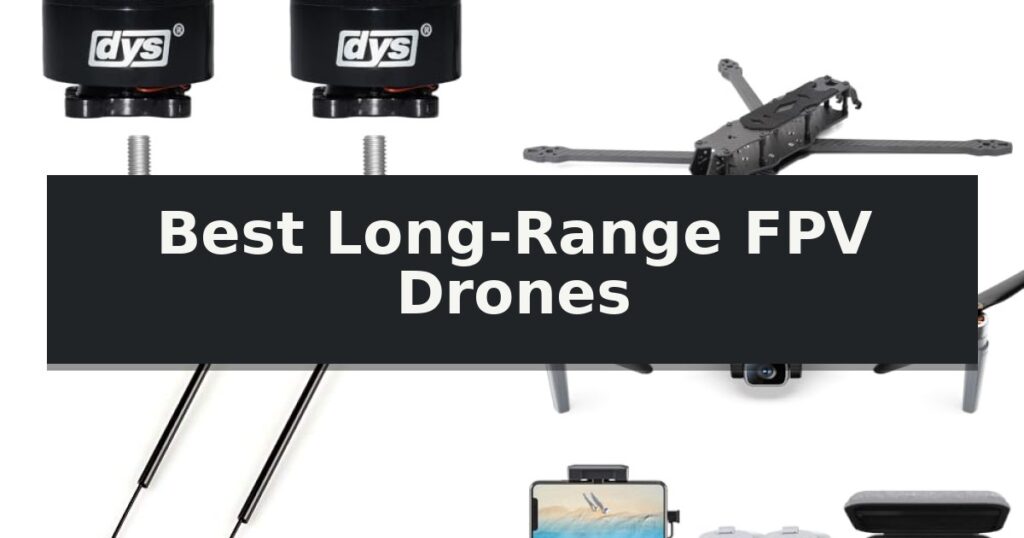
10 Best Long-Range FPV Drones in 2026 Reviews
Quick Comparison
| Product | Best For | Key Strength | Score |
|---|---|---|---|
| Cozyego X3115 Brushless FPV Motor | Best Overall | 12N14P high-torque design for responsive flight control. | 4.9 |
| HGLRC 10-inch FPV Racing Frame | Stable Platform for Long-Range Builds | Robust 3K carbon fiber construction for high durability. | 4.7 |
| HGLRC 5.8G FPV Long-Range Antenna | Enhanced Signal for Distant Flights | 2.5 dBi gain for reliable long-range signal strength | 4.5 |
| Holy Stone HS360D GPS Drone | Long-Range 6KM FPV Transmission | 6KM HD transmission range with low-latency wired controller connection. | 4.7 |
| GXTDL M24 Long-Range GPS Drone | Extended 3KM Control Range | Under 249g weight avoids complex registration requirements. | 4.5 |
| Punieayi ZY90 PRO GPS Drone | Long-Range 6,500ft Transmission | Dedicated 5.7-inch touchscreen controller eliminates the need for smartphone app connectivity. | 4.7 |
| Nexaero F3 GPS Drone | Built-in Screen for Latency-Free FPV | Built-in 7.22-inch controller display for latency-free FPV. | 4.7 |
| Dingdongwu F3 GPS Drone | Integrated Screen for Long-Range FPV | Integrated 7.22-inch screen eliminates the need for smartphone app connectivity. | 4.3 |
| NAFYRE N11 PRO GPS Drone | Reliable 3,328ft Control Range | Under 0.55lb weight eliminates the need for FAA registration. | 4.3 |
| Vvoqeote GPS Camera Drone | Extended 60-Minute Flight Time | Built-in 4.5-inch HD screen eliminates the need for a smartphone app. | 4.4 |
How We Chose
Evaluating the best long-range FPV drones requires a technical assessment of individual components and integrated flight systems. We prioritize hardware that demonstrates consistent power delivery, structural resilience, and reliable signal connectivity. By analyzing these specific performance metrics, we identify equipment capable of maintaining stable, long-distance flight under varied environmental conditions.
- Motor torque and efficiency ratings for sustained flight
- Frame structural durability and vibration dampening
- Signal transmission range and latency stability
- Battery capacity and total flight time endurance
- GPS positioning accuracy and automated return-to-home reliability
1 Cozyego X3115 Brushless FPV Motor — High-Torque for Long-Range Cruising
The Cozyego X3115 Brushless FPV Motor is engineered specifically for pilots seeking reliable thrust and stability in larger-scale aerial platforms. Featuring a 12N14P motor design, this component delivers the high torque necessary for smooth, responsive control, making it a suitable candidate for long-range cruising and freestyle flight.
Designed to accommodate larger airframes, the motor includes M3*19 mounting holes optimized for 9-inch and 10-inch propellers. This configuration is intended to maximize lift and stability, providing the mechanical leverage required to carry the equipment loads often associated with long-range FPV setups.
Versatility is a core feature, as the unit supports a 2S-6S LiPo voltage range. This wide compatibility allows builders to adapt their power systems to specific flight requirements, whether prioritizing extended flight times or aggressive performance. The brushless architecture is built for high-efficiency power delivery, translating battery energy into consistent thrust.
To address the thermal demands of extended flight, the motor incorporates robust construction with effective heat dissipation features. This design choice aims to maintain performance reliability and extend the overall lifespan of the motor under the sustained operational conditions typical of long-range FPV missions.
Best for: Pilots building 9-inch or 10-inch FPV drones who require high-torque motors capable of supporting long-range flight and varied LiPo configurations.
Skip if: Pilots operating smaller 5-inch or micro-class FPV drones, as the physical size and mounting specifications of this motor are optimized for larger airframes.
- 12N14P high-torque design for responsive flight control.
- Wide 2S-6S LiPo compatibility for flexible power setups.
- Optimized for 9-10 inch propellers to maximize lift and stability.
- Integrated heat dissipation for improved long-term reliability.
- Large physical footprint may not be compatible with smaller drone frames.
2 HGLRC 10-inch FPV Racing Frame — Stable Platform for Long-Range Builds
The HGLRC 415mm 10 inch FPV Racing Drone Frame is engineered for pilots prioritizing long-range flight and freestyle training. Its primary advantage lies in the robust 3K carbon fiber build, which provides the necessary structural integrity to withstand the rigors of extended flight sessions and potential impacts.
This frame features an optimized geometry designed to balance stability with responsive handling, a critical requirement for executing sharp maneuvers. The design includes an integrated stack holder and dedicated cable routing paths, which streamline the assembly process and help maintain a clean internal layout for sensitive electronics.
Practicality is further enhanced by the integrated component guard and elevated arm design. These features serve to protect propellers and the camera from ground contact during landings or unexpected encounters. The frame is part of a modular series, offering versatility for those who may eventually want to transition between 5-inch, 7-inch, or 10-inch configurations.
While the 10-inch variant is specifically tailored for long-range capabilities, builders should note that the frame's performance is highly dependent on the selection of compatible motors, flight controllers, and battery systems. The open-frame design requires careful component selection to ensure the final build remains within the intended weight and balance specifications.
Best for: Pilots seeking a durable, stable platform for long-range FPV flight and freestyle training.
Skip if: Pilots looking for a pre-assembled, ready-to-fly drone, as this is a frame-only kit requiring full assembly and component sourcing.
- Robust 3K carbon fiber construction for high durability.
- Integrated component guard protects hardware during landings.
- Optimized geometry for stable and responsive flight handling.
- Simplified assembly with integrated stack holder and cable routing.
- Frame-only kit requires separate purchase of all electronic components.
- Larger 10-inch footprint may be less agile than smaller freestyle frames.
3 HGLRC 5.8G FPV Long-Range Antenna — Enhanced Signal for Distant Flights
Maintaining a stable link during extended flight is essential for any pilot pushing the limits of their equipment, and the HGLRC 5.8G FPV Long-Range Antenna is engineered to address this need. Operating within a frequency range of 5500-6000 MHz, this component is built to provide consistent signal transmission, helping to minimize the risk of interference or dropouts when flying at a distance.
The antenna features a 2.5 dBi gain, which is specifically optimized to balance signal reach with efficiency. By focusing on robust signal strength, it helps ensure that the communication between the UAV and the pilot remains reliable throughout the flight path. This specification is a practical choice for those who prioritize steady video feeds over extreme directional range.
Durability is a core design consideration, evidenced by the use of a high-quality ABS radome material. This housing serves as a protective shell for the internal components, offering resistance to environmental factors that might otherwise degrade performance during outdoor use. The black finish provides a low-profile aesthetic that integrates cleanly with various drone builds.
Versatility is further supported by the unit's 50Ω input impedance and standard SMA connector type. This configuration allows for straightforward integration with a wide variety of existing UAV systems, making it a convenient upgrade for pilots who want to swap out stock hardware without needing specialized adapters or complex modifications to their current setup.
Best for: Pilots seeking a durable, high-efficiency antenna upgrade for long-range FPV drone signal stability.
Skip if: Users whose specific drone hardware or video transmission systems require a connector type other than SMA.
- 2.5 dBi gain for reliable long-range signal strength
- ABS radome construction provides environmental durability
- Standard SMA connector ensures broad system compatibility
- Fixed connector type may require adapters for non-SMA systems
4 Holy Stone HS360D GPS Drone — Long-Range 6KM FPV Transmission
The Holy Stone HS360D GPS Drone prioritizes long-range connectivity by utilizing a wired connection between the remote controller and your mobile device, which is designed to reduce video latency compared to standard WiFi-only systems. This architecture supports a stable 6KM HD image transmission range, providing a consistent live feed for pilots operating at significant distances.
Equipped with a 1/3'' CMOS sensor and a 4K wide-angle lens, the drone captures 3840×2160 resolution imagery across an 85° field of view. The system is powered by two included batteries that provide up to 80 minutes of total flight time, allowing for extended sessions without frequent landing for power swaps.
The airframe weighs under 249g, a design choice that classifies it as FAA-friendly and removes the necessity for registration in the United States. Its foldable construction ensures portability for outdoor use, while the integrated GPS enables automated flight modes such as Follow Me, Waypoint Flight, and Circle Fly.
Operational safety and ease of use are supported by an Auto Return to Home function and beginner-friendly controls. The Holy Stone HS Fly App provides a platform for ongoing firmware updates, which the manufacturer notes are intended to enhance flight performance and image quality over the life of the product.
Best for: Beginners and travelers who require a lightweight, FAA-compliant drone with extended flight time and long-range transmission capabilities.
Skip if: Professional cinematographers requiring higher-end camera sensors or advanced obstacle avoidance systems not present in this model.
- 6KM HD transmission range with low-latency wired controller connection.
- Under 249g weight eliminates the need for FAA registration.
- 80-minute total flight time provided by the included dual-battery setup.
- Smart GPS modes including Follow Me and Auto Return to Home.
- Fixed 85° field of view may limit creative framing compared to adjustable gimbal-heavy professional drones.
- Dependent on mobile device connection for full FPV functionality.
5 GXTDL M24 Long-Range GPS Drone — Extended 3KM Control Range
Capturing expansive aerial footage requires a reliable connection, and the GXTDL M24 Long-Range GPS Drone addresses this with a dedicated 4.5-inch touchscreen controller that provides stable, real-time FPV viewing. This integration simplifies the piloting experience by removing the need for a separate smartphone, allowing for a more focused flight session.
The drone is engineered for extended exploration, offering a maximum remote control range of up to 9,842 feet. To support longer missions, the package includes three high-capacity 7.4V 2000mAh intelligent batteries, which combine for a total flight time of 90 minutes. Stability during these flights is maintained by four upgraded brushless motors, which provide consistent performance even in breezy conditions.
Safety and ease of use are central to the design, featuring 360° all-round obstacle avoidance to help navigate complex environments. For beginners, the GPS auto-return function is a critical safety net; the drone automatically calculates a route back to the takeoff point if the signal is lost or the battery level drops, ensuring the aircraft remains recoverable.
Portability is a key advantage, as the GXTDL M24 Long-Range GPS Drone weighs under 249 grams. This specific weight class is significant because it eliminates the need for FAA or Remote ID registration in many regions. The foldable design and included carrying case make it a practical choice for those who need a lightweight, high-performance drone for travel or outdoor adventures.
Best for: Beginners and creators who need a lightweight, portable drone with long flight times and an integrated touchscreen controller.
Skip if: Professional cinematographers requiring higher-end sensor performance or advanced obstacle-sensing capabilities beyond the scope of this beginner-focused model.
- Under 249g weight avoids complex registration requirements.
- 90 minutes total flight time via three included batteries.
- Integrated 4.5-inch touchscreen for simplified FPV control.
- 360° obstacle avoidance enhances safety for new pilots.
- Fixed 3KM control range may be limited compared to professional-grade long-range systems.
6 Punieayi ZY90 PRO GPS Drone — Long-Range 6,500ft Transmission
The Punieayi ZY90 PRO GPS Drone distinguishes itself with a dedicated 5.7-inch touchscreen remote controller, allowing pilots to monitor live FPV feeds without relying on a smartphone app. This integration simplifies the setup process and provides a direct, stable connection for long-range flights up to 6,500 feet.
Designed for versatility, this quadcopter features a 4K camera with a 90-degree adjustable lens, capable of recording 2K video at 30fps. The inclusion of powerful brushless motors and Level 4 wind resistance ensures stability during flight, while built-in composition guides—such as a 3×3 grid and center dot—assist users in framing professional-quality shots.
Operational efficiency is a core focus, as the drone comes with two 7.4V 3500mAh batteries that provide a combined 100 minutes of flight time. The system supports USB-C fast charging, minimizing downtime between sessions. Safety is prioritized through smart GPS functions, including one-key return, low-power auto return, and beginner-friendly flight modes that allow for altitude and distance limitations.
The drone is engineered to be accessible for novices while offering features that appeal to experienced creators. It includes automated flight patterns like Rocket, Helix, and Follow Me, which are easily triggered through the intuitive touchscreen interface. Pilots must remember to perform the inverted-V joystick maneuver to unlock the motors before takeoff.
Best for: Beginners and creators seeking an all-in-one FPV drone with a dedicated touchscreen controller and extended flight endurance.
Skip if: Pilots requiring professional-grade cinematic stabilization or those who prefer ultra-compact, sub-250g drones for travel.
- Dedicated 5.7-inch touchscreen controller eliminates the need for smartphone app connectivity.
- 100-minute total flight time provided by two high-capacity 3500mAh batteries.
- Smart GPS features including auto-return and customizable flight boundaries for safety.
- Built-in composition guides to assist with professional framing and symmetry.
- Requires specific manual unlocking procedure (inverted-V joystick motion) which may be non-intuitive for some users.
- Heavier footprint compared to ultra-lightweight portable drones.
7 Nexaero F3 GPS Drone — Built-in Screen for Latency-Free FPV
Achieving a seamless aerial perspective often requires balancing portability with transmission reliability. The Nexaero F3 GPS Drone addresses this by integrating a 7.22-inch display directly into the remote controller, effectively removing the need for a smartphone or external app during flight. This design choice provides real-time FPV transmission with zero latency, allowing for immediate photo and video previews directly on the controller hardware.
Engineered for versatility, the Nexaero F3 GPS Drone captures 2K resolution photos and 2K/60fps HDR video. To maintain clarity during flight, the system utilizes EIS (Electronic Image Stabilization) to mitigate shake, even when operating in windy conditions. The drone also incorporates an AI-powered tracking system for precise object locking, alongside specialized modes for capturing clear imagery during night operations.
The unit is designed for extended utility, offering up to 64 minutes of total flight time through the use of two 7.6V 2700mAh modular batteries. Weighing under 249g, the drone avoids the need for FAA and Remote ID registration, making it a convenient option for travel. For added operational security, the Smart Safety Ecosystem triggers an automatic return to the take-off point if the battery reaches a low level, if the signal is lost, or if the pilot manually engages the return function.
Beginners should note that the manufacturer recommends initial practice in a windless indoor environment, keeping altitude under 6 meters and distance within 30 meters. Proper pre-flight calibration is required to ensure the GPS positioning capabilities function accurately, which also serves as a recovery tool should the drone need to be located after a flight.
Best for: Pilots who prefer an all-in-one flight system with a dedicated, built-in screen that eliminates the need for smartphone integration.
Skip if: Users who require professional-grade 4K cinematic resolution or advanced obstacle avoidance sensors found in larger, more expensive enterprise-class drones.
- Built-in 7.22-inch controller display for latency-free FPV.
- Under 249g weight eliminates the need for FAA and Remote ID registration.
- 64 minutes of total flight time via dual modular batteries.
- EIS image stabilization for shake-free video capture.
- Limited to 2K resolution, which may not satisfy users seeking 4K or higher output.
- Manual calibration required for optimal GPS performance.
8 Dingdongwu F3 GPS Drone — Integrated Screen for Long-Range FPV
Capturing high-quality aerial footage often requires complex setups, but the Dingdongwu F3 GPS Drone simplifies the process by integrating a 7.22-inch screen directly into the remote control. This design choice removes the need for a smartphone app, providing a true plug-and-play experience with zero connection delays for real-time FPV.
The drone is equipped with a 2K HD camera featuring a 90-degree adjustable lens and a wide 100-110 degree field of view. To ensure stable flight during outdoor sessions, it utilizes 1503 brushless motors that provide Level 5 wind resistance. The package includes two intelligent 7.4V 2000mAh batteries, offering a combined 64-minute total flight time for extended exploration.
Portability is a primary focus, as the unit weighs under 249g and features a foldable design, making it exempt from FAA Remote ID registration requirements. For added security, the Dingdongwu F3 GPS Drone includes an anti-lost program with one-key return and automatic return functions triggered by low battery or signal loss.
Advanced flight features include AI object locking and tracking, as well as specialized modes for capturing clear video during night shots. The drone comes as a complete kit, including a carrying case, spare propellers, and an SD card, ensuring users have all necessary components for immediate operation.
Best for: Beginners and travelers seeking a portable, FAA-compliant drone with an integrated screen for simplified FPV flight.
Skip if: Users who require professional-grade 4K cinematic resolution or advanced obstacle avoidance sensors found in higher-tier, heavier drone models.
- Integrated 7.22-inch screen eliminates the need for smartphone app connectivity.
- Under 249g weight ensures exemption from FAA Remote ID registration.
- 64-minute total flight time provided by the included dual-battery system.
- Level 5 wind resistance supported by brushless motors for stable outdoor flight.
- 2K resolution may not meet the needs of users requiring 4K or higher video quality.
- Fixed camera resolution limits post-production cropping flexibility compared to higher-end sensors.
9 NAFYRE N11 PRO GPS Drone — Reliable 3,328ft Control Range
Capturing aerial footage over significant distances requires a reliable connection and stable flight characteristics. The NAFYRE N11 PRO GPS Drone addresses this by offering a 3,328-foot control range and a 5GHz FPV transmission system, ensuring a consistent link between the pilot and the aircraft during extended flights.
Engineered for efficiency, this mid-sized GPS drone utilizes alloy brushless motors that provide increased wind resistance compared to standard brushed alternatives. The package includes three batteries, which combine to deliver a 90-minute total flight time, allowing for prolonged sessions without frequent ground stops.
The NAFYRE N11 PRO GPS Drone features a dual positioning system that integrates GPS for stable outdoor hovering with optical flow positioning for controlled indoor flight. These systems enable automated features such as Follow Me, Tap Fly, and Point of Interest, which simplify complex shots by handling flight paths automatically.
Equipped with a 4K UHD camera, the drone captures 4096×3072 resolution photos and 2048×1080 video. The 100° wide-angle lens is adjustable by 90° via remote control or app, providing flexibility in framing shots. Weighing under 0.55lb, the unit is designed to bypass the requirement for FAA registration in the United States, simplifying the setup process for new operators.
Best for: Beginners and hobbyists looking for a lightweight, FAA-registration-free drone capable of long-range flight with extended battery life.
Skip if: Professional cinematographers requiring higher-bitrate video recording or advanced obstacle avoidance sensors for complex environments.
- Under 0.55lb weight eliminates the need for FAA registration.
- 90-minute total flight time provided by the included three-battery set.
- 3,328-foot control range for expansive aerial operations.
- Brushless motors offer improved wind resistance and durability.
- No charger included in the standard package.
- Mid-sized frame may be less portable than dedicated mini-drones.
10 Vvoqeote GPS Camera Drone — Extended 60-Minute Flight Time
Capturing aerial footage without the need for a mobile device is the primary advantage of the Vvoqeote GPS Camera Drone, which features a 4.5-inch HD screen integrated directly into the remote controller. This design choice allows for immediate live flight monitoring as soon as the system is powered on, streamlining the setup process for users who prefer an all-in-one hardware experience.
The drone is equipped with a 4K camera featuring a remotely adjustable 90° lens, providing flexibility to change shooting angles mid-flight. To ensure stable and efficient operation, the quadcopter utilizes brushless motors. The package includes two rechargeable batteries, offering a combined total flight time of up to 60 minutes, with each battery supporting approximately 30 minutes of operation.
Navigation and safety are supported by GPS positioning, which enables features such as One-Key Return, Low Battery Return, and Signal Loss Return. For creative flight paths, the system includes smart modes like Follow Me, Tap Fly, and Point of Interest. The unit is designed for portability, featuring a foldable frame and a total weight of under 249g.
Ease of use is prioritized through flight-assist functions including One-Key Takeoff/Landing, Headless Mode, and Altitude Hold. Users can select between 3 Speed Modes to match their experience level, while additional features like Gesture Photo offer further interaction options for capturing aerial content.
Best for: Beginners and travelers who prioritize a self-contained controller with a built-in screen and extended flight time.
Skip if: Users requiring professional-grade gimbal stabilization or advanced obstacle avoidance sensors for complex cinematography.
- Built-in 4.5-inch HD screen eliminates the need for a smartphone app.
- 60-minute total flight time provided by the included dual-battery system.
- GPS-enabled safety features including automatic return-to-home functions.
- Lightweight, foldable design weighing under 249g for easy transport.
- No advanced obstacle avoidance sensors included in the hardware package.
- Fixed-gimbal design relies on manual lens adjustment rather than active stabilization.
Best Long-Range FPV Drones Buying Guide
Motor and Propeller Matching
The relationship between motor KV ratings and propeller size is critical for long-range efficiency. Motors like the X3115 are designed to provide the high torque necessary to spin larger 9-inch or 10-inch propellers, which generate the lift required for heavier, long-range builds.
Choosing a motor that lacks sufficient torque for your propeller size can lead to overheating and reduced flight times. Always verify that your motor's mounting pattern and voltage compatibility align with the specific requirements of your frame and battery setup.
Frame Rigidity and Weight
A long-range FPV frame must be stiff enough to minimize vibrations while remaining lightweight to maximize battery life. Carbon fiber remains the industry standard due to its high strength-to-weight ratio, which protects internal components during landings.
Consider the layout of the frame, specifically how it accommodates the flight controller and battery. A well-designed frame provides clear cable routing and integrated stack holders, which simplifies maintenance and reduces the risk of electrical interference.
Signal Transmission and Latency
For long-range operations, maintaining a clear video feed is as important as flight control. High-gain antennas, such as those with 2.5 dBi ratings, help maintain signal strength in environments where interference might otherwise degrade the FPV feed.
If you are using a pre-built GPS drone, look for systems that utilize wired connections between the remote and the mobile device. This configuration significantly reduces video latency compared to standard wireless setups, providing a smoother experience at greater distances.
GPS and Autonomous Safety
GPS functionality is a vital safety feature for long-range flying, enabling automated return-to-home protocols if the signal is lost or battery levels become critical. These systems provide peace of mind by ensuring the drone can navigate back to its takeoff point autonomously.
When relying on GPS, ensure the drone also features optical flow or secondary positioning sensors for stable hovering. These sensors assist in maintaining position during takeoff and landing, especially in areas where GPS signal might be temporarily obstructed.
Battery Management for Extended Flight
Total flight time is dictated by the synergy between your battery capacity and the efficiency of your motors. Using multiple high-capacity batteries can extend your range, but be mindful of the added weight, which can decrease agility and increase power consumption.
Always monitor your battery voltage in real-time through your FPV display. Establishing a strict threshold for when to initiate a return flight is the most effective way to prevent mid-air power failures during long-range missions.
Frequently Asked Questions
What is the main advantage of using a 10-inch frame for long-range FPV?
A 10-inch frame provides a larger surface area for propellers, which allows for more efficient lift and stability, making it ideal for carrying heavier batteries or camera equipment over longer distances.
Why is motor torque important for long-range drones?
High torque allows the motor to maintain consistent RPMs even when using larger propellers or flying in windy conditions, ensuring the drone remains responsive and efficient throughout the flight.
Do I need FAA registration for all long-range FPV drones?
Many modern drones weighing under 249 grams are exempt from FAA registration requirements, but you should always verify current local regulations and weight limits before flying.
How do I reduce video latency in long-range FPV?
Using a wired connection between your remote controller and mobile device, or utilizing a dedicated FPV screen, can significantly reduce the latency often associated with standard wireless app-based transmissions.
What is the purpose of an FPV antenna gain rating?
A higher dBi gain rating indicates that the antenna is more focused in its signal transmission, which helps maintain a stronger, more reliable connection between the drone and the pilot at greater distances.
Conclusion: Our Top Pick
Our top pick is Cozyego X3115 Brushless FPV Motor. Building or selecting the right long-range FPV drone requires a careful balance of component efficiency and reliable flight systems. By prioritizing high-torque motors, rigid frames, and stable signal transmission, you can achieve the performance needed for extended aerial exploration.
Whether you choose to customize your build with specialized motors or opt for an integrated GPS drone, understanding the technical requirements of your setup is the best way to ensure a safe and successful flight experience.