WeFone WF30 Foldable 4K Camera Drone is our top choice for the Best Starter Drones because it combines GPS-assisted stability with a lightweight design that avoids complex registration requirements.
For those prioritizing an immersive experience, the AxrumRC VR FPV Drone Kit offers a unique first-person perspective, while the Cheerwing Syma X5C-1 RC Quadcopter remains a reliable, classic choice for mastering manual flight basics.
Selecting a drone for beginners requires balancing flight control features against the durability needed for inevitable learning curves. We focus on how these models handle stability, ease of operation, and the practical utility of their onboard cameras.
If you are interested in capturing high-quality images beyond aerial photography, our guide to Best Starter Cameras for Photography provides excellent recommendations for ground-based equipment.
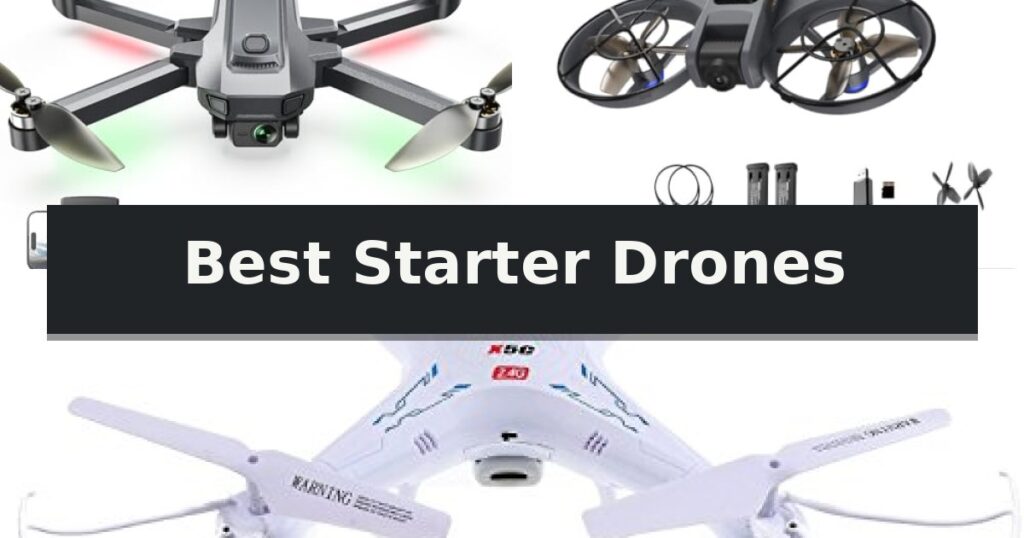
3 Best Starter Drones in 2026 Reviews
Quick Comparison
| Product | Best For | Key Strength | Score |
|---|---|---|---|
| WeFone WF30 Foldable 4K Camera Drone | Best Overall | Under 249g weight eliminates the need for FAA or Remote ID registration. | 4.9 |
| AxrumRC VR FPV Drone Kit | Immersive First-Person Flying | Immersive VR headset for first-person perspective. | 4.9 |
| Cheerwing Syma X5C-1 RC Quadcopter | Classic Stable Flight Trainer | Built-in 6-axis gyroscope for enhanced hovering stability. | 4.8 |
How We Chose
When evaluating drones for beginners, we prioritize flight stability and ease of control over advanced cinematic features. An experienced reviewer looks for reliable hovering systems, intuitive return-to-home functions, and clear transmission links to ensure a successful first flight. We assess these models based on how they simplify the learning process while providing enough capability for meaningful practice.
- GPS and Optical Flow Stability
- Flight Control Intuition
- Camera Resolution and Transmission
- Battery Life and Portability
- Regulatory Compliance and Weight
1 WeFone WF30 Foldable 4K Camera Drone — Simple GPS Flight for Beginners
The WeFone WF30 Foldable 4K Camera Drone simplifies aerial photography for newcomers by integrating a 90° electrically adjustable 4K camera with a 117° wide-angle lens, allowing for precise framing without manual repositioning. This drone is engineered for ease of use, featuring GPS-assisted flight and optical flow positioning to maintain stable hovering, which helps beginners capture steady footage even in varying outdoor conditions.
Designed with portability in mind, the WeFone WF30 Foldable 4K Camera Drone weighs under 249 grams, meaning it does not require FAA or Remote ID registration. Its foldable design and included carrying case make it a practical choice for travel. The system includes two modular batteries providing a combined 40 minutes of flight time, ensuring extended sessions for landscape or selfie photography.
Operational control is streamlined through 5G FPV transmission, which provides real-time video streaming to a mobile device within a range of approximately 300 meters. The drone includes automated flight modes such as Follow Me, Waypoint Flight, and Point of Interest, alongside safety features like one-key return, low battery alerts, and weak signal protection to prevent loss during operation.
The use of brushless motors contributes to a quieter, more efficient flight experience compared to standard brushed alternatives. With one-key takeoff and landing and headless mode, the interface is tailored to reduce the learning curve for those new to quadcopter piloting, providing a reliable platform for learning the fundamentals of drone flight.
Best for: Beginners seeking a lightweight, GPS-enabled drone for aerial photography that avoids complex registration requirements.
Skip if: Experienced pilots requiring long-range transmission beyond 300 meters or professional-grade gimbal stabilization for high-speed cinematic tracking.
- Under 249g weight eliminates the need for FAA or Remote ID registration.
- Dual modular batteries provide a total of 40 minutes of flight time.
- Brushless motors offer quieter operation and increased longevity.
- GPS and optical flow systems ensure stable, beginner-friendly hovering.
- 300-meter transmission range may limit long-distance exploration.
- Fixed 40-minute total flight time requires swapping batteries between sessions.
2 AxrumRC VR FPV Drone Kit — Immersive First-Person Flying
The AxrumRC VR FPV Drone Kit offers a unique perspective for new pilots by including a dedicated VR headset, providing an immersive, first-person flying experience that places the user directly in the cockpit. This setup is designed to simplify the transition into aerial photography and hobbyist flight for those just starting out.
Engineered with brushless motors, this quadcopter delivers responsive and stable flight characteristics. It features optical flow hover technology, which assists in maintaining a steady position during flight, whether operating indoors or outdoors. This stabilization is particularly beneficial for capturing clearer video footage without excessive drift.
The drone is equipped with a dual camera system that allows for seamless switching between wide-angle and close-up perspectives. The electric lens automatically adjusts to optimize the framing based on the selected flight mode. Pilots can also execute 360-degree aerial stunts using the integrated Electronic Speed Control (ESC), which helps maintain stability during maneuvers.
Safety and ease of use are addressed through the inclusion of a built-in propeller guard, which helps protect the rotors during minor impacts. With its compact dimensions of approximately 8.86 by 7.48 inches and a lightweight design, it is a portable option for beginners looking to practice both basic flight and advanced aerial photography techniques.
Best for: Beginners seeking an immersive first-person flying experience with integrated stabilization technology.
Skip if: Experienced pilots requiring professional-grade long-range transmission or high-resolution cinematic sensor capabilities.
- Immersive VR headset for first-person perspective.
- Brushless motors for improved responsiveness and stability.
- Optical flow hover technology for precise positioning.
- Dual camera system with automated lens adjustment.
- Small form factor may be more susceptible to high wind conditions.
- Integrated design limits modular upgrades for the camera or motor systems.
3 Cheerwing Syma X5C-1 RC Quadcopter — Classic Stable Flight Trainer
Learning to navigate a drone requires a balance of responsiveness and stability, and the Cheerwing Syma X5C-1 RC Quadcopter is engineered to provide exactly that for new pilots. Featuring a built-in 6-axis gyroscope, this model is designed to maintain precise hovering capabilities, which helps beginners focus on mastering flight controls without constantly fighting to keep the aircraft steady.
The drone utilizes spread spectrum technology, which offers a distinct advantage by providing a wider remote control distance and improved anti-interference performance. This technical choice allows for a more reliable connection, even when multiple drones are in the air simultaneously. The system is tuned for a rapid reaction speed, which is a key factor for those just starting to learn the nuances of aerial maneuvering.
Beyond its flight stability, the unit includes an integrated HD camera for capturing aerial footage. Pilots can execute dynamic maneuvers using the one-key 360° roll function, which simplifies complex stunts into a single command. The drone offers a full range of directional controls, including forward, backward, leftward, and rightward flight, providing a comprehensive platform for skill development.
Measuring 12.2 inches in length and width, the Cheerwing Syma X5C-1 RC Quadcopter is sized for visibility and control. Its design prioritizes ease of use, making it a practical choice for those looking to transition from basic flight to more advanced aerial actions without the complexity of high-end professional equipment.
Best for: Beginners seeking a stable, responsive platform to learn flight controls and basic aerial maneuvers.
Skip if: Experienced pilots looking for advanced GPS-assisted flight modes or high-end professional-grade video stabilization.
- Built-in 6-axis gyroscope for enhanced hovering stability.
- Spread spectrum technology for superior anti-interference and range.
- One-key 360° roll feature for easy stunt execution.
- Integrated HD camera for entry-level aerial photography.
- Fixed-focus camera lacks advanced stabilization features found in premium models.
Best Starter Drones Buying Guide
Understanding Flight Stability Systems
Modern entry-level drones often utilize GPS or optical flow sensors to maintain a steady hover without constant pilot input. These systems are essential for beginners, as they allow the drone to hold its position against light wind, providing a stable platform for learning basic maneuvers.
Models lacking these sensors require more active stick input, which can be challenging for novices. While manual flight builds skill, GPS-enabled drones offer a safety net that prevents the aircraft from drifting unexpectedly during the initial stages of training.
The Importance of Weight and Regulation
Many starter drones are designed to weigh under 249 grams to simplify regulatory compliance. This weight threshold is significant for recreational pilots, as it often removes the need for formal registration in many jurisdictions, making it easier to start flying immediately.
Beyond legal requirements, lighter drones are generally more portable and easier to transport. However, they may be more susceptible to wind gusts, so pilots should always check local weather conditions before heading out for a flight session.
Camera Quality and FPV Transmission
While 4K resolution is a common marketing spec, the quality of the transmission link is often more important for a beginner. A stable 5G or high-frequency link ensures that the real-time video feed remains clear, allowing the pilot to see what the drone sees without significant lag.
First-person view (FPV) capabilities can transform the flying experience, but they require a reliable connection to be effective. Beginners should look for drones that offer a balance between image clarity and transmission range to avoid signal drops during flight.
Battery Management and Flight Time
Most starter drones provide between 15 to 20 minutes of flight time per battery. Because this is relatively short, many kits include multiple modular batteries to extend your time in the air without needing to wait for a full recharge between sessions.
Managing battery life is a critical skill for any pilot. Learning to monitor voltage levels and initiating a return-to-home sequence before the battery reaches a critical state is a fundamental safety practice that preserves the longevity of your equipment.
Durability and Maintenance
Beginner drones are bound to experience minor bumps and landings. Models with propeller guards or brushless motors often offer better durability and lower maintenance needs, as brushless motors generally run quieter and last longer than traditional brushed alternatives.
Regularly inspecting your propellers for chips or cracks is essential for maintaining flight stability. Keeping a few spare parts on hand and storing the drone in a protective case will help ensure your investment remains ready for flight.
Frequently Asked Questions
Do I need a license to fly these starter drones?
Many of these models weigh under 249 grams, which often exempts them from certain registration requirements. However, you should always check your local aviation authority's specific rules regarding recreational drone flight.
How long does it take to learn to fly a drone?
Most beginners can master basic takeoff, landing, and hovering within a few hours of practice. GPS-assisted drones significantly shorten this learning curve compared to manual-only models.
Can I fly these drones indoors?
While some models are stable enough for indoor flight, it is generally recommended to practice in a large, open outdoor space to avoid damaging furniture or the drone itself.
What happens if the drone loses connection?
Many GPS-enabled drones feature an automatic return-to-home function that triggers if the signal is lost or the battery becomes critically low, helping to prevent fly-aways.
Are spare parts easy to find for these drones?
Most manufacturers provide modular components like batteries and propellers. It is advisable to purchase extra propellers when you buy your drone, as they are the most common parts to wear out or break.
Conclusion: Our Top Pick
Our top pick is WeFone WF30 Foldable 4K Camera Drone. Choosing the right starter drone depends on whether you prioritize GPS-assisted stability for photography or a more manual, immersive experience. The WeFone WF30 stands out for its ease of use, while alternatives like the AxrumRC and Cheerwing offer specialized features for different pilot preferences.
Regardless of the model you select, focus on mastering basic flight patterns in open areas before attempting complex maneuvers. With proper care and regular practice, these drones provide a solid foundation for developing your piloting skills.