SIMREX GPS Drone is our top choice for the Best WiFi Drone for Beginners, offering reliable GPS-assisted stability and an intuitive return-to-home feature that simplifies flight for new pilots. The lanvansrc F417PRO Drone follows as a strong alternative for those who prefer a dedicated screen-based controller, while the NAFYRE N11 PRO Drone provides extended flight time for users focused on longer outdoor sessions.
Selecting a drone requires balancing flight control features with camera capabilities and portability. An experienced reviewer focuses on how these systems integrate to reduce the learning curve, prioritizing models that offer stable hovering and clear transmission over those that prioritize complex, manual-heavy flight modes.
If you are still exploring your options, our guide on Best Drones for Beginners provides additional context on selecting a model that matches your skill level.
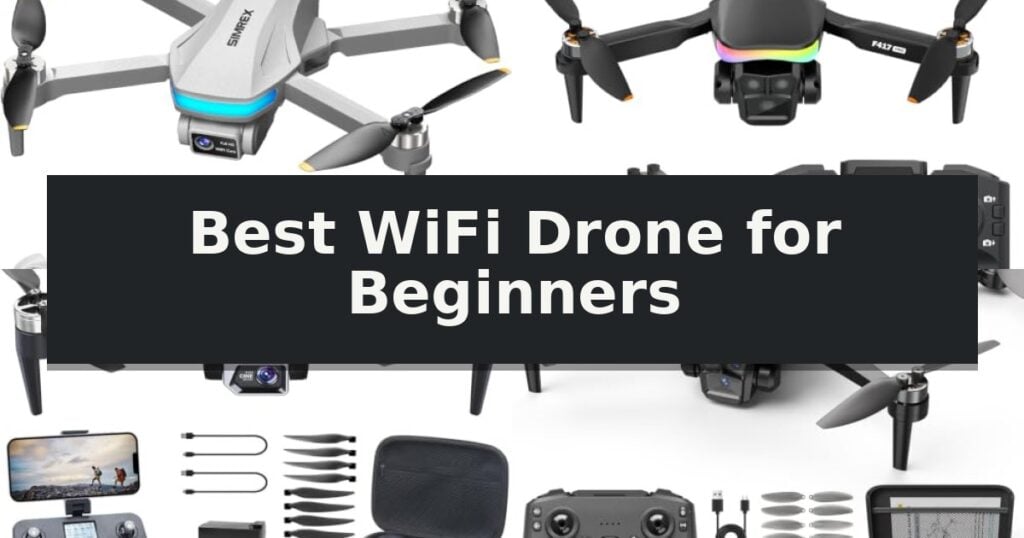
10 Best WiFi Drone for Beginners in 2026 Reviews
Quick Comparison
| Product | Best For | Key Strength | Score |
|---|---|---|---|
| SIMREX GPS Drone | Best Overall | GPS Auto Return provides a reliable safety net against losing the drone. | 4.9 |
| lanvansrc F417PRO Drone | Integrated Screen for Phone-Free Flying | Integrated LCD screen remote eliminates smartphone dependency. | 4.5 |
| NAFYRE N11 PRO Drone | Extended Flight Time for Beginners | Under 0.55lb weight removes the need for FAA registration. | 4.3 |
| Vvoqeote GPS Drone | Built-in Display for Easy Monitoring | Built-in 4.5-inch HD screen removes the need for a mobile device. | 4.3 |
| Cloarks Foldable Drone | Compact Design for Travel | Optical flow positioning for stable hovering. | 4.4 |
| PLEGBLE PL-515 Drone | Anti-Lost Alarm for Safety | No FAA or Remote ID registration required due to sub-250g weight. | 4.7 |
| YGFBQE 2K Drone | Simple Controls for First-Time Pilots | Built-in 2.8" FPV screen eliminates the need for smartphone integration. | 4.7 |
| Scharkspark FPV Drone | Real-Time View Without Mobile Apps | Built-in 2.8-inch FPV screen eliminates the need for smartphone pairing. | 4.7 |
| CHUBORY F89 Drone | Long Range for Open Spaces | 2,650-foot control range for expansive flight. | 4.4 |
| Deeptoysrc RC Drone | Brushless Motors for Smooth Handling | Integrated 4.5-inch LCD screen on the remote eliminates phone pairing issues. | 4.3 |
How We Chose
When evaluating the Best WiFi Drone for Beginners, we look for systems that prioritize flight stability and user-friendly controls. We assess how well integrated GPS and optical flow sensors maintain position, the clarity of real-time video transmission, and the overall convenience of the controller design to ensure a smooth transition from ground to air.
- GPS and Optical Flow stability for steady hovering
- Ease of control for first-time pilots
- Camera resolution and adjustable lens angles
- Total flight time per charge
- Portability and foldable design for travel
1 SIMREX GPS Drone — GPS Stability for Steady Shots
Navigating the skies for the first time requires a balance of stability and intuitive flight controls, which is exactly what the SIMREX GPS Drone provides for new pilots. By integrating GPS Auto Return, this drone ensures that your investment remains protected by automatically navigating back to its takeoff point if the signal is lost or with a single command.
The SIMREX GPS Drone is engineered with a 90° electrically adjustable 4K camera, allowing you to frame shots precisely from the air. Real-time monitoring is handled via 5G WiFi FPV, which maintains a stable connection up to 2296 feet. To assist those still learning, the system incorporates Optical Flow & Altitude Hold, which keeps the drone steady in a hover, while Headless Mode simplifies orientation during flight.
Beyond basic flight, this model offers Intelligent Flight Modes such as Follow Me, Waypoint Flight, and Circle Around, effectively acting as a personal aerial cameraman. The Brushless Motors contribute to a quieter flight experience and improved wind resistance, supporting a total flight time of up to 40 minutes for extended sessions.
Designed for portability, the foldable arms allow the drone to be packed away easily for travel. Whether you are capturing cinematic shots or practicing basic maneuvers, the combination of Gesture Control and automated flight features makes this a practical entry point into drone photography.
Best for: Beginners who prioritize stable, GPS-assisted flight and automated camera modes for aerial photography.
Skip if: Experienced pilots looking for high-speed racing capabilities or those requiring professional-grade gimbal stabilization for complex cinematography.
- GPS Auto Return provides a reliable safety net against losing the drone.
- Brushless Motors offer increased longevity and better wind resistance.
- 40 minutes of total flight time allows for longer aerial sessions.
- Foldable design ensures high portability for travel.
- WiFi-dependent FPV may be subject to interference in high-traffic wireless environments.
2 lanvansrc F417PRO Drone — Integrated Screen for Phone-Free Flying
The lanvansrc F417PRO Drone simplifies the pilot experience by integrating an LCD screen directly into the remote controller, eliminating the need to tether a smartphone for real-time flight monitoring. This design choice allows beginners to focus on maneuvering the quadcopter without managing additional mobile app connections during their initial flights.
Engineered for efficiency, the lanvansrc F417PRO Drone utilizes brushless motors to provide a smoother, quieter flight compared to traditional brushed alternatives. The unit features a 1080P HD camera with a 90° electrically adjustable lens, enabling users to shift perspectives mid-flight using the remote. Its foldable, lightweight construction—weighing under 249g—enhances portability for outdoor use.
Operation is tailored for novices through a suite of automated flight aids, including one-key takeoff and landing, altitude hold, and headless mode. The inclusion of 3 adjustable speed modes and 3D flip functionality provides a progression path for pilots as they gain confidence. The system supports Type-C charging for both the drone and the remote, with storage expandable up to 32GB.
While the integrated screen offers convenience, users should note that the drone relies on a modular battery system, requiring manual replacement between flights. The compact form factor is optimized for recreational use rather than professional-grade cinematography, making it a practical entry point for those learning the basics of aerial photography and RC flight.
Best for: Beginners seeking a phone-free, easy-to-operate drone with an integrated display for immediate aerial feedback.
Skip if: Experienced pilots requiring professional-grade camera stabilization, long-range transmission, or advanced GPS-based flight path programming.
- Integrated LCD screen remote eliminates smartphone dependency.
- Brushless motor design offers improved efficiency and reduced wear.
- Under 249g weight ensures a highly portable, foldable form factor.
- Electrically adjustable 90° lens allows for flexible shooting angles.
- Modular battery system requires physical swapping for extended flight sessions.
- Limited storage capacity necessitates a separate microSD card up to 32GB.
3 NAFYRE N11 PRO Drone — Extended Flight Time for Beginners
The NAFYRE N11 PRO Drone offers a distinct advantage for new pilots by weighing under 0.55lb, which eliminates the requirement for FAA registration in the United States. This mid-sized GPS drone balances portability with a robust feature set, making it a practical entry point for those looking to capture aerial footage without navigating complex regulatory hurdles.
Equipped with alloy brushless motors, the drone is engineered for increased wind resistance and quieter operation compared to standard brushed alternatives. The package includes three batteries, providing a total flight time of up to 90 minutes, and supports a control range of 3,328 feet. Note that a charger is not included in the box, so users must account for this when planning their initial flight sessions.
The dual positioning system utilizes both Optical Flow and GPS sensors to maintain stability. Optical Flow assists with indoor hovering, while GPS enables outdoor stabilization and automated features like One-Key Auto Return, which activates if the battery runs low or the signal is lost. These safety-focused flight modes are designed to help beginners maintain control during their first few outings.
For imaging, the 4K UHD camera captures 4096×3072 photos and 2048×1080 video, supported by a 100° wide-angle lens that can be adjusted 90° via the remote or app. The 5GHz FPV transmission provides a stable connection for real-time viewing, while intelligent flight modes such as Follow Me, Tap Fly, and Point of Interest allow the drone to handle navigation automatically, letting the pilot focus on composition.
Best for: Beginners who want a lightweight, GPS-enabled drone that avoids FAA registration requirements while offering extended flight time.
Skip if: Users who require a professional-grade camera sensor or those who prefer a kit that includes a dedicated wall charger.
- Under 0.55lb weight removes the need for FAA registration.
- 90-minute total flight time provided by three included batteries.
- Brushless motors offer improved wind resistance and durability.
- GPS-assisted flight modes like Follow Me and Auto Return enhance ease of use.
- No charger included in the package.
- Mid-sized design may be less portable than ultra-compact mini drones.
4 Vvoqeote GPS Drone — Built-in Display for Easy Monitoring
Capturing aerial footage is simplified by the Vvoqeote GPS Drone, which features a built-in 4.5-inch HD screen on its remote controller. This design choice eliminates the need for a smartphone or external app during flight, allowing users to view live video transmission immediately upon connection.
Equipped with a 4K camera and a remotely adjustable 90-degree lens, this quadcopter provides flexibility for various shooting angles. The inclusion of brushless motors ensures efficient power delivery, while the dual-battery system supports a total flight time of up to 60 minutes, giving beginners ample time to practice maneuvers and capture scenery.
Safety and ease of use are prioritized through integrated GPS positioning and smart flight modes. Features such as One-Key Return, Low Battery Return, and Signal Loss Return provide automated assistance, while Altitude Hold, Headless Mode, and One-Key Takeoff/Landing help stabilize the flight experience for those new to piloting.
The foldable design and lightweight construction—weighing under 249g—make this drone highly portable for outdoor activities. Whether recording cycling trips or performing roof inspections, the combination of 3 speed modes and intuitive controls makes the Vvoqeote GPS Drone a practical entry point for aerial photography.
Best for: Beginners seeking an all-in-one aerial photography solution that includes a dedicated controller display without requiring a smartphone.
Skip if: Users who require professional-grade obstacle avoidance sensors or advanced gimbal stabilization for cinematic-level video production.
- Built-in 4.5-inch HD screen removes the need for a mobile device.
- Dual-battery setup provides up to 60 minutes of total flight time.
- GPS-assisted flight modes include auto-return for added safety.
- Brushless motors offer efficient and reliable power.
- No obstacle avoidance sensors included for automated collision prevention.
- Fixed-lens camera system lacks mechanical 3-axis gimbal stabilization.
5 Cloarks Foldable Drone — Compact Design for Travel
The Cloarks Foldable Drone simplifies aerial photography for newcomers by integrating an optical flow positioning system, which maintains a stable hover altitude without constant manual correction. This design choice allows users to focus on capturing high-definition footage rather than struggling with basic flight stabilization.
Equipped with a 1080P HD camera, the unit offers a tiltable lens that can be adjusted via the remote or app to capture forward or downward perspectives. The inclusion of two rechargeable batteries provides a combined flight time of 24–28 minutes, ensuring extended sessions for practice or creative projects.
Safety and ease of use are central to its operation, featuring over-current protection and an emergency stop function. Beginners can utilize headless mode, one-key takeoff/landing, and 3-speed modes to gradually build confidence. The drone also supports advanced maneuvers like 360° flips and trajectory flight for more dynamic control.
For those interested in mobile-based operation, the drone connects via WiFi to the JY016 DRONE app. Users can switch between remote control and direct app control, the latter of which unlocks features such as gravity control and gesture photo commands for a more interactive flying experience.
Best for: Beginners seeking an affordable, feature-rich drone with stable hovering and extended flight time for casual photography.
Skip if: Experienced pilots requiring professional-grade stabilization, long-range transmission, or high-speed performance capabilities.
- Optical flow positioning for stable hovering.
- Extended flight time with two included batteries.
- Foldable design for easy portability.
- App-integrated controls including gravity and gesture modes.
- Flight time reduction when using high speeds or performing flips.
- Gyroscope calibration required before every flight for optimal stability.
6 PLEGBLE PL-515 Drone — Anti-Lost Alarm for Safety
The PLEGBLE PL-515 Drone simplifies the entry into aerial photography by weighing less than 250 grams, which removes the need for FAA or Remote ID registration in the United States. This ultra-lightweight design makes it a practical choice for beginners who want to start flying immediately without navigating complex regulatory requirements.
Engineered for stability, the PLEGBLE PL-515 Drone utilizes a brushless motor system that offers increased efficiency and wind resistance compared to traditional brushed models. The aircraft features a built-in altitude maintenance system and ground detection technology, which work together to ensure steady hovering during flight. A shock-absorbing mount for the 4K UHD camera further minimizes shake, helping to produce clearer images and videos at 3840 x 2160 resolution.
Safety and usability are central to the design, highlighted by a smart child lock feature that requires a specific remote controller sequence to unlock and start the motors. This prevents accidental activation, while the included propeller guards provide an additional layer of protection during indoor or close-proximity flight. The foldable frame and dedicated storage box enhance portability, allowing users to transport the drone easily.
The package includes a dual-battery setup that provides a total flight time of 32 minutes. These UL-certified batteries support USB 3.0 charging, including compatibility with USB-C/PD standards, and are rated for up to 500 recharge cycles. With an adjustable 90-degree lens and ultra-smooth WiFi FPV transmission, the drone provides an immersive experience for those learning to pilot and capture aerial footage.
Best for: Beginners seeking a lightweight, registration-free drone that includes safety features like propeller guards and a child lock.
Skip if: Users requiring professional-grade cinematic flight times or advanced obstacle avoidance sensors beyond basic altitude maintenance.
- No FAA or Remote ID registration required due to sub-250g weight.
- Brushless motors provide improved stability and wind resistance.
- Dual-battery system offers a combined 32 minutes of flight time.
- Integrated safety features including propeller guards and a child lock.
- Limited flight time compared to higher-end, non-beginner models.
7 YGFBQE 2K Drone — Simple Controls for First-Time Pilots
Learning to fly a drone is often intimidating, but the YGFBQE 2K Drone simplifies the process by integrating a built-in 2.8" FPV screen directly into the controller. This design choice eliminates the need for a separate smartphone connection, allowing pilots to focus entirely on the flight experience while viewing live footage in real-time.
Engineered for stability, the drone utilizes brushless motors that provide a smoother flight experience compared to standard brushed alternatives. The onboard 2K HD camera features a 90° adjustable lens, which is particularly useful for capturing aerial perspectives or inspecting hard-to-reach areas like rooftops. Pilots can also trigger photo captures using simple hand gestures.
Accessibility is central to this model, which includes Headless Mode to maintain orientation regardless of the drone's direction and a One-Key Takeoff/Landing function to assist with basic handling. Beginners can progress through 3 speed modes, starting at a slower pace to build confidence before increasing speed as their control improves.
The package includes two batteries, providing a combined up to 30 minutes of flight time. Weighing under 249 grams, this drone does not require FAA registration, making it a straightforward entry point for new pilots. Additional features like 360° Flips, Trajectory Flight, and Gravity Control offer varied ways to practice maneuvering and flight dynamics.
Best for: Beginners and younger pilots looking for an all-in-one drone package that includes a dedicated screen controller and does not require FAA registration.
Skip if: Experienced drone photographers who require professional-grade stabilization, long-range transmission, or high-end GPS positioning systems.
- Built-in 2.8" FPV screen eliminates the need for smartphone integration.
- Brushless motors offer improved stability and flight performance.
- Under 249g weight removes the requirement for FAA registration.
- Two batteries included for extended practice sessions.
- Limited storage capacity requires an external SD card (up to 32GB) to save footage.
8 Scharkspark FPV Drone — Real-Time View Without Mobile Apps
Capturing aerial footage without the complexity of smartphone integration is the primary advantage of the Scharkspark FPV Drone. This model features a built-in 2.8-inch FPV screen directly on the remote controller, allowing pilots to monitor live 1080P HD video feeds instantly. By removing the dependency on mobile apps, it simplifies the setup process for those new to drone flight.
The drone utilizes brushless motors to maintain stability during operation, which is complemented by a 90-degree adjustable camera lens for versatile framing. Beginners can utilize Headless Mode and One-Key Takeoff/Landing to manage the craft without needing to track its orientation manually. Three distinct speed modes allow users to adjust the flight pace as they build confidence.
Beyond standard flight, the unit includes interactive features such as gesture control for selfies and 360-degree flips for added maneuverability. For more advanced navigation, the drone supports trajectory flight, where users draw a path on a connected device to guide the movement. The package includes two batteries, providing a total of up to 30 minutes of flight time.
Designed for portability and ease of use, the drone weighs under 249 grams, exempting it from FAA registration requirements. While the remote screen provides a convenient real-time view, users should note that the system relies on a 32GB SD card—not included—to record and save media directly from the remote.
Best for: Beginners who prefer a dedicated hardware controller with a built-in screen over smartphone-dependent flight systems.
Skip if: Users who require high-end professional camera stabilization or advanced GPS-based return-to-home navigation features.
- Built-in 2.8-inch FPV screen eliminates the need for smartphone pairing.
- Brushless motors offer improved stability and performance.
- Under 249g weight avoids the need for FAA registration.
- Two included batteries provide up to 30 minutes of total flight time.
- SD card required for recording is not included in the package.
- Limited flight time per battery necessitates frequent swaps.
9 CHUBORY F89 Drone — Long Range for Open Spaces
The CHUBORY F89 Drone stands out for its impressive 2,650-foot control range, a specification that significantly exceeds the capabilities of standard entry-level models. This extended reach provides users with the freedom to explore expansive flight paths, making it a practical choice for those who want to capture aerial photography without being tethered by the short-range limitations common in this category.
Engineered with alloy brushless motors, this quadcopter offers a distinct advantage in flight stability and durability. These motors are designed to provide better wind resistance and quieter operation compared to traditional brushed alternatives. The package includes three upgraded batteries, which together deliver up to 84 minutes of total flight time, effectively minimizing downtime and allowing for longer practice sessions in the field.
Equipped with a 120° wide-angle 4K HD camera and a secondary bottom optical flow camera, the drone allows users to switch between perspectives for versatile filming. The integration of optical flow positioning and altitude hold technology helps maintain steady flight, which is essential for capturing clear footage. These features are complemented by a suite of beginner-friendly controls, including one-key take-off and landing, headless mode, and gesture selfie controls.
Designed for maximum portability, the CHUBORY F89 Drone features a foldable frame that weighs less than 249g. This lightweight design is particularly useful as it eliminates the need for registration in many jurisdictions, simplifying the entry process for new pilots. While it offers excellent value for beginners, users should note that the system relies on optical flow rather than GPS-based navigation and lacks a mechanical gimbal for advanced stabilization, representing a trade-off between compact simplicity and professional-grade cinematography features.
Best for: Beginners seeking a portable, long-range drone with extended flight time and automated flight assistance features.
Skip if: Users requiring professional-grade gimbal stabilization or GPS-based navigation will find this model too basic for advanced aerial cinematography.
- 2,650-foot control range for expansive flight.
- 84 minutes total flight time with three included batteries.
- Brushless motors for improved wind resistance and durability.
- Under 249g weight avoids registration requirements.
- No mechanical gimbal for advanced camera stabilization.
- Limited to basic optical flow for positioning rather than GPS-based navigation.
10 Deeptoysrc RC Drone — Brushless Motors for Smooth Handling
Capturing aerial footage without the complexity of smartphone pairing is the primary advantage of the Deeptoysrc RC Drone, which features an integrated 4.5-inch HD LCD screen directly on its remote controller. This design choice provides a dedicated, real-time first-person view (FPV) that bypasses common mobile app connectivity hurdles, making it a straightforward option for those new to drone operation.
Equipped with high-performance brushless motors, this quadcopter offers improved wind resistance and quieter flight characteristics compared to standard brushed models. The Deeptoysrc RC Drone includes essential flight assistance features such as altitude hold, headless mode, and one-key takeoff and landing, which help stabilize the craft and simplify the learning curve for novice pilots.
The onboard 4K HD camera supports a 90-degree electric adjustable tilt, allowing users to capture varied angles during flight. Footage and photos are saved directly to local SD storage, which prevents wireless transmission delays during recording. The system also supports mobile app control as an alternative to the screen-based remote, providing flexibility for different user preferences.
Designed for portability, this foldable quadcopter weighs under 249g, meaning it is FAA compliant and does not require registration. The modular battery setup allows for quick swaps during extended practice sessions, while the remote itself features a built-in rechargeable battery that charges via a Type-C connection, ensuring the controller is ready for travel.
Best for: Beginners and travel enthusiasts who want a simple, phone-free FPV experience with a compact, registration-free drone.
Skip if: Experienced pilots looking for professional-grade gimbal stabilization or advanced obstacle avoidance sensors.
- Integrated 4.5-inch LCD screen on the remote eliminates phone pairing issues.
- Brushless motors provide quieter operation and better wind resistance.
- Under 249g design is FAA compliant and highly portable for travel.
- 90-degree electric adjustable camera for flexible shooting angles.
- Local SD storage required for high-quality recording.
- Limited flight time per modular battery necessitates frequent swaps.
Best WiFi Drone for Beginners Buying Guide
Flight Stability and GPS
GPS-enabled drones provide a significant advantage for beginners by maintaining a fixed position in the air, even in light wind. This technology allows the drone to hover steadily without constant manual input, which is essential for capturing clear photos and videos.
Models lacking GPS often rely on altitude hold and optical flow sensors. While these are effective for indoor or low-altitude flight, they may not offer the same level of security as GPS, which also enables automatic return-to-home functions if the signal is lost.
Controller and FPV Experience
The way you view your flight makes a difference in your learning experience. Some drones require a smartphone app for first-person view (FPV), while others include a remote controller with a built-in LCD screen.
Choosing a model with a built-in screen can eliminate the need to manage app connections and phone battery life during flight. However, app-based systems often provide more advanced features like waypoint mapping and gesture control, which are useful for creative shots.
Camera Quality and Adjustability
For beginners, the ability to adjust the camera angle remotely is a key feature. A 90-degree adjustable lens allows you to capture both horizon shots and downward-facing views without having to land the drone to change the position manually.
Resolution is another factor, though stability is often more important for image quality than raw pixel count. A drone that hovers steadily will produce clearer footage than a higher-resolution camera mounted on an unstable, drifting platform.
Battery Life and Flight Time
Flight time is a common limitation for entry-level drones, with most models offering between 15 to 30 minutes per battery. Many kits now include multiple batteries, which is a practical way to extend your time in the field.
Consider how the batteries are charged and swapped. Modular, detachable batteries are generally easier to manage and replace than internal, fixed batteries, allowing for a quick turnaround between flights.
Portability and FAA Compliance
Most beginner-friendly drones feature a foldable design, making them easy to pack into a backpack for hiking or travel. Portability is a major benefit for those who plan to use their drone in various outdoor locations.
Weight is also a critical consideration in the United States. Drones weighing under 249 grams generally do not require FAA registration, which simplifies the process for recreational users who want to start flying immediately.
Frequently Asked Questions
Do I need a smartphone to fly these drones?
It depends on the model. Some drones, like the lanvansrc F417PRO, feature a remote with a built-in screen, while others require a smartphone app for FPV and advanced flight modes.
What is the benefit of a brushless motor?
Brushless motors are more efficient, quieter, and generally last longer than traditional brushed motors, providing a smoother and more stable flight experience.
Do I need to register my drone with the FAA?
In the United States, drones weighing less than 249 grams typically do not require FAA registration for recreational use, but you should always check current local regulations.
How do I ensure my drone doesn't get lost?
Models with GPS have a return-to-home feature that brings the drone back to its takeoff point automatically if the signal is lost or the battery gets low.
Can I fly these drones indoors?
Yes, but it is recommended to use drones with altitude hold and optical flow sensors for indoor flight, as GPS signals are often unavailable inside buildings.
Conclusion: Our Top Pick
Our top pick is SIMREX GPS Drone. Choosing the right drone depends on whether you prioritize the convenience of a built-in screen or the advanced features offered by app-based control. Focus on models that offer robust stability features like GPS or optical flow to ensure your first flights are successful.
Regardless of the model you select, always practice in an open area away from obstacles. Mastering basic flight controls before attempting complex maneuvers will help you get the most out of your new equipment.