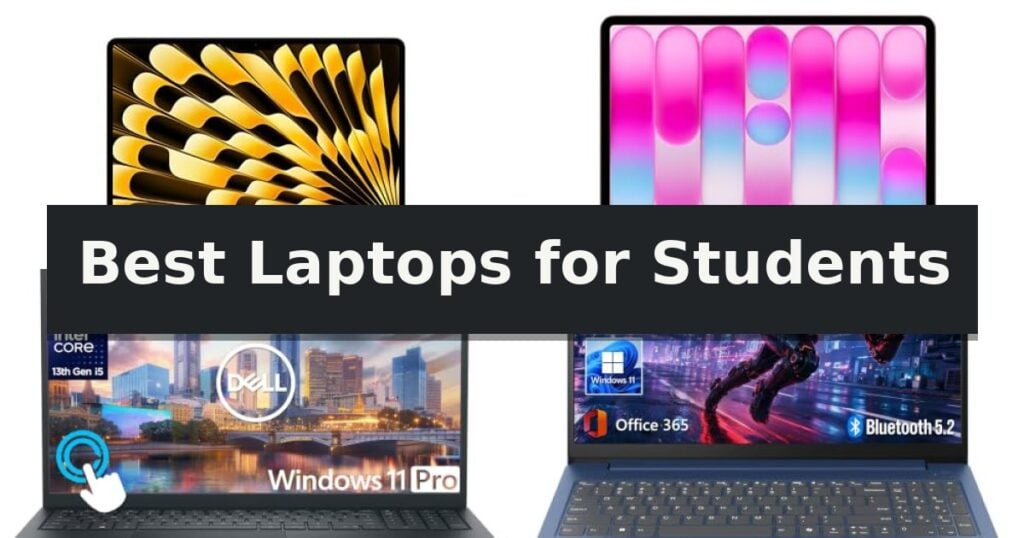
The Apple MacBook Air 13-inch Laptop is our top recommendation for the Best Laptops for Students, offering a blend of high-performance processing and long-lasting battery life that supports demanding academic schedules. For those seeking a more budget-conscious alternative, the Apple MacBook Neo 13-inch Laptop provides essential AI-ready features in a highly portable frame, while the Dell Inspiron 15 Touchscreen Laptop serves as a robust choice for students who prioritize a larger display and versatile multitasking capabilities.
Selecting a laptop for academic use requires balancing portability with the processing power necessary for research, writing, and multitasking. Experienced reviewers look beyond marketing claims to evaluate how physical dimensions, display quality, and input comfort affect daily productivity during long library sessions or back-to-back lectures.
Beyond raw specifications, the integration of software ecosystems and hardware durability plays a significant role in long-term reliability. Students should consider how connectivity options and battery efficiency align with their specific field of study and the frequency of their travel between classes.
For students who prefer a more flexible form factor, Best 2-in-1 Laptops for Students can offer additional utility for note-taking and creative tasks.
10 Best Laptops for Students in 2026 Reviews
Quick Comparison
| Product | Best For | Key Strength | Score |
|---|---|---|---|
| Apple MacBook Air 13-inch Laptop | Best Overall | M5 chip provides powerful AI-ready performance and efficient multitasking. | 4.9 |
| Apple MacBook Neo 13-inch Laptop | Portable Design for Students | Up to 16 hours of battery life for all-day portability. | 4.8 |
| Dell Inspiron 15 Touchscreen Laptop | Versatile Multitasking Powerhouse | Responsive 15.6-inch FHD IPS touchscreen for intuitive navigation. | 4.8 |
| Lenovo Essential Laptop | Durable Design for Campus Life | MIL-STD-810H tested for enhanced durability during daily transport. | 4.3 |
| Lenovo Flagship Chromebook | Intuitive Touchscreen Navigation | Responsive 14-inch Full HD touchscreen for intuitive navigation. | 4.6 |
| HP Essential Laptop | Reliable Daily Computing | Integrated Copilot AI for streamlined task management. | 4.9 |
| HP Chromebook Laptop | Long Battery for Study Sessions | 14-hour battery life supports extended study sessions. | 4.5 |
| Ofive 15.6-inch Laptop | Immersive Screen for Research | Large 15.6-inch Full HD display with slim bezels for an immersive viewing experience. | 4.3 |
| PADIX 15.6-inch Laptop | Silent Operation for Libraries | Fanless silent operation for distraction-free study environments. | 4.6 |
| DRKAKO 15.6-inch Student Laptop | Lay-Flat Hinge for Collaboration | 180° lay-flat hinge for easy screen sharing | 4.8 |
How We Chose
Selecting the right laptop for students involves evaluating how hardware specifications translate into real-world academic performance. We analyze portability, battery efficiency, and input ergonomics to ensure each device supports the rigorous demands of daily coursework, research, and collaborative projects without compromising on reliability or user comfort.
- Battery longevity for full-day campus use
- Portability and weight for frequent commuting
- Processing capability for multitasking and research
- Display clarity and anti-glare properties for reading
- Connectivity options for external peripherals and displays
1 Apple MacBook Air 13-inch Laptop — Powerful AI-Ready Performance
The Apple 2026 MacBook Air 13-inch Laptop integrates the advanced M5 chip, specifically engineered to deliver high-performance AI capabilities within a highly portable, thin-and-light chassis. This machine is designed to handle demanding academic workloads while maintaining an impressive battery life of up to 18 hours, ensuring students can work through a full day of classes without needing a power outlet.
Performance is driven by the M5 chip, which features a faster CPU, unified memory, and a dedicated Neural Engine. These components work in tandem to accelerate creative workflows and multitasking. The 13.6-inch Liquid Retina display supports 1 billion colors, providing high-contrast, sharp visuals for presentations and media consumption, while the 12MP Center Stage camera and three-mic array ensure clear communication during remote lectures.
Connectivity options include two Thunderbolt 4 ports, a MagSafe charging port, and Wi-Fi 7 support, allowing for a versatile workstation setup that can drive up to two external displays. The laptop also features Apple Intelligence, which provides tools for writing and organization, backed by privacy protections designed to keep user data secure.
The integration between the Mac and iPhone ecosystems allows for seamless transitions, such as controlling an iPhone directly from the laptop or sharing content between devices instantly. With built-in virus protection and regular software updates, the macOS environment is built to remain stable and secure throughout a student's academic career.
Best for: Students who require a portable, AI-capable machine with long battery life for intensive multitasking and creative assignments.
Skip if: Users who require a dedicated graphics card for heavy 3D rendering or those who prefer a non-macOS operating system for specific legacy software compatibility.
- M5 chip provides powerful AI-ready performance and efficient multitasking.
- 18-hour battery life supports all-day academic use without recharging.
- Liquid Retina display offers high color accuracy and sharp detail.
- Wi-Fi 7 and Thunderbolt 4 connectivity ensure fast data transfer and network speeds.
- Limited port selection may require external adapters for legacy peripherals.
- Fixed unified memory cannot be upgraded after purchase.
2 Apple MacBook Neo 13-inch Laptop — Portable Design for Students
The Apple MacBook Neo 13-inch Laptop is engineered for modern academic demands, featuring the high-performance A18 Pro chip designed to handle intensive AI-driven tasks and everyday coursework with efficiency. Its durable recycled aluminum enclosure provides a lightweight, portable frame that fits easily into a student backpack, while the 13-inch Liquid Retina display supports 1 billion colors for clear, vibrant visuals during study sessions.
Designed for long days on campus, this model offers up to 16 hours of battery life, allowing students to move between classes without needing a power outlet. The integration of Apple Intelligence provides specialized tools for summarizing notes and managing assignments, while the 1080p FaceTime HD camera and dual-mic array ensure high-quality audio and video for remote collaboration or virtual presentations.
The device emphasizes seamless connectivity within the Apple ecosystem, enabling users to control their iPhone directly from the laptop or transition tasks between devices effortlessly. With a color-coordinated keyboard available in four distinct finishes, the hardware balances aesthetic appeal with practical utility. The 256GB SSD storage and 8GB unified memory provide a responsive foundation for running macOS applications and multitasking through various academic projects.
While the Apple MacBook Neo 13-inch Laptop offers a robust feature set for general student use, it is important to note the hardware configuration. The 8GB of unified memory is optimized for standard productivity and AI-assisted workflows, making it a reliable choice for writing, research, and media consumption throughout the academic year.
Best for: Students who require a portable, AI-ready laptop with long battery life for daily academic tasks and seamless integration with other Apple devices.
Skip if: Users who require high-capacity local storage or massive amounts of RAM for professional-grade video editing or complex software development may find the base configuration limiting.
- Up to 16 hours of battery life for all-day portability.
- A18 Pro chip optimized for AI-driven academic tools.
- Durable recycled aluminum construction.
- 1080p FaceTime HD camera for clear video conferencing.
- Fixed 8GB unified memory may limit advanced multitasking.
- 256GB SSD storage may require cloud solutions for large file libraries.
3 Dell Inspiron 15 Touchscreen Laptop — Versatile Multitasking Powerhouse
The Dell Inspiron 15 Touchscreen Laptop distinguishes itself with a versatile 15.6-inch Full HD IPS touchscreen display, enabling intuitive navigation through pinch, zoom, and swipe gestures. This device is engineered for students and professionals who require a responsive interface for both academic research and creative tasks.
Under the hood, the laptop features a 10-core 13th Gen Intel i5-1334U processor with a max boost clock of up to 4.6GHz. This processing power is paired with 16GB of high-bandwidth DDR4 RAM, facilitating smooth multitasking across multiple browser tabs and productivity applications. The system includes a 512GB PCIe NVMe SSD for fast data access, supplemented by an additional 500GB external drive for expanded storage needs.
Designed for comprehensive productivity, the package includes the Windows 11 Pro operating system, which provides advanced security features like hardware-based isolation and encryption. The inclusion of an Office Suite ensures that essential software for word processing, data analysis, and presentations is ready for immediate use.
The unit prioritizes connectivity by bundling a 6-in-1 USB-C hub, which expands port options to include USB 3.0, 4K HDMI, and SD/TF card readers. This ecosystem of accessories—which also features a wireless mouse, mouse pad, and necessary cabling—creates a complete, ready-to-use workspace for students working from home or in a dormitory setting.
Best for: Students and home professionals who need a comprehensive, ready-to-use workstation with integrated touchscreen capabilities and versatile storage options.
Skip if: Users who require a lightweight, ultra-portable device for frequent travel may find the 15.6-inch form factor and 3.66-pound weight less convenient than a smaller, dedicated ultrabook.
- Responsive 15.6-inch FHD IPS touchscreen for intuitive navigation.
- 10-core 13th Gen Intel i5 processor provides efficient multitasking power.
- Comprehensive accessory bundle including a 6-in-1 USB-C hub and wireless mouse.
- Windows 11 Pro offers enhanced security and professional-grade features.
- Larger 15.6-inch footprint may be less portable than smaller laptop alternatives.
4 Lenovo Essential Laptop — Durable Design for Campus Life
Navigating a busy academic schedule requires reliable hardware, and the Lenovo 15.6" FHD Essential Laptop is built to handle daily demands with a focus on portability and structural integrity. Weighing just 3.42 lbs and measuring 0.70 inches thin, this device is designed for students who frequently transition between classrooms, libraries, and home study spaces.
Under the hood, the laptop utilizes an Intel processor paired with 8GB of LPDDR5 memory and 128GB of UFS 2.2 storage. This configuration provides the necessary responsiveness for common educational tasks, including web research, document editing, and participating in virtual meetings. The inclusion of a dedicated Copilot key offers quick access to AI-assisted productivity tools, while the pre-installed Windows 11 Home and Microsoft 365 Personal suite ensure immediate readiness for coursework.
The 15.6-inch Full HD display features an anti-glare coating and a TUV Rheinland Low Blue Light solution, which helps reduce eye strain during long study sessions. To ensure the device survives the rigors of campus life, it has undergone MIL-STD-810H testing across 21 different items, confirming its ability to withstand everyday travel and handling.
Connectivity is well-supported with Wi-Fi 6 and Bluetooth 5.2 for stable wireless performance. The chassis includes a versatile array of ports, such as USB-C with Power Delivery and DisplayPort, two USB-A ports, an HDMI 1.4 output, and an SD card reader. For privacy during online classes, the 720p webcam is equipped with a physical shutter, and the system is rounded out by Dolby Audio speakers and dual microphones.
Best for: Students who need a lightweight, durable, and reliable laptop for daily coursework, research, and virtual learning.
Skip if: Users who require high-performance hardware for intensive tasks like video editing, 3D rendering, or gaming will find the processor and storage capacity limiting.
- MIL-STD-810H tested for enhanced durability during daily transport.
- Lightweight and thin profile makes it highly portable for students.
- TUV Rheinland Low Blue Light screen technology supports comfortable extended use.
- Physical privacy shutter on the webcam provides added security.
- Limited 128GB internal storage may require reliance on cloud solutions or external drives.
- Entry-level processor is optimized for productivity rather than heavy creative or gaming workloads.
5 Lenovo Flagship Chromebook — Intuitive Touchscreen Navigation
The Lenovo Flagship Chromebook simplifies academic workflows through its responsive 14-inch Full HD touchscreen, which enables intuitive navigation across the Chrome OS interface. Designed for students and remote learners, this device integrates a 720p HD webcam with a privacy shutter and a dual-array microphone to support clear communication during virtual classes and collaborative projects.
Under the hood, the laptop is powered by the 8-core MediaTek Kompanio 520 processor, an architecture engineered to balance efficient power consumption with the performance required for daily educational tasks. With 4GB of RAM and 64GB of eMMC storage, the system provides sufficient capacity for managing multiple browser tabs and cloud-based applications, ensuring quick boot-up times for busy schedules.
Portability remains a primary focus, as the unit weighs only 2.86 pounds and measures 0.73 inches in thickness. Connectivity options include USB-A and USB-C 3.2 Gen 1 ports, a microSD card reader, and Wi-Fi 6 compatibility, allowing students to maintain reliable network connections and interface with various external peripherals in diverse learning environments.
While this Chromebook excels in cloud-centric environments, users should note that the 64GB storage capacity is optimized for web-based workflows rather than extensive local file storage. The device offers a streamlined, secure computing experience that prioritizes simplicity and long-term utility for students navigating modern digital curricula.
Best for: Students who primarily utilize cloud-based applications, web-based research, and virtual classroom platforms.
Skip if: Users who require significant local storage for large media files or those who need to run specialized desktop software incompatible with Chrome OS.
- Responsive 14-inch Full HD touchscreen for intuitive navigation.
- Integrated privacy shutter on the webcam for enhanced security.
- Efficient MediaTek Kompanio 520 processor designed for long battery life.
- Lightweight and slim profile at 2.86 lbs for easy portability.
- Limited 64GB eMMC storage capacity for local files.
- 4GB RAM may constrain heavy multitasking with numerous intensive tabs.
6 HP Essential Laptop — Reliable Daily Computing
The HP 2027 Essential Laptop integrates a dedicated Copilot key, providing immediate access to AI-powered assistance for streamlining academic research and document management. Designed for students and remote learners, this device balances essential computing power with a highly portable form factor.
At the core of this laptop is an Intel N150 processor with 4GB of LPDDR5-4800 RAM, configured to handle daily productivity tasks such as web browsing, email, and word processing. The inclusion of 128GB UFS storage and a 1-year Microsoft 365 Personal subscription ensures that users have immediate access to necessary software tools right out of the box.
The 14-inch HD display features a micro-edge bezel design, achieving a 79% screen-to-body ratio that maximizes viewing area while maintaining a compact footprint. With 250 nits of brightness and an anti-glare coating, the screen is optimized to reduce eye strain during extended study sessions, while the integrated HP True Vision 720p HD camera and dual-array microphones support clear video conferencing.
Connectivity is managed through Wi-Fi 6 and Bluetooth 5.4, ensuring stable network performance and seamless pairing with wireless peripherals. The chassis, weighing only 3.24 lbs, houses a versatile port selection including USB Type-C with DisplayPort 1.2, HDMI 1.4b, and a multi-format SD card reader, providing the flexibility needed for various classroom and home office environments.
Best for: Students and remote learners requiring a lightweight, portable device for daily productivity and web-based coursework.
Skip if: Users who require high-performance computing for video editing, complex software development, or heavy multitasking will find the 4GB RAM and 128GB storage capacity limiting.
- Integrated Copilot AI for streamlined task management.
- Ultra-portable design weighing only 3.24 lbs.
- Wi-Fi 6 connectivity for improved network reliability.
- Anti-glare display reduces eye strain during long study hours.
- Limited 4GB RAM may restrict performance during heavy multitasking.
- 128GB storage capacity is relatively small for large media libraries.
7 HP Chromebook Laptop — Long Battery for Study Sessions
Reliability during long study sessions is often defined by power efficiency, and the HP 14" HD Chromebook Laptop for Students addresses this with an impressive 14-hour battery life. This longevity ensures that students can move between classes or library sessions without needing to hunt for an available power outlet.
At the heart of the device is the Intel Celeron N4120 processor, which features four cores and four threads. With a base clock of 1.1GHz and a boost clock reaching up to 2.6GHz, this hardware is specifically configured to handle multitasking, such as running multiple browser tabs or educational applications simultaneously, without significant slowdowns.
The laptop is designed for portability, measuring just 0.72 inches in height and weighing approximately 3.35 pounds. Its 14-inch HD display provides a clear workspace for document editing and research, while the inclusion of USB-A and USB-C ports alongside an HDMI output ensures broad compatibility with external monitors, projectors, and peripheral accessories.
Running on Chrome OS, the system prioritizes streamlined performance and security. The 64GB eMMC storage offers quick access to essential files, and the integrated webcam makes it a practical tool for remote learning and video conferencing via platforms like Zoom.
Best for: Students who require a portable, long-lasting device for web-based research, document writing, and video conferencing.
Skip if: Users who need to run resource-heavy professional software or require significant local storage capacity beyond cloud-based options.
- 14-hour battery life supports extended study sessions.
- Quad-core processor provides reliable multitasking performance.
- Lightweight and slim design enhances portability for campus use.
- Versatile connectivity including USB-C and HDMI ports.
- Limited 64GB eMMC storage may require reliance on cloud storage.
- 4GB RAM is sufficient for basic tasks but may limit intensive multitasking.
8 Ofive 15.6-inch Laptop — Immersive Screen for Research
The Ofive 15.6-inch Laptop is designed for students who prioritize a large, clear workspace for research and document editing. Its 15.6-inch Full HD display features a 1920×1080 resolution and slim bezels, providing an expansive view that is well-suited for multitasking across multiple windows or streaming educational content.
Under the hood, this device is powered by an Intel Celeron N4020 processor paired with 4GB of LPDDR4 memory. This hardware configuration is specifically optimized for everyday academic tasks, such as web browsing, writing papers, and participating in video meetings. The 128GB eMMC storage provides a baseline for saving essential files, while the pre-installed Windows 11 operating system ensures a modern, familiar interface for immediate use.
Portability is a key focus for this model, which weighs approximately 1500g and features a slim, lightweight plastic housing. This makes it a practical choice for students moving between classrooms or libraries. The chassis also supports a 180-degree lay-flat hinge, offering flexibility for different desk setups or collaborative group work.
Connectivity is handled through a versatile array of ports, including USB 3.2 Gen1 Type-A and Type-C connections, a TF card reader, and a standard headphone jack. The inclusion of dual-band Wi-Fi and Bluetooth ensures stable wireless connections. For power, the 38Wh battery supports 45W fast charging via the Type-C port, allowing for efficient replenishment throughout the school day.
Best for: Students requiring a lightweight, budget-friendly laptop with a large screen for research and general academic productivity.
Skip if: Users who need high-performance processing power for video editing, gaming, or intensive multitasking will find the Celeron processor and 4GB of RAM insufficient.
- Large 15.6-inch Full HD display with slim bezels for an immersive viewing experience.
- Lightweight 1500g design makes it easy to carry in a backpack for daily travel.
- Versatile connectivity including multiple USB Type-A and Type-C ports.
- 180-degree lay-flat hinge provides flexible positioning for various study environments.
- 45W fast charging capability via Type-C for convenient power management.
- Limited 4GB RAM may restrict performance during heavy multitasking.
- 128GB eMMC storage offers limited space for large media libraries or software installations.
9 PADIX 15.6-inch Laptop — Silent Operation for Libraries
Maintaining a quiet workspace is essential for academic focus, and the PADIX 15.6-inch Laptop addresses this with a fanless, silent design that eliminates distracting mechanical noise during study sessions. This portable notebook is built to handle the rigors of student life, offering a balance of efficiency and connectivity for daily tasks.
At the core of the PADIX 15.6-inch Laptop is an Intel Celeron N4020 processor paired with 4GB of LPDDR4 RAM, providing the necessary foundation for document editing, web browsing, and attending online classes. The 15.6-inch Full HD (1920×1080) anti-glare display features micro-edge bezels, which helps maximize screen real estate while maintaining a slim, portable form factor that weighs just 3.17 pounds.
Storage needs are managed through 128GB of eMMC memory, with the added flexibility of an integrated TF card slot that supports expansion up to 1TB. This allows students to keep a large library of working files, photos, and digital media accessible without relying solely on cloud storage.
Connectivity is a standout feature, as the device includes two full-featured Type-C ports that support data transfer, fast charging, and dual-monitor output. These are complemented by two USB 3.2 Gen1 ports and a 3.5mm audio jack, ensuring compatibility with a wide range of peripherals for a complete home office or library setup.
The 38Wh battery is designed for mobility, and the inclusion of 45W Type-C fast charging helps minimize downtime between classes. With an integrated 1MP HD webcam, the laptop is also equipped for remote meetings and collaborative group projects.
Best for: Students and home office users who prioritize a silent, portable device for document editing, web research, and remote learning.
Skip if: Users requiring high-performance computing for video editing, 3D rendering, or intensive multitasking will find the 4GB RAM and Celeron processor insufficient.
- Fanless silent operation for distraction-free study environments.
- Full-featured Type-C ports supporting dual-monitor output and fast charging.
- Expandable storage via an integrated 1TB-capable TF card slot.
- Lightweight and slim design for easy commuting.
- Limited 4GB RAM may restrict heavy multitasking capabilities.
- 128GB eMMC storage is modest for modern software and large file collections.
10 DRKAKO 15.6-inch Student Laptop — Lay-Flat Hinge for Collaboration
The DRKAKO 15.6-inch Student Laptop simplifies collaborative study sessions with its unique 180° lay-flat hinge, allowing the screen to sit flush against a desk for easy group viewing. This design choice, combined with a lightweight 3.7-pound chassis, makes it a practical choice for students moving between classrooms and libraries.
Equipped with a J4105 quad-core processor and 12GB of DDR4 RAM, this device is engineered for everyday academic tasks such as web research, streaming lectures, and document management. The inclusion of a 256GB SSD ensures fast boot times, while the storage remains flexible with support for expansion up to 2TB via SSD or 1TB through the microSD slot.
The 15.6-inch FHD IPS display features ultra-narrow bezels that maximize the active viewing area, providing a clear 1920×1080 resolution for reading text or watching educational content. Connectivity is well-rounded for a student environment, featuring USB 3.2, USB-C for charging and data, and a Mini HDMI port for external monitor support.
To support long days on campus, the 53.2Wh battery offers up to 6 hours of runtime. The laptop comes pre-installed with a 1-year subscription to Office 365, providing immediate access to essential productivity tools like Word, Excel, and PowerPoint, alongside an integrated AI assistant to help with drafting and summarizing assignments.
Best for: Students requiring a portable, budget-friendly device for document editing, web research, and collaborative group study.
Skip if: Users who require high-performance hardware for intensive tasks like video editing, 3D rendering, or gaming will find the J4105 processor insufficient.
- 180° lay-flat hinge for easy screen sharing
- 12GB RAM for smooth multitasking during study sessions
- Expandable storage up to 2TB SSD
- Includes 1-year Office 365 subscription
- 6-hour battery life may require a charger for full-day use
- J4105 processor is limited to basic productivity tasks
Best Laptops for Students Buying Guide
Balancing Portability and Screen Real Estate
Students often face a trade-off between a compact, lightweight design that fits easily into a backpack and a larger screen that provides more room for side-by-side document viewing. A 13-inch model is typically the sweet spot for those who prioritize mobility, whereas 15-inch models offer a more expansive workspace for complex spreadsheets or creative projects.
When choosing, consider the weight and dimensions of the chassis. A laptop that exceeds four pounds can become cumbersome during long days on campus, while thinner models often sacrifice some port variety, necessitating the use of external hubs for connectivity.
Battery Life and Power Management
Reliable battery life is essential for students who cannot always count on finding an available power outlet in a crowded lecture hall or library. Look for devices that offer at least eight hours of real-world usage to ensure you can complete a full day of classes on a single charge.
Consider how the laptop handles power management when running multiple browser tabs and productivity applications simultaneously. Efficient processors and optimized operating systems are key to preventing sudden battery drain during critical study sessions.
Input Comfort and Ergonomics
Since students spend significant time typing essays and taking notes, keyboard quality is a non-negotiable factor. A keyboard with adequate travel and tactile feedback can significantly reduce fatigue during long writing sessions compared to shallow, flat keys.
Trackpad responsiveness and size also impact workflow efficiency. A spacious, accurate trackpad allows for smoother navigation through research materials and quick switching between applications without the constant need for an external mouse.
Connectivity and Peripheral Support
The ability to connect to external displays, projectors, and storage devices is vital for presentations and collaborative work. While many modern laptops lean heavily on USB-C, having a mix of ports, including HDMI or an SD card reader, can save you from carrying extra adapters.
Wireless connectivity standards like Wi-Fi 6 or 7 are increasingly important for maintaining stable connections in high-density campus environments. Ensure the device supports the latest standards to avoid lag during online classes or video conferences.
Durability and Build Quality
A student laptop is subjected to frequent movement, being pulled in and out of bags, and exposure to various environments. Look for chassis materials like aluminum or reinforced plastics that can withstand the rigors of daily travel.
Check for features like spill-resistant keyboards or anti-glare screen coatings, which add a layer of protection and usability. A well-built machine is an investment that should last through multiple academic years without requiring frequent repairs.
Frequently Asked Questions
How much RAM do I really need for school?
For most students, 8GB of RAM is the minimum for smooth multitasking, but 16GB is recommended if you frequently run many browser tabs, research software, or creative applications simultaneously.
Is a touchscreen necessary for students?
A touchscreen can be helpful for quick navigation and annotating documents, but it is not strictly necessary for standard writing and research tasks. It often adds to the cost and can increase screen glare.
Should I choose a Chromebook or a Windows/Mac laptop?
Chromebooks are excellent for web-based tasks and budget-conscious students. However, if your coursework requires specific desktop software or high-performance creative tools, a Windows or macOS laptop is generally more versatile.
What is the best way to extend my laptop's battery life?
To preserve battery, lower your screen brightness, close unused background applications, and disable unnecessary wireless connections like Bluetooth when not in use.
Do I need a dedicated graphics card?
Most students do not need a dedicated graphics card unless they are studying fields like 3D modeling, video editing, or high-end gaming. Integrated graphics are sufficient for standard academic work.
Conclusion: Our Top Pick
Our top pick is Apple MacBook Air 13-inch Laptop. Choosing the right laptop for your studies depends on balancing your specific academic needs with your daily mobility requirements. By focusing on battery life, keyboard comfort, and build quality, you can select a machine that serves as a reliable partner throughout your education.
Prioritize devices that offer the best performance-to-portability ratio for your major. Whether you need the power for heavy research or a lightweight design for moving between classrooms, the right choice will enhance your productivity and simplify your daily workflow.