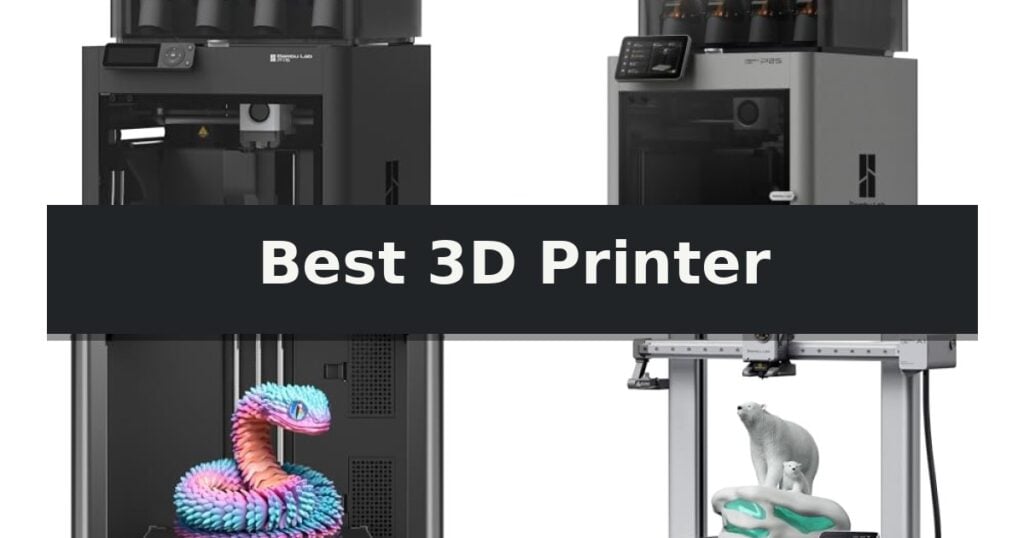
Bambu Lab P1S 3D Printer is our pick for the Best 3D Printer because it provides a reliable, high-speed, and enclosed printing environment that handles a wide range of engineering-grade materials with minimal setup time.
Selecting a 3D printer requires balancing your specific project goals against the machine's technical capabilities. For those focused on rapid prototyping or complex multi-color designs, the integration of automated filament management systems and high-acceleration motion platforms has become the industry standard for efficiency.
Beginners should prioritize machines that offer full-auto calibration and user-friendly software ecosystems, which significantly reduce the learning curve. Meanwhile, experienced users might look for high-temperature nozzles and advanced AI-assisted monitoring to ensure consistent results during long, complex print jobs.
If you are looking for a machine for educational settings, our Best 3D Printer for Students guide covers models that prioritize safety and ease of use. For those on a tighter budget, we also maintain a list of the Best 3D Printer Under $300 to help you find capable entry-level options.
10 Best 3D Printer in 2026 Reviews
Quick Comparison
| Product | Best For | Key Strength | Score |
|---|---|---|---|
| Bambu Lab P1S 3D Printer | Best Overall | High-speed printing up to 500mm/s for rapid project completion. | 4.9 |
| Bambu Lab P2S 3D Printer | Advanced AI-Powered Precision | High-speed printing up to 600 mm/s with active flow compensation. | 4.3 |
| Flashforge Adventurer 5M 3D Printer | Fastest Setup for Rapid Prototyping | 600mm/s high-speed printing for rapid output. | 4.7 |
| Bambu Lab A1 3D Printer | Easiest Multi-Color for Beginners | Full-Auto Calibration eliminates manual bed-leveling and Z-offset adjustments. | 4.4 |
| Anycubic Kobra X 3D Printer | Efficient Multi-Color Production | Native 4-color printing expandable up to 19 colors. | 4.7 |
| Elegoo Centauri 2 3D Printer | High-Temp Versatility for Makers | High-speed printing capabilities up to 500 mm/s. | 4.5 |
| Snapmaker U1 3D Printer | Zero-Waste Multi-Material Printing | 5-second tool change via SnapSwap system | 4.4 |
| Aoseed X-Maker Joy AI 3D Printer | Safest Pick for Kids and STEM | Leveling-free platform and enclosed design for enhanced safety and simplicity. | 4.7 |
| Bambu Lab A1 Mini 3D Printer | Compact Choice for Desktop Projects | Full-auto calibration simplifies the initial setup process. | 4.9 |
| Entina Tina2C 3D Printer | Best Mini Printer for Beginners | Fully assembled with factory presets for rapid setup | 4.4 |
How We Chose
When evaluating the best 3D printer, we focus on technical reliability and workflow efficiency. An experienced reviewer separates top-tier machines by examining how effectively they automate complex tasks like bed leveling and flow compensation, while ensuring the hardware remains stable enough to maintain high-speed precision across various material types.
- Print Speed and Acceleration: Evaluating the machine's ability to maintain precision at high travel speeds.
- Multi-Material Compatibility: Assessing the printer's capacity to handle diverse filaments and multi-color systems.
- Calibration and Ease of Use: Determining the effectiveness of automated bed leveling and setup processes.
- Build Environment: Analyzing the benefits of enclosed versus open-frame designs for material stability.
- Software and Connectivity: Reviewing the integration of slicing software, remote monitoring, and model libraries.
1 Bambu Lab P1S 3D Printer — Best for High-Speed Multi-Color
Achieving professional-grade results in a home workshop requires a machine that balances speed with precision. The Bambu Lab P1S 3D Printer distinguishes itself with a fully enclosed design, which significantly enhances print performance when working with advanced filaments that require stable thermal environments to prevent warping or layer adhesion issues.
Engineered for high-throughput workflows, this printer features a CoreXY motion system capable of reaching speeds up to 500mm/s with an acceleration of 20000 mm/s². These specifications allow for rapid prototyping, translating into significantly shorter wait times for complex parts without sacrificing the structural integrity of the final output.
Versatility is a core component of the system, particularly when paired with the optional Bambu Lab AMS. This combination enables multi-color and multi-material printing with up to 16 colors, allowing for complex, vibrant designs that would otherwise require manual filament swaps. This integration is ideal for users looking to produce multi-part assemblies or aesthetic models in a single print job.
Usability is prioritized through a 15-minute setup process and automatic bed leveling, which removes the guesswork from initial calibration. The printer supports a wide range of materials, including PLA, PETG, TPU, and ASA, making it a robust tool for diverse additive manufacturing projects. While highly capable, users should note that this model is not recommended for carbon or glass fiber reinforced polymers, representing a clear trade-off for those requiring specialized industrial-grade composites.
Best for: Users who require high-speed, multi-color printing capabilities and a reliable enclosed environment for advanced materials.
Skip if: Users who primarily print with carbon or glass fiber reinforced polymers, as these materials are not recommended for this specific model.
- High-speed printing up to 500mm/s for rapid project completion.
- Enclosed body design improves thermal stability for advanced filaments.
- Multi-color capability supports up to 16 colors when using the AMS.
- Automatic bed leveling ensures consistent first-layer quality.
- Not recommended for carbon or glass fiber reinforced polymers.
- AMS unit required for multi-color and multi-material functionality.
2 Bambu Lab P2S 3D Printer — Advanced AI-Powered Precision
Achieving rapid, high-precision results in a desktop format is the primary objective of the Bambu Lab P2S 3D Printer. This machine is engineered for speed, capable of reaching print speeds up to 600 mm/s while utilizing Active Flowrate Compensation and a PMSM Servo Extruder to ensure that corners remain sharp and layers stay consistent during high-velocity operation.
The system is designed for a streamlined user experience, featuring a 15-minute setup process that includes automatic calibration and AI failure detection to minimize manual intervention. For users requiring advanced material management, the included AMS 2 Pro unit provides seamless multi-material capabilities and integrates built-in filament drying at temperatures up to 65 °C, ensuring materials remain moisture-free for optimal extrusion.
Environmental control is handled by the Adaptive Airflow System, which intelligently balances heat retention and cooling. This allows the printer to maintain a stable 50 °C chamber for engineering-grade filaments or switch to active cooling for crisp overhangs. A built-in carbon filter is included to assist with air quality during the printing process.
Integration into a digital workflow is supported through the MakerWorld model library, which offers access to over one million designs. Users can manage their projects through the Bambu Studio desktop software or the Bambu Handy mobile application, creating a unified ecosystem from initial design to the final printed object.
Best for: Users who require high-speed, professional-grade 3D printing with integrated multi-material capabilities and automated environmental controls.
Skip if: Users who only need a basic, single-material printer and do not require the advanced filament management or high-speed capabilities of the AMS 2 Pro system.
- High-speed printing up to 600 mm/s with active flow compensation.
- Integrated filament drying via the AMS 2 Pro unit.
- AI-powered failure detection and automated calibration.
- Adaptive Airflow System for versatile material compatibility.
- Multi-color printing requires the specific Combo version.
- Chamber temperature management is limited to 50 °C for specific engineering materials.
3 Flashforge Adventurer 5M 3D Printer — Fastest Setup for Rapid Prototyping
The FLASHFORGE Adventurer 5M 3D Printer distinguishes itself through its high-speed CoreXY structure, capable of reaching travel speeds of 600mm/s and accelerations of 20000mm/s². This design choice prioritizes rapid prototyping and production efficiency, significantly reducing cycle times for complex projects.
Engineered for reliability, the unit features fully automatic bed leveling to ensure consistent first-layer adhesion without manual intervention. The integration of a 280°C direct drive extruder, combined with dual-fan cooling and active vibration compensation, maintains print quality even at high speeds. Users can also perform maintenance quickly thanks to the 3-second detachable nozzle system.
The printer offers a generous 220x220x220mm build volume on a dual-sided PEI platform, facilitating easy part removal. Its high-flow 32mm³/s nozzle allows for rapid material extrusion, while the 35-second warm-up time to 200°C minimizes downtime between prints. The system is compatible with various nozzle sizes, ranging from 0.25mm to 0.8mm, to accommodate different detail requirements.
Connectivity and management are handled through the Flash Studio, which provides real-time app monitoring and remote status alerts. This smart control suite allows for seamless adjustments and oversight, ensuring that the printing process remains efficient and accessible from anywhere.
Best for: Users requiring rapid prototyping and high-speed production with minimal setup time.
Skip if: Users who require a larger build volume than 220x220x220mm or those who prefer manual control over all calibration parameters.
- 600mm/s high-speed printing for rapid output.
- Fully automatic bed leveling eliminates manual calibration.
- 3-second detachable nozzle for quick maintenance and swaps.
- Remote app monitoring via Flash Studio for convenient oversight.
- Fixed build volume of 220x220x220mm may limit large-scale projects.
4 Bambu Lab A1 3D Printer — Easiest Multi-Color for Beginners
The Bambu Lab A1 3D Printer streamlines the additive manufacturing process for beginners by integrating Full-Auto Calibration, which manages Z-offset and bed-leveling without manual intervention. This device is engineered for those who prioritize a simplified workflow, utilizing a 1-Clip quick swap nozzle system that makes maintenance straightforward and efficient.
Performance is defined by high-speed capabilities, featuring an acceleration of 10,000 mm/s² to maintain precision during rapid movements. To ensure consistent output, the printer employs Active Flow Rate Compensation, an algorithm that adjusts extrusion based on real-time readings to prevent print defects. The unit also operates at a noise level of ≤48 dB, utilizing active motor noise canceling to maintain a quiet environment.
For users interested in multi-color projects, the Bambu Lab A1 3D Printer supports the AMS lite system. This accessory enables the use of multiple filaments, allowing for vibrant, multi-colored designs. The ecosystem is further supported by the MakerWorld Model Library, which provides a centralized resource for finding and preparing print files.
Designed with a user-friendly interface and a simplified touchscreen, this FDM printer balances advanced technical features with accessibility. While it offers high-speed output and automated maintenance, users should note that the AMS lite is required for multi-color functionality and must be acquired separately or as part of the A1 Combo.
Best for: Beginners seeking a quiet, automated FDM printer with optional multi-color capabilities.
Skip if: Users who require a large-format build volume or those who do not intend to purchase the separate AMS lite unit for multi-color printing.
- Full-Auto Calibration eliminates manual bed-leveling and Z-offset adjustments.
- High-speed printing with 10,000 mm/s² acceleration maintains detail.
- Active motor noise canceling keeps operation at or below 48 dB.
- Active Flow Rate Compensation ensures consistent extrusion accuracy.
- AMS lite required for multi-color printing, which is sold separately or as part of a combo.
- Specific maintenance requirements for the 1-Clip nozzle system.
5 Anycubic Kobra X 3D Printer — Efficient Multi-Color Production
The Anycubic Kobra X 3D Printer streamlines complex fabrication by offering native 4-color printing capabilities right out of the box. Designed for versatility, this FDM printer allows users to expand their creative palette up to 19 colors by integrating up to four ACE 2 Pro units, transforming multi-material projects into reality with ease.
Efficiency is central to the design, as the machine reduces filament waste and machine travel paths by 81.25%, effectively doubling printing speeds. It features a high-durability hardened steel nozzle capable of reaching 300°C, supporting a wide range of rigid and flexible materials including PLA, PETG, TPU, PVA, and ASA. With a maximum print speed of 600mm/s, it maintains precision through advanced vibration compensation technology.
Usability is enhanced by the LeviQ 3.0 auto bed leveling system, which utilizes 49-point calibration to ensure a flawless first layer. The printer is equipped with smart AI monitoring, including spaghetti and foreign object detection, accessible via a dedicated app. Connectivity is robust, featuring dual-band 2.4G/5G Wi-Fi and LAN options for remote control and live status monitoring.
The unit maximizes desktop utility with an innovative top-mount spool holder and provides a generous build volume of 260mm x 260mm x 260mm. While it offers advanced features for professional and home use, users should note that the four filament spools shown in promotional materials are not included, and compatibility is limited to specific ACE 2 Pro units.
Best for: Makers and professionals seeking high-speed, multi-color FDM printing with advanced AI monitoring and multi-material support.
Skip if: Users who do not require multi-color capabilities or those who prefer a smaller footprint for basic, single-material printing tasks.
- Native 4-color printing expandable up to 19 colors.
- High-speed performance up to 600mm/s.
- LeviQ 3.0 auto leveling for consistent first-layer quality.
- Wide multi-material compatibility including flexible filaments.
- Integrated AI monitoring for spaghetti and object detection.
- Filament spools are not included with the printer.
- Requires specific ACE 2 Pro units for color expansion.
6 Elegoo Centauri 2 3D Printer — High-Temp Versatility for Makers
The ELEGOO Centauri 2 3D Printer streamlines the additive manufacturing process through its full auto calibration and intelligent pre-print checks, ensuring the machine is ready for operation without manual intervention. This focus on automation allows makers to load filament and begin printing immediately, catering to both novices and experienced users who prioritize a simplified workflow.
Engineered for high-output environments, the printer utilizes a CoreXY system capable of reaching speeds up to 500 mm/s with an acceleration of 20,000 mm/s². This mechanical design, supported by a rigid aluminum frame, is intended to maintain stability during high-speed operations, facilitating the production of prototypes and complex models with reduced wait times.
To ensure print fidelity, the device incorporates vibration compensation and precise extrusion control. These features work in tandem to produce clean surface finishes and sharp edges. The inclusion of a 350°C high-temp nozzle expands the range of compatible materials, allowing for versatility in project selection beyond standard filaments.
Usability is enhanced through a 5-inch touchscreen interface and a suite of maintenance-focused design choices. The printer includes a magnetic printhead cover, a nozzle wiper, and a semi-automatic belt tensioner to simplify routine upkeep. Users can manage their projects through the ELEGOO Matrix app for remote monitoring, while the ElegooSlicer software and Nexprint model library provide a comprehensive ecosystem for file preparation and inspiration.
Best for: Makers seeking a high-speed, automated 3D printing experience that minimizes manual setup and maintenance.
Skip if: Users who require a build volume larger than 256x256x256mm or those who prefer manual calibration controls for specific experimental setups.
- High-speed printing capabilities up to 500 mm/s.
- Full auto calibration and smart pre-print checks for simplified setup.
- 350°C high-temp nozzle for material versatility.
- Integrated ecosystem including remote monitoring via the ELEGOO Matrix app.
- Fixed build volume of 256x256x256mm may limit large-scale projects.
7 Snapmaker U1 3D Printer — Zero-Waste Multi-Material Printing
The Snapmaker U1 3D Printer introduces a sophisticated approach to additive manufacturing through its 4-Toolhead System, which utilizes the proprietary SnapSwap mechanism to achieve a tool change in just 5 seconds. By keeping four filaments preloaded and preheated, the system eliminates the need for manual material swaps or the lengthy purging cycles typical of standard single-nozzle printers. This design choice significantly enhances efficiency, allowing for seamless transitions between rigid, flexible, and water-soluble materials during a single print job.
Engineered for high-performance output, the printer features a CoreXY motion system reinforced with lightweight carbon fiber X-axis rails. This architecture supports print speeds reaching 500 mm/s without sacrificing structural stability or dimensional accuracy across the 270 x 270 x 270 mm build volume. The integration of Smart Calibration ensures that toolhead offsets and vibration compensation are handled automatically, which is essential for maintaining consistent first-layer adhesion and precision in complex, multi-material assemblies.
Usability is central to the Snapmaker U1 3D Printer experience, supported by the Snapmaker Orca open-source slicing software. This platform includes a built-in model library to streamline the transition from design to production. The workflow is further augmented by AI-powered print monitoring, a 3.5-inch touchscreen interface, and remote app control, providing a comprehensive toolset for both beginners and professional users. The system is designed to minimize material waste by up to 5X compared to traditional filament-changing methods, offering a practical trade-off by replacing complex manual maintenance with a high-speed, automated mechanical tool-swapping process.
Best for: Makers and small businesses requiring high-speed, multi-material, and multi-color printing with minimal material waste.
Skip if: Users who require a smaller footprint or those who do not need multi-material capabilities may find the 4-toolhead system more complex than necessary for basic single-material projects.
- 5-second tool change via SnapSwap system
- 5X faster printing and reduced material waste
- True multi-material compatibility including TPU, PVA, and engineering filaments
- High-speed CoreXY motion up to 500 mm/s
- Complex multi-toolhead maintenance compared to single-nozzle systems
8 Aoseed X-Maker Joy AI 3D Printer — Safest Pick for Kids and STEM
The Aoseed X-Maker Joy AI 3D Printer simplifies the entry into additive manufacturing for children by integrating an enclosed, pinch-resistant design with a leveling-free platform. This setup prioritizes safety and ease of use, allowing families to start printing immediately without the calibration hurdles often associated with desktop 3D printers.
Engineered for speed and precision, this device achieves print speeds up to 400 mm/s and offers a resolution of 0.05 mm. The inclusion of filament runout detection and a quick-release nozzle helps maintain consistent operation, while the built-in camera allows for real-time monitoring and the creation of automated time-lapse videos via a smartphone app.
Creativity is facilitated through an AI-powered ecosystem that includes AI Doodle, which generates 3D models from voice, text, or image prompts. Users also gain access to a library of over 20,000 human-reviewed models, alongside specialized modules like AI MiniMe for transforming photos into 3D figures, making the design process accessible for beginners without requiring advanced CAD skills.
The printer arrives as a comprehensive All-in-One Creative Starter Kit, bundled with 8 rolls of PLA filament, a magnetic build plate, and essential tools. By utilizing TÜV Rheinland ISO 16000-tested PLA, the system ensures that the materials used are suitable for home and school environments, supporting a focus on STEM education and long-term creative engagement.
Best for: Families and educators seeking a safe, plug-and-play 3D printing solution for children that emphasizes ease of use and creative AI-assisted design.
Skip if: Users requiring multi-color printing capabilities or those looking for a large-format printer for professional-grade, high-volume engineering projects.
- Leveling-free platform and enclosed design for enhanced safety and simplicity.
- AI-powered model generation via voice, text, and photo prompts.
- High-speed printing capabilities with up to 400 mm/s peak performance.
- Extensive starter kit including 8 spools of filament.
- Supports single-color printing only, requiring assembly for multi-color designs.
- Limited to the manufacturer's ecosystem for AI-assisted model creation.
9 Bambu Lab A1 Mini 3D Printer — Compact Choice for Desktop Projects
The Bambu Lab A1 Mini 3D Printer streamlines the entry into additive manufacturing by prioritizing a user-friendly, automated experience. Featuring full-auto calibration and active flow rate compensation, this machine removes the manual setup hurdles often associated with desktop printing, allowing users to focus on their creative output rather than technical troubleshooting.
Designed for versatility, the unit includes an LED Lamp Kit that enables users to print functional, decorative lighting fixtures directly. Its compact footprint makes it an efficient addition to a home studio or workspace, while the ≤48 dB quiet operation ensures that the printing process remains unobtrusive during daily activities.
Integration with the Bambu Lab ecosystem provides access to the MakerWorld model library, simplifying the process of finding and printing projects. Users can manage their workflow through the Bambu Handy app, which facilitates a connected and streamlined experience from file selection to the final print.
This printer is engineered for reliability and speed, balancing high-quality output with a beginner-focused design. Whether producing toys, home décor, or functional tools, the Bambu Lab A1 Mini 3D Printer provides a consistent platform for everyday creative projects.
Best for: Beginners seeking a compact, quiet, and fully automated 3D printing experience with easy access to a library of ready-to-print models.
Skip if: Users who require a large build volume for printing oversized components or industrial-grade parts will find the compact size of this model limiting.
- Full-auto calibration simplifies the initial setup process.
- Active flow rate compensation ensures consistent print quality.
- Quiet operation at ≤48 dB is suitable for shared living or work spaces.
- Integrated LED Lamp Kit allows for immediate creation of functional decor.
- Bambu Handy app and MakerWorld library offer a seamless, connected user experience.
- Compact build volume restricts the size of individual print projects.
10 Entina Tina2C 3D Printer — Best Mini Printer for Beginners
The Entina Tina2C 3D Printer streamlines the entry into additive manufacturing by arriving fully assembled with factory presets, allowing users to initiate their first print in as little as 5 minutes. This compact device is specifically engineered for beginners and STEM learning environments, featuring a space-saving footprint and a 3.9 x 3.9 x 3.9-inch build volume.
Operation is managed through the Poloprint Cloud app, which provides access to over 3500 ready-to-print models and 25 DIY projects. The printer supports wireless connectivity via 2.4GHz WiFi, enabling users to manage print jobs and utilize AI-powered tools like text-to-3D and photo-to-3D conversion without requiring advanced modeling skills.
To ensure consistent results, the unit includes automatic bed leveling to optimize first-layer adhesion and a power-loss recovery function that resumes printing after unexpected interruptions. Maintenance is simplified through the inclusion of a flexible magnetic print bed for easy part removal and a quick-swap nozzle design.
While optimized for ease of use, the printer maintains flexibility by offering compatibility with standard slicing software such as Cura and Simplify3D. It also supports offline printing via a TF card, providing a reliable workflow for those who prefer not to rely on a constant wireless connection.
Best for: Beginners, students, and families looking for a compact, plug-and-play 3D printing experience without complex assembly.
Skip if: Users requiring a large build volume for industrial-scale projects or those who prefer manual hardware calibration over app-guided workflows.
- Fully assembled with factory presets for rapid setup
- Automatic bed leveling for improved print consistency
- AI-powered app control with access to 3500+ models
- Flexible magnetic build plate for easy print removal
- Limited build volume of 3.9 x 3.9 x 3.9 inches
- Requires 2.4GHz WiFi for full app functionality
Best 3D Printer Buying Guide
Understanding Motion Systems
Modern high-speed printers typically utilize a CoreXY motion system, which keeps the print bed stationary while the print head moves in both X and Y directions. This design reduces the weight on the moving parts, allowing for significantly higher acceleration and speed without sacrificing structural integrity.
When choosing a printer, look for rigid frame construction, as this is essential for minimizing vibrations at high speeds. A stable frame ensures that the print head maintains accuracy, preventing layer shifting or surface artifacts during rapid movements.
The Importance of Enclosed Designs
An enclosed 3D printer is critical if you plan to work with advanced materials like ABS, ASA, or PC. These filaments are prone to warping and cracking when exposed to ambient temperature fluctuations, so a heated, enclosed chamber is necessary to maintain consistent thermal conditions.
Even for standard PLA printing, an enclosure can provide a quieter experience and keep dust away from the internal components. If your projects are limited to basic materials, an open-frame printer may suffice, but an enclosure offers greater long-term versatility.
Multi-Color and Multi-Material Printing
Multi-color printing is achieved through automated filament systems that swap materials during the print process. These systems require precise synchronization between the printer's firmware and the filament management unit to ensure that color changes occur cleanly without clogging the nozzle.
Consider the waste management strategy of the printer you choose. Some systems purge a significant amount of filament during color changes, which can increase material costs. Look for printers that optimize the purge sequence to balance color purity with material efficiency.
Automated Calibration Features
Automatic bed leveling and Z-offset calibration have transformed the user experience, removing the need for manual paper-based leveling. These systems use sensors to map the build plate surface, allowing the printer to compensate for any slight unevenness in real-time.
Beyond leveling, look for active flow rate compensation. This feature adjusts the extrusion speed based on the filament's characteristics, ensuring that corners remain sharp and layers are consistent even when printing at high speeds.
Software Ecosystems and Connectivity
The best 3D printers are supported by integrated software ecosystems that handle everything from model slicing to remote monitoring. Features like AI-powered spaghetti detection and mobile app integration allow you to manage prints from anywhere and receive alerts if a failure occurs.
Check for compatibility with popular slicing software and the availability of a robust online model library. A well-supported ecosystem makes it easier to find pre-tested print profiles, which can save hours of trial-and-error tuning.
Frequently Asked Questions
Do I need an enclosed printer for PLA?
No, an enclosure is not required for PLA, but it can help maintain a consistent temperature and reduce noise. Enclosures are primarily necessary for engineering materials like ABS or ASA that warp easily.
How does multi-color printing work?
Multi-color printing uses an external unit that feeds multiple filament spools into a single nozzle. The printer automatically cuts and retracts the current filament before loading the next color.
Is auto bed leveling worth it?
Yes, auto bed leveling is highly recommended. It ensures a perfect first layer by compensating for surface irregularities, which is the most common cause of print failure.
What is the benefit of a CoreXY printer?
CoreXY printers offer superior speed and precision by keeping the build plate stationary and reducing the mass of the moving print head assembly.
Can I print with flexible materials like TPU?
Most modern direct-drive extruders can handle TPU, but you should verify the specific printer's compatibility. Enclosed printers often provide a more stable environment for printing flexible filaments.
Conclusion: Our Top Pick
Our top pick is Bambu Lab P1S 3D Printer. Selecting the right 3D printer depends on balancing your need for speed, material versatility, and ease of use. For most users, a machine that offers automated calibration and a reliable software ecosystem will provide the best experience, allowing you to focus on design rather than hardware maintenance.
Before making a final purchase, consider the specific materials you intend to use and whether you require the advanced capabilities of a multi-color system. Investing in a machine that fits your current skill level while offering room for growth will ensure you get the most value from your 3D printing journey.