The HP OmniBook X Flip 2-in-1 Laptop is our top choice for the Best 2-in-1 Laptops for Computer Science Students, offering a high-performance Intel Core Ultra 7 processor and a 120Hz touchscreen that excels at multitasking complex development environments. The Dell Inspiron 14 2-in-1 Laptop provides a robust 32GB memory configuration ideal for running multiple virtual machines, while the Dell 14 2-in-1 Laptop utilizes the AMD Ryzen 7 8840HS processor to handle intensive compilation tasks efficiently.
Computer science students require a balance of raw computational power and physical versatility. A 2-in-1 form factor allows for seamless transitions between coding in a desktop-like environment and using tablet mode for reading documentation or sketching system diagrams during lectures.
When selecting a device for technical coursework, prioritize hardware that supports modern development tools without thermal throttling. The integration of high-speed RAM and reliable solid-state storage ensures that IDEs and local servers remain responsive throughout long study sessions.
If you are still exploring your options, our guide on Best 2-in-1 Laptops for Students provides a broader look at versatile devices for various academic disciplines.
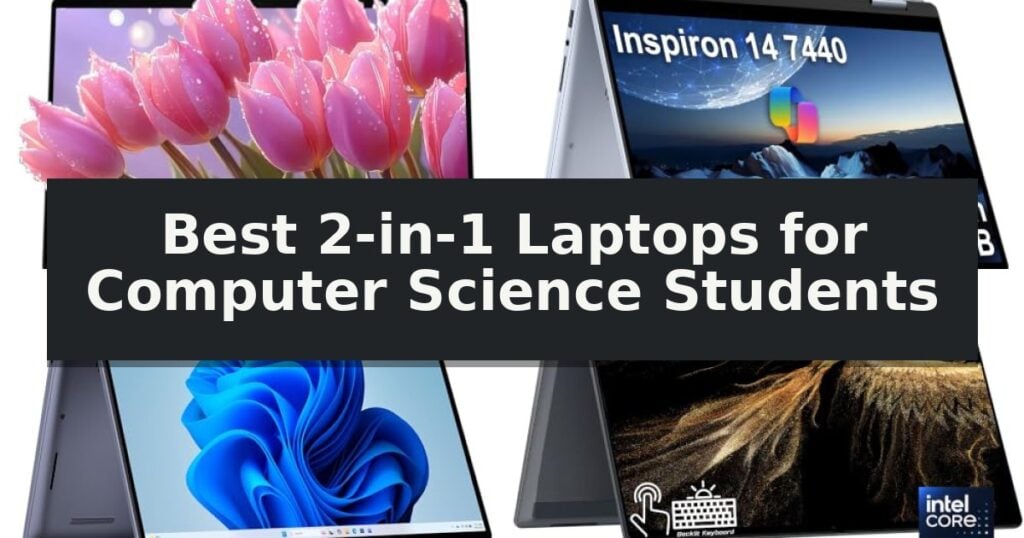
10 Best 2-in-1 Laptops for Computer Science Students in 2026 Reviews
Quick Comparison
| Product | Best For | Key Strength | Score |
|---|---|---|---|
| HP OmniBook X Flip 2-in-1 Laptop | Best Overall | High-performance AI NPU with 47 TOPS for advanced computing tasks. | 4.9 |
| Dell Inspiron 14 2-in-1 Laptop | High-Capacity Memory for Multitasking | 32GB DDR5 RAM for efficient multitasking. | 4.3 |
| Dell 14 2-in-1 Laptop | Fast Processing for Complex Projects | 360° hinge design allows for flexible usage modes. | 4.9 |
| HP OmniBook X Flip 2-in-1 Laptop (B0GQLCPFH1) | Extended Battery for Long Study | High-efficiency Intel Core Ultra 7 256V processor with 47 TOPS NPU for AI tasks. | 4.6 |
| HP OmniBook 2-in-1 Laptop | Portable Design for Campus Life | 360-degree foldable design for flexible usage modes | 4.8 |
| HP OmniBook X Flip 2-in-1 16" WUXGA Touchscreen Laptop | Includes Stylus for Digital Notes | Large 16-inch 2K IPS touchscreen provides ample workspace for coding. | 4.6 |
| Dell Latitude 5300 2-in-1 Laptop | Reliable Value for Students | 360° hinge design allows for flexible usage modes including tablet and tent. | 4.8 |
| Dell Latitude 7420 2-in-1 Laptop | Professional Grade Build Quality | Intel Core i7-1165G7 processor provides high-speed operation for complex programs. | 4.3 |
| Omnica 2-in-1 Laptop | Budget Friendly Convertible Choice | 360° hinge enables flexible usage modes. | 4.3 |
| Dell Latitude 3190 2-in-1 Laptop | Compact Form for Mobile Learning | 360-degree hinge enables seamless transition between laptop and tablet modes. | 4.9 |
How We Chose
Selecting the right hardware for computer science requires evaluating how specific components handle the heavy workloads of software engineering. We examine each 2-in-1 laptop based on its ability to maintain performance under load, the reliability of its input methods for documentation, and the practical ergonomics required for students moving between classrooms and labs.
- Processor architecture and multi-core performance for code compilation.
- RAM capacity and speed to support virtualization and containerization.
- Display resolution and color accuracy for extended coding sessions.
- Portability and build quality for daily transit between campus buildings.
- Battery efficiency for sustained productivity away from power outlets.
1 HP OmniBook X Flip 2-in-1 Laptop — AI-Powered Performance for Coding
The HP OmniBook X Flip 2-in-1 Laptop integrates an Intel Core Ultra 7 256V 8-Core Processor with a dedicated AI-powered NPU capable of 47 TOPS, providing significant computational overhead for demanding computer science workloads. Its versatile 2-in-1 design allows students to transition between a traditional laptop setup for coding and a tablet mode for diagramming or note-taking.
Visual clarity is prioritized through a 16-inch 2K IPS touchscreen featuring a 120Hz refresh rate and 100% DCI-P3 color gamut. The display is protected by Corning Gorilla Glass 3, ensuring durability during frequent transport between lecture halls and labs. With a thin 0.58-inch profile and a weight of just 3.06 lbs, it remains highly portable without sacrificing screen real estate.
Performance is bolstered by 16GB of LPDDR5x-8533 MT/s memory and a 1TB PCIe Gen4 SSD, offering fast data access and ample storage for virtual machines, large datasets, and development environments. Connectivity options include Thunderbolt 4, Wi-Fi 6E, and an HDMI port, ensuring compatibility with external monitors and high-speed networking equipment required for modern software development.
The device is optimized for long-duration study sessions, boasting a battery life of up to 22.75 hours for video playback. Integrated features like the 5MP IR webcam with AI noise reduction and Poly Studio audio tuning enhance remote collaboration, while the included stylus provides an immediate tool for digital annotation and design tasks.
Best for: Computer science students requiring a portable, high-performance machine capable of handling AI-driven development tasks and intensive multitasking.
Skip if: Users who prioritize a dedicated discrete GPU for heavy 3D rendering or gaming, as this model utilizes integrated Intel Arc 140V graphics.
- High-performance AI NPU with 47 TOPS for advanced computing tasks.
- 120Hz 2K IPS touchscreen provides fluid visuals and accurate color reproduction.
- Exceptional battery life reaching up to 22.75 hours.
- Ultra-portable 3.06 lb design with a durable 0.58-inch thin chassis.
- Integrated graphics may limit performance in specialized 3D modeling or high-end gaming applications.
- Fixed 16GB RAM configuration cannot be upgraded by the user.
2 Dell Inspiron 14 2-in-1 Laptop — High-Capacity Memory for Multitasking
The Dell Inspiron 14 2-in-1 Laptop utilizes a versatile x360 degree hinge, allowing students to transition seamlessly between traditional laptop, tablet, and presentation modes. This flexibility is supported by an Intel Core 5 120U processor, which provides the necessary computational overhead for multitasking across various development environments and academic applications.
Equipped with 32GB of DDR5 4800 MHz RAM and a 1TB PCIe NVMe M.2 SSD, this machine is configured to handle large datasets and resource-intensive software builds. The 14-inch WUXGA (1920 x 1200) touchscreen display features a 16:10 aspect ratio, offering additional vertical screen real estate that is particularly beneficial for viewing code or documentation.
Connectivity is a priority for technical workflows, and the device includes two USB Type-C 3.2 Gen 2 ports, two USB 3.2 Gen 1 Type-A ports, and an HDMI 1.4 output. These ports support external display configurations, allowing for multi-monitor setups at 1080p via HDMI or 4K resolution through the USB Type-C interface, enhancing productivity during long study sessions.
Designed for portability and sustained use, the unit weighs approximately 2.91 pounds and includes a backlit keyboard for low-light environments. The integrated 1080p webcam and Wi-Fi 6E connectivity ensure reliable performance for remote learning and collaborative video conferencing, while the inclusion of Windows 11 Professional provides advanced management features suitable for educational and professional tasks.
Best for: Computer science students requiring a versatile, high-memory convertible laptop for coding, multitasking, and remote learning.
Skip if: Users who require high-performance dedicated graphics for intensive 3D rendering or gaming, as this model relies on integrated Intel graphics.
- 32GB DDR5 RAM for efficient multitasking.
- x360 degree hinge for flexible usage modes.
- 1TB PCIe NVMe SSD for fast storage and data access.
- Multi-monitor support via USB Type-C and HDMI.
- Integrated graphics may limit performance in graphics-heavy applications.
- HDMI 1.4 port is restricted to 1080p resolution at 60Hz.
3 Dell 14 2-in-1 Laptop — Fast Processing for Complex Projects
The Dell 14 2-in-1 Laptop provides a versatile computing environment for students, featuring a 360° hinge that allows for seamless transitions between laptop, tablet, tent, and stand modes. This adaptability is paired with the AMD Ryzen 7 8840HS processor and 16GB of DDR5 memory, ensuring the hardware can handle demanding academic software and multitasking requirements.
Visual clarity is prioritized through a 16:10 aspect ratio display, which offers a taller screen profile compared to standard displays, providing more vertical space for coding, documentation, and research. To support long study sessions, the device includes Dell ComfortView software to help reduce blue light emissions, while the 1TB SSD provides ample storage for large project files and datasets.
The laptop integrates modern communication tools, including AI-enabled video chat features such as auto-framing and eye-contact correction, which assist in maintaining professional engagement during remote lectures or group collaborations. Connectivity is managed via Wi-Fi 6E, ensuring stable network performance for research and cloud-based development environments.
Designed for long-term utility, the unit includes a 1-year onsite service warranty, providing support at the user's location if hardware issues arise. The slim, 3.77-pound chassis is built for portability, making it a practical choice for students moving between classrooms and study spaces.
Best for: Students who require a flexible, high-performance device for both intensive coding tasks and portable note-taking.
Skip if: Users who require a dedicated workstation with a discrete GPU for heavy 3D rendering or high-end machine learning model training.
- 360° hinge design allows for flexible usage modes.
- AMD Ryzen 7 8840HS processor provides robust computing power.
- 16:10 aspect ratio offers increased vertical screen space.
- 1TB SSD provides significant storage capacity for large projects.
- Integrated graphics may limit performance in specialized 3D rendering or heavy gaming tasks.
4 HP OmniBook X Flip 2-in-1 Laptop (B0GQLCPFH1) — Extended Battery for Long Study
The HP OmniBook X Flip 2-in-1 Laptop (B0GQLCPFH1) distinguishes itself with a high-efficiency Intel Core Ultra 7 256V processor that integrates a dedicated NPU capable of 47 TOPS, providing the specialized AI-processing power often required for modern computer science workflows. Its versatile 2-in-1 design allows students to transition between a traditional laptop setup for coding and a tablet orientation for diagramming or note-taking with the included stylus.
Engineered for portability, the device weighs only 3.06 lbs and measures just 0.58 inches thin, making it suitable for carrying between lecture halls and labs. The 16-inch 2K touchscreen display features a 120Hz refresh rate and 400 nits of brightness, which helps maintain visual clarity during long programming sessions. The inclusion of Corning Gorilla Glass 3 adds a layer of scratch resistance for students on the move.
Connectivity for peripheral devices is managed through a Thunderbolt 4 port, facilitating high-speed data transfers and external display support. The laptop is equipped with 16GB of LPDDR5x RAM and a 1TB PCIe Gen4 SSD, ensuring sufficient memory and storage overhead for compiling code and running virtual environments. Furthermore, the 5MP IR webcam with an integrated HDR switch and AI noise reduction supports clear video conferencing for remote collaboration.
Battery management is a key strength, with the unit rated for up to 22.75 hours of video playback on its 65 Wh battery. This longevity is beneficial for students who spend extended periods away from power outlets. While the hardware is robust, users should note that the factory-sealed box is opened for the inclusion of the upgraded SSD, which is a standard procedure for this specific configuration.
Best for: Computer science students who require a portable, AI-capable machine with long battery life for coding and academic projects.
Skip if: Users who require dedicated high-end discrete graphics for intensive 3D rendering or gaming, as this model utilizes integrated Intel Arc 140V graphics.
- High-efficiency Intel Core Ultra 7 256V processor with 47 TOPS NPU for AI tasks.
- Long battery life rated for up to 22.75 hours of video playback.
- Versatile 2-in-1 design with included stylus for flexible input methods.
- 120Hz 2K touchscreen display with 400 nits brightness.
- Integrated graphics may limit performance for heavy 3D modeling or gaming.
- 16GB RAM is fixed, which may be a limitation for users running multiple heavy virtual machines.
5 HP OmniBook 2-in-1 Laptop — Portable Design for Campus Life
The HP OmniBook 2-in-1 Laptop offers a flexible 14-inch 2K QHD touchscreen designed for users who need to transition between coding, documentation, and research. Its 360-degree foldable flip design allows for rapid switching between laptop, tablet, and stand modes, providing a versatile interface for various academic tasks.
Under the hood, this machine is powered by an Intel Core 7 processor and 16GB of DDR5 RAM. This hardware configuration supports smooth multitasking, which is essential for running integrated development environments (IDEs), virtual machines, or multiple browser tabs simultaneously. The 512GB SSD ensures fast boot times and quick access to large project files.
Connectivity is a notable strength, as the device includes a comprehensive array of built-in ports. This design choice eliminates the need for external adapters or dongles when connecting to external displays, peripherals, or laboratory equipment. The slim, lightweight chassis maintains a portable profile, making it a practical choice for students moving between lecture halls and study spaces.
Running on Windows 11, the system provides a stable environment for daily home office and study requirements. The combination of its high-resolution display and efficient processing power makes it a reliable tool for computer science students who require a balance of performance and portability in their daily workflow.
Best for: Students who require a versatile, portable device for coding, research, and multitasking across various study environments.
Skip if: Users who require dedicated high-end discrete graphics for intensive 3D rendering or heavy machine learning model training.
- 360-degree foldable design for flexible usage modes
- Comprehensive built-in ports reducing the need for external adapters
- 14-inch 2K QHD touchscreen for high-resolution workspace
- 16GB DDR5 RAM for responsive multitasking
- 512GB storage may require external drives for large datasets
6 HP OmniBook X Flip 2-in-1 16" WUXGA Touchscreen Laptop — Includes Stylus for Digital Notes
For students balancing intensive coding projects with digital note-taking, the HP OmniBook X Flip 2-in-1 16" WUXGA Touchscreen Laptop offers a versatile hardware configuration. It features a 16-inch 2K IPS touchscreen that provides significant screen real estate, reducing the need for constant scrolling when reviewing long lines of code or documentation.
At the heart of this device is the AMD Ryzen 5 220 processor, built on the Zen 4 architecture. With 6 cores and 12 threads, it is capable of handling multitasking workloads, supported by a boost clock speed of up to 4.9 GHz. The system includes 8GB of DDR5 RAM and a 512GB SSD, providing a baseline for local development environments and file storage.
The 2-in-1 design is complemented by the included aluminum alloy capacitive stylus, which requires no charging or Bluetooth pairing. This makes it a practical tool for sketching diagrams or annotating lecture notes directly on the screen. The integration of AMD FreeSync Technology and integrated Radeon 740 graphics supports smooth visual output during use.
Measuring just 0.61 inches in height and weighing 4.18 pounds, the laptop maintains a relatively slim profile for a 16-inch device. It comes pre-installed with Windows 11 Home and includes Microsoft Copilot, offering AI-assisted features for productivity tasks. The edge-to-edge glass display and micro-edge bezels contribute to a clean, modern aesthetic suitable for academic environments.
Best for: Computer science students who require a large, high-resolution touchscreen for coding and digital annotation.
Skip if: Students who prioritize extreme portability or require more than 8GB of RAM for memory-intensive virtualization or heavy compiling tasks.
- Large 16-inch 2K IPS touchscreen provides ample workspace for coding.
- Included stylus requires no charging or pairing for immediate note-taking.
- AMD Ryzen 5 220 processor with 12 threads handles multitasking efficiently.
- Slim 0.61-inch profile for a 16-inch form factor.
- 8GB of RAM may be limiting for advanced virtualization or large-scale software development.
- 4.18-pound weight is heavier than smaller, more portable ultrabooks.
7 Dell Latitude 5300 2-in-1 Laptop — Reliable Value for Students
For students balancing intensive coding projects with daily coursework, the Dell Latitude 5300 2-in-1 Laptop provides a versatile platform that adapts to various academic environments. Its 360° hinge design allows for quick transitions between a traditional laptop setup for heavy typing and a tablet mode for digital note-taking or reviewing diagrams.
Performance is driven by an Intel Core i7-8665U processor, which handles multitasking and development environments with efficiency. The system is equipped with 16GB of DDR4 RAM and a 512GB solid-state drive, ensuring that applications load quickly and there is sufficient space for project files and local development tools.
Visual clarity is supported by a 13.3-inch Full HD touchscreen with a 1920×1080 resolution. This display provides the necessary screen real estate for viewing code side-by-side or managing multiple windows during research. The inclusion of a backlit keyboard further aids productivity during late-night study sessions in low-light conditions.
Connectivity is well-rounded for a modern student, featuring USB-C and HDMI ports to facilitate external monitor setups or peripheral connections. Running Windows 11 Pro, the device offers professional-grade security and management tools, making it a reliable choice for students who need a stable, portable machine for their computer science curriculum.
Best for: Students needing a portable, versatile machine for coding, research, and note-taking in a compact 13.3-inch form factor.
Skip if: Users who require dedicated graphics hardware for high-end gaming or intensive machine learning model training will find this integrated-graphics model insufficient.
- 360° hinge design allows for flexible usage modes including tablet and tent.
- 16GB of RAM provides ample memory for multitasking and running development environments.
- Full HD 1080p touchscreen offers crisp visuals for coding and media consumption.
- Lightweight construction at 2.9 pounds enhances portability for campus travel.
- 8th Gen Intel processor is older technology compared to current market standards.
- Integrated graphics limit capability for GPU-intensive tasks or modern gaming.
8 Dell Latitude 7420 2-in-1 Laptop — Professional Grade Build Quality
The Dell Latitude 7420 2-in-1 Laptop provides a versatile computing platform for students, featuring a 14-inch FHD touchscreen with an anti-glare finish designed to minimize eye strain during extended coding or research sessions. This device functions as both a traditional notebook and a tablet, offering flexibility for various academic workflows.
Under the hood, this laptop is powered by an Intel Core i7-1165G7 processor, which reaches a maximum turbo frequency of 4.7GHz. With 4 cores and 8 threads, it is equipped to handle multiple development environments, compilers, and browser tabs concurrently. The inclusion of 16GB of RAM and a 512GB Solid State Drive ensures that data access remains responsive for demanding software applications.
The system runs on Windows 11 Pro, which offers advanced management and security features beneficial for professional-grade computing tasks. It supports virtualization and remote access, capabilities often required for computer science coursework. The device is also designed with language support for multiple international configurations, making it adaptable to diverse user needs.
As a refurbished model, the Dell Latitude 7420 2-in-1 Laptop includes a compatible power supply and charger. While the packaging is standard rather than original, the hardware remains fully functional for professional use. This unit balances processing power with a compact, 14-inch form factor, making it a practical choice for students who require a reliable machine for both daily assignments and specialized technical projects.
Best for: Computer science students who need a high-performance, versatile 2-in-1 device capable of running virtualization and multiple development tools.
Skip if: Users who require original manufacturer packaging or a brand-new device with a full factory warranty.
- Intel Core i7-1165G7 processor provides high-speed operation for complex programs.
- 16GB of RAM allows for efficient multitasking across multiple development environments.
- FHD anti-glare touchscreen reduces visual fatigue during long study sessions.
- Windows 11 Pro supports virtualization and advanced remote access features.
- Refurbished status means the charger and power supply may not be original equipment.
- Standard packaging is provided instead of original retail box.
9 Omnica 2-in-1 Laptop — Budget Friendly Convertible Choice
The Omnica 2-in-1 Laptop features a versatile 360° hinge that allows users to transition between laptop, tablet, tent, and stand modes, providing flexibility for various academic tasks. This convertible design is supported by a 15.6-inch FHD touchscreen with a 1920×1080 resolution, offering a clear display for coding projects, research, or media consumption.
Under the hood, this device is equipped with a Ryzen 3 3200U processor capable of reaching speeds up to 3.5GHz, paired with 16GB of DDR4 RAM. This memory configuration is intended to support smooth multitasking, which is essential for running integrated development environments and managing multiple browser tabs simultaneously. Storage needs are addressed by a 1TB SATA SSD, providing rapid boot times and significant space for large datasets or software installations.
For connectivity, the laptop includes a range of ports such as USB Type-C (3.2 Gen1), USB 3.0, and HDMI 1.4, alongside an RJ45 Ethernet port for stable wired networking. The inclusion of WiFi 5 and Bluetooth 5.1 ensures wireless communication capabilities. Additionally, the integrated backlit keyboard allows for typing in low-light environments, which can be toggled via the Fn+F9 key combination.
Weighing approximately 4.4 pounds with a thickness of 0.8 inches, this unit is designed to balance portability with a full-sized screen. It comes pre-installed with Windows 11 Pro, offering a professional operating environment. The manufacturer provides a 2-year warranty, covering the hardware for long-term use throughout a student's academic career.
Best for: Students who require a versatile, convertible form factor with ample storage for large software projects and multitasking.
Skip if: Users who prioritize extreme lightweight portability or high-end processing power for intensive machine learning or 3D rendering tasks.
- 360° hinge enables flexible usage modes.
- 16GB RAM supports efficient multitasking.
- 1TB SSD provides substantial storage capacity.
- Backlit keyboard enhances usability in dim lighting.
- Ryzen 3 processor may limit performance in highly demanding computational tasks.
- 4.4-pound weight is heavier than some ultra-portable alternatives.
10 Dell Latitude 3190 2-in-1 Laptop — Compact Form for Mobile Learning
For students navigating demanding coursework, the Dell Latitude 3190 2-in-1 Laptop offers a versatile form factor that transitions between a traditional notebook and a tablet. Its 11.6-inch HD multi-touch display provides the necessary interaction for digital note-taking or reviewing diagrams, while the 360-degree hinge allows for flexible positioning in cramped lecture hall desks or library study carrels.
Under the hood, this device is powered by an Intel Celeron N5030 Quad-Core processor with a boost frequency up to 2.4GHz. Paired with 4GB of DDR4 system memory and a 128GB solid-state drive, it is configured for essential academic tasks such as word processing, web research, and light coding environments. The inclusion of Windows 11 Pro ensures compatibility with standard professional software suites.
Connectivity is addressed through a functional port selection, including two USB 3.1 Gen 1 ports and an HDMI output for connecting to external monitors during group projects. It also features a Noble Wedge Lock slot for physical security in shared spaces and a combo headphone/microphone jack for clear audio during virtual meetings or lectures.
This unit is designed with a focus on portability, weighing approximately 4.39 pounds. While it is a compact machine, users should note the 128GB storage capacity and 4GB of RAM, which are optimized for lightweight computing rather than intensive multitasking or heavy software compilation. It serves as a reliable, dedicated tool for students prioritizing mobility and a flexible interface.
Best for: Students who require a compact, convertible device for note-taking, web research, and light academic workloads.
Skip if: Users who need high-performance hardware for heavy software development, complex simulations, or extensive multitasking will find the 4GB RAM and Celeron processor limiting.
- 360-degree hinge enables seamless transition between laptop and tablet modes.
- Multi-touch display facilitates interactive learning and digital annotation.
- Windows 11 Pro provides a professional-grade operating system environment.
- Compact 11.6-inch form factor is ideal for mobile use in classrooms.
- 4GB of RAM may restrict performance during heavy multitasking.
- 128GB SSD provides limited storage for large datasets or software libraries.
Best 2-in-1 Laptops for Computer Science Students Buying Guide
Processing Power for Development
Computer science students frequently run resource-intensive applications, including integrated development environments (IDEs), database management systems, and local web servers. A processor with high core counts and efficient thermal management is essential to prevent system slowdowns during compilation.
Look for modern mobile processors that feature dedicated neural processing units (NPUs) if you plan to experiment with machine learning or AI-driven development tools. These chips offer a balance of power and efficiency, allowing you to run complex scripts without draining the battery prematurely.
Memory and Multitasking Capacity
Memory is often the primary bottleneck for students running multiple virtual machines or large-scale data sets. While 16GB is a standard baseline, opting for 32GB provides significant headroom for more complex projects and future-proofing your machine throughout your degree.
Fast memory speeds, such as LPDDR5X, contribute to smoother transitions between open applications. This responsiveness is critical when you are juggling browser tabs for research, a terminal for coding, and a communication app for group projects.
Display Quality and Ergonomics
A high-resolution display with a 16:10 aspect ratio provides more vertical screen real estate, which is invaluable for viewing more lines of code at once. Touchscreen functionality, when paired with a stylus, transforms your laptop into a digital notebook for complex algorithm diagrams.
Consider the impact of screen brightness and blue light reduction features on eye strain. Since computer science students spend significant time in front of a screen, a display that offers high nits and comfort-focused technology is a worthwhile investment for long-term health.
Portability and Build Quality
Campus life demands a device that is lightweight enough to carry in a backpack all day but durable enough to withstand frequent movement. A slim, 2-in-1 design should feature a robust hinge mechanism that maintains stability in both laptop and tablet configurations.
Weight distribution and chassis material play a role in how the device feels during transit. Aluminum or reinforced glass constructions offer a premium feel and added protection against the minor impacts that occur in busy lecture halls and study spaces.
Connectivity and Peripheral Support
Ensure your laptop includes a versatile selection of ports, such as Thunderbolt 4 or USB-C, to connect to external monitors, high-speed storage, and other peripherals. Reliable Wi-Fi 6E support is also necessary for stable connections in dense campus network environments.
While many modern laptops rely on adapters, having a variety of built-in connections reduces the need to carry extra dongles. Check for HDMI and SD-card slots if your specific coursework involves hardware interfacing or media-heavy projects.
Frequently Asked Questions
Is 16GB of RAM enough for a computer science student?
16GB is sufficient for most undergraduate coursework, including web development and standard programming tasks. However, if you plan to run multiple virtual machines or work with large datasets, 32GB is highly recommended.
Why choose a 2-in-1 over a traditional laptop?
A 2-in-1 offers the flexibility of a tablet for reading textbooks, taking handwritten notes, or sketching diagrams, while maintaining the full power and keyboard functionality of a traditional laptop for coding.
Do I need a dedicated graphics card for computer science?
Most computer science programs do not require a dedicated GPU unless you are specializing in game development, 3D rendering, or heavy machine learning. Integrated graphics, like Intel Arc, are usually sufficient for standard development.
How important is battery life for a student?
Battery life is crucial for students who spend long days on campus without consistent access to power outlets. Aim for a device that offers at least 10 hours of real-world usage.
Can I use a 2-in-1 laptop for long-term coding projects?
Yes, provided the laptop has adequate cooling and a comfortable keyboard. Ensure the device can maintain sustained performance without overheating during long compilation sessions.
Conclusion: Our Top Pick
Our top pick is HP OmniBook X Flip 2-in-1 Laptop. Choosing the right 2-in-1 laptop for computer science involves prioritizing processing power and memory to handle your specific development needs. By focusing on these core specifications, you ensure your device remains a reliable tool throughout your academic career.
Ultimately, the best choice depends on your specific focus, whether that is data science, web development, or systems engineering. Select a model that balances your performance requirements with the portability needed for your daily campus routine.