Casio Prizm FX-CG50 Graphing Calculator is our top choice for the Best College Calculus Calculator, offering a high-resolution color display and advanced 3D graphing capabilities that simplify complex calculus visualization.
Selecting a calculator for advanced mathematics requires balancing raw processing power with specific exam requirements. For students, the primary goal is finding a device that handles derivatives, integrals, and complex equations while remaining permitted in testing environments.
Beyond raw function counts, we prioritize interface clarity and input methods. A calculator that displays expressions exactly as they appear in textbooks reduces input errors during high-pressure exams, while features like Python integration or built-in note-taking provide additional utility for engineering and science coursework.
For students seeking more targeted advice on advanced math tools, our Best Calculator for Calculus guide provides additional insights into selecting the right device for your specific curriculum. If your coursework requires less graphing and more heavy-duty computation, consult our Best Scientific Calculator recommendations for alternative options.
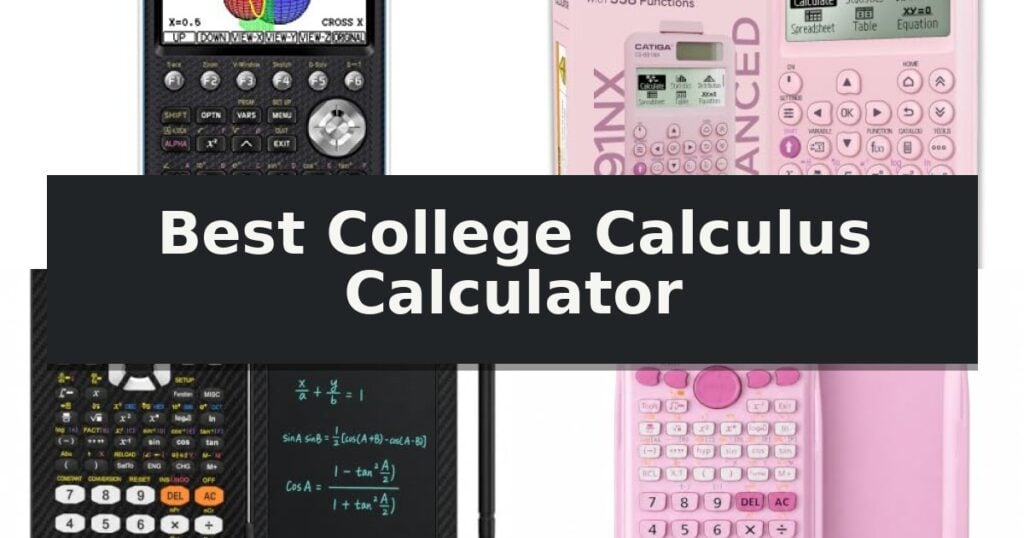
10 Best College Calculus Calculator in 2026 Reviews
Quick Comparison
| Product | Best For | Key Strength | Score |
|---|---|---|---|
| Casio Prizm FX-CG50 Graphing Calculator | Best Overall | High-resolution color display for clear 3D graphing. | 4.9 |
| CATIGA CS-991NX Scientific Calculator | Textbook-style display with 538 functions | Textbook-style HD display for clear equation visualization | 4.9 |
| iPepul 991EX Scientific Calculator | Rechargeable with built-in notepad | Built-in notepad for simultaneous calculation and note-taking. | 4.6 |
| iPepul TX Graphing Calculator | Visualizes complex equations | 10 versatile calculation modes covering everything from basic statistics to advanced vector and matrix… | 4.3 |
| CATIGA CS-121 Scientific Calculator | Budget-friendly graphing capabilities | Integrated graphing and scientific functions in a single, compact device. | 4.5 |
| ROATEE 991ES Scientific Calculator | Integrated LCD writing tablet | Integrated LCD writing tablet for convenient note-taking. | 4.8 |
| OSALO OS-991ES Plus Scientific Calculator | Efficient 417-function design | Reduces keystrokes by 50% through intelligent shortcut optimization. | 4.6 |
| Rudnia 911EX Scientific Calculator | Includes handy study timer | 417 scientific functions covering a wide range of academic math needs. | 4.5 |
| Nadex NXTE-1943 Scientific Calculator | Formula visualization for students | Includes over 360 functions for comprehensive mathematical support. | 4.7 |
| Mr. Pen Scientific Calculator | Reliable dual-power academic tool | Dual power source with solar and battery backup for consistent reliability. | 4.3 |
How We Chose
Selecting the right calculator for college-level calculus involves evaluating how well a device handles advanced symbolic and graphical tasks. We focus on display technology, function depth, and the physical design to ensure the tool supports both classroom learning and rigorous exam environments.
- Exam compliance and standardized testing approval
- Display clarity for complex mathematical expressions
- Advanced function support for calculus and engineering
- Build quality and portability for daily campus use
- Power efficiency and long-term reliability
1 Casio Prizm FX-CG50 Graphing Calculator — Advanced 3D graphing and Python
Visualizing complex mathematical concepts becomes more intuitive with the Casio Prizm FX-CG50 Color Graphing Calculator, which features a high-resolution LCD capable of displaying over 65,000 colors. This vibrant display allows students to render 3D functions—including spheres, cylinders, and planes—with clarity that standard monochrome screens cannot match.
Beyond its visual capabilities, the device is built for rigorous academic environments. It includes a Natural Textbook Display that renders expressions and results exactly as they appear in standard math textbooks, reducing the cognitive load when interpreting complex equations. The calculator is also exam-approved for major assessments, including the AP, SAT, ACT, and IB exams.
For students interested in computational mathematics, the Casio Prizm FX-CG50 offers Python integration. Users can write and execute programs directly on the device or connect it to a PC to manage and share code. This functionality extends the utility of the calculator beyond standard graphing, making it a versatile tool for science and engineering coursework.
The hardware is designed for portability and ease of use, measuring approximately 7.42 inches in width and weighing just 0.8 pounds. Its comprehensive suite of advanced math functions covers everything from basic calculations and complex numbers to dynamic statistics and geometry, ensuring it remains a relevant resource throughout a college career.
Best for: Students in high school or college math, science, and engineering programs who require 3D graphing capabilities and Python programming support.
Skip if: Users who do not require advanced 3D rendering or programming features may find a simpler, more affordable scientific calculator sufficient for their needs.
- High-resolution color display for clear 3D graphing.
- Natural Textbook Display simplifies the entry and interpretation of complex math.
- Python integration allows for custom programming and data sharing.
- Exam-approved for major standardized tests including SAT, ACT, and AP.
- Higher complexity may require a learning curve for those unfamiliar with graphing calculator interfaces.
2 CATIGA CS-991NX Scientific Calculator — Textbook-style display with 538 functions
Navigating complex coursework requires a tool that displays equations exactly as they appear in your textbook. The CATIGA CS-991NX Scientific Calculator features a textbook-style HD display with 4-gradation shading, ensuring that fractions, roots, and exponents are rendered clearly rather than squeezed onto a single line.
Equipped with 538 functions, this device is engineered to handle a wide range of academic requirements, from general math and algebra to advanced calculus, physics, and engineering. It supports complex operations including matrix and vector calculations, equation solving, and built-in spreadsheet functionality, allowing students to manage diverse coursework with a single device.
Usability is enhanced by an intuitive icon menu that allows for rapid switching between modes such as statistics, distribution, and table calculations. The hardware is designed for portability and durability, measuring 6.38 x 3.03 x 0.42 inches and weighing only 0.21 lbs, making it a practical addition to any student's bag.
Reliability during high-stakes testing is addressed through dual solar and battery power, which ensures the device remains operational even if one power source fails. Furthermore, the included magnetic hard case provides a secure, rigid cover that protects the screen and keys, offering a significant upgrade over standard slide-on covers that may slip or break.
Best for: College and high school students requiring a versatile, high-resolution calculator for advanced math, science, and engineering coursework.
Skip if: Students whose specific exam board or course curriculum mandates the use of a graphing calculator rather than a scientific model.
- Textbook-style HD display for clear equation visualization
- Comprehensive 538-function library covering multiple STEM disciplines
- Dual solar and battery power for consistent reliability
- Secure magnetic hard case for improved protection
- Scientific-only functionality may not meet requirements for courses necessitating graphing capabilities
3 iPepul 991EX Scientific Calculator — Rechargeable with built-in notepad
Navigating complex mathematical coursework requires tools that keep pace with both computation and documentation. The iPepul 991EX Scientific Calculator distinguishes itself by integrating a built-in notepad directly into the device, allowing students to record formulas and intermediate steps alongside their calculations. This dual-functionality is particularly useful for students who need to track variable changes or scratch out multi-step derivations without losing focus on the primary digital readout.
Engineered for versatility, this device offers 552 scientific functions covering a broad spectrum of subjects including algebra, geometry, trigonometry, statistics, calculus, matrices, and vectors. The 5-line display provides a clear view of complex expressions, which is essential for verifying work during rigorous study sessions or exam preparation. By displaying multiple lines of information, the screen reduces the likelihood of input errors when dealing with long, multi-part equations.
Power management is addressed through a dual-source system featuring Type-C rechargeable capabilities and solar power. This design choice minimizes the need for frequent battery swaps, supporting long-term reliability for high school and college students engaged in STEM courses. The integration of a standard charging port ensures that the calculator remains operational during extended study periods.
The physical interface includes an organized keyboard layout designed to streamline the input of common math symbols. The integrated writing tablet features a lock key to prevent accidental erasure of notes, ensuring that critical data remains visible until the user is ready to clear the screen. While this integrated design adds a layer of utility for note-taking, it does result in a larger footprint compared to traditional, single-purpose scientific calculators.
Best for: Students in STEM fields who need to perform complex calculations while simultaneously documenting formulas and scratch work.
Skip if: Users who require a graphing calculator for advanced visual plotting or those who prefer a traditional, non-rechargeable battery-powered device.
- Built-in notepad for simultaneous calculation and note-taking.
- 552 scientific functions covering a wide range of advanced mathematics.
- Type-C rechargeable and solar-powered energy system.
- 5-line display for improved visibility of expressions and results.
- Integrated design may be less portable than standard scientific calculators.
- Writing pad functionality requires manual clearing and locking management.
4 iPepul TX Graphing Calculator — Visualizes complex equations
Visualizing complex mathematical functions is a primary challenge for students navigating higher-level coursework, and the iPepul TX Graphing Calculator addresses this with a dedicated graphing interface. By supporting Cartesian coordinate equations, conic curves, polar functions, and parametric equations, this device serves as a functional tool for students in algebra, trigonometry, and calculus.
The hardware is built around a 128 x 64 high-resolution screen designed to render formulas and graphs with clarity. The interface includes 10 built-in calculation modes, such as Matrix, Vector, and Equation solvers, which allow users to shift between different mathematical disciplines without needing multiple devices. The well-spaced keyboard layout is specifically engineered to minimize accidental inputs during intensive study sessions.
For practical classroom and home use, the calculator is powered by 4 AAA batteries. To manage power consumption effectively, it features an auto power-off function that triggers after 6 minutes of inactivity. The unit's dimensions—approximately 7.16 inches in length and 3.89 inches in width—provide a balance between a large, readable display and a portable form factor suitable for backpacks.
While designed for versatility, the iPepul TX Graphing Calculator is a specialized tool for those requiring advanced graphing and multi-mode calculation capabilities. Its distinct pink aesthetic offers a departure from standard office-style electronics, making it a recognizable choice for students organizing their academic supplies.
Best for: High school and college students needing a multi-mode calculator capable of graphing complex equations and functions.
Skip if: Users who require a calculator with specific standardized test certifications or those who prefer rechargeable internal batteries over standard AAA battery operation.
- 10 versatile calculation modes covering everything from basic statistics to advanced vector and matrix operations.
- High-resolution 128 x 64 display that simplifies the visualization of graphs and complex formulas.
- Well-spaced keyboard design intended to reduce input errors during fast-paced testing or homework.
- Energy-efficient operation with an automatic power-off feature to preserve battery life.
- Battery-dependent power requires maintaining a supply of 4 AAA batteries.
- Specialized aesthetic may not suit professional environments that prefer traditional, neutral-colored office equipment.
5 CATIGA CS-121 Scientific Calculator — Budget-friendly graphing capabilities
Navigating complex mathematical coursework requires a tool that bridges the gap between basic computation and advanced visualization. The CATIGA CS-121 Scientific Calculator addresses this by integrating graphing capabilities directly into a familiar, compact scientific calculator layout, allowing students to plot functions and solve equations while simultaneously viewing the graph and formula on the same screen.
Designed to be a practical middle ground for students, this model avoids the bulk and high cost often associated with premium graphing units. It features over 360 built-in functions and three smart modes that adapt to various subjects, including trigonometry, statistics, and linear regression. This versatility ensures it remains useful from pre-algebra through advanced college calculus.
Portability is a primary focus of its design, featuring a 7 x 3.3-inch body that weighs only 6.4 ounces. The device is constructed with anti-drop housing and includes a protective case to safeguard the screen and keys during daily transport between classrooms and study spaces. It is powered for long sessions and includes a reset button on the back for quick troubleshooting.
To support long-term use, the manufacturer includes a 365-day limited warranty and provides responsive support. This calculator offers a streamlined approach for students who need reliable graphing and equation-solving power without the steep learning curve or investment of more complex, professional-grade devices.
Best for: Students requiring a portable, budget-friendly device that combines standard scientific functions with essential graphing capabilities for college-level math.
Skip if: Users who require advanced programming, computer algebra systems (CAS), or large color touchscreens for high-level engineering or professional research.
- Integrated graphing and scientific functions in a single, compact device.
- Over 360 functions covering a wide range of math and statistics coursework.
- Durable anti-drop housing and included protective case for portability.
- Cost-effective alternative to premium, bulky graphing calculators.
- Limited screen size compared to high-end, dedicated graphing tablets.
- Lacks advanced programming features found in professional engineering calculators.
6 ROATEE 991ES Scientific Calculator — Integrated LCD writing tablet
The ROATEE 991ES Scientific Calculator simplifies complex coursework by integrating a dedicated LCD writing tablet directly into its chassis. This dual-function design allows students to perform advanced calculations while simultaneously jotting down notes or intermediate steps with the included stylus, ensuring that critical data remains visible during multi-step problems.
Engineered for versatility, this device supports 417 distinct functions, covering a wide range of academic needs from basic algebra and geometry to complex matrix, vector, and statistical regression calculations. The 4-line display provides a clear view of multiple calculations at once, which helps maintain workflow efficiency when working through lengthy equations or system-based math.
Portability and durability are central to its construction. The anti-drop body is designed to withstand the rigors of daily transport in a backpack, and the unit weighs only 5 ounces, making it a practical choice for students moving between classrooms. Its dual power system combines a rechargeable battery with a replaceable coin battery, providing a reliable power source that minimizes the risk of depletion during exams.
Usability is enhanced by a user-friendly memory function and a straightforward interface. To protect the integrity of your notes, the device includes a LOCK KEY that must be disengaged to activate the writing area and erase button. This thoughtful inclusion prevents accidental deletion of work while the calculator is stored or in use.
Best for: Students requiring a compact, all-in-one tool for complex calculus and science coursework who benefit from an integrated scratchpad for manual note-taking.
Skip if: Users who prefer a dedicated graphing calculator with a large color screen for advanced visual plotting or those who require specific exam-board-approved hardware that excludes integrated writing tablets.
- Integrated LCD writing tablet for convenient note-taking.
- 417 built-in functions covering a broad range of math and science disciplines.
- Dual power source with rechargeable capability.
- Anti-drop body design for increased durability.
- Lock key requirement for the writing tablet may add an extra step for quick note-taking.
7 OSALO OS-991ES Plus Scientific Calculator — Efficient 417-function design
Navigating complex mathematical coursework requires a reliable tool that minimizes manual input errors, and the OSALO OS-991ES Plus Scientific Calculator addresses this with an intelligent design that reduces keystrokes by 50%. By incorporating shortcut keys and editable expressions, this device streamlines the workflow for students tackling demanding subjects like Calculus and Linear Algebra.
The OSALO OS-991ES Plus Scientific Calculator is equipped with 417 essential functions, providing comprehensive support for everything from basic trigonometry to advanced matrix operations and complex number calculations. Its textbook-like written display is a standout feature, allowing users to view expressions exactly as they appear in academic materials, which simplifies the process of converting between fractions and decimals.
Efficiency is further bolstered by the smart history and quick recall functionality. This allows students to retrieve, edit, and reuse previous formulas without the frustration of repeated data entry, making it highly effective for multi-step equation solving. The device is powered by both solar and battery sources, ensuring consistent operation during long study sessions or examinations.
Designed for versatility, this calculator serves as a practical companion for high school and college students alike. Its compact dimensions of 6.4 by 3.15 inches ensure it remains portable for daily use in classrooms or lecture halls, while the improved, concise user manual helps students get up to speed quickly.
Best for: High school and college students requiring a versatile tool for advanced coursework like Calculus, Linear Algebra, and Differential Equations.
Skip if: Students who require a graphing calculator for advanced visual function analysis or those restricted by specific exam board hardware requirements.
- Reduces keystrokes by 50% through intelligent shortcut optimization.
- Features 417 essential functions covering a wide range of academic needs.
- Textbook-like display improves readability and input accuracy.
- Smart history and quick recall allows for effortless formula editing.
- Dual solar and battery power ensures reliable performance.
- Lacks advanced graphing capabilities required for some specialized engineering courses.
- Compact size may feel small for users who prefer larger button layouts.
8 Rudnia 911EX Scientific Calculator — Includes handy study timer
Managing complex coursework often requires more than just standard arithmetic, and the Rudnia 911EX Scientific Calculator integrates a unique built-in study timer and alarm to help students structure their review sessions and class preparation. This specialized tool is designed to assist with time management while providing the computational power needed for advanced academic tasks.
Equipped with 417 scientific functions, this device handles a broad spectrum of requirements including fractions, percentages, trigonometry, statistics, and complex equations. The inclusion of an integrated LCD notepad and writing pad allows for immediate documentation of formulas, intermediate steps, or quick notes, serving as a practical companion during study groups or classroom work.
The hardware design emphasizes versatility with a USB-C rechargeable battery supplemented by solar backup power, ensuring the device remains operational during long days in the classroom or dorm. Its portable, compact form factor fits easily into school bags, making it a reliable choice for students needing a consistent tool for daily math, algebra, and geometry assignments.
While this calculator provides a comprehensive suite of features for high school and college-level mathematics, its primary strength lies in the combination of calculation capability and note-taking convenience. The classic black aesthetic maintains a professional look suitable for any academic environment, providing a functional solution for those who need to track both their math and their time.
Best for: Students who need to combine advanced scientific calculations with integrated note-taking and time management tools for study sessions.
Skip if: Users who require a graphing calculator for advanced calculus or engineering courses that mandate specific visual plotting capabilities.
- 417 scientific functions covering a wide range of academic math needs.
- Integrated LCD notepad for writing formulas and notes on the fly.
- USB-C rechargeable power with solar backup for consistent reliability.
- Built-in study timer to assist with time management during homework or exams.
- Lacks advanced graphing capabilities required for higher-level engineering or specialized calculus coursework.
9 Nadex NXTE-1943 Scientific Calculator — Formula visualization for students
Navigating complex mathematical concepts requires a tool that bridges the gap between raw calculation and visual understanding. The Nadex NXTE-1943 Scientific Calculator is designed to assist students through high school and college coursework, including Algebra, Trigonometry, and Calculus, by providing a large screen that enables the simultaneous display of equations and formula visualizations.
Equipped with over 360 functions, this device handles a wide range of academic requirements, from complex number calculations and fractions to linear regression and standard deviation. It features three distinct operating modes—Calculation, Angular Measurement, and Display—allowing users to tailor the interface to their specific problem-solving needs. While it provides visual aids for formulas, it is important to note that this is not a dedicated graphing calculator.
The unit is built for portability and convenience, measuring 11 inches in length and 2 inches in width. To ensure it remains functional during long study sessions or exams, the package includes a secondary replacement battery stored directly in the battery chamber. This focus on readiness makes it a practical companion for standardized testing preparation, including the SAT, ACT, and AP exams.
By combining variable solving and permutation capabilities with a user-friendly layout, the Nadex NXTE-1943 Scientific Calculator offers a balanced approach for students who need advanced mathematical support without the complexity of a full-scale graphing device. Its streamlined design ensures that essential functions remain accessible for both classroom assignments and rigorous exam environments.
Best for: High school and college students needing a versatile calculator for advanced mathematics, AP courses, and standardized exam preparation.
Skip if: Students specifically requiring a full-featured graphing calculator for complex coordinate geometry or advanced function plotting will find this model insufficient.
- Includes over 360 functions for comprehensive mathematical support.
- Features a large screen for simultaneous equation and formula display.
- Includes a secondary replacement battery for added convenience.
- Supports standardized testing preparation including SAT and ACT.
- Not a dedicated graphing calculator for advanced plotting.
- Limited to formula visualization rather than full coordinate graphing.
10 Mr. Pen Scientific Calculator — Reliable dual-power academic tool
The Mr. Pen Scientific Calculator simplifies complex academic workflows by utilizing a clear 2-line display, which allows students to view both their input expressions and calculated results simultaneously. This design choice minimizes errors during multi-step calculations, making it a functional tool for students navigating high school and college-level mathematics.
Engineered for versatility, this device supports a wide range of functions, including trigonometry, logarithms, and statistics. It also features dedicated keys for scientific and engineering notation, ensuring it remains relevant across various math and science disciplines. The inclusion of these specific mathematical operations makes it a reliable companion for standardized tests and classroom assignments.
Portability and reliability are central to its design, highlighted by a durable slide-on cover that protects the unit during transport. The dual power source—combining solar power with a battery backup—ensures the calculator remains operational in diverse lighting conditions, from bright classrooms to dim exam halls.
While it offers a robust feature set for general academic use, it is a dedicated scientific tool rather than a graphing calculator. Students requiring advanced visual plotting or programmable memory for complex engineering projects may find its capabilities limited compared to more specialized, higher-tier graphing models.
Best for: Students in middle school, high school, and college needing a reliable, dual-powered scientific calculator for standard math and science coursework.
Skip if: Students requiring advanced graphing capabilities, complex matrix programming, or symbolic algebra features will need a more specialized graphing calculator.
- Dual power source with solar and battery backup for consistent reliability.
- Clear 2-line display for simultaneous viewing of input and results.
- Wide range of functions covering trigonometry, logs, and statistics.
- Durable slide-on cover for enhanced portability and protection.
- Lacks advanced graphing or complex programming features required for higher-level engineering courses.
Best College Calculus Calculator Buying Guide
Graphing Capabilities and Visualization
Calculus often requires visualizing functions, derivatives, and areas under curves. A high-resolution color display allows students to distinguish between multiple functions on a single graph, which is essential for understanding intersection points and complex geometric relationships.
While basic scientific calculators handle numerical computation, graphing models provide the visual context necessary for mastering concepts like limits and optimization. Look for models that support 3D graphing if your curriculum includes multivariable calculus or advanced engineering physics.
Exam Compliance and Restrictions
Before purchasing, verify that your specific calculator model is approved for the exams you intend to take, such as the SAT, ACT, or AP Calculus tests. Some advanced models with computer algebra systems (CAS) may be prohibited in certain testing scenarios.
A reliable calculator for college should balance advanced functionality with strict adherence to exam board guidelines. Always check the official approved-equipment list for your specific course or standardized test to avoid issues on test day.
Input Methods and Display Logic
Natural Textbook Display technology is a significant advantage for calculus students. By showing fractions, exponents, and radicals exactly as they appear in a textbook, these displays reduce the cognitive load required to translate written math into calculator syntax.
Efficient menu navigation is equally important. Models that use intuitive icon-based menus allow you to switch quickly between calculation, statistics, and equation-solving modes, saving valuable time during timed assessments or complex homework assignments.
Durability and Power Management
College students carry their gear across campus daily, making build quality a critical factor. Look for models that include a rigid, snap-on hard case rather than a flimsy slide-on cover to protect the screen and keys from damage in a crowded backpack.
Power reliability is non-negotiable for long study sessions. Calculators featuring dual-power sources, such as solar panels combined with battery backup, ensure that you are never left with a dead device in the middle of an exam or lecture.
Advanced Features for STEM Majors
If you are pursuing an engineering or physics degree, consider models that offer additional features like matrix operations, vector analysis, and programming capabilities. These tools extend the utility of your calculator well beyond basic calculus.
Some modern calculators now integrate features like built-in note-taking tablets or USB-C charging. While these are convenient, ensure they do not compromise the core mathematical performance or exam eligibility required for your specific degree path.
Frequently Asked Questions
Do I need a graphing calculator for college calculus?
Most college calculus courses require a graphing calculator to visualize functions and perform numerical integration. Check your course syllabus to confirm if a specific model is recommended or required.
Can I use a calculator with a notepad feature on exams?
Policies vary by institution and exam board. While these features are helpful for study, they are often prohibited in secure testing environments. Always verify your exam's specific policy before bringing a device with a writing pad.
What is the difference between a scientific and a graphing calculator?
A scientific calculator handles advanced mathematical functions like trigonometry and logarithms but cannot plot graphs. A graphing calculator includes these functions plus the ability to visualize equations on a screen.
How do I know if my calculator is exam-approved?
Check the official website of the testing organization, such as the College Board for SAT/AP exams. They maintain a list of permitted and prohibited calculator features and models.
Is it worth buying a rechargeable calculator?
Rechargeable models are convenient for daily use and reduce battery waste. However, ensure the battery life is sufficient for your needs and that you have a way to charge it before important exams.
Conclusion: Our Top Pick
Our top pick is Casio Prizm FX-CG50 Graphing Calculator. Choosing the right calculator for college calculus depends on your specific course requirements and the types of exams you will face. Prioritizing a clear, textbook-style display and reliable build quality will serve you well throughout your academic career.
By selecting a model that balances advanced graphing capabilities with exam compliance, you ensure that your tool remains an asset rather than a liability. Evaluate your long-term needs in STEM to determine if a specialized graphing model or a versatile scientific calculator is the best fit.