Texas Instruments TI-Nspire CX II CAS is our top choice for the Best Calculator for Calculus, offering a powerful computer algebra system that simplifies complex symbolic manipulation. For students who prefer a touch-based interface for dynamic geometry, the HP Prime G2 Graphing Calculator serves as a capable alternative, while the Texas Instruments TI-36X Pro provides a reliable, non-graphing option for courses where graphing technology is restricted.
Selecting a calculator for calculus requires balancing advanced mathematical functionality with the specific requirements of your coursework and exam policies. While high-end models provide deep symbolic capabilities for exploring functions, simpler scientific models often offer the precision needed for rigorous algebraic work without the complexity of graphing software.
Understanding the distinction between Computer Algebra System (CAS) and non-CAS models is essential for any calculus student. CAS-enabled devices can solve equations symbolically, which is invaluable for homework and conceptual learning, but these features are frequently prohibited during standardized testing, necessitating a clear understanding of your classroom and exam constraints.
If you are also enrolled in foundational math courses, our guide on the Best Calculator for Algebra provides recommendations for tools that bridge the gap between basic arithmetic and calculus. For students preparing for broader STEM requirements, we also cover the Best Calculator for College Students to help you select a device that remains useful across multiple disciplines.
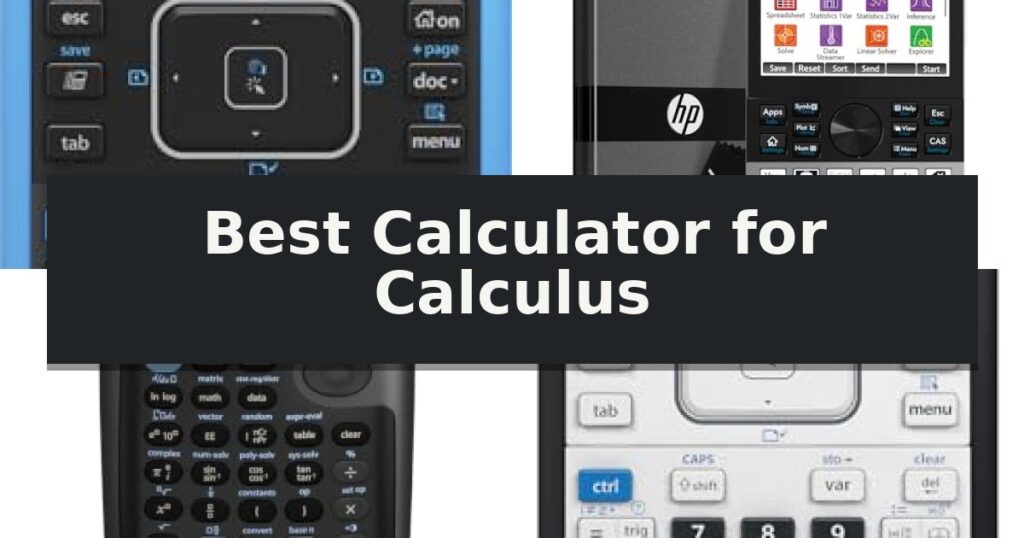
10 Best Calculator for Calculus in 2026 Reviews
Quick Comparison
| Product | Best For | Key Strength | Score |
|---|---|---|---|
| Texas Instruments TI-Nspire CX II CAS | Best Overall | Computer Algebra System (CAS) for symbolic math manipulation. | 4.9 |
| HP Prime G2 Graphing Calculator | Intuitive Multi-Touch Calculus Interface | Multi-touch color display for interactive graph manipulation. | 4.9 |
| Texas Instruments TI-36X Pro | Non-Graphing Essential for Calculus | MultiView display allows for simultaneous calculation viewing. | 4.8 |
| Texas Instruments TI-Nspire CX II | Visual Learning for Complex Functions | High-resolution full-color display for complex function visualization. | 4.9 |
| Texas Instruments TI-84 Plus CE | Standard Classroom Calculus Choice | Full-color backlit display enhances graph readability and data visualization. | 4.8 |
| Casio Prizm FX-CG50 | 3D Graphing for Advanced Math | High-resolution color display for clear 3D graphing. | 4.6 |
| Casio FX-115ESPLSB-WA-IT | Engineering-Grade Scientific Precision | Natural Textbook Display for clear expression viewing | 4.9 |
| Casio fx-9750GIII | Programmable Math for Students | MicroPython integration for direct programming. | 4.7 |
| Texas Instruments TI-30XS MultiView | Four-Line Calculus Problem Solving | MultiView four-line display for simultaneous calculation tracking | 4.9 |
| iPepul Scientific Calculator | Integrated Notepad for Calculus Steps | 552 scientific functions covering a wide range of advanced mathematics. | 4.6 |
How We Chose
Evaluating the best calculator for calculus requires a focus on functional depth and academic compliance. An experienced reviewer assesses how effectively a device handles symbolic integration and differentiation while ensuring the interface remains accessible. We prioritize models that balance advanced computational power with the specific constraints imposed by standardized testing boards and classroom curricula.
- Computer Algebra System (CAS) capability for symbolic manipulation
- Display clarity and ability to show math expressions as they appear in textbooks
- Exam-approval status for standardized testing environments
- Battery life and charging convenience for long study sessions
- Interface intuitiveness and navigation speed
1 Texas Instruments TI-Nspire CX II CAS — Advanced Symbolic Calculus Power
Navigating complex derivatives and integrals requires a tool capable of symbolic manipulation, and the Texas Instruments TI-Nspire CX II CAS provides this through its integrated Computer Algebra System. This handheld device features a vibrant 3.5-inch color screen with a resolution of 320 x 240 pixels, allowing for clear visualization of mathematical functions and geometric constructions.
The calculator is designed for efficiency with a thin, lightweight profile and a responsive touchpad for navigation. Users can differentiate their work using six different graph styles and 15 distinct colors, which helps in identifying multiple functions on a single coordinate plane. Quick alpha keys are integrated into the layout to streamline the entry of variables and equations.
For extended study sessions, the unit includes a rechargeable battery that can last up to two weeks on a single charge. The package also includes the TI-Inspire CX Student Software for PC and Mac, which extends the handheld's graphing and computational capabilities to a desktop environment, providing a seamless transition between classroom work and home study.
While the device offers advanced functionality, its reliance on a specific interface and software ecosystem means users should be prepared to learn the navigation logic. The combination of the high-resolution display and the CAS engine makes it a specialized tool for students tackling advanced mathematics.
Best for: Students and professionals requiring advanced symbolic manipulation and graphing capabilities for calculus and higher-level mathematics.
Skip if: Users who prefer a traditional, non-CAS calculator interface or those who do not require the advanced symbolic features of this specific model.
- Computer Algebra System (CAS) for symbolic math manipulation.
- High-resolution color display with 15 color options for graphing.
- Long-lasting rechargeable battery providing up to two weeks of use.
- Includes student software for enhanced desktop functionality.
- Learning curve associated with the touchpad navigation and software interface.
2 HP Prime G2 Graphing Calculator — Intuitive Multi-Touch Calculus Interface
Navigating complex mathematical functions requires a tool that bridges the gap between symbolic manipulation and graphical visualization. The HP Prime G2 Graphing Calculator offers a distinct advantage for calculus students through its 3.5-inch multi-touch color display, which allows for intuitive pinch-to-zoom graph manipulation and the ability to sketch functions directly on the screen.
Beyond its display, this device integrates a powerful Computer Algebra System (CAS), enabling users to perform symbolic calculations alongside traditional numerical and graphical analysis. Dedicated keys allow for rapid switching between these views, ensuring that students can verify their work across different mathematical representations efficiently.
Designed for the modern classroom, the HP Prime G2 Graphing Calculator is exam approved for major assessments including the SAT, PSAT/NMSQT, and select AP exams. Its 256 MB flash memory provides ample space for storing complex programs and configurations, while the brushed metal design and rechargeable lithium-ion battery offer a durable, portable solution for daily academic use.
Connectivity features further distinguish this model, as it supports wireless data sharing and polling through the HP Prime Wireless Kit. For those who prefer digital integration, the HP Prime Mobile App mirrors the calculator's full functionality across Windows, iOS, and Android platforms, facilitating a seamless transition between the physical device and digital study environments.
Best for: Students requiring a high-resolution, touch-enabled interface for advanced calculus, symbolic algebra, and exam-compliant graphing.
Skip if: Users who prefer a traditional, non-touch interface or those whose specific coursework or testing requirements prohibit the use of CAS-enabled devices.
- Multi-touch color display for interactive graph manipulation.
- Integrated Computer Algebra System (CAS) for symbolic math.
- Exam approved for SAT, PSAT, and select AP testing.
- Wireless and mobile app integration for data sharing.
- CAS functionality may be restricted in certain specific classroom or testing environments.
3 Texas Instruments TI-36X Pro — Non-Graphing Essential for Calculus
Calculus students often require a reliable tool that handles complex mathematical notation without the distraction of advanced graphing features. The Texas Instruments TI-36X Pro is engineered specifically for this environment, offering a robust set of scientific functions that align with high school and college curricula, including Algebra, Trigonometry, and Calculus.
The standout feature of this model is its MultiView display, which allows users to view multiple calculations simultaneously on the screen. This is complemented by MathPrint technology, which renders mathematical expressions, symbols, and stacked fractions exactly as they appear in standard textbooks. This design choice minimizes the cognitive load associated with interpreting complex notation.
Functionality extends beyond basic arithmetic, as the device allows for the conversion of fractions, decimals, and terms—including Pi—into various alternate representations. Users can also toggle between specific modes such as degrees/radians, floating/fix, and different number formats to suit the requirements of specific problems.
Measuring 9.7 inches in length and weighing only 0.32 pounds, the Texas Instruments TI-36X Pro is a portable solution for students who need a powerful, non-graphing calculator. Its design ensures it remains a viable option for testing environments where graphing technology is restricted, while still providing the computational depth necessary for advanced coursework.
Best for: Students in high school or college calculus courses who require a powerful scientific calculator that is permitted in non-graphing testing environments.
Skip if: Users who specifically require advanced graphing capabilities, 3D plotting, or a color touchscreen interface for complex visual analysis.
- MultiView display allows for simultaneous calculation viewing.
- MathPrint technology displays expressions in standard textbook format.
- Versatile conversion capabilities for fractions, decimals, and constants.
- Permitted in testing environments where graphing calculators are prohibited.
- Lacks graphing functionality required for advanced visual data analysis.
4 Texas Instruments TI-Nspire CX II — Visual Learning for Complex Functions
Visualizing complex mathematical concepts requires more than just a standard display, and the Texas Instruments TI-Nspire CX II addresses this by allowing students to connect multiple representations of the same function on its high-resolution, full-color screen. This approach helps bridge the gap between abstract equations and their graphical counterparts, making it a powerful tool for those navigating the rigors of calculus.
Beyond its display, the device is built for academic environments where reliability is paramount. It features a long-lasting rechargeable battery that eliminates the need for frequent replacements, and because it functions without requiring an internet connection, it remains a consistent, distraction-free tool during study sessions or high-stakes testing. Its portability ensures that students can transition easily between the classroom and home study.
The calculator is designed to be a long-term academic companion, as evidenced by its inclusion of a 4-year license for student software compatible with PC and Mac. This software integration allows for deeper data analysis and exploration on a larger screen, extending the utility of the hardware. Educators were involved in the development process to ensure the interface challenges students to think critically rather than simply providing automated answers.
Compatibility is a key consideration for any student, and this model is pre-approved for major standardized assessments, including the PSAT/NMSQT, SAT, ACT, AP, and IB Diploma Programme exams. This broad acceptance means students can rely on a single, familiar interface throughout their high school and early college mathematics journey without needing to switch devices for different testing requirements.
Best for: Students enrolled in advanced mathematics courses like calculus who need a versatile, exam-approved device with integrated software for deeper conceptual analysis.
Skip if: Users who prefer a traditional, non-graphing calculator or those who do not require advanced visualization and software integration for their specific coursework.
- High-resolution full-color display for complex function visualization.
- Approved for major standardized exams including SAT, ACT, and AP.
- Includes a 4-year student software license for PC and Mac.
- Features a long-lasting rechargeable battery.
- Requires learning curve to master the computer-like interface and software features.
5 Texas Instruments TI-84 Plus CE — Standard Classroom Calculus Choice
Navigating complex mathematical concepts requires a tool that bridges the gap between abstract equations and visual representation. The Texas Instruments TI-84 Plus CE simplifies this process by utilizing a high-resolution, full-color backlit display that makes graphing functions and identifying intersections significantly more intuitive than monochrome alternatives.
Designed for the rigors of academic life, this calculator features the MathPrint interface, which allows students to input and view math symbols, formulas, and stacked fractions exactly as they appear in standard textbooks. This design choice reduces input errors and helps users focus on the calculus concepts rather than the syntax of the machine.
Portability and battery longevity are essential for students moving between lectures. The Texas Instruments TI-84 Plus CE is lightweight and includes a TI Rechargeable Battery capable of lasting up to one month on a single charge. It also comes with a four-year subscription for the online version, providing a consistent experience across both physical and digital platforms.
While built to withstand classroom demands, the device remains a specialized tool. It is optimized for middle school through college-level coursework, offering a balance of processing speed and functional depth that supports advanced calculus without unnecessary complexity.
Best for: Students from middle school through college who need a reliable, color-coded graphing tool for calculus and science coursework.
Skip if: Users who require a computer algebra system (CAS) for advanced symbolic manipulation will find this model insufficient for their specific needs.
- Full-color backlit display enhances graph readability and data visualization.
- MathPrint technology displays equations exactly as they appear in textbooks.
- Long-lasting rechargeable battery provides up to one month of use per charge.
- Lightweight and durable construction suitable for daily academic transport.
- Lacks a computer algebra system (CAS), which may be required for specific advanced calculus applications.
6 Casio Prizm FX-CG50 — 3D Graphing for Advanced Math
The Casio Prizm FX-CG50 distinguishes itself through a high-resolution, full-color LCD screen capable of rendering over 65,000 colors. This visual clarity is particularly useful for students navigating complex calculus, as it allows for the precise visualization of 3D functions, including spheres, cylinders, and planes.
Beyond its display capabilities, the calculator is equipped with a wide range of advanced math functions. It supports polar and rectilinear graphing of simultaneous equations, dynamic geometry, and statistics. The inclusion of the Natural Textbook Display ensures that mathematical expressions and results are rendered exactly as they appear in standard textbooks, which helps reduce errors during input and interpretation.
For students interested in computational mathematics, the device features integrated Python programming support. Users can write and execute MicroPython code directly on the hardware or connect to a PC to manage and share scripts. This functionality expands the utility of the device beyond traditional graphing tasks.
The unit is designed for portability and academic compliance, measuring approximately 0.73 inches in height. It is officially approved for use in major standardized tests, including the AP, SAT, ACT, and IB exams, ensuring that students can utilize its advanced feature set in testing environments without compatibility concerns.
Best for: Students in high school and college-level calculus, science, and engineering courses who require 3D graphing and Python programming capabilities.
Skip if: Users who prefer a monochrome display or those who do not require advanced 3D graphing and programming features may find a simpler, more affordable scientific calculator sufficient.
- High-resolution color display for clear 3D graphing.
- Natural Textbook Display simplifies complex math input.
- Python integration allows for custom programming.
- Standardized exam approval for AP, SAT, ACT, and IB.
- Advanced feature set may have a steeper learning curve for basic users.
7 Casio FX-115ESPLSB-WA-IT — Engineering-Grade Scientific Precision
Navigating complex mathematical expressions requires a tool that mirrors the way you work on paper, and the Casio FX-115ESPLSB-WA-IT is designed specifically for this purpose. This advanced scientific calculator features a Natural Textbook Display, which presents fractions, derivatives, integrals, and other symbols exactly as they appear in your coursework, eliminating the need to decipher linear code on a screen.
Beyond its display capabilities, the Casio FX-115ESPLSB-WA-IT serves as a comprehensive tool for engineering, science, and statistics students. Its architecture is optimized for the rigorous demands of calculus, providing the necessary functions to handle multi-step problems with precision. The device maintains a slim profile, measuring only 0.1 inches in height, making it highly portable for students moving between classrooms and study sessions.
The physical design emphasizes both utility and durability. Weighing just 0.4 pounds, the calculator is lightweight enough for daily carry while remaining stable during use. It includes a 1-year manufacturer warranty, providing assurance for the hardware components. With its intuitive layout, it balances advanced functionality with a user-friendly interface that helps streamline complex calculations.
When selecting a calculator for calculus, the primary trade-off involves balancing advanced computational power with ease of operation. While this model excels at displaying mathematical notation clearly, users should ensure its specific feature set aligns with the requirements of their current curriculum or examination guidelines. Its focus on textbook-style visualization makes it a practical choice for those who prefer visual clarity over complex programming features.
Best for: Students in engineering, science, and statistics who require a calculator that displays complex mathematical expressions in a natural, textbook-like format.
Skip if: Users who require a graphing calculator with advanced plotting capabilities or programmable memory for highly specialized software applications.
- Natural Textbook Display for clear expression viewing
- Advanced functionality tailored for engineering and calculus
- Slim, lightweight design for easy portability
- 1-year manufacturer warranty included
- Lacks advanced graphing or complex programming features
8 Casio fx-9750GIII — Programmable Math for Students
Navigating the complexities of calculus requires a tool that balances computational power with an intuitive interface, and the Casio fx-9750GIII is engineered to meet these rigorous academic demands. By integrating MicroPython programming capabilities, this device allows students to write, execute, and debug code directly on the hardware, providing a practical bridge between theoretical mathematics and modern computational logic.
The device features a Natural Textbook Display, which renders mathematical expressions, fractions, and symbols exactly as they appear in standard academic materials. This design choice significantly reduces the cognitive load during complex calculations, allowing students to focus on solving derivatives or integrals rather than deciphering formatting errors. The interface is optimized to handle a wide range of applications, including graph plotting, probability distributions, vectors, and spreadsheets, ensuring versatility across various STEM coursework.
For practical file management, the Casio fx-9750GIII includes USB connectivity, enabling users to transfer, store, and share programs or data between the calculator and a computer. This feature is particularly useful for students who need to manage multiple scripts or datasets for different projects. Furthermore, the device is officially exam-approved for major standardized tests, including the AP, SAT, ACT, and IB exams, providing the necessary assurance for students who require a consistent, reliable tool that meets strict regulatory requirements for testing environments.
While the Casio fx-9750GIII offers robust functionality, it is important to note that it utilizes a monochrome display. This represents a trade-off compared to higher-end models that feature high-resolution color touchscreens. However, for students who prioritize functional reliability and programming access over color-coded visuals, this device remains a highly capable and efficient choice for advanced mathematics.
Best for: Students requiring a programmable, exam-compliant graphing calculator for high school and college-level mathematics.
Skip if: Users who require a high-resolution color touchscreen or advanced computer algebra system (CAS) functionality for complex symbolic manipulation.
- MicroPython integration for direct programming.
- Natural Textbook Display for intuitive expression entry.
- Exam-approved for major standardized tests.
- USB connectivity for efficient file management.
- Monochrome display lacks the visual clarity of high-end color models.
9 Texas Instruments TI-30XS MultiView — Four-Line Calculus Problem Solving
Visualizing complex math problems requires a tool that bridges the gap between abstract notation and digital display. The Texas Instruments TI-30XS MultiView addresses this by utilizing a four-line screen that allows users to view multiple calculations simultaneously, making it easier to compare results and identify patterns during intensive coursework.
Designed to handle the rigors of high school and early college mathematics, this calculator displays expressions, symbols, and stacked fractions exactly as they appear in standard textbooks. This design choice removes the need for students to translate their work into a technical, linear syntax, which can often lead to input errors during complex calculus or algebra operations.
Beyond basic arithmetic, the device offers advanced functionality for data analysis and function exploration. Students can automatically generate an (x,y) table of values for a given function or manually input specific x-values to observe output changes. Additionally, the unit supports scientific notation with proper superscripted exponents, ensuring that output remains readable and consistent with academic standards.
With a compact footprint measuring 7.25 inches by 3.375 inches, the calculator is portable enough for daily classroom use while maintaining a clear, readable interface. It is a specialized tool for students navigating subjects ranging from Pre-Algebra and Geometry to Biology and Chemistry, providing a reliable, syntax-free environment for problem-solving.
Best for: Students who need a clear, textbook-style display to visualize fractions, symbols, and multi-step calculations without complex syntax.
Skip if: Users requiring advanced graphing capabilities or programmable features for high-level engineering and university-grade calculus will find this scientific model insufficient.
- MultiView four-line display for simultaneous calculation tracking
- Textbook-style formatting for fractions and symbols
- Automatic (x,y) table generation for function analysis
- Scientific notation output with superscripted exponents
- Lacks advanced graphing capabilities required for higher-level calculus
- Fixed scientific feature set limits use in specialized engineering fields
10 iPepul Scientific Calculator — Integrated Notepad for Calculus Steps
Managing complex mathematical expressions requires a tool that keeps pace with your workflow, and the iPepul Scientific Calculator integrates a physical writing surface directly into its design to bridge the gap between calculation and note-taking. This dual-purpose device allows students to perform advanced computations while simultaneously jotting down formulas or intermediate steps on the attached notepad.
Equipped with 552 scientific functions, this calculator handles a broad spectrum of academic requirements, including algebra, geometry, trigonometry, statistics, and calculus. The 5-line display provides the necessary screen real estate to view expressions and results clearly, reducing the likelihood of transcription errors during intensive problem-solving sessions.
The hardware is built for sustained academic use, featuring Type-C rechargeable capabilities combined with solar power to minimize downtime. The inclusion of a lock key on the writing tablet ensures that your notes remain secure until you are ready to clear the screen, providing a reliable way to track multi-step calculus problems without needing separate scratch paper.
Designed for high school and college environments, the iPepul Scientific Calculator balances portability with a comprehensive set of mathematical tools. Its organized keyboard layout is specifically arranged to provide quick access to commonly used symbols, making it a practical addition to any STEM-focused study routine.
Best for: Students and professionals who need to perform complex calculus calculations while keeping handwritten notes or formulas visible nearby.
Skip if: Users who require a graphing calculator with advanced plotting capabilities or those who prefer a traditional, non-rechargeable battery-powered device.
- 552 scientific functions covering a wide range of advanced mathematics.
- Built-in notepad with a lock key for recording formulas and steps.
- Type-C rechargeable and solar-powered for long-term reliability.
- 5-line display for improved visibility of complex expressions.
- Integrated design may be less portable than a standard, slim-profile scientific calculator.
Best Calculator for Calculus Buying Guide
Symbolic vs. Numerical Processing
Calculus students must decide if they need a Computer Algebra System (CAS). CAS models can perform symbolic operations like finding exact derivatives or integrals, which is highly beneficial for verifying homework and understanding theoretical concepts.
Non-CAS calculators are restricted to numerical approximations. While these are often required for specific exams, they lack the ability to manipulate variables directly, forcing students to rely more heavily on manual algebraic derivation.
Exam Compliance and Restrictions
Standardized tests often have strict rules regarding which calculators are permitted. Before purchasing, verify if your specific exam allows CAS-enabled devices, as many high-stakes tests explicitly forbid them to ensure students demonstrate manual proficiency.
Many schools maintain a list of approved models for AP or IB exams. Choosing a calculator that is widely accepted ensures you can use the same device for both daily coursework and final assessments without needing to learn a new interface.
Display and Interface Design
Modern calculators often feature high-resolution color screens that support 'MathPrint' or 'Natural Textbook' display modes. These features allow you to view fractions, exponents, and radicals exactly as they appear in your textbook, reducing input errors.
Navigation speed is another critical factor. Look for models with intuitive menus, dedicated function keys, or touchscreens that allow you to switch between graphing, table, and symbolic views quickly during a timed test.
Battery Life and Portability
Calculus courses often involve long study sessions and intensive exam periods. Rechargeable lithium-ion batteries are standard in modern graphing calculators, often providing weeks of usage on a single charge, which is more convenient than traditional disposable batteries.
Consider the physical dimensions and weight of the device. A thin, lightweight design is easier to carry in a backpack alongside heavy textbooks, though ensure the build quality remains durable enough to withstand daily classroom use.
Software and Connectivity
Many premium calculators now include companion software for PC or Mac. This allows you to transfer data, update the calculator's operating system, and perform more complex analysis on a larger screen, which can be a significant advantage for project work.
Connectivity options like USB ports or wireless modules enable students to share data or collaborate in classroom environments. While not strictly necessary for basic calculus, these features add long-term value for engineering or advanced physics coursework.
Frequently Asked Questions
Do I need a CAS calculator for AP Calculus?
Most AP Calculus exams do not require a CAS calculator, and some specific test sections may even prohibit them. Always check the official College Board calculator policy for your specific exam year.
Can I use a graphing calculator in all math classes?
Not necessarily. Some introductory or specific engineering courses may require a non-graphing scientific calculator to ensure students master the underlying mathematical principles without relying on graphing technology.
How long do rechargeable calculator batteries last?
Most modern color graphing calculators can last anywhere from two weeks to a month on a single charge, depending on usage intensity and screen brightness settings.
What is the difference between MathPrint and standard display?
MathPrint or Natural Textbook display shows fractions, square roots, and exponents in a vertical, formatted style that matches textbook notation, whereas standard displays often use linear, text-based syntax.
Is it worth upgrading to a color screen?
A color screen is primarily useful for distinguishing between multiple graphs on a single coordinate plane, which can make complex function analysis much clearer and faster.
Conclusion: Our Top Pick
Our top pick is Texas Instruments TI-Nspire CX II CAS. Choosing the right calculator for calculus depends on your specific academic goals and the testing environment you will encounter. If you need advanced symbolic power for high-level study, a CAS-enabled model is the superior choice, provided it aligns with your exam requirements.
For those focused on standardized testing or general coursework, a reliable non-CAS graphing or scientific model offers the necessary precision and ease of use. Evaluate your syllabus and exam rules carefully to ensure your chosen device supports your success throughout the semester.