Bambu Lab P1S Combo 3D Printer is our pick for the Best 3D Printers with Wi-Fi because it integrates advanced cloud-based remote management with a high-speed, enclosed CoreXY system that ensures consistent print quality.
For users prioritizing a compact, beginner-friendly experience, the Entina Tina2C offers reliable wireless connectivity in a plug-and-play package. Meanwhile, the Elegoo Mars 5 Ultra provides specialized resin printing capabilities with robust Wi-Fi cluster printing features for those needing high-resolution detail.
When selecting a 3D printer with wireless capabilities, consider how the manufacturer's software ecosystem handles file transfers and remote monitoring. Reliable Wi-Fi performance is essential for managing print queues, checking progress via integrated cameras, and receiving firmware updates without needing a physical connection.
If you are just starting your journey, our guide on Best 3D Printers for Beginners provides additional context on selecting a machine that balances ease of use with long-term growth potential. For those specifically setting up a workshop at home, the Best 3D Printers for Home Use guide covers essential considerations like noise levels and space requirements.
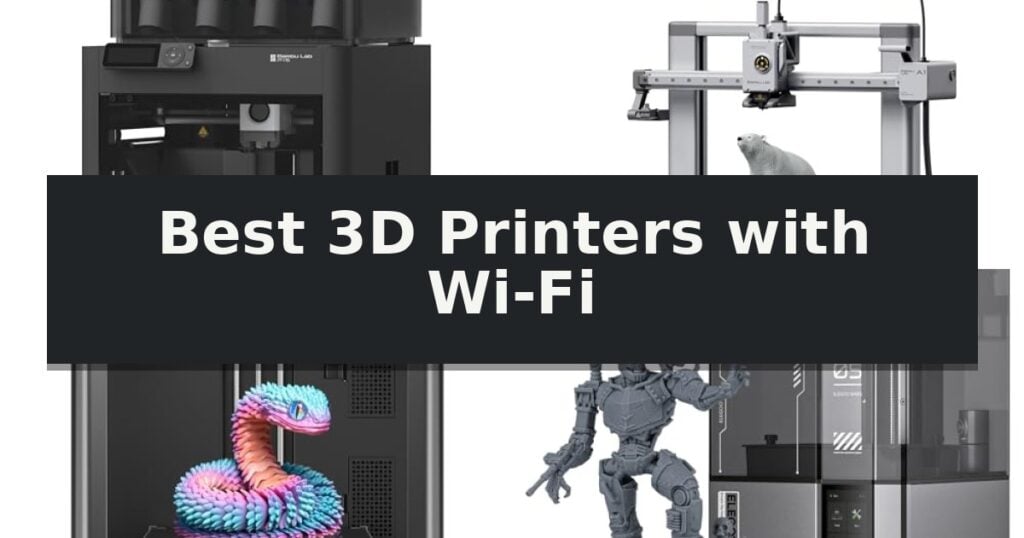
10 Best 3D Printers with Wi-Fi in 2026 Reviews
Quick Comparison
| Product | Best For | Key Strength | Score |
|---|---|---|---|
| Bambu Lab P1S Combo 3D Printer | Best Overall | Multi-color printing capability for up to 16 colors via the included AMS. | 4.9 |
| Bambu Lab A1 3D Printer | Beginner-Friendly Multi-Color Ecosystem | Full-auto calibration for hands-free setup | 4.5 |
| Flashforge Adventurer 5M 3D Printer | Ultra-Fast CoreXY Performance | 600mm/s high-speed printing for rapid production. | 4.6 |
| Elegoo Mars 5 Ultra 3D Printer | Advanced 9K Resin Precision | Tilt Release Innovation significantly increases print speed. | 4.6 |
| Creality Sparkx i7 3D Printer | Smart AI-Monitored Desktop Printing | Built-in smart camera for remote monitoring and time-lapse recording. | 4.4 |
| Aoseed X-Maker Joy AI 3D Printer | Kid-Safe AI-Powered Creative Toy | AI-powered design tools for voice and image-to-3D model generation. | 4.3 |
| Entina Tina2C 3D Printer | Compact Plug-and-Play Starter | Fully assembled design allows for a 5-minute setup time. | 4.8 |
| Entina Tina2 Plus 3D Printer | Fast Printing for STEM Learning | Fully assembled out of the box for immediate use. | 4.6 |
| Hephi3d Tina2S 3D Printer | Quiet Operation for Home | Fully assembled out of the box for immediate use. | 4.7 |
| XZN Mini M1S 3D Printer | Complete High-Speed Starter Kit | Fully assembled design for immediate out-of-the-box use. | 4.6 |
How We Chose
Evaluating 3D printers with Wi-Fi requires looking beyond basic network specs to how connectivity enhances the actual printing workflow. We prioritize machines that offer stable cloud integration, intuitive remote monitoring, and reliable file transfer speeds, ensuring that wireless features provide genuine convenience rather than just another layer of technical complexity.
- Wireless connectivity stability and app integration quality
- Print speed and acceleration capabilities
- Ease of setup and automated calibration features
- Build volume and enclosure design for material compatibility
- Remote monitoring tools such as AI camera support
1 Bambu Lab P1S Combo 3D Printer — High-Speed Multi-Color Printing
The Bambu Lab P1S Combo 3D Printer distinguishes itself with an integrated AMS (Automatic Material System), enabling seamless multi-color and multi-material printing for up to 16 colors. This system is designed to streamline complex projects by automating filament swaps, making it a capable tool for those looking to expand their creative output beyond single-color limitations.
Built on a high-speed CoreXY architecture, the printer achieves acceleration up to 20,000 mm/s² and print speeds reaching 500mm/s. This performance-oriented design is complemented by an enclosed body, which stabilizes the printing environment to improve results when working with advanced filaments like ABS, ASA, or PC. The structure is engineered to maintain precision even during high-velocity movements.
Usability is prioritized through a 15-minute setup process and automatic bed leveling, which reduces the manual calibration typically required for consistent first-layer adhesion. The printer includes Wi-Fi connectivity, allowing users to manage print jobs and monitor progress remotely via the MakerWorld model library integration.
While highly capable, the Bambu Lab P1S Combo 3D Printer is optimized for specific material sets. It is best suited for PLA, PETG, TPU, and ABS, but it is not recommended for carbon or glass fiber reinforced polymers. This trade-off ensures the hardware remains reliable for standard and advanced engineering plastics while maintaining its high-speed output.
Best for: Makers who require high-speed, multi-color printing capabilities and a simplified, ready-to-use setup.
Skip if: Users who primarily print with carbon or glass fiber reinforced polymers, as these materials are not recommended for this model.
- Multi-color printing capability for up to 16 colors via the included AMS.
- High-speed performance with 500mm/s capability and 20,000 mm/s² acceleration.
- Enclosed design improves thermal stability for advanced filaments.
- Quick 15-minute setup with automated bed leveling.
- Not recommended for carbon or glass fiber reinforced polymers.
- AMS required for multi-color functionality.
2 Bambu Lab A1 3D Printer — Beginner-Friendly Multi-Color Ecosystem
The Bambu Lab A1 3D Printer distinguishes itself through a full-auto calibration system that eliminates manual Z-offset and bed-leveling adjustments, streamlining the setup process for users. This FDM printer is engineered for efficiency, boasting an impressive acceleration of 10,000 mm/s² to maintain high-speed precision without sacrificing print detail.
Designed with a focus on a seamless user experience, the machine features a simplified touchscreen interface and a 1-Clip quick swap nozzle for straightforward maintenance. The printer operates in a quiet environment, utilizing active motor noise canceling to keep sound levels at or below 48 dB, making it suitable for home or office settings.
For those interested in multi-color capabilities, the system integrates with the AMS lite (sold separately or as part of a combo), allowing for vibrant, multi-colored prints. The active flow rate compensation algorithm ensures consistent extrusion accuracy, which helps prevent common print defects and promotes smoother surface finishes.
This printer is part of a broader ecosystem that includes the MakerWorld model library, providing ready-to-use designs. While the hardware offers high-speed performance and automated features, potential buyers should note that multi-color printing requires the additional AMS lite hardware to unlock its full creative potential.
Best for: Beginners and hobbyists seeking a high-speed, automated FDM printing experience with multi-color expansion potential.
Skip if: Users who require a large-format build volume or those who do not intend to purchase the separate AMS lite module for multi-color functionality.
- Full-auto calibration for hands-free setup
- High-speed precision with 10,000 mm/s² acceleration
- Quiet operation at ≤48 dB with active noise canceling
- Active flow rate compensation for consistent print quality
- Multi-color capability requires separate AMS lite purchase
- Specific hardware ecosystem reliance
3 Flashforge Adventurer 5M 3D Printer — Ultra-Fast CoreXY Performance
The FLASHFORGE Adventurer 5M 3D Printer streamlines the additive manufacturing process through its one-click automatic bed leveling system, which eliminates the need for manual calibration to ensure consistent first-layer adhesion. Designed for efficiency, this machine leverages a CoreXY structure to achieve travel speeds of up to 600mm/s and accelerations of 20000mm/s², significantly reducing production cycles for rapid prototyping.
Built for versatility, the printer features a 280°C direct drive extruder that supports a wide range of materials. The hardware is optimized for maintenance and speed, utilizing a 3-second detachable nozzle system and a high-flow 32mm³/s nozzle design that reaches 200°C in just 35 seconds. A dual-fan cooling array and integrated vibration compensation work in tandem to maintain high print quality even during high-speed operations.
Users can manage their workflow remotely via the Flash Studio app, which provides real-time monitoring and instant status alerts. The all-metal structure provides a stable foundation for the 220x220x220mm build volume, while the dual-sided PEI platform simplifies part removal. The unit is compatible with various nozzle sizes, ranging from 0.25mm to 0.8mm, allowing for fine-tuned adjustments based on specific project requirements.
Best for: Makers and professionals who require high-speed, automated printing with remote monitoring capabilities.
Skip if: Users who require a larger build volume than 220x220x220mm or those who prefer a fully enclosed chamber for advanced industrial filaments.
- 600mm/s high-speed printing for rapid production.
- One-click automatic bed leveling for consistent results.
- 3-second detachable nozzle for quick maintenance.
- Remote app monitoring and control via Flash Studio.
- Fixed build volume of 220x220x220mm may limit large-scale projects.
4 Elegoo Mars 5 Ultra 3D Printer — Advanced 9K Resin Precision
Achieving high-resolution prints with modern convenience is the primary focus of the ELEGOO Mars 5 Ultra 9K MSLA Resin 3D Printer, which distinguishes itself through its Tilt Release Innovation. This mechanical design choice allows for quicker model separation by reducing Z-axis movement time, enabling impressive printing speeds of up to 150mm/h.
The printer integrates a 7-inch monochrome 9K LCD screen that provides a resolution of 8520×4320 pixels, ensuring fine detail for lifelike models. To maintain precision, an internal COB light source delivers 92% light uniformity, protected by durable 9H tempered glass. Users can rely on the smart mechanical sensor for one-click calibration, which actively monitors for issues like low resin levels or temperature fluctuations to pause and resume jobs automatically.
Connectivity is a standout feature, as the ELEGOO Mars 5 Ultra supports WiFi Cluster Printing. This allows for file transfers at speeds of 6-10Mbps across 2.4G and 5G networks, enabling remote control and simultaneous management of multiple printers on the same LAN. The inclusion of a built-in AI camera further enhances the workflow by providing real-time monitoring and the ability to detect common failure points like empty build plates or model warping.
Designed for efficiency, the system supports OTA firmware upgrades and includes time-lapse photography features for documenting the printing process. With a substantial printing volume of 6.04 x 3.06 x 6.49 inches, this unit balances advanced technical specifications with a user-friendly interface for high-precision resin printing.
Best for: Makers who require high-resolution 9K output and remote management capabilities via Wi-Fi for multi-printer workflows.
Skip if: Users who prefer a larger build volume than 6.04 x 3.06 x 6.49 inches or those who do not require advanced AI monitoring and network-based cluster printing.
- Tilt Release Innovation significantly increases print speed.
- 9K resolution provides high-precision detail for complex models.
- WiFi Cluster Printing enables seamless remote management and file transfer.
- AI camera provides real-time monitoring and failure detection.
- Limited build volume may restrict the size of individual prints.
- Resin-based printing requires more post-processing compared to FDM alternatives.
5 Creality Sparkx i7 3D Printer — Smart AI-Monitored Desktop Printing
Integrating advanced monitoring into a desktop workflow, the Creality SPARKX i7 3D Printer utilizes built-in smart camera technology to facilitate remote viewing and print status detection. This feature allows users to manage their projects via smartphone or PC, significantly reducing the risk of material waste during long printing sessions.
Engineered for efficiency, the Creality SPARKX i7 3D Printer features a 260×260×255mm build volume and a flexible PEI build plate, providing ample space for larger models and batch production. The inclusion of automatic bed leveling and a streamlined calibration process simplifies the initial setup, making it accessible for those prioritizing a faster transition from unboxing to first print.
Maintenance is addressed through a tool-free 5-second quick-swap hotend, which minimizes downtime when changing nozzles. The machine is further optimized for a quiet environment, utilizing an optimized motion system to maintain stability and reduce vibration during high-speed operation.
For users looking to expand their creative capabilities, the system supports multi-color printing when integrated with the optional CFS Lite system. This modular approach allows for more complex material management without requiring a complete hardware overhaul.
Best for: Makers who prioritize remote monitoring and a streamlined, low-maintenance setup for larger desktop projects.
Skip if: Users who require a pre-integrated multi-color system out of the box without purchasing additional hardware.
- Built-in smart camera for remote monitoring and time-lapse recording.
- Tool-free quick-swap hotend for efficient nozzle maintenance.
- Automatic bed leveling for simplified calibration.
- Large 260×260×255mm build volume for versatile project sizes.
- Multi-color printing requires the purchase of an optional, separate system.
6 Aoseed X-Maker Joy AI 3D Printer — Kid-Safe AI-Powered Creative Toy
Bringing a digital-first approach to home crafting, the Aoseed X-Maker Joy AI 3D Printer simplifies the creation process by integrating one-click Wi-Fi app control directly into its interface. This compact unit is specifically engineered to function as a home toy factory, allowing users to access a library of over 20,000 print-tested models or generate custom 3D figures using AI-driven voice and image prompts.
The printer prioritizes a streamlined workflow with its leveling-free platform and rapid operation, capable of reaching peak speeds of 400mm/s. To ensure consistent results, it includes filament runout detection that automatically pauses the print cycle, alongside a built-in camera for real-time monitoring and automated time-lapse creation via a smartphone.
Safety and accessibility remain central to the design, featuring an enclosed, pinch-resistant chassis and quiet operation suitable for home or school environments. The included TÜV Rheinland ISO 16000-tested PLA provides a verified material option for younger users, while the quick-release nozzle simplifies maintenance tasks like filament changes.
The Aoseed X-Maker Joy AI 3D Printer arrives as a comprehensive starter kit, bundled with eight rolls of PLA filament, a magnetic build plate, and essential tools. While it is optimized for single-color printing, users can achieve multi-color designs by printing individual components for assembly, making it a versatile tool for STEM-focused projects and creative exploration.
Best for: Families and beginners seeking a safe, AI-assisted, and fully integrated 3D printing experience for educational projects and toy creation.
Skip if: Users requiring multi-color printing in a single pass or those who prefer advanced manual calibration and open-source hardware customization.
- AI-powered design tools for voice and image-to-3D model generation.
- Fast printing speeds up to 400mm/s with automatic pause features.
- Enclosed, kid-safe design with a leveling-free build platform.
- Comprehensive starter kit including eight spools of PLA filament.
- Single-color printing only, requiring assembly for multi-color projects.
7 Entina Tina2C 3D Printer — Compact Plug-and-Play Starter
Getting started with 3D printing often involves complex assembly and calibration, but the Entina Tina2C 3D Printer streamlines this process with a fully assembled, plug-and-play design. By arriving with factory presets and integrated auto-leveling, this unit allows users to initiate their first print in as little as 5 minutes, removing the barrier of technical setup for beginners and younger makers.
The printer integrates modern connectivity through 2.4GHz Wi-Fi, enabling remote management via the Poloprint Cloud app. This ecosystem provides access to over 3,500 ready-to-print models and includes AI-powered tools like text-to-3D and photo-to-3D conversion. For those who prefer traditional workflows, the device remains compatible with standard slicing software such as Cura and Simplify3D, while also supporting offline printing via a TF card.
Designed for home and educational environments, the Entina Tina2C 3D Printer prioritizes a quiet operation and a compact footprint. It features a 3.9 x 3.9 x 3.9-inch build volume, making it suitable for desks and small learning spaces. Maintenance is simplified through a quick-swap nozzle system, and the flexible magnetic build plate allows for easy removal of finished projects with a simple bend.
Reliability is supported by a power-loss recovery function, which helps users resume prints after unexpected interruptions. The inclusion of built-in LED lighting further assists in monitoring the printing process, ensuring a consistent experience for those exploring STEM projects or creative hobbies.
Best for: Beginners and families seeking a compact, pre-assembled 3D printer with integrated Wi-Fi and app-based model access for STEM projects.
Skip if: Users requiring a large build volume for industrial-scale prototypes or those who prefer advanced manual control over hardware components.
- Fully assembled design allows for a 5-minute setup time.
- Auto-leveling technology improves first-layer adhesion and ease of use.
- Wi-Fi connectivity enables remote control and access to 3,500+ models via the Poloprint app.
- Flexible magnetic build plate simplifies the removal of finished prints.
- Small build volume of 3.9 x 3.9 x 3.9 inches limits the size of printable objects.
- 2.4GHz Wi-Fi only may not be compatible with 5GHz-exclusive network environments.
8 Entina Tina2 Plus 3D Printer — Fast Printing for STEM Learning
Integrating modern connectivity into a compact workspace, the Entina Tina2 Plus 3D Printer offers a streamlined experience for those new to additive manufacturing. This device arrives fully assembled, allowing users to begin printing immediately without the need for complex calibration or initial setup.
Performance is driven by a high-speed capability reaching up to 250mm/s, which significantly shortens project turnaround times. The printer utilizes a 40-second fast-heat ceramic hotend to minimize downtime, while the quick-swap nozzle design ensures that maintenance remains straightforward for consistent, long-term operation.
For remote management and accessibility, the unit features WiFi app control via the Poloprint Cloud, providing access to a library of over 3,500 printable models. This integration is supported by a partially enclosed frame that enhances safety by shielding moving parts and high-temperature components, making it a practical choice for home or classroom environments.
Reliability is bolstered by a dual Z-axis structure and auto-leveling technology, which work in tandem with the PEI spring steel build plate to promote print stability and reduce common failure points. Its compact footprint ensures it fits easily on standard desks, providing a versatile solution for STEM learning and creative DIY projects.
Best for: Beginners, students, and educators seeking a compact, pre-assembled 3D printer with remote WiFi management for STEM projects.
Skip if: Users requiring a large build volume for industrial-scale prototypes or those who prefer a fully open-frame design for manual modifications.
- Fully assembled out of the box for immediate use.
- High-speed printing up to 250mm/s.
- WiFi connectivity with app-based cloud slicing and model library access.
- Safety-focused design with a partially enclosed frame.
- Auto-leveling and dual Z-axis for improved stability.
- Compact build volume may limit the size of larger projects.
- Partially enclosed frame restricts access compared to fully open-style printers.
9 Hephi3d Tina2S 3D Printer — Quiet Operation for Home
The Hephi3d Tina2S 3D Printer streamlines the entry into additive manufacturing by arriving fully assembled and ready to operate within five minutes. Designed for home and educational environments, this compact machine features auto-bed leveling to eliminate the manual calibration hurdles often encountered by beginners.
Connectivity is a primary focus, as the unit integrates Wi-Fi control via a dedicated app. This interface provides access to a library of over 3,500 ready-to-print models, enabling one-tap printing from a smartphone or tablet. For users seeking more technical control, the printer is fully open-source and compatible with standard slicing software including Cura, PrusaSlicer, and Wiibuilder, allowing for wireless file uploads or traditional transfers via TF card and USB.
Engineered for quiet operation, the device utilizes a self-developed motherboard that maintains noise levels between 40 and 50dB. Despite its small footprint, it supports print speeds up to 200mm/s and includes integrated safety features such as a filament sensor and power-loss resume function to minimize material waste during interrupted sessions.
The physical design prioritizes safety and ease of use with a semi-enclosed structure that improves visibility while protecting users from the heated nozzle, which is further shielded by a high-temperature-resistant silicone cover. The flexible magnetic build plate simplifies the removal of finished parts, making this an accessible tool for daily DIY projects using PLA, PLA Pro, or TPU filaments.
Best for: Beginners and families seeking a compact, pre-assembled 3D printer with integrated wireless controls for home or educational projects.
Skip if: Users requiring a large build volume for industrial-scale parts or those who prefer a fully enclosed professional-grade chassis.
- Fully assembled out of the box for immediate use.
- Auto-bed leveling simplifies the setup process.
- Integrated Wi-Fi allows for convenient app-based control and model access.
- Silent printing motherboard keeps noise levels low at 40-50dB.
- Flexible magnetic build plate ensures easy model removal.
- Compact build volume limits the size of individual print projects.
- Semi-enclosed design may not be suitable for materials requiring strictly controlled ambient temperatures.
10 XZN Mini M1S 3D Printer — Complete High-Speed Starter Kit
The XZN Mini M1S 3D Printer streamlines the entry into additive manufacturing by arriving fully assembled, allowing users to begin printing immediately out of the box. Designed with a focus on accessibility for beginners and younger users, this compact unit integrates Wi-Fi connectivity for modern, cable-free operation.
Performance is driven by a high-speed capability reaching up to 250mm/s, which significantly reduces wait times while maintaining a 0.01mm precision standard. The printer includes a PEI heated bed to facilitate easier model removal, alongside automated features such as one-button auto-leveling and one-touch filament loading to minimize manual setup requirements.
Maintenance is simplified through an automatic nozzle cleaning system, ensuring consistent print quality over time. The machine is fully open-source, providing flexibility for users who wish to customize their workflow. For those needing to utilize larger 1kg filament spools, the included SD card contains a pre-sliced file to print a compatible spool holder.
This starter kit provides a comprehensive package, including the printer, a roll of test PLA filament, and the necessary accessories to get started. The manufacturer supports the hardware with a 30-day return policy, a 12-month free repair service, and ongoing technical support.
Best for: Beginners and students seeking a compact, pre-assembled printer with integrated Wi-Fi and automated setup features.
Skip if: Users who require a large build volume or professional-grade industrial specifications beyond the capabilities of a mini-format printer.
- Fully assembled design for immediate out-of-the-box use.
- High-speed printing up to 250mm/s.
- Integrated Wi-Fi connectivity for convenient operation.
- One-button auto-leveling and automated nozzle cleaning.
- Requires printing a custom holder to accommodate 1kg filament spools.
- Compact form factor limits the maximum build size.
Best 3D Printers with Wi-Fi Buying Guide
Connectivity and Remote Management
Wi-Fi integration allows you to send files directly from your slicer to the printer, eliminating the need for manual USB or SD card transfers. Look for printers that offer a dedicated mobile app or cloud platform, as these provide the most stable experience for remote monitoring and print management.
Some advanced models include AI-powered cameras that detect print failures or empty build plates. This feature is particularly useful for long prints, as it allows you to stop a failing job remotely, saving both time and filament.
Print Speed and Motion Systems
Modern high-speed printers often utilize CoreXY motion systems to achieve rapid acceleration without sacrificing precision. These systems are designed to handle the mechanical stress of high-speed printing, making them ideal for users who need to iterate on designs quickly.
While speed is a major benefit, ensure the printer also features active flow rate compensation or similar algorithms. These technologies help maintain print quality at high speeds, preventing common issues like under-extrusion or layer shifting.
Enclosure and Material Versatility
An enclosed build chamber is crucial for printing advanced materials like ABS or ASA, which are prone to warping in open-air environments. The enclosure maintains a stable ambient temperature, significantly improving the success rate of complex prints.
If you primarily print with PLA or PETG, an open-frame printer may suffice and often comes at a lower price point. However, an enclosed design provides better noise reduction and safety, which is beneficial for home or classroom settings.
Ease of Setup and Calibration
Automatic bed leveling has become a standard expectation for modern 3D printers. This feature eliminates the tedious manual process of adjusting the build plate, ensuring a perfect first layer for every print.
Look for printers that arrive fully assembled or require minimal assembly. A quick setup process allows you to start printing within minutes, which is especially helpful for beginners who may be intimidated by complex mechanical builds.
Build Volume and Workflow
The build volume determines the maximum size of the objects you can create. While larger printers offer more flexibility, they also require more desk space and may take longer to heat up.
Consider your specific projects when choosing a size. If you are printing functional parts or batch projects, a larger build volume is essential. For smaller decorative items or STEM learning, a compact printer is often more efficient and easier to maintain.
Frequently Asked Questions
Do all 3D printers with Wi-Fi require a cloud account?
Most modern Wi-Fi-enabled 3D printers use a manufacturer-specific cloud service to facilitate remote control and file management. While some offer local network printing options, the cloud app is typically the primary interface for wireless features.
Is 5GHz Wi-Fi supported on all these printers?
Compatibility varies by model. While many newer printers support dual-band Wi-Fi, some entry-level models are restricted to 2.4GHz networks. Check the specific technical specifications of your chosen printer if your home network is exclusively 5GHz.
Can I use my own slicer software with these printers?
Yes, most of these printers are compatible with popular third-party slicing software like Cura or PrusaSlicer. However, you may need to export the file and upload it through the printer's web interface or cloud app to utilize the wireless transfer feature.
What happens if my Wi-Fi connection drops during a print?
Most printers with Wi-Fi connectivity store the print file locally on the machine's internal memory or SD card once the transfer is complete. A temporary loss of Wi-Fi during the print job typically does not affect the printing process.
Are these printers safe for use in a classroom?
Many of the models listed, particularly those with enclosed designs or kid-friendly features, are suitable for educational environments. Always ensure proper ventilation and adult supervision when using 3D printers in a school setting.
Conclusion: Our Top Pick
Our top pick is Bambu Lab P1S Combo 3D Printer. Selecting the right 3D printer with Wi-Fi depends on balancing your need for remote convenience against your specific material and size requirements. High-speed, enclosed models like the Bambu Lab P1S offer the most robust feature set for advanced users, while compact options provide an accessible entry point for beginners.
Prioritize printers that offer a stable software ecosystem, as this is the most critical factor in ensuring a seamless wireless experience. By matching the printer's capabilities to your intended use case, you can significantly streamline your creative workflow.