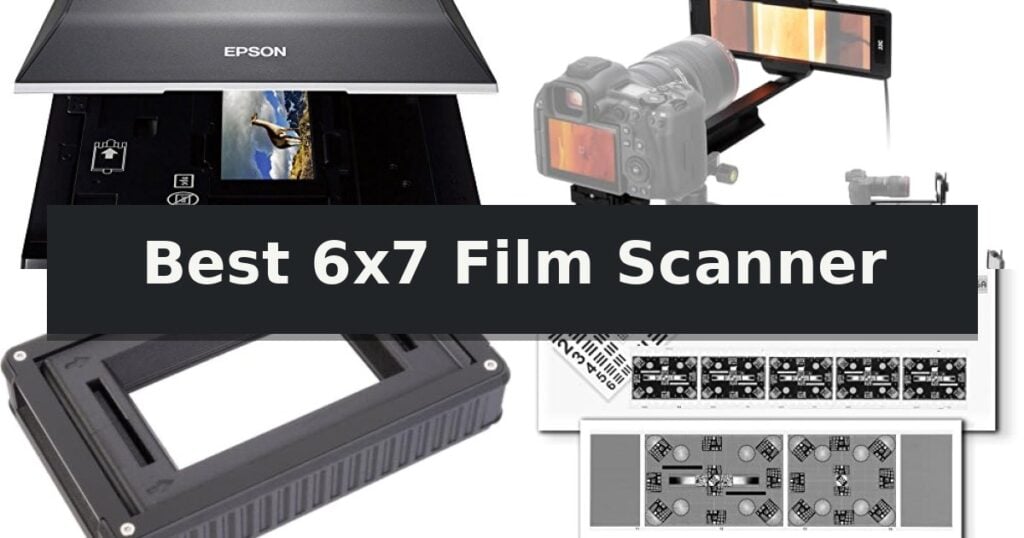
Epson Perfection V550 Photo Scanner is our top choice for the Best 6×7 Film Scanner, offering a dedicated transparency unit that simplifies digitizing medium format negatives without complex external setups. For those prioritizing modularity and professional-grade precision, the Negative Supply Basic Film Carrier 120 provides a robust masking system, while the JJC Film Digitizer offers a versatile foundation for photographers who prefer using their own macro lenses for high-resolution camera scanning.
Selecting the right equipment for medium format film requires balancing convenience against the need for archival-quality detail. Flatbed scanners provide an all-in-one solution that includes software for dust removal and color correction, making them ideal for users who want a streamlined workflow. Conversely, camera-based scanning systems rely on your existing digital camera and lens, often yielding superior sharpness and speed if you are comfortable managing the alignment and lighting components independently.
Understanding the trade-offs between these methods is essential for consistent results. While flatbeds are generally more accessible for beginners, camera scanning setups allow for greater control over the final digital file's resolution and dynamic range. Regardless of your chosen path, ensuring your film stays perfectly flat and properly aligned is the most critical factor in capturing the full detail of your 6×7 negatives.
When you are ready to expand your workflow to other formats, our guide on the Best 6×6 Film Scanner provides similar insights for square-format enthusiasts.
4 Best 6×7 Film Scanner in 2026 Reviews
Quick Comparison
| Product | Best For | Key Strength | Score |
|---|---|---|---|
| Epson Perfection V550 Photo Scanner | Best Overall | Dedicated transparency unit for 6×7 film and 35mm slides | 4.9 |
| JJC Film Digitizer for 120 Format | Best for Camera Scanning Setups | Adjustable focus slider rail for precise camera-to-film distance. | 4.5 |
| Negative Supply Basic Film Carrier 120 | Precision Medium Format Masking | Double S-curve design ensures optimal film flatness. | 4.9 |
| Vlads Test Target Calibration Charts | Essential for Sharp 6×7 Scans | High-resolution test patterns including USAF 1951 charts and Siemens stars for precise focus and align… | 4.4 |
How We Chose
Evaluating the best 6×7 film scanner requires a focus on how effectively a device maintains film flatness and optical clarity. We analyze how different scanning methods—ranging from integrated flatbeds to modular camera-scanning rigs—handle the larger surface area of medium format film to ensure high-resolution, sharp digital reproductions.
- Optical resolution and sensor capability for capturing fine film grain.
- Compatibility with 120 medium format film holders and specific 6×7 masking.
- Ease of alignment to ensure uniform sharpness across the entire frame.
- Integration with existing hardware, such as digital cameras or computer software.
- Build quality and stability of the film holding mechanism.
1 Epson Perfection V550 Photo Scanner — Flatbed Choice for Medium Format
The Epson Perfection V550 Photo Scanner offers a dedicated transparency unit designed to handle film formats, including 6×7 negatives and slides, making it a versatile choice for digitizing analog archives. By utilizing a high 6400 dpi optical resolution, it captures fine details suitable for enlargements up to 17 x 22 inches.
Efficiency is central to its operation, as the scanner features ReadyScan LED technology, which eliminates warmup time and removes mercury from the light source. For those managing large collections, the unit supports scanning multiple photos simultaneously, utilizing auto edge detection to crop and save each image as an individual file.
Restoration is simplified through Digital ICE technology, which is engineered to remove the appearance of dust and scratches from film surfaces. Additionally, the Easy Photo Fix feature allows for one-touch restoration of faded prints, while the 48-bit color depth ensures accurate color reproduction.
This flatbed scanner connects via Hi-Speed USB 2.0 and includes ABBYY FineReader Sprint Plus OCR software to convert scanned documents into editable text. With its compact footprint, it serves as a functional tool for photographers and archivists looking to preserve medium format film and physical documents.
Best for: Users who need a versatile flatbed scanner capable of digitizing medium format film, 35mm slides, and physical documents in a single device.
Skip if: Users requiring a dedicated high-speed drum scanner or those who do not have a computer with a USB 2.0 port.
- Dedicated transparency unit for 6×7 film and 35mm slides
- Digital ICE technology for automated dust and scratch removal
- ReadyScan LED technology provides instant-on scanning
- High 6400 dpi optical resolution for detailed enlargements
- USB 2.0 interface is slower than modern high-speed connectivity standards
- Flatbed design requires more desk space than dedicated film-only scanners
2 JJC Film Digitizer for 120 Format — Best for Camera Scanning Setups
Digitizing medium format film requires a stable platform to ensure alignment and sharpness across the entire frame. The JJC Film Digitizer for 120 Format provides a dedicated solution for photographers looking to convert 35mm and 120 film using their existing digital camera and macro lens setup.
This system features an adjustable focus slider rail that allows for precise front-to-back positioning between 10.4 and 18.5 inches. The rail is constructed from durable aluminum and includes an Arca-Swiss base, enabling quick attachment to standard tripod heads. For added versatility, the unit also supports mounting via 1/4-inch or 3/8-inch threaded holes.
Lighting is managed through an included LED panel that offers 11 levels of adjustable brightness, powered via a Type-C connection. The system comes with specific holders for 35mm and 120 film, both designed with magnetic closures and transparent masks to keep negatives flat during the capture process. Silicone pads on the bottom of these holders help protect the scanning plate from surface scratches.
While this digitizer is a robust tool for camera-based scanning, it is important to note that it is not intended for 35mm slide digitizing. Users should pair this device with a macro lens to achieve optimal focus and clarity across the film surface.
Best for: Photographers who already own a macro lens and want to build a high-quality, camera-based film scanning station.
Skip if: Users who require a dedicated, all-in-one standalone scanner that does not rely on a separate digital camera and lens.
- Adjustable focus slider rail for precise camera-to-film distance.
- 11-level brightness control for consistent backlighting.
- Durable aluminum construction with Arca-Swiss compatibility.
- Includes dedicated holders for both 35mm and 120 film formats.
- Not compatible with 35mm slides.
- Requires a separate macro lens and digital camera to function.
3 Negative Supply Basic Film Carrier 120 — Precision Medium Format Masking
Achieving high-fidelity digital captures of medium format negatives requires a stable, precise platform to ensure consistent results. The Negative Supply Basic Film Carrier 120 MK2 is engineered specifically to address this, utilizing a double S-curve design that keeps film flat during the scanning process, which is essential for maintaining sharpness across the entire frame.
This carrier is built with high-quality carbon fiber, providing a durable yet lightweight structure that stands up to frequent use. Its compact design, measuring just 7.1 x 4.5 x 1.4 inches, allows for easy integration into existing camera-based scanning workflows without occupying excessive workspace.
Versatility is a core feature, as the unit includes interchangeable masks for 6×4.5, 6×6, 6×7, and 6x9cm formats. This allows photographers to switch between different medium format styles seamlessly using a single, precision-engineered tool manufactured by a brand dedicated to film photography equipment.
Designed as a specialized film copier accessory, the Negative Supply Basic Film Carrier 120 MK2 prioritizes efficiency and ease of handling. Its streamlined profile and robust construction make it a practical choice for those looking to digitize their medium format archives with consistent, reliable alignment.
Best for: Photographers seeking a dedicated, flat-film scanning solution for multiple medium format sizes including 6x7cm.
Skip if: Users who require a motorized or automated scanning system rather than a manual, camera-based copy stand workflow.
- Double S-curve design ensures optimal film flatness.
- Includes interchangeable masks for four common medium format sizes.
- Constructed from durable, high-quality carbon fiber.
- Compact, streamlined profile for efficient storage and handling.
- Requires an existing camera-based copy stand setup for operation.
4 Vlads Test Target Calibration Charts — Essential for Sharp 6×7 Scans
Achieving precise focus and uniform sharpness across your film scans requires more than just a high-resolution sensor; it demands a reliable reference for your optical alignment. The Vlads Test Target Calibration Charts provide a specialized, artisanal solution for photographers who need to verify their camera-scanning setup, ensuring that every detail of a 6×7 frame is captured with maximum clarity.
This combo set includes targets for 35mm and medium format film, utilizing high-quality film stock to create a standard that exceeds the resolution capabilities of modern digital cameras. By incorporating USAF 1951 resolution power charts at strategic points across the frame, these targets allow you to identify potential softness or unevenness caused by lens performance or slight sensor misalignment. The inclusion of Siemens stars further simplifies the process of achieving perfect film plane alignment, working in tandem with your camera's focus peaking to streamline your workflow.
Whether you are using a dedicated camera-scanning rig or fine-tuning a flat-bed scanner, these charts serve as an indispensable tool for calibration. The Adox CMS 20 Pro II film used for the 35mm targets provides a resolution of 90 lp/mm, offering a rigorous test for any lens-sensor combination. Because these targets are produced in Brooklyn and designed for versatility, they are compatible with all standard film holders, making them a practical addition to any serious analog-to-digital scanning setup.
Investing in these calibration charts helps eliminate the guesswork often associated with digitizing film. By verifying your equipment's performance before you begin your scanning session, you can ensure that your final images reflect the true quality of your negatives without the interference of focus errors or edge softness.
Best for: Photographers and archivists who need to calibrate their camera-scanning rigs for maximum sharpness and perfect film plane alignment.
Skip if: Users who are looking for an automated software solution or a complete hardware scanner rather than a manual calibration tool for their existing setup.
- High-resolution test patterns including USAF 1951 charts and Siemens stars for precise focus and alignment.
- Versatile compatibility with all film holders and various scanning methods, including flat-bed and camera scanning.
- Artisanal production using high-quality Adox CMS 20 Pro II film for reliable, consistent results.
- 20% combo savings when purchasing the 35mm and medium format target set together.
- Manual calibration process requires time and attention to detail to interpret the resolution charts correctly.
Best 6×7 Film Scanner Buying Guide
Flatbed Scanners vs. Camera Scanning
Flatbed scanners are self-contained units that use a light source in the lid to illuminate film from above. They are generally easier to set up and include proprietary software that automates the conversion of negatives into positive images, which is helpful for those who prefer a hands-off approach.
Camera scanning involves using a digital camera mounted on a tripod or copy stand to photograph the film. This method is often faster and can produce higher-resolution files, but it requires you to assemble a system including a light source, a film holder, and a macro lens.
The Importance of Film Flatness
Medium format film, particularly 6×7, has a large surface area that is prone to curling. If the film is not held perfectly flat during the scanning process, parts of your image may appear soft or out of focus, regardless of the quality of your scanner or lens.
High-quality film carriers use tension or glass inserts to keep the film strip taut. When shopping for a scanner or carrier, prioritize models that feature specific masks for 6×7 frames to ensure the edges of your film remain sharp and undistorted.
Resolution and Sharpness Considerations
Resolution is measured in dots per inch (DPI) for scanners, but for camera scanning, it depends on your camera's sensor and the quality of your macro lens. A higher optical resolution allows for larger prints and more detailed cropping without losing image integrity.
To maximize sharpness, ensure your setup is perfectly parallel to the film plane. Using calibration targets can help you identify if your lens or scanner is resolving detail evenly across the entire frame, allowing you to make micro-adjustments to your focus.
Lighting and Color Accuracy
Consistent lighting is vital for accurate color reproduction and shadow detail. Flatbed scanners have built-in, calibrated light sources designed specifically for transparency scanning, which helps maintain color consistency across different rolls of film.
If you choose a camera scanning setup, the quality of your LED light panel is paramount. Look for panels with high Color Rendering Index (CRI) ratings and adjustable brightness levels to ensure your digital camera captures the full dynamic range of the negative.
Workflow and Productivity
Consider how many frames you typically scan at once. Some scanners allow for batch processing, which can save significant time if you have large archives to digitize. Auto-detection features can also help by automatically cropping individual frames into separate files.
For those who scan sporadically, a simpler, manual setup might be more cost-effective. However, if you are digitizing entire collections, investing in a system that allows for quick film advancement and minimal readjustment between frames will significantly improve your efficiency.
Frequently Asked Questions
Can I use a standard document scanner for 6×7 film?
No, a standard document scanner lacks the transparency unit and backlight required to illuminate film. You must use a scanner specifically designed with a built-in transparency unit or a dedicated film scanning setup.
Is camera scanning better than using a flatbed scanner?
Camera scanning generally offers higher resolution and faster operation if you already own a high-quality macro lens. Flatbed scanners are generally more convenient and provide an all-in-one solution for those who do not want to assemble separate components.
Do I need a special lens for camera scanning?
Yes, a dedicated macro lens is highly recommended. Macro lenses are designed to focus at very close distances and provide a flat field of focus, which is necessary to capture the entire 6×7 frame with uniform sharpness.
How do I keep my 6×7 film from curling?
Using a high-quality film carrier with a dedicated 6×7 mask is the best way to keep film flat. Some advanced carriers use magnetic closures or glass inserts to ensure the film remains perfectly planar during the scan.
What is the benefit of using a calibration target?
A calibration target allows you to verify that your camera or scanner is perfectly aligned with the film plane. It helps you detect and correct issues like corner softness or uneven focus before you spend time scanning your entire collection.
Conclusion: Our Top Pick
Our top pick is Epson Perfection V550 Photo Scanner. Choosing the right 6×7 film scanner depends on your specific workflow needs and whether you prefer an integrated flatbed device or the modular flexibility of a camera-scanning setup. For most users, the Epson Perfection V550 provides the most straightforward path to high-quality results without the need for additional equipment.
If you are a photographer looking for maximum resolution and control, investing in a dedicated film carrier and a high-CRI light source for camera scanning is the superior choice. Regardless of the hardware you select, prioritizing film flatness and proper alignment will ensure your scans accurately reflect the detail of your medium format negatives.