SunFounder PiDog AI Robot Dog Kit is our top recommendation for the Best AI Robotics Kits for Adults because it offers a comprehensive, Raspberry Pi-based platform that balances complex AI interaction with accessible Python development. The HIWONDER TonyPi Humanoid Robot Kit provides a more sophisticated humanoid form factor for those focused on advanced inverse kinematics and vision-based scene understanding, while the LewanSoul NexArm Robotic Arm serves users prioritizing high-precision industrial-style manipulation and imitation learning.
Selecting an advanced robotics kit requires balancing hardware versatility with the depth of the software ecosystem. Experienced builders often prioritize kits that offer open-source access to core algorithms, as this allows for deeper customization beyond basic pre-programmed movements. The ability to integrate modern large language models, such as ChatGPT or local LLMs, has become a defining feature for kits intended for adult hobbyists and researchers.
When evaluating these platforms, consider the specific mechanical architecture—whether quadruped, humanoid, or robotic arm—as this dictates the types of projects you can pursue. While some kits emphasize ease of assembly, others are designed for modular expansion, allowing you to add sensors or chassis components as your technical skills evolve. Compatibility with standard controllers like Raspberry Pi or ESP32 remains a critical factor for long-term project viability.
If you are interested in the foundational hardware behind these robots, our guide to Best Microcontroller Experiment Kits offers a deeper look at the boards that power these complex machines.
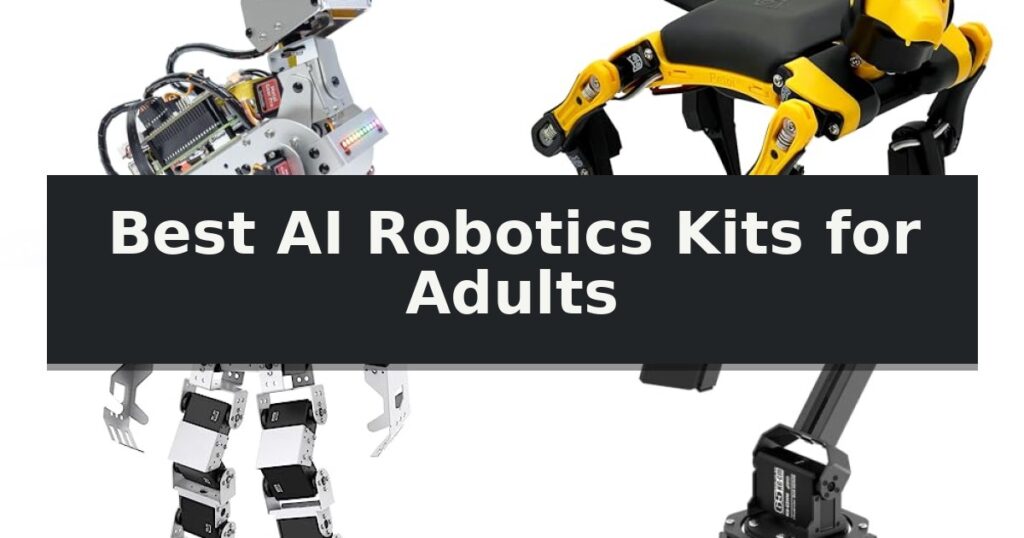
10 Best AI Robotics Kits for Adults in 2026 Reviews
Quick Comparison
| Product | Best For | Key Strength | Score |
|---|---|---|---|
| SunFounder PiDog AI Robot Dog Kit | Best Overall | Advanced 12-servo architecture for realistic movement. | 4.9 |
| Petoi Bittle X V2 Robot Dog | Portable Quadruped for Advanced Coding | Open-source architecture supports progression from block coding to Python and ROS/ROS2. | 4.8 |
| HIWONDER TonyPi Humanoid Robot Kit | Advanced Humanoid with LLM Integration | Powered by the high-performance Raspberry Pi 5. | 4.9 |
| LewanSoul NexArm Robotic Arm | Precise Imitation Learning Capability | Advanced dual-chip architecture for complex AI processing. | 4.9 |
| LewanSoul miniHexa Pro Robot Kit | Agile Bionic Spider Movement | Multimodal AI integration with real-time voice and vision processing. | 4.9 |
| LewanSoul TurboPi Robot Car | Omnidirectional ROS2 Development Platform | Integrated Raspberry Pi 5 for high-speed AI processing. | 4.6 |
| LewanSoul AI Robot Building Kit | Versatile 32-in-1 Modular Design | Multimodal AI integration supports advanced voice and vision tasks. | 4.8 |
| Yahboom DOFBOT-Ultra Robotic Arm | High-Precision 3D Spatial Vision | 6-DOF design with high-torque metal-gear digital servos for precise movement. | 4.7 |
| OSOYOO Smart Robot Car Kit | Accessible Arduino Starter Platform | Integrated expansion board simplifies wiring and reduces assembly errors. | 4.7 |
| LewanSoul miniArm Starter Kit | Compact 5-Axis Programming Entry | Open-source platform compatible with Arduino programming. | 4.4 |
How We Chose
To identify the most capable robotics kits for adult enthusiasts, we evaluate each platform based on its technical depth, hardware quality, and the flexibility of its programming environment. We prioritize kits that provide robust documentation and open-source code, ensuring that users can move beyond basic tutorials to develop custom AI applications and complex robotic behaviors.
- Controller Architecture and Compatibility
- Software Ecosystem and LLM Integration
- Mechanical Precision and Degree of Freedom (DOF)
- Sensor Suite and Vision Capabilities
- Open-Source Documentation and Community Support
1 SunFounder PiDog AI Robot Dog Kit — Best for Interactive AI Development
The SunFounder PiDog AI Robot Dog Kit distinguishes itself through a sophisticated integration of 12 powerful servos that enable 32 distinct, life-like movements, including walking, sitting, and tail-wagging. Designed for users aged 15 and above, this platform serves as a versatile foundation for engineers and robotics enthusiasts to explore advanced AI development.
At the heart of the system is its compatibility with the Raspberry Pi series, allowing the robot to leverage multi-LLM support including ChatGPT, Gemini, Grok, and local models like Ollama. This connectivity enables the robot to process natural language, recognize gestures, and perform voice-to-text and text-to-speech operations, creating an immersive, interactive experience.
The hardware suite is equally robust, featuring an array of sensors such as ultrasonic, touch, gyroscope, and a camera module. These components provide the robot with spatial awareness and the ability to detect obstacles or respond to physical touch, which can be programmed using Python and OpenCV for custom behavioral logic.
To facilitate the development process, the kit includes access to comprehensive online documentation, video tutorials, and an active forum community. These resources are intended to assist makers in navigating the complexities of robotics programming, from basic movement sequences to complex AI-driven interactions.
Best for: Engineers and robotics enthusiasts looking to develop custom AI-driven behaviors using Raspberry Pi and LLM integration.
Skip if: Users who do not own a compatible Raspberry Pi board or those seeking a pre-assembled, ready-to-run consumer toy.
- Advanced 12-servo architecture for realistic movement.
- Extensive sensor suite including camera and ultrasonic sensors.
- Multi-LLM integration for intelligent, conversational AI.
- Extensive learning resources and community support.
- Raspberry Pi board not included in the kit.
- Requires technical proficiency in Python and robotics assembly.
2 Petoi Bittle X V2 Robot Dog — Portable Quadruped for Advanced Coding
The Petoi Bittle X V2 Robot Dog brings sophisticated robotic motion to a desktop-friendly scale, utilizing lite feedback servos to achieve lifelike navigation and movement. Unlike static kits, this quadruped is engineered for active engagement, allowing users to teach it new gaits through kinesthetic teaching by manually guiding its legs, a method commonly found in advanced robotics research.
Designed as an open-source platform, this kit serves as a bridge between simple block coding and complex development environments. It supports Arduino C++ and Python, providing a flexible architecture that can scale from beginner-level projects to advanced implementations using optional Raspberry Pi and ROS/ROS2 integration. The unit arrives fully assembled, meaning users can begin programming immediately after charging.
The robot is capable of performing over 35 lifelike actions, including walking, sitting, and backflips, all of which can be controlled via app, voice commands, or custom code. With its ESP32 controller and modular design, it offers a robust foundation for those interested in exploring AI, sensor integration, and autonomous behavior in a portable, interactive form factor.
While highly versatile, the hardware is specifically optimized for flat surfaces such as hardwood or concrete. Users should note that the design is not intended for use on carpet, grass, or uneven terrain, which may impede the traction and mechanical performance of the servos.
Best for: Adults and students seeking a hands-on, open-source robotics platform that bridges the gap between basic block coding and advanced C++/Python development.
Skip if: Users requiring a robot capable of traversing carpet, grass, or outdoor terrain will find the specialized surface requirements of this model limiting.
- Open-source architecture supports progression from block coding to Python and ROS/ROS2.
- Kinesthetic teaching allows users to physically guide the robot's legs to program new gaits.
- Pre-assembled design enables immediate use without complex mechanical construction.
- Voice and app control provide multiple interfaces for interaction and customization.
- Surface sensitivity restricts operation to flat, hard surfaces like hardwood or concrete.
- Limited runtime of approximately 1 hour per charge.
3 HIWONDER TonyPi Humanoid Robot Kit — Advanced Humanoid with LLM Integration
Integrating advanced artificial intelligence into a physical form, the HIWONDER TonyPi Humanoid Robot Kit serves as a sophisticated platform for exploring embodied AI and robotics. Powered by a Raspberry Pi 5, this kit provides a high-performance environment for users to engage with OpenCV image processing and complex robotic inverse kinematics.
The core of the robot's interaction system is its integration with ChatGPT, which enables the device to perform advanced voice command recognition and scene understanding. By combining this large language model with an HD camera mounted on a 2DOF head, the robot can track targets, follow lines, and execute actions based on visual cues, creating a responsive human-machine interface.
Mechanical precision is achieved through 16 high-voltage intelligent bus servos, which allow for stable, multi-joint coordination. These components are designed to facilitate accurate humanoid postures, making the kit suitable for those interested in deep learning, MediaPipe-based motion control, and sensor-driven applications.
To support the development process, the kit includes comprehensive educational resources, ranging from foundational motion control tutorials to advanced Python programming exercises. This open-source access ensures that users have the flexibility to experiment with their own AI models while leveraging the provided hardware architecture.
Best for: Adults and students seeking a hands-on, programmable humanoid platform to study AI vision, large language model integration, and robotic kinematics.
Skip if: Users looking for a pre-assembled, plug-and-play consumer robot, as this kit requires assembly and significant programming knowledge to utilize its full potential.
- Powered by the high-performance Raspberry Pi 5.
- Integrated ChatGPT for advanced voice and scene interaction.
- Equipped with 16 high-voltage intelligent bus servos for precise movement.
- Includes extensive open-source learning resources and tutorials.
- Requires assembly and programming expertise to operate effectively.
- Advanced functionality depends on stable network connectivity for LLM integration.
4 LewanSoul NexArm Robotic Arm — Precise Imitation Learning Capability
Advancing beyond standard hobbyist hardware, the LewanSoul NexArm Robotic Arm integrates a dual-chip ESP32 + AT32 architecture to facilitate complex imitation learning and embodied AI research. This industrial-grade metal arm features 6 high-precision magnetic encoder servos, enabling a 20-inch reach and a 1.1lb payload capacity with ±2mm repeatability.
The system is built for sophisticated interaction, utilizing a K230 AI vision module that supports over 30 vision-based features, including gesture, object, and personalized face recognition. Its multimodal capabilities allow it to process natural voice commands and execute long-horizon tasks, making it a versatile platform for developers working on hand-eye coordination and smart sorting applications.
Compatibility with the LeRobot SO-ARM101 framework provides a direct pathway for users to deploy end-to-end imitation learning algorithms and VLA (Vision-Language-Action) training models. The inclusion of open-source code and detailed tutorials supports the study of inverse kinematics and multimodal AI deployment, suitable for university labs and advanced robotics projects.
Designed for flexibility, the kit can be paired with mobile chassis, electric sliders, or conveyor belts to simulate real-world automation scenarios. While it offers robust technical specifications, users should ensure their project scope aligns with the specific 1.1lb payload limit and the requirements of the provided software ecosystem.
Best for: University AI labs and developers focused on embodied AI, imitation learning, and VLA model training.
Skip if: Users seeking a simple plug-and-play toy for children, as this kit requires advanced knowledge of Arduino programming and AI deployment.
- Advanced dual-chip architecture for complex AI processing.
- Full compatibility with the LeRobot SO-ARM101 framework.
- High-precision magnetic encoder servos ensuring smooth, jitter-free movement.
- Versatile AI vision module with 30+ built-in recognition features.
- Limited 1.1lb payload capacity restricts the handling of heavier objects.
- Steep learning curve requires familiarity with Arduino and AI model training.
5 LewanSoul miniHexa Pro Robot Kit — Agile Bionic Spider Movement
The LewanSoul miniHexa Pro Robot Kit distinguishes itself through the integration of the ESP32-P4C5 WonderLLM module, which enables multimodal AI vision and voice interaction for real-time responsiveness. This hexapod platform is designed for users interested in advanced robotics, combining a complex 18DOF spider chassis with a 2DOF robotic arm to facilitate sophisticated manipulation tasks.
Engineered for versatility, the robot utilizes an embodied ESP-Claw agent to translate natural language prompts into autonomous, multi-step physical actions. The system supports a wide range of control methods, including app-based interfaces, somatosensory gravity tilt, and wireless controllers, allowing for diverse interaction styles beyond simple programming.
The mechanical design relies on inverse kinematics algorithms to achieve 360-degree omnidirectional movement and dynamic gait switching. An onboard IMU provides active self-balancing, ensuring the robot maintains stability while navigating varied terrains or adjusting its posture during object transport.
For educational and development purposes, the kit is compatible with Arduino, Scratch, and Python. It is supported by open-source code, detailed circuit schematics, and tutorials, providing a comprehensive framework for those looking to explore AI-driven robotics and bionic movement.
Best for: Adults and teens seeking an advanced, programmable hexapod robot with integrated AI vision and voice interaction capabilities.
Skip if: Users looking for a simple, pre-assembled toy or those without interest in programming environments like Python or Arduino.
- Multimodal AI integration with real-time voice and vision processing.
- 18DOF hexapod chassis combined with a 2DOF robotic arm for complex movement and manipulation.
- Versatile programming support including Python, Scratch, and Arduino.
- Advanced motion control via inverse kinematics and active self-balancing.
- High complexity may require significant time investment for assembly and programming.
- Requires technical familiarity with coding environments to fully utilize the AI features.
6 LewanSoul TurboPi Robot Car — Omnidirectional ROS2 Development Platform
Transitioning from basic hobbyist projects to sophisticated AI development requires hardware capable of handling complex computational tasks. The LewanSoul TurboPi Robot Car serves as a high-performance platform, integrating the Raspberry Pi 5 to provide the processing power necessary for advanced ROS2 educational workflows and real-time AI applications.
This robotic kit distinguishes itself through its multimodal large AI model capabilities, which allow for advanced voice interaction and scene understanding. By leveraging Python and OpenCV, users can program the robot to perform autonomous tasks, including gesture recognition, face detection, and target tracking via its integrated 2-DOF HD camera system.
Design versatility is a core component of the hardware, featuring an omnidirectional Mecanum wheel chassis. This configuration supports 360° movement, enabling the robot to navigate complex environments with precision through forward, horizontal, diagonal, and rotational maneuvers. The inclusion of pan-tilt servos further enhances the camera's field of view for FPV video feedback.
To support the learning curve associated with robotics, the kit includes comprehensive Python source code and detailed tutorials. These resources are designed to guide users through various experiments, making it a robust tool for those looking to deepen their understanding of autonomous systems and machine learning integration.
Best for: Adults seeking a high-performance, ROS2-compatible platform for advanced AI programming and autonomous robotics experimentation.
Skip if: Users looking for a simple, plug-and-play toy or those without prior experience in Python and Linux-based operating systems.
- Integrated Raspberry Pi 5 for high-speed AI processing.
- 360° omnidirectional movement via Mecanum wheels.
- Supports multimodal large AI models and voice interaction.
- Includes comprehensive Python source code and tutorials.
- Requires familiarity with ROS2 and Linux environments.
- Advanced assembly and programming complexity may be steep for beginners.
7 LewanSoul AI Robot Building Kit — Versatile 32-in-1 Modular Design
The LewanSoul AI Robot Building Kit distinguishes itself through a powerful ESP32 core brain that facilitates real-time, lag-free control over complex robotic movements. Designed for those ready to move beyond basic circuitry, this kit integrates advanced technology with modular construction to provide a sophisticated platform for learning robotics and software development.
At the heart of the system is the WonderLLM module, which enables multimodal AI capabilities including object recognition and fluid voice interaction. By supporting integration with large language models like DeepSeek and Qwen, the kit allows users to experiment with high-level AI applications. The inclusion of 10+ electronic sensors ensures that built models can interact dynamically with their environment, such as tracking lines or avoiding obstacles.
The building experience is structured around a 32-in-1 modular design, supported by detailed tutorials that guide users through assembly. This approach helps bridge the gap between simple mechanical builds and complex engineering projects. The system is engineered to grow with the user, starting with drag-and-drop Scratch programming for foundational logic and transitioning into Python coding for more advanced software development tasks.
This kit is a comprehensive tool for those seeking to bridge the gap between physical engineering and software intelligence. While the 497-piece count offers significant build variety, users should be prepared for the assembly time required to transition between the 32 different models.
Best for: Teens and adults interested in transitioning from visual block-based programming to real-world Python development within a robotics context.
Skip if: Users looking for a simple, quick-assembly toy that does not require an interest in coding or complex sensor integration.
- Multimodal AI integration supports advanced voice and vision tasks.
- Dual-language coding support allows progression from Scratch to Python.
- Versatile 32-in-1 build capability provides extensive project variety.
- ESP32 controller ensures responsive, real-time performance.
- High piece count requires significant time for assembly and model transitions.
8 Yahboom DOFBOT-Ultra Robotic Arm — High-Precision 3D Spatial Vision
The Yahboom DOFBOT-Ultra Robotic Arm serves as a sophisticated platform for those looking to engage with advanced robotics, featuring a 6-DOF (six degrees of freedom) design built specifically for the ROS2 Humble operating system. By integrating a DaBai DCW2 depth camera, this kit enables true 3D spatial vision, allowing users to perform complex tasks like real-time object tracking and spatial grasping through algorithmic computation.
Engineered for versatility, the arm utilizes 15kg intelligent serial bus metal-gear digital servos, which provide independent control and precise angle readback for every joint. The inclusion of a 7-inch display and an integrated AI voice module facilitates a multimodal interaction experience, supporting advanced applications such as scene understanding and voice-activated commands.
This kit is designed for developers and educators who require a robust environment for algorithm verification and project development. It supports Raspberry Pi 5 or RDK X5 as main controllers and provides extensive open-source materials covering OpenCV, YOLO26, MediaPipe, and robot inverse kinematics, ensuring users have the necessary tools to master cutting-edge AI-driven robotics.
While the Yahboom DOFBOT-Ultra Robotic Arm offers a comprehensive suite of hardware and software, users should note that it is a specialized development platform. It requires a foundational understanding of programming and robotics to fully leverage its capabilities, making it a powerful tool for those committed to deep-dive technical exploration.
Best for: Robotics researchers, AI developers, and STEM educators seeking a high-precision, ROS2-compatible platform for algorithm development and 3D vision projects.
Skip if: Beginners looking for a simple, plug-and-play toy or those without experience in Python coding and ROS2 development environments.
- 6-DOF design with high-torque metal-gear digital servos for precise movement.
- 3D spatial vision capabilities via the DaBai DCW2 depth camera.
- Full ROS2 Humble support for advanced robotics research and education.
- Multimodal AI integration including voice interaction and real-time object recognition.
- Steep learning curve requiring familiarity with ROS2 and Python programming.
- Requires separate main controller (Raspberry Pi 5 or RDK X5) for full operation.
9 OSOYOO Smart Robot Car Kit — Accessible Arduino Starter Platform
The OSOYOO Smart Robot Car Kit for Arduino Adult Teen Robotic Assembly Starter simplifies the entry into robotics by integrating a Monolithic Integrated Expansion board that eliminates the need for complex wiring. By utilizing the OSOYOO Motor Shield with an integrated L293DD driver chip, this kit streamlines the assembly process, allowing users to focus on programming and logical development rather than troubleshooting hardware connections.
Designed for versatility, the kit includes a comprehensive suite of components such as a Bluetooth module, ultrasonic sensor, and a 5-channel tracking module. These sensors enable the robot to perform diverse functions including obstacle avoidance, line tracking, and mobile application-controlled movement. The inclusion of XH2.54 interfaces for motors and power further enhances reliability by minimizing potential connection errors during the build.
For those new to the platform, the manufacturer provides detailed tutorials that encompass video instructions, schematic diagrams, and sample code. This educational approach guides users from a basic setup to a fully functional robotic car, making it a practical choice for those looking to improve their mechanical and electrical abilities through hands-on practice.
The chassis features clear prints for easier component placement, and the integrated voltage meter provides real-time feedback on battery levels. This humanized design ensures that users can monitor power consumption effectively, preventing unexpected shutdowns during operation and maintaining a consistent learning experience.
Best for: Beginners and hobbyists seeking an integrated, tutorial-supported platform to learn Arduino-based robotics and programming.
Skip if: Users who require a pre-assembled robot or those looking for advanced industrial-grade components beyond the scope of an educational starter kit.
- Integrated expansion board simplifies wiring and reduces assembly errors.
- Comprehensive educational tutorials include video guides and sample code.
- Multi-functional sensor suite supports diverse operations like line tracking and obstacle avoidance.
- Humanized design features such as a voltage meter and clearly marked chassis.
- Assembly required for all components, which may be time-consuming for some users.
- Educational focus may limit the complexity of projects compared to professional-grade robotics.
10 LewanSoul miniArm Starter Kit — Compact 5-Axis Programming Entry
The LewanSoul miniArm Starter Kit provides a foundational 5-axis robotic platform built on the Atmega328 architecture, specifically designed for those interested in exploring open-source robotics and Arduino-based programming. This compact kit serves as an accessible entry point for users to experiment with mechanical assembly and code-driven motion control.
Engineered for versatility, the system features high-precision digital servos and a 6-channel knob controller that allows for real-time manual manipulation and offline action editing. The open-source nature of the platform encourages secondary development, enabling users to build upon existing tutorials to customize the robotic hand's functionality.
The hardware supports significant expansion, offering multiple ports for sensor integration. Users can incorporate components such as an ESP32 Cam, touch sensors, or ultrasonic sensors to add advanced capabilities like sonic ranging and pose control. This modular design allows the project to grow in complexity as the user gains proficiency in programming and engineering.
While the starter kit provides the essential components for a functional 5-axis arm, it is a streamlined package. Those seeking to utilize advanced sensing features immediately will need to consider the standard kit version, which includes the additional sensor modules and necessary wiring for expanded functionality.
Best for: Adults looking for an open-source, Arduino-compatible platform to learn robotics, coding, and sensor integration through a hands-on 5-axis arm project.
Skip if: Users who require a pre-assembled, plug-and-play robot or those who specifically need advanced sensors like the ESP32 Cam or ultrasonic modules should opt for the standard kit instead of this starter version.
- Open-source platform compatible with Arduino programming.
- Includes a 6-channel knob controller for intuitive manual control.
- Modular expansion ports allow for future sensor integration.
- Supports offline action editing for custom motion sequences.
- Starter kit excludes advanced sensors like the ESP32 Cam and ultrasonic modules.
- Requires manual assembly and programming knowledge.
Best AI Robotics Kits for Adults Buying Guide
Controller Ecosystems
The choice of controller, such as a Raspberry Pi or ESP32, fundamentally shapes your development experience. Raspberry Pi-based kits are generally better suited for complex AI tasks, including vision processing and running large language models, due to their higher computational power and Linux-based environment.
Conversely, ESP32-based kits often provide superior real-time performance for motor control and sensor integration. These are frequently preferred for projects where low latency is critical, such as high-speed robotic arm movements or complex bionic gaits.
Mechanical Complexity and DOF
Degrees of Freedom (DOF) determine the range of motion and the complexity of tasks a robot can perform. A higher DOF count allows for more natural, fluid movements, which is essential for humanoid robots or sophisticated robotic arms attempting to mimic human dexterity.
However, increased mechanical complexity also introduces challenges in calibration and inverse kinematics. Beginners should look for kits that include pre-calibrated servos or bus-servo systems, which simplify the process of managing multiple joints simultaneously.
AI and Vision Integration
Modern robotics kits now frequently include dedicated vision modules capable of object tracking, face recognition, and gesture control. These features rely on libraries like OpenCV and MediaPipe, which are standard in advanced robotics education.
Integration with multimodal AI models allows robots to interpret voice commands and visual scenes more naturally. This level of interaction transforms a simple mechanical kit into an embodied AI agent capable of responding to environmental cues.
Programming Environments
Most kits support a transition from block-based coding to professional languages like Python and C++. Python is the industry standard for AI and machine learning, making it the preferred choice for users who intend to implement custom algorithms or integrate external AI APIs.
Ensure the kit you select provides clear, well-commented source code. Open-source platforms are significantly more valuable for long-term learning, as they allow you to inspect the underlying logic and modify it to suit your specific project requirements.
Expandability and Modular Design
A kit's longevity often depends on its ability to grow with your skills. Modular designs that allow for the addition of extra sensors, grippers, or chassis components provide a better return on investment than static, proprietary systems.
Look for kits that offer standardized mounting points and expansion ports. This compatibility allows you to incorporate third-party sensors or custom 3D-printed parts, turning a standard kit into a unique research or hobbyist platform.
Frequently Asked Questions
Do these kits include the Raspberry Pi board?
Most advanced robotics kits, particularly those from SunFounder and Yahboom, do not include the Raspberry Pi board. You will typically need to purchase the specific model, such as a Raspberry Pi 4 or 5, separately.
Can I use these robots for research purposes?
Yes, many of these kits are designed for educational and research use. They often support ROS2 (Robot Operating System), which is the standard framework for academic and professional robotics development.
Is prior programming experience required?
While many kits include beginner-friendly tutorials, having a basic understanding of Python or C++ will significantly enhance your ability to customize the robot's behavior and integrate advanced AI features.
What surfaces are best for quadruped robots?
Most small-scale quadruped robots are optimized for flat, hard surfaces like hardwood or concrete. Using them on carpet or uneven terrain can strain the servos and lead to stability issues.
How do I update the AI capabilities of these robots?
Since these kits are open-source and often run on Linux, you can update their AI capabilities by modifying the Python scripts or deploying new models via the command line, provided the controller has sufficient hardware resources.
Conclusion: Our Top Pick
Our top pick is SunFounder PiDog AI Robot Dog Kit. Choosing the right AI robotics kit depends on your specific goals, whether you are interested in bionic movement, industrial-style automation, or advanced AI vision. Platforms that offer open-source access and compatibility with standard controllers like the Raspberry Pi provide the most flexibility for long-term development.
By focusing on kits that support Python and modern AI frameworks, you ensure that your investment remains relevant as you progress from basic assembly to complex, autonomous programming projects. Evaluate your workspace and technical interests carefully to select the platform that best aligns with your learning objectives.