ELEGOO 37-in-1 Sensor Module Kit is our recommendation for the Best Arduino Sensor Kits thanks to its comprehensive selection of modules and well-documented tutorial materials. For those needing maximum component variety, the KEYESTUDIO 48-in-1 Sensor Kit offers a broader range of specialized sensors, while the HiLetgo 37-in-1 Sensor Kit provides a streamlined, essential set focused on foundational robotics and automation tasks.
Selecting the right sensor bundle requires balancing the number of included modules against the quality of the provided instructional resources. While larger kits offer more experimental freedom, they often require more advanced troubleshooting skills to integrate effectively into custom builds.
Experienced makers should prioritize kits that provide clear pin labeling and reliable module performance. These practical considerations ensure that time is spent on project logic and coding rather than diagnosing faulty hardware or ambiguous wiring configurations.
If you are just starting your electronics journey, our guide on Best Arduino Kits for Beginners provides a solid foundation for selecting your first controller and basic components. For those specifically interested in testing multiple sensor types, our overview of Best Microcontroller Experiment Kits offers additional context on how to integrate these modules into larger systems.
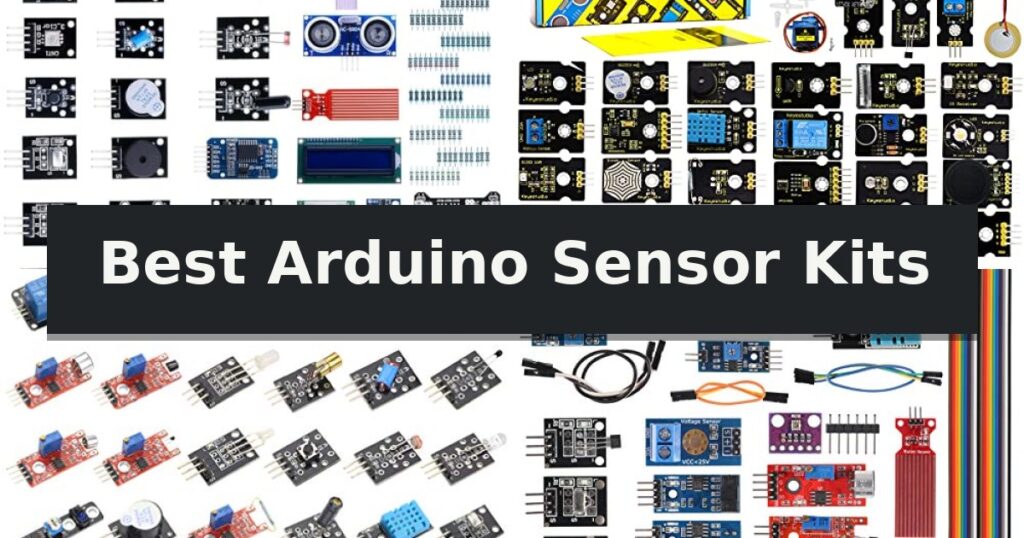
10 Best Arduino Sensor Kits in 2026 Reviews
Quick Comparison
| Product | Best For | Key Strength | Score |
|---|---|---|---|
| ELEGOO 37-in-1 Sensor Module Kit | Best Overall | Includes 37 distinct sensor and control modules for diverse project applications. | 4.9 |
| KEYESTUDIO 48-in-1 Sensor Kit | Broadest component variety | Includes 48 popular and mainstream sensors for maximum project versatility. | 4.9 |
| HiLetgo 37-in-1 Sensor Kit | Essential robot project starter | 37-in-1 sensor variety for diverse project applications | 4.8 |
| UMLIFE 22-in-1 Sensor Kit | Curated for beginner reliability | Curated selection of 22 high-quality modules for beginner projects. | 4.8 |
| SunFounder Universal Maker Sensor Kit | Supports 169 diverse projects | Wide Compatibility across Arduino, Raspberry Pi, and ESP32 platforms. | 4.3 |
| Arduino Sensor Kit Base | Official foundation for learning | Comprehensive collection of over 10 essential sensors for diverse projects. | 4.5 |
| ELEGOO Mega 2560 Starter Kit | Complete controller and sensor set | High-capacity MEGA 2560 R3 board with 54 digital I/O pins for complex builds. | 4.3 |
| SunFounder Ultimate Sensor Kit | Includes original Uno R4 board | Includes the original Arduino UNO R4 Minima board. | 4.5 |
| KEYESTUDIO 37-in-1 Sensor Kit | Step-by-step tutorial focus | Includes 37 diverse sensors and modules for broad experimentation. | 4.8 |
| Lonely Binary 46-in-1 Sensor Kit | Clearly labeled pin interfaces | No soldering required due to standard 2.54mm jumper wire compatibility. | 4.4 |
How We Chose
Evaluating the best Arduino sensor kits involves assessing the practical utility of the included components for real-world prototyping. An experienced reviewer focuses on the balance between sensor variety and the quality of educational support, ensuring that both beginners and advanced users have the necessary resources to move from basic experiments to complex, functional automation projects.
- Component diversity and relevance to common project types
- Clarity and availability of instructional documentation
- Compatibility with standard microcontrollers like Arduino and Raspberry Pi
- Physical organization and labeling of individual modules
- Presence of necessary supporting hardware like breadboards or power modules
1 ELEGOO 37-in-1 Sensor Module Kit — Most commonly used modules
The ELEGOO 37-in-1 Sensor Module Kit provides a comprehensive laboratory of components designed to introduce motion, distance, light, sound, and environmental sensing to microcontroller projects. By including a diverse array of 37 distinct modules, this kit allows users to integrate complex functions like ultrasonic ranging, PIR motion detection, and real-time clock tracking into builds based on UNO, MEGA, Nano, or STM32 platforms.
This collection emphasizes versatility for prototyping and classroom experimentation. It features specialized input sensors such as the GY-521 motion sensor, DS18B20 temperature probe, and various touch, flame, and obstacle-avoidance modules. Beyond simple inputs, the kit enables the development of interactive interfaces through the inclusion of an LCD1602 display, rotary encoders, joysticks, and infrared modules, facilitating the creation of functional clocks, alarms, and automated status displays.
To assist in the learning process, the package includes digital tutorial materials, datasheets, and wiring diagrams. These resources guide users through the setup of example code, allowing for the adjustment of thresholds, timing, and logic to suit custom project requirements. The kit is designed for use with a 6.5–9 V DC power supply, and users are advised to verify pin configurations before wiring to ensure compatibility with their specific controller board.
It is important to note that this is a module-only expansion kit. It does not include a controller board, USB cable, breadboard, or jumper wires, which must be sourced separately. Additionally, users should exercise caution with the included laser emitter module to avoid direct eye contact, ensuring a safe environment for all maker builds and educational experiments.
Best for: Makers and students looking to expand their microcontroller project capabilities with a wide variety of sensors and control modules.
Skip if: Users who do not already own a compatible controller board, breadboard, and jumper wires, as these essential components are not included in this kit.
- Includes 37 distinct sensor and control modules for diverse project applications.
- Comprehensive digital tutorial materials and wiring diagrams provided for guided learning.
- Broad compatibility with UNO, MEGA, Nano, ESP-32, and STM32 platforms.
- Enables advanced functionality like real-time clock, ultrasonic ranging, and motion sensing.
- Essential hardware such as controller boards, breadboards, and jumper wires are not included.
- Requires careful pin requirement verification before wiring to avoid damage.
2 KEYESTUDIO 48-in-1 Sensor Kit — Broadest component variety
The KEYESTUDIO 48-in-1 Sensor Kit provides a comprehensive collection of 48 distinct modules, making it a versatile foundation for those building interactive devices or robotics projects. By centralizing a wide array of mainstream sensors—including sound, motion, gas, and pressure modules—into a single package, it simplifies the process of sourcing individual components for complex electronics experiments.
Designed for broad compatibility, this kit integrates with various micro-controllers, such as the R3 development board, Mega 2560, Leonardo, and Pro Micro, as well as the Raspberry Pi. While the kit does not include an Arduino controller board itself, it is supported by a dedicated wiki website that offers detailed tutorials, wiring diagrams, and test code to assist users in navigating the setup for each specific sensor.
The inclusion of diverse components like a 5v relay, LED modules, and a servo motor allows for a wide range of project applications, from basic automation to more advanced interactive systems. The components are organized in exquisite packaging, which helps maintain order for inventors, hackers, and designers who need to keep a large inventory of parts accessible during the development process.
For those starting out, the provided documentation focuses on practical implementation, detailing the necessary wiring methods and programming logic required to get each sensor operational. This structured approach is intended to lower the barrier to entry for junior high and high school students, as well as adult tinkerers, by providing a clear path from hardware connection to functional code.
Best for: Students, hobbyists, and inventors who require a large variety of sensors and modules to support diverse interactive electronics projects.
Skip if: Users who are looking for a complete, all-in-one package that includes the Arduino controller board itself, as this kit contains only the sensors and modules.
- Includes 48 popular and mainstream sensors for maximum project versatility.
- Provides detailed tutorials and test code via a dedicated wiki website.
- Offers broad compatibility with various micro-controllers and Raspberry Pi.
- Features exquisite packaging to keep components organized.
- Does not include an Arduino controller board in the kit.
- Instructions are limited to Arduino platforms.
3 HiLetgo 37-in-1 Sensor Kit — Essential robot project starter
The HiLetgo 37-in-1 Sensor Kit serves as a comprehensive entry point for those looking to explore hardware interaction through the Arduino and Raspberry Pi ecosystems. By bundling a wide array of input and output modules into a single package, this collection simplifies the process of sourcing individual components for educational projects and prototyping.
This assortment includes specialized modules such as the touch sensor module, a heartbeat detection module, and an infrared sensor receiver module. These components allow users to experiment with diverse data acquisition methods, ranging from simple proximity detection to more complex biometric monitoring, all within a unified hardware set.
Designed specifically for Arduino MCU education, the kit provides the necessary building blocks for building interactive robots or environmental monitoring stations. The inclusion of 37 distinct sensors ensures that users have the flexibility to iterate on designs without needing to purchase additional hardware for basic functionality.
While the kit offers a broad range of capabilities, it is intended for educational and hobbyist use. Users should verify that they have the appropriate jumper wires and breadboards, as the kit focuses on providing the sensor modules themselves to facilitate rapid project development.
Best for: Students and hobbyists seeking a wide variety of sensors in one package for Arduino or Raspberry Pi learning projects.
Skip if: Professional engineers requiring high-precision, industrial-grade sensors with specific calibration documentation.
- 37-in-1 sensor variety for diverse project applications
- Includes specialized modules like heartbeat and touch sensors
- Tailored for Arduino MCU education and prototyping
- Requires additional components like breadboards and wires for full implementation
4 UMLIFE 22-in-1 Sensor Kit — Curated for beginner reliability
The UMLIFE 22-in-1 Sensor Kit provides a comprehensive collection of components designed to streamline the transition from theoretical learning to practical hardware implementation for hobbyists. By focusing on a curated selection of modules, this kit removes redundant or low-reliability components often found in entry-level packages, ensuring a more focused experience for users working with platforms like Arduino, Raspberry Pi, and STM32.
This collection includes essential hardware such as ultrasonic sensors, temperature and humidity modules, and infrared human body induction sensors. These components are specifically chosen to support a wide range of beginner-friendly projects, including obstacle avoidance and path tracing, allowing users to experiment with diverse inputs without needing to source individual parts separately.
Designed for versatility, the kit supports various development boards including the UNO R3, Nano V3.0, and Mega 2560. The inclusion of a sound sensor and path tracing module further expands the potential for interactive robotics and environmental monitoring projects, providing a solid foundation for those looking to develop their programming and circuit-building skills.
By consolidating these 22 modules into a single package, the UMLIFE 22-in-1 Sensor Kit minimizes hardware compatibility concerns and simplifies the setup process. This approach allows users to focus on the logic and execution of their projects, moving from basic knowledge to advanced application without the common hurdles associated with disparate hardware sourcing.
Best for: Beginners seeking a curated, reliable set of essential sensor modules for Arduino and Raspberry Pi projects.
Skip if: Advanced users who require specialized, high-precision industrial-grade sensors or those who already own a large collection of individual modules.
- Curated selection of 22 high-quality modules for beginner projects.
- Broad compatibility with Arduino, Raspberry Pi, and STM32 platforms.
- Includes essential sensors like ultrasonic, temperature, and infrared modules.
- Eliminates duplicate or low-reliability components.
- Limited to beginner-level project components.
- Does not include a microcontroller board in the kit.
5 SunFounder Universal Maker Sensor Kit — Supports 169 diverse projects
The SunFounder Universal Maker Sensor Kit provides a comprehensive entry point into electronics by bundling over 25 sensors, actuators, and display modules into a single package. Designed to support a wide range of development platforms, this kit is engineered to help users navigate through 169 distinct projects, making it a versatile resource for both hobbyists and engineers.
Compatibility is a core strength of this kit, as it supports the Arduino series—including the R4 WiFi, R4 Minima, R3, and Mega 2560—alongside Raspberry Pi models like the 5, 4, 3B+, and Zero. It also integrates with the Raspberry Pi Pico W and ESP32, allowing developers to switch between platforms without needing additional hardware. The inclusion of step-by-step tutorials covers both C/C++ and Python/MicroPython, providing a structured learning path for various skill levels.
Beyond the hardware, the kit facilitates a progression from basic circuits to complex systems such as environmental monitoring, smart home automation, and robotics. The modular nature of the components allows for rapid prototyping, while the dedicated support infrastructure, including community forums, assists users in troubleshooting and project development.
While the kit offers a vast array of components, users should ensure their specific development board is compatible with the provided sensor voltage levels to avoid potential issues. The 169 projects included serve as a robust foundation, though advanced users may eventually seek specialized sensors beyond the included set as their project requirements grow.
Best for: Beginners and engineers looking for a versatile, multi-platform sensor kit that supports both Arduino and Raspberry Pi ecosystems.
Skip if: Users who only require a specific, single-purpose sensor rather than a broad collection of modules and educational materials.
- Wide Compatibility across Arduino, Raspberry Pi, and ESP32 platforms.
- Includes over 25 sensors and actuators for diverse project applications.
- Comprehensive step-by-step tutorials for C/C++ and Python/MicroPython.
- Access to dedicated technical support and community forums.
- Broad project scope may be overwhelming for users seeking a simple, single-component solution.
- Requires verification of voltage compatibility across different development boards.
6 Arduino Sensor Kit Base — Official foundation for learning
The Arduino Sensor Kit – Base [TPX00031] serves as a centralized entry point for those beginning their journey into electronics and IoT, bundling over 10 essential sensors into a single, cohesive package. By providing a curated selection of components alongside structured learning resources, this kit removes the guesswork often associated with sourcing individual parts for DIY projects.
Designed specifically for educational and hobbyist use, the kit includes a variety of hardware such as temperature, light, motion, and humidity sensors. This comprehensive sensor collection allows users to build functional, responsive systems like weather stations, motion-activated alarms, or smart home prototypes. The inclusion of tutorials and example projects facilitates a hands-on approach to learning how to wire and program each sensor effectively.
The hardware is highly versatile and expandable, catering to a range of applications from basic environmental monitoring to more complex robotics. With a compact physical footprint of approximately 7.16 by 4.8 inches, the kit is easy to manage on a workspace, yet it provides enough breadth to support diverse experimentation in electronics.
While the kit provides a robust foundation, it is optimized for those who prefer an integrated, guided learning experience. It is a practical tool for prototyping and gaining fundamental skills in sensor-driven development, ensuring that beginners have the necessary components to move from initial concepts to working, interactive projects.
Best for: Beginners, students, and educators seeking a guided, all-in-one introduction to sensor-based electronics and IoT projects.
Skip if: Experienced engineers or advanced hobbyists who require specific, high-precision industrial-grade sensors or a larger volume of specialized components not included in this base set.
- Comprehensive collection of over 10 essential sensors for diverse projects.
- Includes integrated tutorials and resources for rapid skill development.
- Versatile hardware suitable for home automation, robotics, and environmental monitoring.
- Designed specifically for beginners and educational use.
- Limited to base-level sensors, which may not satisfy advanced prototyping needs.
7 ELEGOO Mega 2560 Starter Kit — Complete controller and sensor set
The ELEGOO Mega 2560 Starter Kit provides a comprehensive foundation for electronics prototyping by bundling over 200 components with the high-capacity MEGA 2560 R3 controller. This board is designed for complex builds that require extensive connectivity, featuring 54 digital I/O pins, 16 analog inputs, and four hardware serial ports to manage multiple sensors and displays simultaneously.
Designed for structured learning, the kit includes 35+ guided projects that progress from basic LED and button circuits to advanced applications like RFID access control, real-time clock integration, and environmental monitoring. Users can modify the provided example code to adjust sensor thresholds, motor behavior, and control logic, facilitating a transition from guided exercises to custom interactive projects.
The hardware selection is tailored for versatility, featuring a wide array of sensors including DHT11 for environmental data, HC-SR501 PIR for motion detection, and ultrasonic modules for distance sensing. Actuators such as SG90 servos, stepper motors, and DC motors are included to support physical movement, while the LCD1602 and MAX7219 displays allow for real-time data visualization.
To maintain an efficient workspace, the kit is organized with pre-soldered modules and a solderless breadboard, which significantly reduces setup time. The included storage case and small-parts box ensure that components such as resistors, ICs, and jumper wires remain sorted and accessible between prototyping sessions, supporting a repeatable and scalable learning environment.
Best for: Students, hobbyists, and makers who require a high-capacity controller and a wide variety of sensors for complex, multi-component electronics projects.
Skip if: Users seeking a minimalist, low-cost kit for simple, single-sensor projects may find the extensive component count and larger board footprint unnecessary.
- High-capacity MEGA 2560 R3 board with 54 digital I/O pins for complex builds.
- Extensive component library including over 200 pieces for diverse prototyping needs.
- Guided 35+ project tutorials with example code for structured learning.
- Organized storage system with a dedicated case and small-parts box for component management.
- Larger physical footprint of the MEGA 2560 board may be oversized for simple, space-constrained projects.
8 SunFounder Ultimate Sensor Kit — Includes original Uno R4 board
The SunFounder Ultimate Sensor Kit centers its design around the original Arduino UNO R4 Minima board, providing a robust foundation for users to explore electronics and programming. This kit is specifically tailored for those looking to engage with hardware through a structured curriculum, featuring over 50 projects that range from basic electronics to more complex IoT and advanced automation tasks.
Equipped with 30+ high-quality sensors and modules, the kit facilitates diverse applications such as environmental monitoring and smart home automation. The inclusion of an ESP8266 module and LCD1602/OLED displays allows for immediate experimentation with connectivity and data visualization, ensuring that the hardware remains relevant for evolving project requirements.
To support the learning process, the kit includes access to free video lessons co-created with Professor Joselito, alongside step-by-step tutorials and sample code. This pedagogical approach is designed to assist beginners aged 8 and up, while the RoHS compliant components ensure that the hardware meets safety standards for educational and hobbyist environments.
The system is fully compatible with other common boards like the Uno R3 and Nano, offering flexibility for future expansion. SunFounder supplements the physical hardware with dedicated technical support and troubleshooting forums, providing a resource for users to navigate programming challenges as they progress through the provided curriculum.
Best for: Beginners and students aged 8+ seeking a comprehensive, curriculum-based introduction to Arduino programming and IoT projects.
Skip if: Users who already possess an Arduino Uno R4 board and only require individual sensors or specific electronic components rather than a full educational kit.
- Includes the original Arduino UNO R4 Minima board.
- Comprehensive library of 30+ sensors and modules for diverse projects.
- Structured video lessons and tutorials for guided learning.
- RoHS compliant for safety and quality assurance.
- Requires a computer for programming and accessing online course materials.
- May contain more components than necessary for users focused on a single, narrow application.
9 KEYESTUDIO 37-in-1 Sensor Kit — Step-by-step tutorial focus
Navigating the complexities of electronics projects requires a reliable foundation, and the KEYESTUDIO 37-in-1 Sensor Kit provides a comprehensive starting point for those beginning their journey into programming. This set is specifically designed to facilitate hands-on learning by offering 37 distinct sensors and modules, allowing users to explore a wide variety of input and output configurations without needing to source individual components separately.
Each of the included modules features 3-4 pins that are broken out, ensuring they are compatible with standard solderless breadboards or can be easily connected using Dupont wires. This design choice simplifies the prototyping process, making it straightforward to integrate these sensors with platforms like the Arduino R3, MEGA 2560, NANO, or Raspberry Pi. The kit is organized into a protective box, with each item individually packaged to maintain order and prevent damage during storage.
To support the learning process, the kit includes detailed tutorials that cover 37 specific projects. These guides are presented step-by-step, incorporating both pictures and code to help users understand how to implement each sensor effectively. Please note that while the hardware is versatile, the provided educational materials are tailored specifically for the Arduino platform and do not include documentation for Raspberry Pi.
It is important to recognize that this is a component set and the main controller is not included. Users will need to provide their own compatible microcontroller to execute the code and power the modules. This kit is an ideal resource for those looking to build a library of common sensors for educational experimentation or hobbyist programming tasks.
Best for: Beginners interested in learning electronics and programming through a wide variety of guided sensor projects.
Skip if: Users who already possess a specific controller board and need only individual, specialized sensors rather than a broad educational starter set.
- Includes 37 diverse sensors and modules for broad experimentation.
- Features detailed, step-by-step tutorials with code and project examples.
- Modules are designed for easy connection via standard pin layouts and Dupont wires.
- Components are individually packaged in a well-organized storage box.
- The main controller is not included in the kit.
- Tutorials are limited to the Arduino platform.
10 Lonely Binary 46-in-1 Sensor Kit — Clearly labeled pin interfaces
Navigating the complexities of electronics projects often begins with sourcing reliable, well-documented components. The Lonely Binary 46-in-1 Sensor Kit addresses this by providing a comprehensive collection of 46 distinct modules, each clearly marked with specific TK part numbers and silkscreened pin labels to eliminate the guesswork often associated with generic sensor packs.
Designed for versatility, this kit is compatible with major microcontrollers including the ESP32, Raspberry Pi Pico, and UNO R3. It supports a wide range of interfaces such as DIGITAL, ANALOG, I2C, SPI, and PWM, allowing users to experiment with diverse inputs and outputs like the 1.8" TFT LCD, 8×8 LED matrix, and various environmental sensors without the need for soldering.
The modules feature Immersion Gold (ENIG) PCBs, which enhance signal integrity and provide superior corrosion resistance compared to standard finishes. By including detailed wiring diagrams and reference code, the kit serves as a structured learning path for students and hobbyists looking to build functional projects like weather stations or digital clocks.
Organization is a primary focus of this collection. Every module is housed in a dedicated storage case with clear labeling, ensuring that users spend more time coding and less time identifying components. Because each board explicitly indicates its interface type—such as ACTIVE HIGH or I2C—the kit provides a transparent hardware environment for both educational and prototyping purposes.
Best for: Students, educators, and hobbyists who require a wide variety of clearly labeled, solder-free sensors for rapid prototyping with 3.3V or 5V microcontrollers.
Skip if: Users who already possess specific sensors or those who require specialized industrial-grade components not included in this general-purpose educational set.
- No soldering required due to standard 2.54mm jumper wire compatibility.
- Clearly labeled PCBs with pin names and interface types for reduced setup errors.
- High-quality ENIG gold-plated contacts for improved signal reliability.
- Comprehensive documentation including wiring diagrams and reference code for each module.
- Jumper wires and development boards are not included in the kit.
- Fixed selection of 46 modules may not cover highly specialized or niche sensor requirements.
Best Arduino Sensor Kits Buying Guide
Component Variety and Project Scope
The primary differentiator between kits is the breadth of sensors included. A larger count, such as 48 modules, allows for more complex environmental monitoring or robotics projects, whereas smaller kits focus on essential inputs like light, sound, and motion.
Consider whether the kit includes specialized modules like real-time clocks or display screens. These components are vital for projects that require data logging or user interaction, which basic input sensors alone cannot provide.
Instructional Quality and Documentation
Reliable tutorials are essential for translating raw hardware into functional code. Look for kits that provide wiring diagrams and example code specifically tailored to the modules included, as this significantly reduces the learning curve.
Some manufacturers offer online forums or video courses alongside their PDF guides. These resources are particularly helpful when you encounter specific integration challenges or need to adapt code for different microcontroller platforms.
Compatibility and Interface Standards
Most sensor kits are designed to be platform-agnostic, but their compatibility with specific boards like the Arduino Uno or Raspberry Pi depends on voltage requirements. Ensure the modules you choose operate within the voltage range of your intended controller.
Standardized pin layouts are crucial for ease of use. Kits that use consistent labeling for VCC, GND, and signal pins allow for faster prototyping on breadboards and reduce the risk of accidental short circuits during wiring.
Physical Organization and Build Quality
The physical state of the components matters for long-term usability. Kits that include a dedicated storage case with labeled compartments help keep small parts organized and prevent damage to sensitive sensor pins.
Check for modules that feature high-quality PCB construction, such as gold-plated contacts. These details improve signal integrity and corrosion resistance, ensuring that your sensors remain functional across multiple project iterations.
Essential Supporting Hardware
While many kits focus exclusively on sensors, some include power modules or breadboards. If you are starting from scratch, these additions are invaluable for setting up a stable testing environment without needing to source extra parts.
Always verify if your chosen kit includes the necessary jumper wires. Having a mix of male-to-female and male-to-male cables is often required to connect various modules to a development board effectively.
Frequently Asked Questions
Do these kits include the Arduino board itself?
Most sensor-only kits do not include a controller board. You will typically need to purchase an Arduino Uno or similar microcontroller separately to use the sensors.
Are these sensors compatible with Raspberry Pi?
Many sensors are compatible with both Arduino and Raspberry Pi, but you must verify the voltage levels. Arduino typically uses 5V, while Raspberry Pi GPIO pins operate at 3.3V, which may require level shifting.
Is soldering required to use these modules?
The majority of modules in these kits come pre-soldered with header pins, allowing them to be plugged directly into a breadboard using jumper wires without any soldering.
Can I use these sensors for home automation projects?
Yes, many kits include temperature, humidity, and motion sensors that are ideal for building basic home automation systems, such as automated lighting or environmental monitoring.
How do I know which sensor to use for my project?
The provided tutorials usually categorize sensors by function, such as motion, light, or sound. Refer to the kit's documentation for project examples that utilize specific sensors to understand their practical applications.
Conclusion: Our Top Pick
Our top pick is ELEGOO 37-in-1 Sensor Module Kit. Choosing the right sensor kit depends on your specific project goals and your comfort level with hardware integration. Prioritizing kits with clear documentation and organized components will save significant time during the development process.
By selecting a kit that matches your current skill level and future project needs, you can effectively expand your prototyping capabilities. Whether you are building simple alarms or complex environmental monitors, these tools provide the essential building blocks for your ideas.