The Arduino UNO R4 WiFi is our top choice for the Best Bluetooth Boards for Arduino because it integrates a powerful ESP32-S3 co-processor for seamless wireless connectivity alongside the Renesas RA4M1 microcontroller. The Arduino Nano ESP32 is our second pick, offering a compact, high-performance solution for space-constrained IoT designs, while the DSD TECH HM-10 Bluetooth Module serves as a reliable, low-energy add-on for legacy boards lacking built-in wireless capabilities.
Selecting the right hardware for wireless communication depends heavily on whether you need an all-in-one development board or a modular component to expand an existing setup. Integrated boards simplify wiring and software integration, while discrete modules provide flexibility for specific communication protocols or legacy hardware upgrades.
When you are ready to build a remote monitoring system, our guide on Best Arduino Weather Station Kits provides excellent examples of how to integrate wireless boards with environmental sensors. For those interested in remote control, pairing these boards with projects from our Best Arduino Robotics Kits guide allows for seamless wireless movement and data feedback.
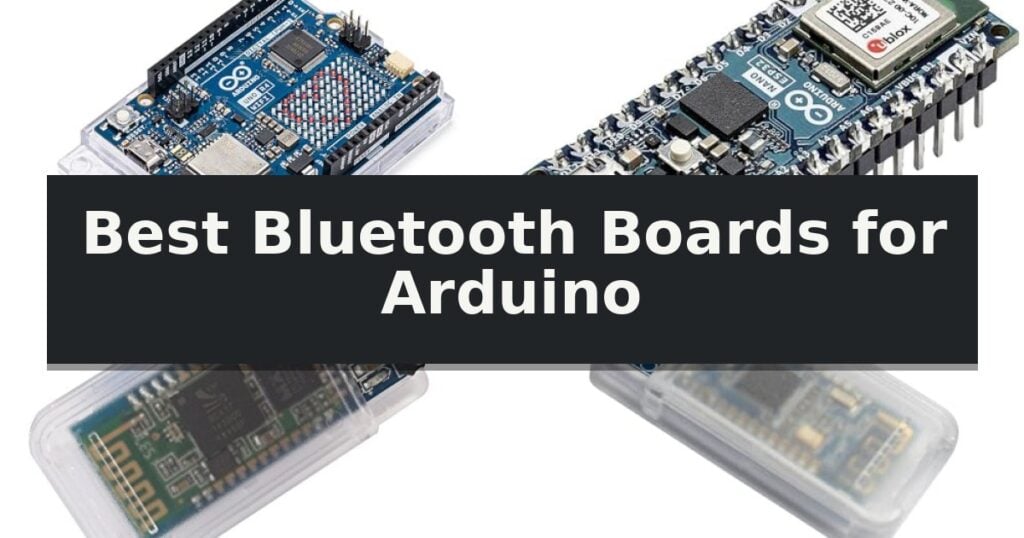
10 Best Bluetooth Boards for Arduino in 2026 Reviews
Quick Comparison
| Product | Best For | Key Strength | Score |
|---|---|---|---|
| Arduino UNO R4 WiFi | Best Overall | Dual-core processing with dedicated Renesas RA4M1 and ESP32-S3 chips. | 4.9 |
| Arduino Nano ESP32 | Compact Power for Wireless Projects | Dual-core Xtensa 32-bit LX7 processor for high-performance computing. | 4.3 |
| DSD TECH HC-05 Bluetooth Module | Classic Serial Communication Add-on | Master and Slave modes are easily switchable via AT commands. | 4.5 |
| DSD TECH HM-10 Bluetooth Module | Low Energy BLE Connectivity | Low energy consumption suitable for battery-powered projects. | 4.9 |
| AITRIP ESP32 Development Board | Versatile Dual-Core Wireless Platform | Dual-mode connectivity featuring both WiFi and Bluetooth on one board. | 4.8 |
| DIYables ESP32-S3 Super Mini | Ultra-Small Form Factor Choice | Ultra-small form factor ideal for wearable and compact designs. | 4.9 |
| DORHEA ESP32 Touchscreen Module | Interactive Display with Wireless Control | Dual-core 32-bit MCU with 240MHz clock speed for high-performance processing. | 4.4 |
| Aideepen ESP32-DevKitC Core Board | External Antenna for Better Range | External 3dBi antenna for superior wireless signal range. | 4.4 |
| AITRIP ESP32 Type-C Board | Modern USB-C Programming Interface | Modern USB-C connectivity for easier programming and power. | 4.5 |
| AITRIP ESP32-C3 Mini Board | Efficient RISC-V IoT Development | Powerful 32-bit RISC-V processor with FPU for efficient computation. | 4.9 |
How We Chose
When evaluating the best Bluetooth boards for Arduino, we prioritize hardware that balances wireless reliability with ease of programming. An experienced reviewer focuses on how well the board handles communication stacks, its physical footprint for various project enclosures, and the availability of development tools that ensure a smooth transition from prototyping to a functional IoT device.
- Integrated Wireless Capability: Assessing whether the board features native Bluetooth and Wi-Fi support or requires external serial modules.
- Processing Power and Architecture: Evaluating the microcontroller's core speed and memory capacity for handling wireless stacks and application code.
- Form Factor and Pinout: Comparing physical dimensions and header compatibility for breadboard prototyping or compact enclosure integration.
- Programming Ecosystem Support: Verifying compatibility with the Arduino IDE, MicroPython, and available community libraries for simplified development.
- Peripheral Connectivity: Checking for additional features like USB-C, analog-to-digital converters, and specialized connectors that expand project functionality.
1 Arduino UNO R4 WiFi — Official Board with Integrated Connectivity
Integrating wireless communication into embedded projects requires robust hardware capable of handling both high-speed data and complex logic. The Arduino UNO R4 WiFi [ABX00087] addresses this by pairing a Renesas RA4M1 microcontroller with an ESP32-S3 chip, providing a versatile foundation for IoT development that includes native Bluetooth 5.0 and Wi-Fi capabilities.
This board distinguishes itself through its dual-core processing architecture, allowing developers to manage real-time tasks on the RA4M1 while offloading wireless connectivity and edge AI operations to the ESP32-S3. The inclusion of a 12×8 LED Matrix provides an immediate, onboard visual interface for status monitoring or user interaction without requiring external displays.
Connectivity is streamlined for modern workflows, featuring a USB-C port for power and programming alongside a Qwiic Connector that simplifies the integration of I2C sensors. For industrial or automotive-focused applications, the board includes CAN bus support, enabling reliable communication with external systems, while the 12-bit DAC and integrated OP-AMP allow for precise analog signal generation.
The Arduino UNO R4 WiFi offers a comprehensive feature set for advanced users looking to consolidate multiple functions into a single, compact footprint. By combining high-precision analog tools with modern wireless standards, it serves as a capable hub for complex, data-driven embedded projects.
Best for: Developers building advanced IoT projects that require integrated wireless connectivity, analog signal processing, and onboard visual feedback.
Skip if: Users who only need basic Bluetooth functionality and prefer a lower-cost, single-microcontroller board without the complexity of dual-core architecture or advanced peripherals.
- Dual-core processing with dedicated Renesas RA4M1 and ESP32-S3 chips.
- Integrated Bluetooth 5.0 and Wi-Fi for robust wireless connectivity.
- Built-in 12×8 LED Matrix for immediate visual output.
- Includes CAN bus and Qwiic Connector for simplified peripheral integration.
- Higher complexity due to the dual-microcontroller architecture.
- Advanced feature set may be excessive for simple, non-IoT projects.
2 Arduino Nano ESP32 — Compact Power for Wireless Projects
Integrating wireless communication into embedded projects requires a balance of processing power and connectivity. The Arduino Nano ESP32 addresses this by utilizing the ESP32-S3 chip, which combines a dual-core Xtensa 32-bit LX7 processor with integrated Wi-Fi and Bluetooth 5.0 capabilities. This hardware foundation allows for efficient data handling, making it a robust choice for developers working on IoT applications, real-time data processing, or machine learning at the edge.
Beyond its wireless features, the board simplifies the development workflow through a modern USB-C port, which provides stable power delivery and faster programming speeds. The inclusion of Human Interface Device (HID) support expands its utility, enabling the board to function as a custom input device or interface directly with peripherals like mice and keyboards. These design choices streamline the transition from prototyping to final integration.
For those prioritizing ease of use, the board is fully compatible with MicroPython. This support allows developers to leverage a streamlined programming environment, which is particularly beneficial for rapid iteration and educational settings. By offering a high-performance microcontroller in a compact form factor, the Arduino Nano ESP32 serves as a versatile tool for complex embedded tasks.
Best for: Developers seeking a compact, high-performance board that combines Bluetooth 5.0 and Wi-Fi with MicroPython compatibility for IoT and HID-based projects.
Skip if: Users who require a board with a larger physical footprint for extensive breadboarding or those who do not need the advanced processing power of the ESP32-S3 chip.
- Dual-core Xtensa 32-bit LX7 processor for high-performance computing.
- Integrated Bluetooth 5.0 and Wi-Fi for comprehensive wireless connectivity.
- USB-C port for reliable power and fast programming.
- Native HID support for custom peripheral and interface projects.
- MicroPython compatibility for streamlined development cycles.
- Advanced feature set may exceed the requirements for simple, low-power sensor projects.
3 DSD TECH HC-05 Bluetooth Module — Classic Serial Communication Add-on
Integrating wireless serial communication into your DIY electronics projects requires reliable hardware, and the DSD TECH HC-05 Bluetooth Module serves as a foundational component for this task. Built around the CSR BC417 mainstream bluetooth chip, this module is engineered to handle Bluetooth V2.0 SPP protocol standards, providing a consistent bridge for serial data transmission between your microcontroller and external devices.
The module offers significant flexibility through its Master and Slave two-in-one design, allowing users to switch operational modes via AT commands. This capability enables the device to act as either a transmitter or a receiver depending on your specific project requirements. With a working voltage range of 3.6V to 6V, it integrates easily into standard Arduino power environments.
Usability is centered on a straightforward configuration process. The module comes with a default baud rate of 9600 and a default pairing pin of 1234, both of which are adjustable. A dedicated button is included to trigger AT Mode, simplifying the setup process for users who need to customize the module's behavior without complex wiring changes.
While this module is a robust choice for serial communication, it is important to note that it is strictly for non-iOS environments. The DSD TECH HC-05 Bluetooth Module does not support iPhone or other iOS devices, making it a specialized tool for Android or PC-based serial interfaces. Its compact dimensions of 1.1 by 0.6 inches ensure it remains unobtrusive on breadboards or custom PCBs.
Best for: Makers and hobbyists looking for a versatile, configurable Bluetooth serial bridge for Android or PC-based Arduino projects.
Skip if: Users who require native Bluetooth connectivity with iOS devices or those needing higher-speed Bluetooth protocols beyond V2.0.
- Master and Slave modes are easily switchable via AT commands.
- Wide 3.6V to 6V operating voltage range for project compatibility.
- Dedicated AT Mode button for simplified configuration.
- Utilizes the established CSR BC417 Bluetooth chip.
- No iOS device support for iPhone or iPad connectivity.
- Limited to Bluetooth V2.0 SPP protocol standards.
4 DSD TECH HM-10 Bluetooth Module — Low Energy BLE Connectivity
Integrating wireless communication into microcontroller projects is simplified with the DSD TECH HM-10 Bluetooth Module, which provides a straightforward bridge for serial data transmission. This module is built around the Bluetooth 4.0 BLE standard, allowing for low-energy connectivity with modern mobile devices, including iPhone 4s and newer models.
The hardware is designed for immediate integration, featuring a dedicated 4-pin base board that breaks out the VCC, GND, TX, and RX pins. This layout eliminates the need for complex wiring, making it highly convenient for connecting directly to an Arduino UNO R3, Mega 2560, or Nano. With a flexible working voltage range of 3.6V to 6V, it accommodates various power configurations common in hobbyist electronics.
Beyond simple data transfer, the module supports advanced functionality such as iBeacon mode and the Apple Notification Center Service (ANCS). Users can monitor the connection status through an integrated LED status indicator, which remains lit when a connection is established and flashes during disconnection. The module operates at a default baud rate of 9600, ensuring compatibility with standard serial communication setups.
DSD TECH provides a one-year warranty for this unit, offering support for technical inquiries. While the module is compact, its reliance on specific UART communication requires users to be comfortable with serial programming and AT command sets to fully configure its BLE settings.
Best for: Makers looking for a low-energy, easy-to-wire Bluetooth 4.0 interface for Arduino-based projects.
Skip if: Users who require high-speed data throughput or classic Bluetooth (BR/EDR) compatibility for legacy devices.
- Low energy consumption suitable for battery-powered projects.
- Convenient 4-pin base board simplifies wiring to Arduino pins.
- Versatile functionality including iBeacon and ANCS support.
- Wide operating voltage from 3.6V to 6V.
- Requires serial programming knowledge to configure advanced settings.
- Limited to BLE and not compatible with older classic Bluetooth protocols.
5 AITRIP ESP32 Development Board — Versatile Dual-Core Wireless Platform
Integrating wireless connectivity into DIY electronics projects requires a balance of power and versatility. The AITRIP ESP32 Development Board provides a robust solution by combining 2.4GHz dual-mode WiFi and Bluetooth capabilities on a single, compact microcontroller platform. This board is built around the ESP32 chip, which features dual-core processing to handle complex tasks efficiently, ensuring that demanding computational requirements are met without sacrificing performance.
Designed with ultra-low power consumption in mind, this board remains a practical choice for battery-operated or energy-sensitive applications. It supports three distinct operational modes—AP, STA, and AP+STA—allowing for flexible network configurations that adapt to various project architectures. The inclusion of the LWIP protocol and Freertos support further enhances its utility for developers working on sophisticated, scalable embedded systems.
Compatibility with the Arduino IDE simplifies the development process, enabling users to leverage familiar programming environments for rapid prototyping. The hardware includes an integrated antenna and RF amplifier filter, which streamlines the setup by reducing the need for external components. This integrated design ensures the board is ready for deployment in a wide variety of hardware projects immediately upon configuration.
Each unit is compact, measuring approximately 2.05 by 1.18 inches, making it suitable for space-constrained enclosures where footprint is a primary concern. As this package includes three boards, it offers a convenient way to prototype multiple nodes or maintain spares for ongoing development work. While the advanced feature set offers significant capability, users should be prepared for the technical complexity inherent in a dual-core, wireless-enabled microcontroller compared to simpler, legacy 8-bit alternatives.
Best for: Developers and hobbyists seeking a compact, dual-core platform for projects requiring both WiFi and Bluetooth connectivity.
Skip if: Users who require a simpler, legacy 8-bit architecture or those who do not need wireless functionality for their specific project.
- Dual-mode connectivity featuring both WiFi and Bluetooth on one board.
- Dual-core processor for handling demanding computational tasks.
- Ultra-low power consumption design suitable for efficiency-focused projects.
- Arduino IDE compatibility for streamlined programming and integration.
- Higher complexity compared to basic microcontrollers due to advanced features.
- Small form factor may require precise soldering or specific breadboard layouts.
6 DIYables ESP32-S3 Super Mini — Ultra-Small Form Factor Choice
The DIYables ESP32-S3 Super Mini is engineered for developers who prioritize space-efficiency without sacrificing wireless capability. Measuring just 23.2mm by 18.2mm, this ultra-compact module integrates the powerful ESP32-S3FH4R2 chip, providing both WiFi and Bluetooth 5 connectivity in a footprint suitable for wearable technology and highly constrained IoT environments.
Designed for immediate integration, this board features presoldered header pins, allowing for rapid connection to breadboards and external modules right out of the box. This design choice eliminates the need for manual soldering, streamlining the prototyping phase for those focused on hardware assembly and software development.
Performance is managed by the ESP32-S3 architecture, which is built for stable and efficient processing in demanding applications. The board maintains full compatibility with the Arduino IDE and MicroPython, supported by available tutorials that facilitate a faster learning curve for users transitioning between different programming environments.
While its small size is an asset for portability, users should ensure their project requirements align with the specific pinout and physical dimensions of this module. It serves as a robust foundation for wireless projects, offering a balance of high-performance processing and reliable connectivity in a minimal form factor.
Best for: Space-constrained IoT and wearable projects requiring reliable WiFi and Bluetooth 5 connectivity.
Skip if: Projects requiring a large number of exposed GPIO pins or a standard-sized development board footprint.
- Ultra-small form factor ideal for wearable and compact designs.
- Presoldered header pins for immediate breadboard compatibility.
- Integrated WiFi and Bluetooth 5 for versatile wireless communication.
- Broad software support including Arduino IDE and MicroPython.
- Limited physical size may restrict the number of accessible I/O connections compared to larger development boards.
7 DORHEA ESP32 Touchscreen Module — Interactive Display with Wireless Control
The DORHEA ESP32 Touchscreen Module integrates a 2.8-inch 240×320 TFT LCD with a low-power dual-core 32-bit MCU, offering a versatile platform for projects requiring both visual feedback and wireless connectivity. This board is designed for developers who need to manage complex tasks, as it features a clock frequency up to 240MHz and 520KB of internal SRAM, providing substantial computing power for interactive applications.
Engineered for flexibility, the module supports Wi-Fi 802.11b/g/n/e/i and Bluetooth, enabling seamless network integration. It includes multiple sleep modes and supports various working modes like STA, AP, and STA+AP, which are essential for power-efficient, connected IoT designs. The board also features a built-in flash and supports TF card expansion, allowing for local data storage and media management.
The hardware interface is highly adaptable, supporting UART, SPI, I2C, PWM, ADC, and DAC protocols. This connectivity allows for the integration of various sensors and peripherals, including support for OV2640 and OV7670 cameras. For developers, the board simplifies the workflow by providing support for one-key automatic downloads and compatibility with the Arduino IDE, along with pre-configured LVGL demo examples.
While the module is a powerful tool for advanced development, users should note its specific operating voltage of 4.75-5.25V. The inclusion of a resistive touch panel and a standard 2.8-inch display makes it a practical choice for creating user-facing interfaces, though it requires careful management of peripheral resources to maximize the efficiency of its dual-core processor.
Best for: Developers seeking an all-in-one ESP32 development board that combines a high-resolution touchscreen display with extensive wireless and peripheral connectivity for IoT projects.
Skip if: Users who require a simple, low-power microcontroller without the overhead of a large TFT display or those who do not need integrated wireless capabilities.
- Dual-core 32-bit MCU with 240MHz clock speed for high-performance processing.
- Integrated 2.8-inch 240×320 TFT touchscreen for interactive interface development.
- Comprehensive wireless connectivity including Wi-Fi and Bluetooth support.
- Extensive peripheral interface support including SPI, I2C, UART, and camera modules.
- Specific voltage requirements (4.75-5.25V) necessitate precise power supply management.
- The resistive touch panel may be less responsive than capacitive alternatives.
8 Aideepen ESP32-DevKitC Core Board — External Antenna for Better Range
The Aideepen ESP32-DevKitC Core Board provides a significant advantage for wireless projects by integrating a U.FL (IPEX) to SMA adapter and a 3dBi external antenna. Unlike standard boards limited by onboard PCB antennas, this design choice offers enhanced signal range and stability for 2.4GHz 802.11 b/g/n Wi-Fi and Bluetooth 4.2 BLE connectivity, making it a robust choice for environments where reliable wireless communication is critical.
Engineered for high versatility, this development board supports a comprehensive range of peripheral integration. It features UART, SPI, I2C, and I2S interfaces, allowing for seamless connections to various sensors, displays, and external modules. The inclusion of an integrated ADC for analog signal measurement and a DAC interface for analog signal generation enables the board to handle complex tasks, such as precise sensor data acquisition or audio waveform output.
Compatibility is a core strength of this platform, as it supports major development frameworks including the Arduino IDE, MicroPython, and ESP-IDF. This flexibility allows developers to utilize established libraries and community resources to accelerate project timelines. Whether you are building smart home automation systems, industrial monitoring nodes, or wearable technology, the board provides a reliable foundation for your code.
Physical implementation is designed to be efficient for rapid prototyping. The 38-pin layout is breadboard-friendly, allowing for quick circuit assembly without the need for complex soldering. The package includes two units, providing a practical solution for multi-node projects or simultaneous development and deployment. While the external antenna assembly increases the overall physical footprint compared to compact integrated modules, it is a necessary trade-off for the improved signal performance provided by the external 3dBi antenna.
Best for: Developers requiring extended wireless range and versatile interface support for IoT or industrial monitoring applications.
Skip if: Users who require a compact, low-profile footprint and do not need the extended range provided by an external antenna assembly.
- External 3dBi antenna for superior wireless signal range.
- Broad interface support including UART, SPI, I2C, and I2S.
- Multi-framework compatibility with Arduino IDE, MicroPython, and ESP-IDF.
- Breadboard-friendly 38-pin design for rapid prototyping.
- Increased physical footprint due to the external antenna and SMA adapter assembly.
9 AITRIP ESP32 Type-C Board — Modern USB-C Programming Interface
The AITRIP ESP32 Type-C Board simplifies project integration by incorporating a modern USB-C programming interface, moving away from older, less convenient connector standards. This development board is built around the ESP32 ESP-WROOM-32 core, providing a robust platform for hobbyists and engineers looking to implement wireless connectivity in their custom builds.
Designed for versatility, the board features 30 pins that support a wide array of communication and control interfaces, including UART, SPI, I2C, PWM, DAC, and ADC. This extensive I/O capability allows for seamless connection to various sensors and peripherals, making it a highly adaptable choice for complex automation or data-logging tasks.
The board leverages 2.4GHz dual-mode WiFi and Bluetooth capabilities, powered by 40nm TSMC low-power technology. By integrating the antenna, RF balun, power amplifiers, and filters directly onto the module, it maintains a compact footprint while ensuring reliable wireless performance for connected projects.
Usability is prioritized through the inclusion of two dedicated onboard buttons: one for reset and another for entering the halberd program mode. These physical controls streamline the development cycle, allowing for quick testing and code deployment without needing to manually bridge connections.
Best for: Developers and hobbyists requiring a compact, versatile microcontroller with integrated WiFi and Bluetooth for wireless project prototyping.
Skip if: Users who require a board with a higher pin count or specific form factors not compatible with the standard 30-pin ESP32 layout.
- Modern USB-C connectivity for easier programming and power.
- Integrated WiFi and Bluetooth dual-mode wireless support.
- Comprehensive 30-pin I/O support for diverse sensor integration.
- Dedicated reset and program buttons for efficient development.
- Limited to the standard 30-pin configuration which may restrict complex wiring setups.
10 AITRIP ESP32-C3 Mini Board — Efficient RISC-V IoT Development
The AITRIP ESP32-C3 Mini Board provides a compact, high-performance solution for IoT projects, utilizing a 32-bit RISC-V single-core processor that reaches clock speeds up to 160 MHz. This development board integrates both WiFi and Bluetooth capabilities, making it a versatile choice for wireless wearable applications and low-power IoT designs.
Engineered for flexibility, the board includes 11 digital I/O pins capable of PWM output and 4 analog I/O pins that function as ADC inputs. It supports multiple serial communication protocols, including UART, I2C, and SPI, allowing for robust connectivity with various sensors and peripherals. The hardware also features dedicated reset and bootloader mode buttons for straightforward programming.
Power management is handled through a 5V input, with support for a 3.3V to 6V range. Users should note that the board requires a choice between USB power or an external power supply, as these cannot be used simultaneously. Each package includes two development boards and two expansion boards, offering a complete kit for immediate prototyping.
The integration of a Floating Point Unit (FPU) within the RISC-V CPU enhances the board's computational efficiency, particularly for 32-bit single-precision arithmetic tasks. This design choice balances power consumption with the processing power required for modern wireless projects.
Best for: Developers seeking a compact, RISC-V based board for low-power IoT and wireless wearable projects.
Skip if: Users who require simultaneous USB and external power connectivity or a larger pin count for complex hardware interfaces.
- Powerful 32-bit RISC-V processor with FPU for efficient computation.
- Integrated WiFi and Bluetooth for versatile wireless connectivity.
- Rich interface set including PWM, ADC, UART, I2C, and SPI support.
- Compact form factor ideal for wearable and space-constrained IoT applications.
- Power input limitation prevents simultaneous use of USB and external power sources.
Best Bluetooth Boards for Arduino Buying Guide
Integrated vs. Modular Connectivity
Integrated boards combine the main microcontroller and the wireless chip on a single PCB. This approach reduces the complexity of your wiring and often provides a more stable, pre-tested communication interface between the processor and the radio.
Modular add-ons, such as the HC-05 or HM-10, connect via serial pins (TX/RX). These are useful if you have a specific board you prefer for its I/O capabilities but need to add Bluetooth functionality as an afterthought.
Power Consumption Considerations
Bluetooth Low Energy (BLE) modules are essential for battery-powered projects where energy efficiency is a priority. These modules allow your device to remain in a low-power sleep state while still being discoverable or ready to transmit data.
Standard Bluetooth modules, while often easier to pair with older devices, typically consume more power. Always verify the voltage requirements of your chosen board to ensure it aligns with your power source, such as a battery pack or USB supply.
Development Environment Compatibility
The best boards for Arduino are those that maintain full compatibility with the Arduino IDE. This ensures you can utilize existing libraries for sensors, displays, and wireless communication without needing to learn entirely new programming languages.
Some advanced boards also support MicroPython, which can significantly speed up the development cycle for IoT applications. Check if your chosen board has a robust community or official documentation for the specific environment you intend to use.
Form Factor and Physical Constraints
The physical size of the board dictates where it can be placed. Compact boards like the Nano ESP32 are ideal for wearables or small sensor nodes, while larger boards like the UNO R4 offer more space for headers and shields.
Consider the layout of the pins and the type of USB connector used. Modern boards with USB-C ports provide more robust connections and faster data transfer, which is beneficial during the frequent uploading cycles of the development process.
Peripheral and Sensor Integration
Wireless boards often include additional features like built-in LED matrices, touch-screen controllers, or high-precision DACs. These integrated peripherals can save you from needing extra modules, effectively reducing the overall cost and footprint of your project.
If your project requires specific sensors, look for boards that include I2C connectors like Qwiic. These standardized connectors simplify the wiring process and ensure reliable communication with a wide range of peripheral devices.
Frequently Asked Questions
Can I use a Bluetooth module with any Arduino board?
Most serial-based Bluetooth modules can be connected to any Arduino board with available hardware or software serial pins. However, ensure the logic levels of the module match your board to prevent damage.
What is the difference between Bluetooth and BLE for Arduino projects?
Bluetooth Classic is typically used for high-bandwidth data like audio, while Bluetooth Low Energy (BLE) is designed for low-power, intermittent data transmission, making it better for battery-operated IoT sensors.
Do I need an external antenna for my Bluetooth board?
Many development boards include an onboard antenna sufficient for short-range communication. If your project is inside a metal enclosure or requires longer range, boards with an IPEX connector for an external antenna are preferred.
Is it better to use an integrated board or a separate module?
Integrated boards are generally more reliable and easier to program. Separate modules are best if you are already committed to a specific microcontroller that lacks wireless capabilities.
Can these boards connect to smartphones?
Yes, most modern Bluetooth-enabled Arduino boards support standard protocols that allow them to communicate with Android and iOS devices, though specific apps may be required depending on the protocol used.
Conclusion: Our Top Pick
Our top pick is Arduino UNO R4 WiFi. Choosing the right Bluetooth board involves balancing your need for integrated wireless features against the flexibility of modular add-ons. For most users, an all-in-one board provides the most streamlined experience and the best support for modern IoT applications.
Assess your power constraints and physical space requirements before finalizing your choice. By selecting a board that aligns with your programming experience and peripheral needs, you can ensure a successful and efficient development process.