ACEBOTT ESP32 Weather Station Kit is our top choice for the Best Arduino Weather Station Kits because it combines comprehensive sensor integration with a dedicated solar-charging system for long-term outdoor monitoring. The SparkFun MicroMod Weather Station Kit serves as a high-end alternative for users requiring a modular, professional-grade ecosystem, while the CHICHIYANG ESP8266 Weather Station Kit offers a streamlined solution for those focused on global data connectivity and internet-based forecasting.
Selecting the right kit involves balancing your technical comfort level with the specific environmental data you intend to track. Kits featuring ESP32 or ESP8266 boards provide built-in Wi-Fi, which is essential for IoT-enabled projects that require remote data logging or real-time web dashboards. Beginners should prioritize kits that include pre-written code and clear assembly diagrams, while experienced makers might prefer modular systems that allow for custom sensor expansion.
If you are new to electronics, our guide to the Best Arduino Starter Kits for Beginners provides a great foundation for learning the basics before tackling a weather station project. For those interested in expanding their project, the Best Arduino Sensor Kits offer a wide range of additional modules to enhance your station's capabilities.
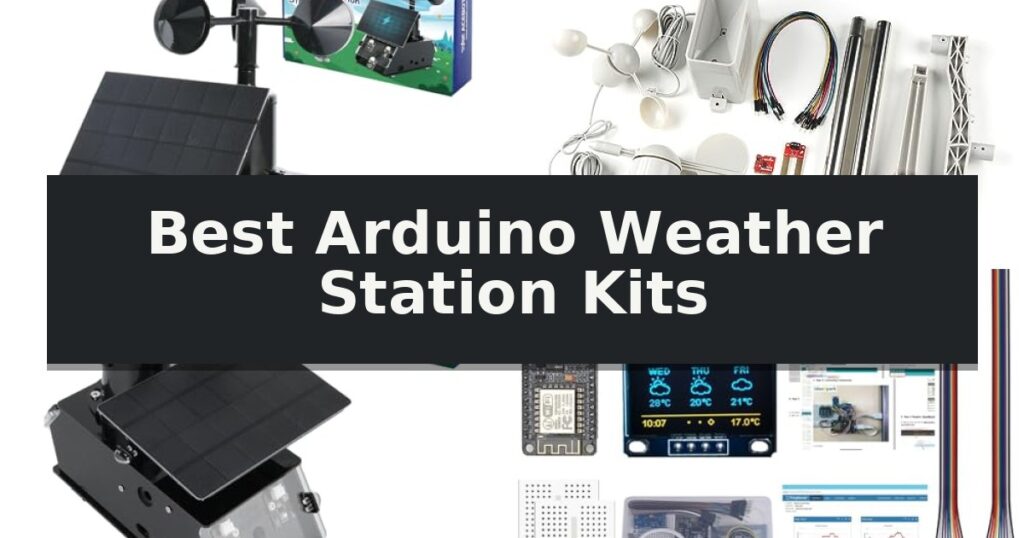
10 Best Arduino Weather Station Kits in 2026 Reviews
Quick Comparison
| Product | Best For | Key Strength | Score |
|---|---|---|---|
| ACEBOTT ESP32 Weather Station Kit | Best Overall | Comprehensive 8-sensor array for diverse environmental data collection. | 4.9 |
| SparkFun MicroMod Weather Station Kit | Modular Sensor Ecosystem | Modular design allows for easy processor swapping via the MicroMod ecosystem. | 4.7 |
| ACEBOTT IoT Weather Station Kit | Solar Powered STEM Learning | Includes 8 environmental sensors for comprehensive data tracking. | 4.3 |
| CHICHIYANG ESP8266 Weather Station Kit | Global Data Connectivity | Integrated internet connectivity via ESP8266-12E for global weather data. | 4.6 |
| SparkFun Weather Meter Kit | Essential Meteorological Sensors | Includes all three core meteorological sensors for wind and rain. | 4.4 |
| KOOKYE Smart Home Sensor Kit | Versatile Environmental Sensing | Broad compatibility with multiple Arduino and Raspberry Pi models. | 4.6 |
| ELEGOO ESP32 Super Starter Kit | Best for IoT Beginners | Integrated Wi-Fi and Bluetooth connectivity for IoT applications. | 4.8 |
| SunFounder Elite Explorer Kit | Advanced Arduino R4 Learning | Includes the upgraded Arduino UNO R4 WiFi with 32-bit processing. | 4.3 |
| KEYESTUDIO Solar Tracking Kit | Automated Energy Harvesting | Dual-axis solar tracking capability using four light sensors. | 4.4 |
| ELEGOO Mega 2560 Starter Kit | Extensive Component Selection | High I/O capacity with 54 digital pins and 16 analog inputs for complex sensor arrays. | 4.3 |
How We Chose
Evaluating the best Arduino weather station kits requires a focus on how well the hardware integrates with common coding platforms. We assess the reliability of the included sensors, the efficiency of the power management systems, and the clarity of the instructional resources to ensure that both beginners and advanced users can successfully deploy their stations.
- Sensor variety and precision for environmental data collection
- Microcontroller compatibility and built-in wireless connectivity
- Ease of assembly and quality of provided documentation
- Power management features including solar integration
- Expandability for future custom sensor additions
1 ACEBOTT ESP32 Weather Station Kit — Complete IoT Environmental Monitoring
Building a custom environmental monitoring system is a practical way to engage with IoT technology, and the ACEBOTT ESP32 Weather Station Kit provides a comprehensive foundation for this project. By leveraging the power of the ESP32 microcontroller, this kit enables real-time weather monitoring and data forecasting, making it a functional tool for both educational exploration and home-based data collection.
The system is equipped with 8 sensors capable of tracking a wide range of environmental metrics, including light intensity, UV levels, atmospheric pressure, rainfall, PM2.5 air quality, wind speed, temperature, humidity, and even ground vibration. This sensor array allows for detailed observation of local conditions, suitable for both indoor and outdoor setups.
Designed for accessibility, the kit includes ACECode graphical mobile programming and 16 structured courses to guide users through the assembly and coding process. The hardware features a solar charging panel to maintain battery life, ensuring consistent operation for extended monitoring periods. Users must provide two 18650 button-top batteries to power the unit.
Assembly is supported by detailed, HD-rendered instructions available via the manufacturer's official WIKI and video resources. This approach simplifies the integration of the ESP32 hardware, allowing makers to focus on the logic of their weather station rather than struggling with complex wiring or configuration.
Best for: STEM enthusiasts and makers looking to build a functional, solar-powered IoT weather station with guided programming tutorials.
Skip if: Users who prefer a pre-assembled, plug-and-play weather station that does not require manual assembly, battery sourcing, or coding.
- Comprehensive 8-sensor array for diverse environmental data collection.
- Includes a solar charging panel for improved energy sustainability.
- Features rich educational resources including 16 courses and graphical programming.
- Detailed HD-rendered assembly instructions and coding tutorials provided.
- Requires the separate purchase of 2 18650 button-top batteries.
- Assembly and programming require a time investment for setup.
2 SparkFun MicroMod Weather Station Kit — Modular Sensor Ecosystem
Building a custom environmental monitoring system requires a flexible foundation, and the SparkFun MicroMod Weather Station Kit provides a modular approach to this task. By leveraging the MicroMod ecosystem, this kit allows users to swap processor boards, making it a versatile choice for those who want to experiment with different hardware configurations for data collection.
The core of this system is the MicroMod Weather Carrier Board, which integrates essential environmental monitoring capabilities directly onto the PCB. It features the BME280 sensor for tracking temperature, pressure, and humidity, alongside an AS3935 Lightning detector for detecting atmospheric electrical activity. These on-board sensors provide a comprehensive starting point for meteorological data gathering.
For broader environmental tracking, the kit includes a Weather Meter Kit consisting of an anemometer for wind speed and a self-emptying bucket-type rain gauge. The rain gauge registers a momentary button closure for every 0.011 inches of precipitation, while the anemometer encodes wind speed through a rotation switch. These components connect via RJ11 jacks on the carrier board, simplifying the physical setup.
The kit also addresses agricultural needs by including a soil moisture sensor with screw terminals for easy integration. With the included SparkFun MicroMod ESP32 Processor, users have a capable microcontroller to process sensor inputs and manage data transmission. The inclusion of premium jumper wires ensures that all components can be connected reliably within the modular framework.
Best for: Agriculturalists and hobbyists who require a modular, customizable weather station platform with integrated lightning and soil moisture detection.
Skip if: Users who prefer a pre-assembled, plug-and-play consumer weather station that does not require programming or manual component integration.
- Modular design allows for easy processor swapping via the MicroMod ecosystem.
- Includes integrated BME280 and AS3935 sensors for comprehensive environmental data.
- Expandable connectivity with dedicated RJ11 jacks and soil moisture sensor terminals.
- Includes essential anemometer and rain gauge hardware for full weather monitoring.
- Requires assembly and programming knowledge to function as a complete weather station.
- Lacks a UV sensor in the provided carrier board configuration.
3 ACEBOTT IoT Weather Station Kit — Solar Powered STEM Learning
The ACEBOTT IoT Weather Station Kit provides a comprehensive entry point into environmental monitoring by integrating eight distinct sensors—including wind, temperature, humidity, UV, and PM2.5—with an ESP32 controller. This setup allows users to track real-time data while exploring the fundamentals of IoT and smart automation through hands-on assembly.
Designed for educational engagement, the kit supports both Arduino IDE and Scratch graphical programming, enabling teens and adults to transition between block-based and text-based coding. The inclusion of a high-efficiency solar panel facilitates continuous outdoor operation, teaching practical lessons in renewable energy and sustainable power management for remote IoT systems.
The assembly process is supported by HD-illustrated instructions, tutorial videos, and prewritten code, which helps streamline the building phase for those new to electronics. By combining environmental science with hardware coding, the kit serves as a functional model for real-world forecasting and data collection projects.
While the kit offers a robust platform for learning, users should note that it requires an external battery, which is not included in the package. This hardware-focused approach encourages problem-solving and technical confidence, making it a versatile tool for classroom environments, homeschool settings, or individual hobbyist projects.
Best for: Students, teens, and hobbyists looking to learn IoT coding and environmental data collection through a hands-on, solar-powered hardware project.
Skip if: Users who require a pre-assembled, plug-and-play weather station or those who do not wish to perform manual assembly and coding.
- Includes 8 environmental sensors for comprehensive data tracking.
- Features a high-efficiency solar panel for sustainable outdoor power.
- Compatible with Arduino IDE and Scratch for versatile coding education.
- Provides HD-illustrated tutorials to guide the DIY assembly process.
- Requires a separate battery purchase to complete the power system.
- Requires manual assembly and coding which may be challenging for absolute beginners.
4 CHICHIYANG ESP8266 Weather Station Kit — Global Data Connectivity
The CHICHIYANG ESP8266 Weather Station Kit offers a specialized approach to environmental monitoring by integrating internet-connected data retrieval with local sensor readings. This kit centers on the ESP8266-12E microcontroller, which facilitates the fetching of time, weather data, and three-day forecasts from the internet to display on an SSD1306 OLED screen.
Designed for versatility, the device allows users to switch between global city data, making it a functional tool for tracking conditions in different locations. The hardware includes a suite of sensors—DHT11 for temperature and humidity, BMP180 for atmospheric pressure, and BH1750FVI for light intensity—to provide a comprehensive snapshot of your immediate surroundings.
Operational efficiency is built into the system, with the device configured to read indoor sensor data every 5 seconds and perform internet uploads every 60 seconds. Users can monitor these metrics through real-time data charts accessible via a computer or phone. The platform remains open for customization, as the included code can be modified to implement unique functions or additional logic.
This kit serves as a practical entry point for those interested in IoT-based environmental sensing. While it requires assembly and coding knowledge to fully leverage its potential, the combination of local sensor data and web-based forecasting provides a robust foundation for a custom weather station project.
Best for: Makers and hobbyists looking to build a custom, internet-connected weather station that displays both local sensor data and global weather forecasts.
Skip if: Users seeking a plug-and-play, pre-assembled weather station without the need for programming or hardware assembly.
- Integrated internet connectivity via ESP8266-12E for global weather data.
- Includes three distinct sensors for comprehensive environmental monitoring.
- Supports real-time data visualization on mobile or desktop devices.
- Customizable firmware allows for personalized function implementation.
- Requires technical assembly and coding to function as intended.
5 SparkFun Weather Meter Kit — Essential Meteorological Sensors
The SparkFun Weather Meter Kit offers a foundational approach to environmental monitoring by providing the three essential sensors required to track local atmospheric conditions: a wind vane, a cup anemometer, and a tipping bucket rain gauge. This kit is designed for users who intend to integrate these sensors into a custom Arduino-based system, as it relies on passive components that require an external voltage source to function.
Each sensor utilizes sealed magnetic reed switches and magnets to detect movement and rainfall, ensuring a mechanical method for data collection. The kit includes a comprehensive mounting system, featuring a two-part mounting mast, a dedicated rain gauge arm, a wind meter bar, and necessary hardware like clamps and zip ties to secure the equipment in an outdoor environment.
Connectivity is streamlined through the inclusion of RJ11 terminated cables, which simplify the wiring process when connecting the sensors to your microcontroller interface. Because the sensors are passive, the user is responsible for sourcing the appropriate voltage to interpret the signals generated by the reed switches, making this a project-oriented solution for those comfortable with circuit design.
This kit focuses on the core mechanics of weather measurement without integrated electronics or pre-built software, allowing for complete customization of the data logging and processing logic. It is a practical choice for developers looking to build a weather station from the ground up using their own hardware and programming preferences.
Best for: Makers and developers who want to build a custom, modular weather station using their own microcontroller and circuit design.
Skip if: Users seeking a plug-and-play weather station with pre-integrated software, wireless connectivity, or an included display unit.
- Includes all three core meteorological sensors for wind and rain.
- Features sealed magnetic reed switches for reliable mechanical sensing.
- Comes with a complete mounting hardware set for easy installation.
- Uses standard RJ11 terminated cables for straightforward connections.
- Requires the user to source an external voltage for operation.
- Lacks integrated electronics or pre-built data processing software.
6 KOOKYE Smart Home Sensor Kit — Versatile Environmental Sensing
The KOOKYE Smart Home Sensor Kit provides a comprehensive entry point for hobbyists looking to integrate environmental monitoring into their DIY projects. By bundling 16 distinct sensor modules, this kit allows users to capture data points including temperature, humidity, air pressure, and light levels, making it a foundational resource for building custom weather-tracking systems.
Compatibility is a core design choice, as the kit is engineered to work seamlessly with Arduino UNO R3, Mega2560, Mega328, Nano, and Raspberry Pi platforms. This broad support ensures that users can transition between different controller boards without needing to replace their sensor hardware, providing a flexible ecosystem for ongoing experimentation.
To streamline the development process, the manufacturer includes access to a dedicated website featuring step-by-step instructions, circuit connection diagrams, and verified library packages. These resources are intended to reduce research time for beginners, allowing for a more direct path from initial assembly to functional data collection.
The component selection prioritizes reliability by excluding outdated or redundant sensors, focusing instead on a curated set of modules for diverse smart home applications. This approach helps maintain a consistent performance standard across the 16 included projects, ensuring that the hardware remains relevant as the user's technical skills advance.
Best for: Beginners and hobbyists who require a versatile, all-in-one sensor bundle to start building custom environmental monitoring projects on Arduino or Raspberry Pi platforms.
Skip if: Users seeking a pre-assembled, weather-proof outdoor station, as this kit requires manual assembly, programming, and housing to function in external environments.
- Broad compatibility with multiple Arduino and Raspberry Pi models.
- Includes 16 distinct sensor modules for comprehensive data collection.
- Access to verified sample code and libraries to accelerate project development.
- Curated selection of high-reliability sensors.
- Requires manual assembly and programming to create a functional station.
- Lacks a weather-proof enclosure for outdoor deployment.
7 ELEGOO ESP32 Super Starter Kit — Best for IoT Beginners
Building a custom environmental monitoring system requires a reliable foundation, and the ELEGOO ESP32 Super Starter Kit provides a versatile starting point for those interested in IoT-based data collection. At its core, the kit features a powerful dual-core ESP-32 microcontroller that integrates both Wi-Fi and Bluetooth 4.2, allowing for seamless connectivity to cloud services or local networks without requiring additional communication modules.
The kit is designed for comprehensive learning, bundling over 35 distinct modules and components. Beyond the primary board, users receive a variety of sensors, displays, and input devices, such as an OLED screen and servo motors. This hardware selection is specifically curated to support the development of functional projects, including weather stations and smart home controllers, by providing the necessary tools to measure and display environmental data.
To assist with the development process, the package includes a step-by-step online tutorial covering more than 30 projects. These guides offer clear circuit diagrams and refined code, which are fully compatible with the Arduino IDE. This structure allows makers to progress from basic circuit assembly to more complex IoT applications, ensuring that the hardware capabilities of the ESP-32 are utilized effectively.
While the kit offers extensive hardware, users should note that it is a modular development platform rather than a pre-assembled weather station. It requires manual assembly, wiring, and software configuration to function as a dedicated monitoring device. This makes it an ideal choice for those prioritizing educational value and customizability over a plug-and-play consumer appliance.
Best for: Students, hobbyists, and engineers who want to build a custom, network-connected weather station from the ground up.
Skip if: Users who prefer a pre-assembled, ready-to-use weather station that does not require coding or circuit assembly.
- Integrated Wi-Fi and Bluetooth connectivity for IoT applications.
- Comprehensive component set with over 35 modules included.
- Beginner-friendly tutorials with 30+ project guides.
- Full compatibility with the Arduino IDE.
- Requires manual assembly and programming to function.
- Not a pre-configured weather station device.
8 SunFounder Elite Explorer Kit — Advanced Arduino R4 Learning
The SunFounder Elite Explorer Kit serves as a comprehensive entry point for those looking to integrate hardware and software, featuring the original Arduino UNO R4 WiFi board. This kit is built to facilitate learning through a structured approach, providing users with a 32-bit processor and integrated connectivity options that allow for more complex project development compared to previous iterations.
Beyond the core board, the kit includes over 300 high-quality components, enabling a wide range of experiments. It is designed to support users through 50 hands-on projects, categorized into basic, fun, and IoT-focused tracks. The inclusion of 100+ free video lessons co-created with educator Paul McWhorter provides a guided path for beginners aged 8 and up to master Arduino C++ programming.
The SunFounder Elite Explorer Kit emphasizes versatility by maintaining compatibility with other boards like the Uno R3 and Nano. By utilizing the Arduino IoT Cloud and supporting Bluetooth and WiFi, the kit allows for the creation of interactive, connected devices. The hardware is RoHS compliant, ensuring it meets safety standards for educational and home environments.
For those seeking technical assistance, the manufacturer provides dedicated support and troubleshooting forums. This ecosystem is intended to help users overcome common programming hurdles, making it a suitable choice for students, teachers, and engineers who require a reliable foundation for their electronics and coding projects.
Best for: Beginners and students who want a comprehensive, guided path to learning Arduino programming and IoT integration with a modern R4 WiFi board.
Skip if: Experienced engineers who already possess a large inventory of sensors and components and only require a standalone microcontroller board.
- Includes the upgraded Arduino UNO R4 WiFi with 32-bit processing.
- Comprehensive set of 300+ components for diverse project building.
- Extensive educational support with 100+ free video lessons.
- Integrated IoT capabilities via WiFi and Bluetooth.
- May contain more components than necessary for users focused on a single, specific application.
- Requires a learning curve to navigate the 50+ project tutorials effectively.
9 KEYESTUDIO Solar Tracking Kit — Automated Energy Harvesting
The KEYESTUDIO Solar Tracking Kit offers a hands-on approach to renewable energy education by utilizing four ambient light sensors and two servos to physically orient a solar panel toward a light source. This mechanism demonstrates the practical application of converting light into electrical energy, providing a tangible way to observe energy harvesting in real-time.
Beyond its primary tracking function, the kit integrates a suite of components including an LCD1602 display, a temperature and humidity sensor, and a BH1750 light sensor. These additions allow users to build comprehensive monitoring systems, while the inclusion of a buzzer and LED module adds interactive feedback capabilities to the programming projects.
Designed for versatility, the hardware maintains compatibility with IIC, UART, and SPI ports, facilitating the connection of external sensors for more advanced experiments. The platform is supported by 11 detailed online tutorials that guide users through a progression of tasks, starting from basic signal control to complex system integration.
As an open-source programming device, this kit serves as a foundational tool for learning electronics, machinery, and control logic. Note that the system arrives unassembled and requires the user to burn the code and provide their own batteries, ensuring a complete build-from-scratch experience.
Best for: Students and hobbyists seeking a modular, programmable platform to learn about solar energy tracking and sensor integration.
Skip if: Users who prefer a pre-assembled, plug-and-play weather station or those who do not wish to perform manual wiring and code uploading.
- Dual-axis solar tracking capability using four light sensors.
- High extensibility with reserved IIC, UART, and SPI ports.
- Comprehensive 11-step online tutorial series.
- Includes a wide array of integrated sensors and modules for diverse projects.
- Requires manual assembly and code burning.
- Batteries are not included in the kit.
10 ELEGOO Mega 2560 Starter Kit — Extensive Component Selection
Building a custom weather station requires a robust foundation that can handle multiple sensor inputs simultaneously. The ELEGOO Mega 2560 Starter Kit provides an expansive hardware ecosystem, centered around the MEGA 2560 R3 board, which offers significantly more I/O pins and memory than standard entry-level microcontrollers. This increased capacity allows for the integration of complex environmental monitoring arrays, including real-time clocks, humidity sensors, and interactive displays.
The kit includes over 200 components, ensuring you have the necessary building blocks for sophisticated prototyping. Key inclusions for weather-related projects are the DHT11 sensor for temperature and humidity data, as well as an LCD1602 display for real-time output. The inclusion of a solderless breadboard and pre-soldered modules streamlines the assembly process, allowing for rapid iteration of your sensor logic without the need for permanent soldering during the development phase.
Beyond the hardware, the kit is designed for educational progression through 35+ guided projects. These tutorials provide a structured path to understanding how to interface sensors with the MEGA 2560 R3, covering everything from basic data collection to more advanced logic like threshold-based alarms. By modifying the provided example code, you can tailor sensor timing and control logic to suit specific environmental monitoring needs.
The ELEGOO Mega 2560 Starter Kit is organized for repeatability, featuring a dedicated storage case and small-parts box to keep sensitive components secure between builds. This focus on organization is particularly beneficial for makers who frequently reconfigure their setups. With 54 digital I/O pins and 16 analog inputs at your disposal, this kit provides the technical headroom required for scaling your weather station from a simple monitor into a comprehensive data-logging system.
Best for: Makers and students who need a high-capacity microcontroller and a wide variety of sensors to build complex, multi-functional environmental monitoring systems.
Skip if: Users who only require a simple, pre-assembled weather station and do not wish to engage in coding, wiring, or custom hardware integration.
- High I/O capacity with 54 digital pins and 16 analog inputs for complex sensor arrays.
- Extensive component library including DHT11, RTC, and LCD modules essential for weather monitoring.
- Structured learning path with 35+ guided projects and example code.
- Organized storage with a dedicated case and small-parts box for component management.
- Requires manual assembly and coding, which may present a steeper learning curve for beginners.
- No weather-proof housing included, necessitating a separate enclosure for outdoor deployment.
Best Arduino Weather Station Kits Buying Guide
Connectivity and IoT Integration
The primary advantage of modern weather station kits is their ability to transmit data to the cloud. Boards like the ESP32 and ESP8266 are preferred because they feature integrated Wi-Fi and Bluetooth, allowing your station to push temperature, humidity, and barometric pressure readings directly to a smartphone app or a web dashboard.
When choosing a kit, verify that the board supports the programming environment you are most comfortable with, such as the Arduino IDE. Kits that offer pre-configured libraries for IoT cloud services significantly reduce the time spent on network debugging, letting you focus on data visualization and analysis.
Sensor Selection and Accuracy
A robust weather station should provide more than just basic temperature readings. Look for kits that include specialized sensors for wind speed, wind direction, and rainfall, as these are critical for meaningful meteorological observations. High-quality kits often include BME280 or similar sensors that provide stable, multi-point data including pressure and humidity.
Consider the placement of your sensors when evaluating a kit. Outdoor-rated sensors must be durable enough to withstand moisture and UV exposure. Ensure the kit provides the necessary mounting hardware or housings to protect sensitive electronic components from the elements while maintaining accurate environmental sampling.
Power Management for Outdoor Use
Since weather stations are often deployed away from wall outlets, power efficiency is a major design consideration. Kits that include solar panels and battery management circuits allow for continuous, autonomous operation, which is essential for long-term data collection in remote or garden settings.
Always check if the kit requires specific battery types, such as 18650 cells, which are often sold separately. A well-designed kit will include a charging controller that prevents overcharging and ensures the system remains powered even during periods of low sunlight.
Assembly and Learning Resources
The complexity of the assembly process varies significantly between kits. Some options are designed as educational STEM tools with step-by-step video tutorials and graphical programming interfaces, making them ideal for students or those new to electronics.
More advanced kits may require soldering or manual wiring of individual modules. Before purchasing, review the availability of documentation on the manufacturer's website. Access to verified sample code and clear circuit diagrams is the most important factor in ensuring a successful build.
Expandability and Customization
As your skills grow, you may want to add sensors for air quality, soil moisture, or light intensity. Choosing a kit with an open-source architecture and extra GPIO pins allows you to scale your project without needing to replace the core controller.
Look for kits that utilize standardized communication protocols like I2C or SPI. These protocols make it much easier to integrate third-party sensors later, ensuring your weather station remains a relevant and evolving project rather than a static device.
Frequently Asked Questions
Do these kits include the batteries required for operation?
Most weather station kits do not include batteries due to shipping regulations. You will typically need to purchase 18650 button-top batteries or other specified power sources separately.
Can I use these kits without prior programming experience?
Many kits are designed for beginners and include detailed tutorials, graphical programming support, and pre-written code to help you get started without needing advanced coding skills.
Are these sensors suitable for permanent outdoor installation?
While many sensors are designed for outdoor use, they often require protective housing or enclosures to prevent damage from rain, wind, and direct sunlight. Always check the kit's documentation regarding weatherproofing.
Can I view my weather data on a smartphone?
Kits based on ESP32 or ESP8266 microcontrollers can be programmed to send data to various IoT platforms or custom apps, allowing you to monitor your local weather conditions from anywhere with an internet connection.
What is the difference between an ESP32 and an ESP8266 kit?
The ESP32 is generally more powerful with dual-core processing and more I/O pins, making it better for complex projects. The ESP8266 is a cost-effective, simpler option that is perfectly capable of handling standard weather monitoring tasks.
Conclusion: Our Top Pick
Our top pick is ACEBOTT ESP32 Weather Station Kit. Choosing the right Arduino weather station kit depends on your specific goals, whether you are looking for a simple educational project or a robust, solar-powered IoT monitoring system. By prioritizing kits with reliable sensor arrays and clear documentation, you can ensure a successful build that provides accurate, real-time environmental data.
Take time to consider your long-term needs, such as the ability to expand with additional sensors or integrate with cloud-based dashboards. With the right foundation, these kits offer a rewarding way to combine electronics, programming, and meteorology into a functional and educational home project.