The Arduino Starter Kit is our top recommendation for the Best Arduino Starter Kits for Beginners because it provides a comprehensive, official educational foundation that simplifies complex electronics and programming concepts. The SunFounder Elite Explorer Kit is our choice for those prioritizing modern IoT connectivity and wireless projects, while the ELEGOO UNO R3 Super Starter Kit serves as the ideal budget-friendly option for foundational circuit building and learning.
Selecting the right kit involves balancing your interest in traditional electronics with the desire for modern features like Wi-Fi or expanded I/O pins. Beginners should prioritize kits that include clear, step-by-step tutorials, as these resources are often more critical than the sheer number of components included in the box.
Experienced makers often look for kits that offer a clear upgrade path, such as those featuring the UNO R4 or ESP-32 boards. These platforms allow you to transition from simple blinking LEDs to complex, connected home automation systems without needing to replace your entire collection of sensors and modules.
If you are interested in exploring a wider range of hardware, you may also find our guide on Best Arduino and Raspberry Pi Starter Kits helpful for comparing different microcontroller ecosystems. For those specifically focused on the hardware side of prototyping, our overview of the Best Microcontroller Experiment Kits provides additional context on selecting the right board for your needs.
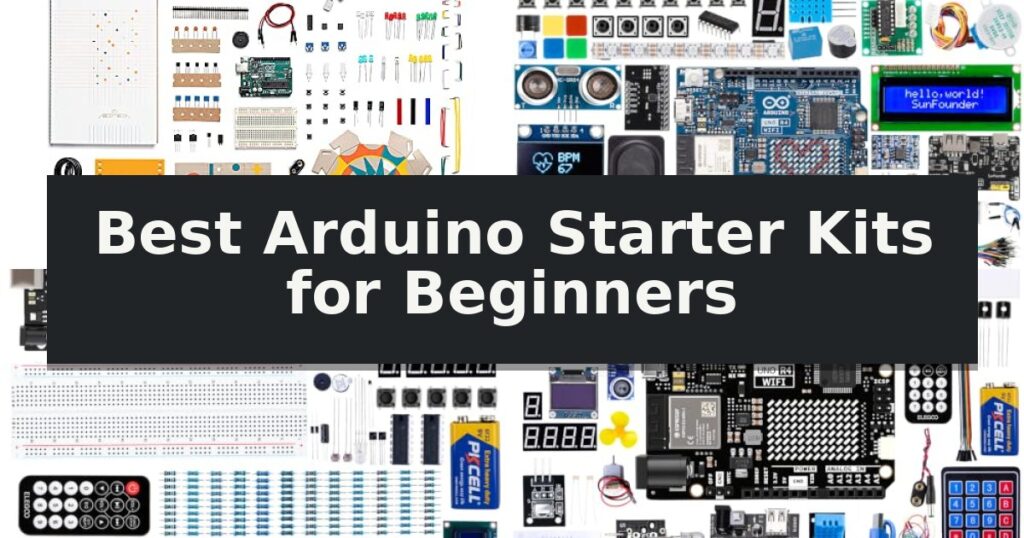
10 Best Arduino Starter Kits for Beginners in 2026 Reviews
Quick Comparison
| Product | Best For | Key Strength | Score |
|---|---|---|---|
| Arduino Starter Kit | Best Overall | Includes genuine, high-quality components sourced from Italy. | 4.9 |
| SunFounder Elite Explorer Kit | Modern IoT learning with WiFi | Includes the powerful Arduino UNO R4 WiFi board with integrated wireless connectivity. | 4.4 |
| ELEGOO UNO R3 Super Starter Kit | Best value for foundational learning | Solderless design using plug-in modules and breadboards for immediate setup. | 4.7 |
| ELEGOO UNO R4 WiFi Starter Kit | Upgraded performance for connected projects | Integrated Wi-Fi and Bluetooth for seamless IoT project development. | 4.7 |
| ELEGOO Mega 2560 Starter Kit | Maximum pins for complex builds | High I/O capacity with 54 digital pins and 16 analog inputs. | 4.9 |
| ELEGOO ESP-32 Super Starter Kit | Advanced dual-core IoT experimentation | Integrated Wi-Fi and Bluetooth 4.2 for advanced IoT connectivity. | 4.6 |
| ELEGOO UNO R3 Complete Starter Kit | Comprehensive components for diverse projects | Comprehensive component library with over 200 items covering a wide range of sensor and motor projects. | 4.8 |
| LAFVIN Project Super Starter Kit | Budget-friendly multi-board compatibility | Extensive tutorial manual with over 20 lessons and supporting libraries. | 4.4 |
| Arduino Starter Kit R4 | Official certification path included | Includes the modern Arduino UNO R4 WiFi board with integrated wireless connectivity. | 4.4 |
| ELEGOO Electronic Fun Kit | Essential components for circuit practice | Includes 235 essential components for a wide range of circuit experiments. | 4.7 |
How We Chose
When evaluating the best Arduino starter kits for beginners, we focus on the practical utility of the included components and the quality of the instructional materials. An effective kit must balance a gentle learning curve with enough hardware versatility to keep a new maker engaged as their skills progress from simple breadboard circuits to connected IoT applications.
- Tutorial Quality: Evaluation of the clarity, depth, and accessibility of provided project guides and code examples.
- Component Versatility: Assessment of the variety and utility of sensors, motors, and displays included for diverse project types.
- Board Capability: Analysis of the microcontroller's processing power, memory, and connectivity features like Wi-Fi or Bluetooth.
- Educational Value: Consideration of the kit's ability to support a progressive learning curve from basic circuits to advanced logic.
- Expandability: Review of compatibility with standard shields and third-party modules for future project growth.
1 Arduino Starter Kit — Official Italian-made educational standard
Stepping into the world of electronics and programming requires a reliable foundation, and the Official Arduino Starter Kit [K000007] provides exactly that through its curated selection of genuine components sourced directly from Italy. This kit is engineered to bridge the gap between theory and practice, offering a structured entry point for those looking to master microcontroller programming and circuit design.
The core of this package is the Comprehensive English Projects Book, which serves as an instructional roadmap for 12 distinct hands-on DIY projects. By following these guided exercises, users move from basic concepts to more complex circuit applications, ensuring a logical progression in skill development. The inclusion of high-quality, original hardware ensures that the components remain durable and consistent across various experimental setups.
Designed for versatility, the kit accommodates a wide range of skill levels, making it an effective resource for classrooms, STEM enthusiasts, and independent hobbyists. Because it focuses on foundational principles, it remains a relevant tool for anyone interested in innovation and creative prototyping, regardless of their prior experience with hardware.
While the kit provides a robust starting point, users should note that it is designed primarily as an educational introduction. It includes a 30-day manufacturer defect warranty, providing a baseline of support for the included hardware as you begin your journey into the Arduino ecosystem.
Best for: Beginners and students seeking a structured, high-quality introduction to electronics and coding through guided project-based learning.
Skip if: Experienced engineers or advanced hobbyists who require specific sensors, specialized modules, or high-volume components not included in this foundational set.
- Includes genuine, high-quality components sourced from Italy.
- Features a comprehensive, step-by-step project book in English.
- Covers 12 hands-on DIY projects to teach coding and circuit design.
- Suitable for all skill levels, from complete beginners to those refreshing their knowledge.
- Limited to the 12 specific projects outlined in the included manual.
- May require additional sensors or modules for more advanced, custom applications.
2 SunFounder Elite Explorer Kit — Modern IoT learning with WiFi
Transitioning from basic electronics to Internet of Things (IoT) projects requires hardware that can bridge the gap between simple logic and connected functionality. The SunFounder Elite Explorer Kit centers on the Arduino UNO R4 WiFi, a board that integrates a 32-bit processor with built-in WiFi and Bluetooth capabilities, moving beyond the limitations of traditional entry-level microcontrollers.
This comprehensive starter kit includes over 300 high-quality components, providing the necessary sensors and hardware to execute 50 distinct projects. The curriculum is structured into 30 basic, 13 fun, and 8 IoT-focused exercises, supported by 100+ free video lessons developed in collaboration with educator Paul McWhorter. This approach allows users to progress from fundamental coding to complex cloud-integrated applications.
Designed for accessibility, the kit is RoHS compliant and tailored for beginners ages 8 and up. The inclusion of the Arduino IoT Cloud integration simplifies the process of connecting hardware to third-party applications, making it a practical choice for students and engineers looking to explore modern connectivity without sourcing individual parts.
Technical support and community forums are available to assist with programming hurdles, ensuring that users have a resource for troubleshooting. By offering a unified ecosystem that remains compatible with standard Arduino boards like the Nano and Uno R3, this kit provides a scalable foundation for future electronics development.
Best for: Beginners and students seeking a comprehensive, IoT-ready platform with guided video tutorials.
Skip if: Users who only require basic, non-connected functionality may find the advanced WiFi and Bluetooth features of the R4 board unnecessary for their specific projects.
- Includes the powerful Arduino UNO R4 WiFi board with integrated wireless connectivity.
- Features 300+ components and 50+ structured projects for immediate hands-on learning.
- Access to 100+ free video lessons co-created with Paul McWhorter.
- Supports Arduino IoT Cloud for advanced, connected project development.
- The advanced feature set may present a steeper learning curve for absolute beginners compared to simpler, non-WiFi kits.
3 ELEGOO UNO R3 Super Starter Kit — Best value for foundational learning
The ELEGOO UNO R3 Super Starter Kit provides a comprehensive entry point for electronics enthusiasts by bundling a versatile microcontroller with a wide array of plug-in modules and sensors. Designed to facilitate learning without the need for soldering, this kit centers on a solderless breadboard and pre-soldered components, allowing users to focus immediately on circuit logic and code development.
This kit supports a broad range of applications, from basic LED control to more complex tasks like reading temperature data, distance sensing, and motor manipulation. By following the 22+ guided lessons, beginners can gain practical experience with digital and analog inputs, timing, and various display functions using the Arduino IDE.
Organization is a key focus of the design, featuring an illustrated component list that helps users identify parts such as the LCD1602, ultrasonic sensors, and IR receivers. The inclusion of a breadboard power module simplifies the setup process, provided that users adhere to the recommended 9V power limit to ensure safe operation during experimentation.
While the kit offers extensive variety for STEM projects and coding clubs, it is intended for educational use and requires careful attention to component polarity and wiring. For younger learners, the manufacturer recommends working alongside an experienced adult to navigate the setup and programming stages effectively.
Best for: Beginners and students seeking a comprehensive, solder-free introduction to Arduino programming and basic circuit building.
Skip if: Advanced users or professional engineers who require specialized industrial-grade sensors or high-current components not included in this educational bundle.
- Solderless design using plug-in modules and breadboards for immediate setup.
- Includes 22+ guided lessons covering a wide variety of sensors and motor types.
- Comprehensive component list with pre-soldered LCD and organized hardware.
- Supports versatile project creation ranging from environmental monitors to motion-based games.
- Requires adult supervision for younger learners to ensure safe power management.
- Strict 9V power limit on the module necessitates careful monitoring of input voltage.
4 ELEGOO UNO R4 WiFi Starter Kit — Upgraded performance for connected projects
The ELEGOO UNO R4 WiFi Super Starter Kit provides a robust foundation for those transitioning from basic circuit building to complex, connected IoT projects. At its core, the kit features a 32-bit 48 MHz Renesas RA4M1 processor, which offers a significant performance upgrade over traditional 8-bit boards. This increased processing power is essential for handling the demands of modern maker projects, such as real-time data processing and wireless communication.
Beyond the core board, the kit includes over 200 components, ensuring users have the necessary hardware to experiment with diverse applications. Key inclusions like the ultrasonic sensor, PIR motion module, and RFID reader allow for the creation of interactive prototypes, while the 12×8 LED matrix and OLED display provide immediate visual feedback. The integration of built-in Wi-Fi and Bluetooth connectivity is a standout feature, enabling beginners to explore remote monitoring and wireless data transmission without needing external modules.
The system is designed to support a progressive learning path, utilizing step-by-step tutorials that pair wiring diagrams with ready-to-run sample code. This structured approach helps minimize setup confusion, allowing users to focus on understanding the underlying logic of their circuits. Furthermore, the hardware maintains full compatibility with the Arduino IDE and existing UNO R3 shields, which protects a user's investment in legacy components and simplifies the integration of new modules.
To ensure an orderly workspace, the kit organizes parts into clear categories, which is particularly beneficial for students and hobbyists managing a large inventory of sensors, motors, and relays. While the advanced feature set provides extensive creative freedom, it does represent a more sophisticated environment than a basic, offline microcontroller. This trade-off is balanced by the inclusion of professional-grade documentation and responsive technical support, which helps bridge the gap for those new to advanced electronics.
Best for: Beginners and students looking to transition from basic electronics to advanced IoT projects with integrated wireless connectivity.
Skip if: Users who only require a basic, non-connected microcontroller board for simple, offline circuit projects may find the advanced features of the R4 WiFi unnecessary.
- Integrated Wi-Fi and Bluetooth for seamless IoT project development.
- High-performance 32-bit 48 MHz processor for handling complex tasks.
- Extensive 200+ component library covering a wide range of sensor and motor applications.
- Full compatibility with existing Arduino IDE and R3 shields.
- Advanced feature set may present a steeper learning curve for absolute beginners compared to standard, non-connected boards.
5 ELEGOO Mega 2560 Starter Kit — Maximum pins for complex builds
The ELEGOO Mega 2560 R3 Project The Most Complete Starter Kit is designed for users who require significant hardware overhead for complex prototyping. Unlike standard entry-level boards, the included Mega 2560 R3 provides 54 digital I/O pins, 15 PWM outputs, and 16 analog inputs, offering the connectivity needed for ambitious builds that integrate multiple sensors, motors, and displays simultaneously.
This kit emphasizes an organized workflow with over 200 components, including essential modules like the LCD1602 display, RC522 RFID reader, and various environmental sensors such as the DHT11. By utilizing a solderless breadboard and pre-soldered modules, the kit minimizes setup time, allowing beginners to focus on the logic of their code rather than the mechanics of assembly.
Educational value is central to the package, which features 35+ guided electronics projects. These lessons provide a structured path from basic LED control to advanced applications like motor control, motion sensing, and interactive display integration. The inclusion of a storage case and small-parts box ensures that components remain categorized, which is vital for maintaining a clean workspace during iterative development.
Users can move beyond the provided tutorials by modifying sensor thresholds, timing, and control logic. With 256 KB of flash memory, the board supports larger, more complex sketches, making it a versatile platform for those looking to transition from simple exercises to creating functional access systems, environmental monitors, or automated alarms.
Best for: Beginners who plan to build complex, multi-sensor projects that require a high number of I/O pins and expanded memory.
Skip if: Users who prefer a compact, minimalist board for simple, low-power projects where the larger footprint of the Mega 2560 is unnecessary.
- High I/O capacity with 54 digital pins and 16 analog inputs.
- Comprehensive component set including over 200 sensors, motors, and displays.
- Organized storage system with a dedicated case and small-parts box.
- Extensive guided curriculum covering 35+ distinct electronics projects.
- Larger physical footprint compared to standard Arduino Uno-style boards.
- Higher complexity may be overwhelming for absolute beginners focused on basic coding.
6 ELEGOO ESP-32 Super Starter Kit — Advanced dual-core IoT experimentation
The ELEGOO ESP-32 Super Starter Kit centers on a powerful dual-core microcontroller equipped with integrated Wi-Fi and Bluetooth 4.2, providing a robust foundation for Internet of Things (IoT) projects. This kit is designed to bridge the gap between basic electronics and advanced connectivity, allowing users to build smart devices that communicate directly with cloud services or mobile applications.
Beyond the core board, the kit includes over 35 distinct modules and components, such as an OLED screen, servo motors, and various sensors. This comprehensive selection enables a wide range of experimentation, from simple LED circuits to complex interactive gadgets like weather stations or smart home controllers.
To assist with the learning curve, the package features a detailed, step-by-step online tutorial. This guide covers more than 30 projects, providing complete code, circuit diagrams, and instructions that are compatible with the Arduino IDE. It is structured to accommodate various skill levels, allowing beginners to start with fundamental coding before progressing to more sophisticated IoT applications.
The components are selected for reliability, and the overall package is organized to facilitate a smooth learning experience. With the inclusion of the CP2102 chip and USB-C support, the board offers modern connectivity standards for efficient programming and power delivery.
Best for: Beginners and hobbyists who want to move beyond basic circuits into IoT and wireless-connected projects.
Skip if: Users who prefer a traditional, non-wireless Arduino board or those who do not require IoT-specific components like Wi-Fi and Bluetooth modules.
- Integrated Wi-Fi and Bluetooth 4.2 for advanced IoT connectivity.
- Comprehensive set of 35+ modules including sensors, motors, and displays.
- Beginner-friendly online tutorials with over 30 project guides.
- USB-C support for modern and convenient power and data transfer.
- Higher complexity compared to standard, non-connected Arduino starter kits.
7 ELEGOO UNO R3 Complete Starter Kit — Comprehensive components for diverse projects
Getting started with electronics and programming requires a reliable foundation, and the ELEGOO UNO R3 Project Most Complete Starter Kit provides an expansive collection of hardware to facilitate this learning process. Designed for those new to circuit building, this kit centers around the ELEGOO UNO R3 controller, offering a comprehensive entry point into the world of microcontrollers without requiring prior soldering skills.
The kit includes over 200 components across 63 types, ranging from fundamental LEDs and breadboards to more advanced modules like the HC-SR501 PIR sensor, ultrasonic distance sensor, and RC522 RFID module. By utilizing the included solderless breadboard and pre-soldered modules, users can quickly assemble circuits and transition between lessons, supported by an organized storage case that keeps small parts like resistors and ICs accessible.
Educational value is driven by 30+ guided electronics projects that progress from simple LED blinking to complex tasks such as motor control, environmental monitoring, and LCD1602 display integration. The provided PDF tutorial and example code allow beginners to program the board via the Arduino IDE, encouraging them to modify sensor thresholds and logic to create original, customized projects.
Power management is simplified through the inclusion of a 9 V, 1 A power supply, a breadboard power module, and a 9 V battery, ensuring that users have the necessary hardware to run experiments immediately. This all-in-one approach removes the need to source basic accessories separately, providing a cohesive environment for STEM learning and hobbyist circuit design.
Best for: Beginners seeking an all-in-one, solderless hardware collection to learn electronics and programming through guided, project-based tasks.
Skip if: Users who already possess a specific microcontroller board or only require a small selection of basic components rather than a comprehensive, project-focused kit.
- Comprehensive component library with over 200 items covering a wide range of sensor and motor projects.
- Solderless design using breadboards and pre-soldered modules for rapid prototyping.
- Guided educational content provided via PDF tutorials for 30+ distinct projects.
- Complete power ecosystem including a dedicated power supply and battery for immediate use.
- Large component count may be overwhelming for users looking for a minimal or focused introductory set.
- Physical storage footprint is relatively large due to the inclusion of 63 different types of items.
8 LAFVIN Project Super Starter Kit — Budget-friendly multi-board compatibility
The LAFVIN Project Super Starter Kit provides a comprehensive entry point for those beginning to explore electronics and programming. By including a variety of components such as servo, stepper, and DC motors alongside an LCD 1602 module, this kit allows users to experiment with diverse hardware interactions immediately upon setup.
Designed for broad utility, the kit is fully compatible with the Arduino IDE, ensuring that users can leverage existing code, libraries, and datasheets. The inclusion of an LCD 1602 module with pre-installed pin headers simplifies the assembly process, as it eliminates the need for manual soldering.
The package is structured around a tutorial user manual that features over 20 distinct lessons. This guided approach helps beginners transition from basic concepts to more complex projects by providing the necessary code and technical documentation within a single, organized collection.
Measuring 8.3 by 5.8 inches with a weight of 1.4 pounds, the kit is compact enough for desktop use while containing enough variety to support multiple learning paths. It serves as a practical resource for those looking to build a foundation in hardware-based programming without sourcing individual components separately.
Best for: Beginners seeking an all-in-one hardware and software learning bundle for Arduino-compatible projects.
Skip if: Advanced users who already possess specific sensors or controllers and prefer to purchase individual components tailored to unique project requirements.
- Extensive tutorial manual with over 20 lessons and supporting libraries.
- Pre-soldered LCD 1602 module for easier integration.
- High compatibility with standard Arduino IDE environments.
- Diverse component set including multiple motor types.
- Limited to the provided components, which may not cover specialized advanced sensor needs.
9 Arduino Starter Kit R4 — Official certification path included
The Arduino Starter Kit R4 provides a comprehensive entry point for electronics and programming by centering its curriculum around the modern Arduino UNO R4 WiFi board. This kit distinguishes itself by integrating current connectivity standards, specifically built-in Wi-Fi and Bluetooth, allowing users to move beyond basic logic into networked and wireless projects.
Designed for both classroom environments and individual self-study, the kit includes a printed project book that guides users through 13 hands-on tutorials. These lessons cover essential components such as sensors, motors, and displays, ensuring a structured progression of skills. The inclusion of an AI coding assistant further supports learners as they navigate the complexities of hardware-software interaction.
A notable feature for those seeking formal recognition is the official certification voucher included with the kit. After completing the project series, users can apply this voucher toward the Arduino Fundamentals certification exam, providing a clear path to validating their technical proficiency.
Beyond the physical components, the kit offers significant digital longevity through a growing repository of online projects. By registering the kit, users gain access to exclusive content and multilingual lessons, ensuring the materials remain relevant as new tutorials are added by the Arduino team over time.
Best for: Beginners who want a structured, official learning path that includes modern wireless connectivity and a path to formal certification.
Skip if: Users who prefer a purely open-ended component collection without guided tutorials or those who do not require the specific wireless capabilities of the R4 WiFi board.
- Includes the modern Arduino UNO R4 WiFi board with integrated wireless connectivity.
- Provides a clear path to professional development with an official certification voucher.
- Supports diverse learning styles with a printed project book and AI coding assistant.
- Offers long-term value through a growing repository of online projects and multilingual resources.
- The fixed project curriculum may be less appealing to advanced users seeking a broader, unguided component set.
10 ELEGOO Electronic Fun Kit — Essential components for circuit practice
The ELEGOO Electronic Fun Kit provides a comprehensive foundation for electronics experimentation by bundling 235 individual components into a single package. Designed for those looking to build breadboard circuits and mini projects, this kit allows users to practice creating LED indicators, button inputs, and buzzer alarms without requiring complex soldering.
This collection includes a 400-tie-point solderless breadboard and a dedicated power module that supports selectable 3.3 V or 5 V rails. By utilizing rigid jumpers and female-to-male leads, users can quickly wire various configurations. The kit also features specific components like the 74HC595 for output expansion, 4N35 optocouplers for signal isolation, and PN2222 transistors for load switching, enabling a deeper understanding of core electronic functions.
Compatibility is a key consideration for this set, as it is intended to be paired with a separate microcontroller. The kit does not include a controller board, programming cable, or wall power adapter, meaning users must provide their own compatible hardware and follow external datasheets or tutorials to execute coded projects. When powering the breadboard module, users should ensure they use a suitable 6.5–9 V DC input and strictly avoid exceeding 9 V to maintain safe operation.
With its focus on repeatable experiments, the ELEGOO Electronic Fun Kit serves as a practical resource for classroom demonstrations and maker projects. By including a wide variety of resistors, capacitors, diodes, and light-sensitive components, it offers the flexibility needed to explore different circuit behaviors and polarity protection techniques.
Best for: Beginners who already own a microcontroller and want a wide variety of components to practice breadboard circuit design.
Skip if: Users who need an all-in-one package that includes the microcontroller board, programming cable, and power supply.
- Includes 235 essential components for a wide range of circuit experiments.
- Features a solderless 400-tie-point breadboard for easy, repeatable prototyping.
- Includes a versatile power module with selectable 3.3 V and 5 V rails.
- Provides specialized parts like optocouplers and transistors for advanced learning.
- Does not include a controller board, programming cable, or wall power adapter.
- Requires the user to source external tutorials and wiring guidance.
Best Arduino Starter Kits for Beginners Buying Guide
Understanding Microcontroller Capabilities
The heart of any starter kit is the microcontroller board, such as the classic UNO R3 or the more modern R4 and ESP-32 variants. The R3 is the industry standard for learning, offering a vast library of existing tutorials and community support that makes troubleshooting straightforward for newcomers.
For those interested in the Internet of Things, boards like the ESP-32 or UNO R4 WiFi offer built-in wireless connectivity. These boards require a slightly higher initial learning curve but enable projects that communicate with smartphones or cloud services, which is a significant step up from basic wired circuits.
The Importance of Guided Tutorials
A kit is only as good as the documentation provided. High-quality kits include step-by-step PDF or printed guides that explain not just how to wire a component, but the logic behind the code. This pedagogical approach is essential for moving from simply following instructions to writing your own original programs.
Look for kits that provide clear wiring diagrams and well-commented code. These resources help prevent common beginner frustrations, such as incorrect pin connections or syntax errors, allowing you to focus on the creative aspects of your project.
Component Selection and Variety
Starter kits typically include a mix of input devices like buttons and sensors, and output devices like LEDs, LCD screens, and motors. A well-rounded kit ensures you have the necessary building blocks to experiment with different types of digital and analog signals.
Consider whether the kit includes essential accessories like a breadboard, jumper wires, and a power supply. Having these items pre-included saves you from the hassle of sourcing individual parts and ensures that everything in the box is compatible and ready for immediate use.
Scalability for Future Projects
As you gain confidence, you may want to build more complex systems that require more input/output pins or higher processing power. Kits based on the Mega 2560 platform provide a larger footprint for projects involving multiple sensors, displays, and motor controllers simultaneously.
Compatibility with standard Arduino shields is another factor to consider. Choosing a kit that uses standard form factors ensures that any additional modules or sensors you purchase later will easily integrate with your existing setup, protecting your long-term investment.
Safety and Quality Standards
When working with electronics, quality matters for both safety and reliability. Genuine or high-quality compatible components are less likely to fail during experiments, which helps maintain a positive learning experience and reduces the need for constant troubleshooting.
Always check for RoHS compliance or manufacturer warranties, which can provide peace of mind. A kit that is well-organized with clearly labeled parts also makes it easier to keep your workspace tidy, which is a practical necessity when managing dozens of small electronic components.
Frequently Asked Questions
Do I need to know how to solder to use these kits?
Most beginner-friendly starter kits are designed to be solderless. They typically include a breadboard, which allows you to plug components in and out to build circuits without permanent connections.
What is the difference between the UNO R3 and the R4?
The UNO R3 is the classic, widely supported board for beginners. The R4 is an upgraded version featuring a faster 32-bit processor, more memory, and often built-in Wi-Fi and Bluetooth capabilities for IoT projects.
Can I use these kits with a Mac or a PC?
Yes, all standard Arduino boards are compatible with the Arduino IDE, which runs on Windows, macOS, and Linux. You will simply need a USB cable to connect the board to your computer.
Are these kits suitable for children?
Many kits are suitable for older children and teens, especially those with an interest in STEM. However, younger learners should work under the supervision of an experienced adult, particularly when handling small parts or power supplies.
What happens if I run out of components or break one?
Most components in these kits, such as LEDs, resistors, and jumper wires, are standard parts that can be easily replaced or upgraded individually from electronics retailers without needing to buy a new kit.
Conclusion: Our Top Pick
Our top pick is Arduino Starter Kit. Choosing the right kit depends on your specific goals, whether you want a straightforward introduction to coding or are eager to jump into connected IoT projects. The official Arduino kits offer the most reliable educational path, while third-party options like those from ELEGOO provide exceptional value and component variety for those looking to experiment broadly.
Regardless of the kit you select, the most important factor is your willingness to experiment and learn through trial and error. By starting with a well-documented kit, you build the foundational skills necessary to tackle increasingly complex and rewarding electronics projects in the future.