ELEGOO Mega 2560 Project Starter Kit is our pick for the Best Arduino and Raspberry Pi Starter Kits because it provides an extensive, well-organized collection of over 200 components that allow users to scale from simple LED circuits to complex interactive systems.
Selecting the right kit depends on whether your goal is to master microcontroller logic through Arduino or explore Linux-based computing and IoT applications with Raspberry Pi. Beginners often benefit from kits that include pre-soldered modules and clear, step-by-step tutorials, while more advanced users should prioritize kits with a high density of diverse sensors and actuators.
Our evaluation focuses on the depth of the provided learning materials and the versatility of the included hardware. We prioritize kits that support multiple programming languages and offer a clear path for expanding projects beyond the initial guided lessons.
If you are just starting your journey into electronics, our guide on Best Arduino Starter Kits for Beginners provides additional context on selecting the right hardware for your first project. Once you have mastered the basics, you may want to explore Best AI Robotics Kits for Adults to take your skills to the next level with advanced automation.
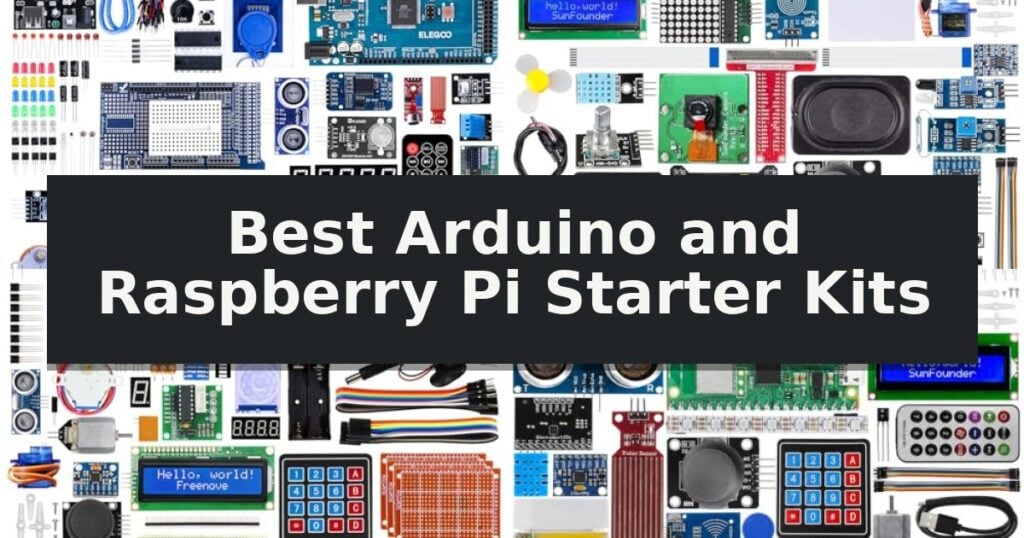
10 Best Arduino and Raspberry Pi Starter Kits in 2026 Reviews
Quick Comparison
| Product | Best For | Key Strength | Score |
|---|---|---|---|
| ELEGOO Mega 2560 Project Starter Kit | Best Overall | High I/O capacity with 54 digital pins and 16 analog inputs for complex builds. | 4.9 |
| SunFounder Raphael Raspberry Pi Starter Kit | Expert-Led Lessons for Pi Beginners | Extensive video curriculum led by an expert educator. | 4.4 |
| Freenove Ultimate Raspberry Pi Starter Kit | Massive Library of Guided Projects | Extensive library of 128 projects with step-by-step guidance. | 4.5 |
| SunFounder Raspberry Pi Pico W Kit | Ideal for Microcontroller IoT Learning | Includes 450+ components for extensive project variety. | 4.6 |
| SunFounder Universal Maker Sensor Kit | Versatile Compatibility Across Platforms | Wide compatibility with major platforms like Arduino, Raspberry Pi, and ESP32. | 4.8 |
| DIYables Basic Electronics Starter Kit | Essential Components for Rapid Prototyping | Curated selection of 10 essential sensors for diverse project types. | 4.5 |
| HiLetgo 37 Sensor Assortment Kit | Expansive Sensor Variety for Makers | Extensive variety of 37 different sensor modules included. | 4.6 |
| LAFVIN Raspberry Pi Pico Starter Kit | Streamlined Entry for STEM Education | Supports multiple programming languages including MicroPython and C/C++. | 4.3 |
| SunFounder Raspberry Pi Pico 2 Kit | Latest Hardware for Modern Projects | 450+ components included for extensive project building | 4.5 |
| WWZMDiB Electronics Breadboard Starter Kit | Solderless Foundation for Circuit Building | Solderless design allows for rapid prototyping and component reuse. | 4.4 |
How We Chose
When evaluating the Best Arduino and Raspberry Pi Starter Kits, we focus on the practical utility of the included components and the effectiveness of the instructional support. An experienced reviewer looks beyond the raw count of items, prioritizing kits that offer a logical progression of skills and reliable documentation for diverse hardware platforms.
- Component Diversity: Evaluating the breadth of sensors, actuators, and modules included to ensure long-term project utility.
- Tutorial Quality: Assessing the clarity, depth, and accessibility of provided guides, including video support and example code.
- Platform Compatibility: Verifying the range of supported microcontrollers and single-board computers for cross-platform learning.
- Educational Scalability: Checking if the projects progress logically from basic circuit fundamentals to complex system integration.
- Hardware Organization: Considering the inclusion of storage cases and breadboards that facilitate repeatable, solderless prototyping.
1 ELEGOO Mega 2560 Project Starter Kit — Best for Complex Arduino Projects
The ELEGOO Mega 2560 Project Starter Kit centers on the versatile Mega 2560 R3 board, which offers expanded capacity for complex builds compared to standard entry-level controllers. With 54 digital I/O pins, 16 analog inputs, and 256 KB of flash memory, this kit is engineered for projects that require multiple sensors, displays, and motor controls simultaneously.
Prototyping is streamlined through the inclusion of over 200 components, including specialized modules like the RC522 RFID, DHT11 environmental sensor, and HC-SR501 motion sensor. The kit provides a solderless breadboard and pre-soldered modules, allowing users to move quickly from basic LED experiments to interactive systems like real-time clocks or distance-monitoring alarms.
To support structured learning, the package includes 35+ guided projects with example code. Users can progress through these lessons to understand control logic and sensor thresholds, then modify the code to customize motor behavior or display outputs for unique maker projects.
Organization is a key design priority, as the kit includes a dedicated storage case and a small-parts box. This layout keeps components such as servos, stepper motors, and various ICs accessible, reducing setup time and helping maintain an orderly workspace during iterative development.
Best for: Makers and students who need extensive I/O pins and memory to build complex, multi-sensor projects.
Skip if: Beginners who prefer a simpler, smaller board like the Arduino Uno or those who do not require the high pin count of the Mega 2560.
- High I/O capacity with 54 digital pins and 16 analog inputs for complex builds.
- Comprehensive component set featuring over 200 items including motors, sensors, and displays.
- Structured learning path with 35+ guided projects and provided example code.
- Organized storage with a dedicated case and small-parts box for component management.
- Larger physical footprint compared to standard Uno-based starter kits.
- Steeper learning curve for those unfamiliar with the increased pin complexity of the Mega 2560.
2 SunFounder Raphael Raspberry Pi Starter Kit — Expert-Led Lessons for Pi Beginners
The SunFounder Raphael Ultimate Starter Kit distinguishes itself by providing a comprehensive learning ecosystem centered around 70+ expert-led video lessons from educator Paul McWhorter. This approach moves beyond simple component lists, offering structured guidance for beginners aged 10 and up to navigate the complexities of Raspberry Pi programming and IoT integration.
With a collection of 337+ components, the kit provides the hardware necessary to build 161 distinct projects. Users have access to a wide array of sensors, actuators, LEDs, and LCDs, alongside a camera and speaker, allowing for diverse experimentation. This hardware versatility is matched by broad software support, as the kit is compatible with Python, C, Java, Node.js, and Scratch.
Designed for flexibility, the kit maintains compatibility with a broad range of boards including the Raspberry Pi 5, 4B, 3B+, 3B, Zero 2 W, and 400. This wide-ranging support ensures that users can utilize various generations of hardware without needing to purchase separate kits for different board models.
To assist with the learning process, the manufacturer provides dedicated support through a community forum and technical assistance. The components are RoHS compliant, and the entire package is organized to facilitate an accessible entry point into electronics and coding for those new to the platform.
Best for: Beginners aged 10+ who prefer a structured, video-guided curriculum for learning Raspberry Pi programming and electronics.
Skip if: Users who already own specific sensors and components and prefer to source their own hardware individually rather than purchasing a pre-bundled kit.
- Extensive video curriculum led by an expert educator.
- Broad compatibility with multiple Raspberry Pi board models.
- Large component library featuring 337+ items for 161 projects.
- Multi-language support including Python, C, Java, Node.js, and Scratch.
- Raspberry Pi board not included, requiring a separate purchase.
- Large component count may be overwhelming for users seeking only basic introductory parts.
3 Freenove Ultimate Raspberry Pi Starter Kit — Massive Library of Guided Projects
The Freenove Ultimate Raspberry Pi Starter Kit provides a comprehensive foundation for electronics exploration by including 223 individual items, ranging from sensors and modules to essential wiring components. This kit is designed to support a wide array of Raspberry Pi models, including the 5, 4B, and Zero 2 W, making it a versatile choice for users looking to build a variety of hardware projects.
Central to the educational experience is a 962-page detailed tutorial that guides users through 128 distinct projects. The curriculum progresses from simple introductory tasks to complex system integrations, ensuring that learners can build their skills incrementally. Each project is supported by complete schematics, wiring diagrams, and code explanations to clarify the underlying electronics and programming concepts.
To accommodate different programming preferences, the kit offers five sets of code: Python, C, Java, Scratch, and Processing. The inclusion of Scratch and Processing is particularly notable as these provide graphical interfaces, which can be helpful for visualizing project logic. All code and instructional materials are accessible via a downloadable link or an online portal, allowing for flexible study at the user's own pace.
While the kit is extensive, it is important to note that the Raspberry Pi board itself is not included, requiring a separate purchase to begin. The wide compatibility across various Pi generations ensures that users can utilize existing hardware they may already own, provided it falls within the supported list of models.
Best for: Beginners and hobbyists who want a structured, project-based learning path with a wide variety of included electronic components.
Skip if: Users who already own a specific set of sensors or those who prefer to source individual components separately for custom builds.
- Extensive library of 128 projects with step-by-step guidance.
- Broad compatibility with nearly all Raspberry Pi models including the 5 and Zero series.
- Multilingual code support including Python, C, Java, Scratch, and Processing.
- Large inventory of 223 items covering most common electronic components.
- Raspberry Pi board not included, requiring a separate purchase.
- Digital-only tutorial requires downloading or online access rather than a physical manual.
4 SunFounder Raspberry Pi Pico W Kit — Ideal for Microcontroller IoT Learning
The SunFounder Raspberry Pi Pico W Ultimate Starter Kit serves as a comprehensive entry point for those looking to explore microcontroller programming and IoT development. By bundling over 450 components into a single package, it removes the barrier of sourcing individual parts, providing a versatile foundation for learners aged 8 and up to build everything from simple LED circuits to complex connected devices.
Central to the educational value of this kit are the 27 expert-led video tutorials provided by educator Paul McWhorter. These lessons are structured to guide beginners through the nuances of coding, effectively bridging the gap between basic electronics theory and practical application. The kit supports multiple programming languages, including MicroPython and C/C++, which allows users to select the environment that best suits their current skill level or project requirements.
The hardware selection is designed for broad experimentation, featuring a diverse array of sensors, actuators, and displays. Because the components are RoHS compliant, users can be confident that the materials meet established environmental standards for electronic hardware. This focus on quality ensures that the kit remains a reliable resource as users progress from introductory projects to more advanced embedded systems development.
While the kit is an expansive resource, it is specifically engineered around the Raspberry Pi Pico W ecosystem. This specialization is a significant advantage for those focused on IoT, but it represents a trade-off for users who might be looking for a general-purpose desktop computing experience. The kit is best utilized by those who intend to dive deep into microcontroller-based projects rather than those seeking a traditional computer replacement.
Best for: Beginners and students aged 8+ seeking a guided, project-based introduction to IoT and microcontroller programming.
Skip if: Users who require a more advanced single-board computer with full desktop operating system capabilities rather than a microcontroller-focused platform.
- Includes 450+ components for extensive project variety.
- Features 27 expert-led video tutorials for structured learning.
- Supports multiple programming languages including MicroPython and C/C++.
- Provides dedicated technical support and community access.
- Specific focus on the Pico W microcontroller may limit users seeking broader Raspberry Pi desktop computer applications.
5 SunFounder Universal Maker Sensor Kit — Versatile Compatibility Across Platforms
The SunFounder Universal Maker Sensor Kit provides a comprehensive foundation for electronics projects by offering wide compatibility across major development platforms, including the Arduino series, Raspberry Pi 5, 4B, 3B+, Zero, Pico W, and ESP32. This versatility allows users to transition between different controllers without needing to replace their entire suite of sensors and actuators.
Equipped with over 25 distinct components, the kit includes a variety of sensors, actuators, and display modules. These parts are specifically selected to facilitate diverse applications such as environmental monitoring, robotics, smart home automation, and custom game controller development, providing a robust toolkit for both novices and experienced engineers.
To support the learning process, the kit includes step-by-step tutorials designed for each component. These guides cover essential programming languages including C/C++ and Python/MicroPython, ensuring that users can effectively interface with their hardware. The curriculum is structured to help users progress from basic concepts to advanced project implementation.
Beyond the hardware and documentation, the package fosters a supportive environment through dedicated technical assistance and access to a community forum. This resource is intended to help users troubleshoot issues and maintain momentum throughout their development journey, making it a practical choice for those looking to build a wide range of electronics projects.
Best for: Makers and students who want a single, versatile sensor kit that works across multiple platforms like Arduino, Raspberry Pi, and ESP32.
Skip if: Users who are looking for a kit focused exclusively on a single platform or those who do not require a wide variety of sensors and actuators for their specific project needs.
- Wide compatibility with major platforms like Arduino, Raspberry Pi, and ESP32.
- Includes over 25 sensors and actuators for diverse project applications.
- Comprehensive step-by-step tutorials for both C++ and Python.
- Access to dedicated support and community forums.
- Broad component selection may include parts not needed for specialized, single-focus projects.
6 DIYables Basic Electronics Starter Kit — Essential Components for Rapid Prototyping
Getting started with microcontrollers often involves navigating a sea of individual parts, but the DIYables Basic Electronics Starter Kit simplifies this by bundling 10 essential sensors and components into one cohesive package. This kit is specifically curated for those looking to experiment with platforms like Arduino, ESP32, ESP8266, and Raspberry Pi without the frustration of sourcing components piece by piece.
The kit focuses on versatility for rapid prototyping, featuring a wide range of sensors including temperature, motion, and light detection modules. These components are designed for easy integration, allowing makers to build interactive circuits and smart devices for home or STEM projects immediately. Whether you are a beginner or an experienced maker, the hardware is configured to work seamlessly with official boards.
While the kit provides the necessary building blocks, it is important to note that boards are not included; users must supply their own Arduino, ESP32, ESP8266, or Raspberry Pi. To assist with the learning curve, the manufacturer provides step-by-step tutorials accessible by searching for the kit name online, which helps bridge the gap between having the hardware and executing a functional project.
This collection serves as a practical foundation for anyone interested in electronics. By focusing on high-utility sensors rather than filler components, the DIYables Basic Electronics Starter Kit ensures that every included piece has a clear application in common DIY electronics projects.
Best for: Beginners and hobbyists who already own a microcontroller board and need a curated set of sensors for educational or DIY projects.
Skip if: Users who require a complete package that includes the microcontroller board itself, as this kit contains only sensors and components.
- Curated selection of 10 essential sensors for diverse project types.
- Seamless integration with popular platforms like Arduino and Raspberry Pi.
- Accessible tutorials provided for quick project startup.
- Versatile component range covering motion, light, and temperature sensing.
- Boards not included, requiring a separate purchase for the main controller.
- Limited to sensors and components, lacking breadboards or jumper wires if not already owned.
7 HiLetgo 37 Sensor Assortment Kit — Expansive Sensor Variety for Makers
Developing custom electronics projects requires a diverse array of inputs to interact with the physical world, and the HiLetgo 37 Sensor Assortment Kit provides a comprehensive foundation for these tasks. This collection is specifically curated for those working with Arduino microcontrollers or Raspberry Pi boards, offering a wide range of modules to facilitate hands-on learning and prototyping.
The kit includes 37 distinct sensor modules, allowing users to experiment with various data inputs. Notable components include a touch sensor module, a heartbeat detection module, and an infrared sensor receiver module. This variety enables the construction of complex robotic or monitoring projects without the need to source individual components separately.
Designed for educational and development purposes, this assortment simplifies the process of integrating hardware into projects. By providing a broad spectrum of sensors in one package, it serves as a versatile resource for makers looking to expand their technical capabilities and explore different sensing technologies in a single, organized set.
While the kit offers significant breadth, users should note that it is primarily a hardware collection. A notable trade-off is the lack of detailed, module-specific documentation included in the package. Makers often need to consult external datasheets or community forums to determine the precise pinouts and code libraries required for each individual sensor, which is a common requirement when working with modular sensor sets.
Best for: Makers and students who need a wide variety of sensors for diverse Arduino or Raspberry Pi educational projects.
Skip if: Users who only require a specific, single sensor type or those who prefer to source individual, high-precision industrial-grade components separately.
- Extensive variety of 37 different sensor modules included.
- Educational focus specifically tailored for Arduino and Raspberry Pi users.
- Convenient all-in-one kit reduces the need to purchase sensors individually.
- Lack of detailed documentation for each individual sensor module.
8 LAFVIN Raspberry Pi Pico Starter Kit — Streamlined Entry for STEM Education
The LAFVIN Raspberry Pi Pico Starter Kit centers on the RP2040 microcontroller, providing a versatile foundation for users to explore embedded project development and programming. By integrating the Raspberry Pi Pico board with a variety of hardware modules, this kit facilitates a hands-on approach to learning electronics and coding.
This package supports multiple programming methods, including MicroPython, C/C++, and Piper Make graphical programming, allowing for flexibility across different skill levels. The inclusion of diverse components such as an LCD1602 display module, SG90 servo motor, human body sensing module, and WS2812 RGB LED strip enables the construction of projects involving sensing, input, and execution control.
Designed for educational environments, the kit comes with comprehensive learning tutorials and sample code. These resources are intended to assist beginners in navigating circuit connections and program deployment, effectively bridging the gap between theoretical knowledge and practical application in STEM education.
With a compact footprint measuring approximately 5.5 by 3.3 inches, the kit is suitable for classroom or home lab setups. It provides a structured entry point for those interested in programming enlightenment and the cultivation of technical hobbies through guided experimentation.
Best for: Students and electronics beginners seeking a structured, multi-language introduction to the RP2040 microcontroller and embedded systems.
Skip if: Users requiring advanced high-level computing power or those looking for a full-sized Raspberry Pi computer experience will find this microcontroller-based kit insufficient for their needs.
- Supports multiple programming languages including MicroPython and C/C++.
- Includes a wide variety of experimental modules for diverse project types.
- Provides comprehensive tutorials to guide beginners through circuit assembly.
- Based on the RP2040 microcontroller for reliable performance in embedded tasks.
- Limited to microcontroller-based projects rather than full desktop computing.
- Requires manual circuit assembly which may be challenging for absolute novices without the provided guides.
9 SunFounder Raspberry Pi Pico 2 Kit — Latest Hardware for Modern Projects
The SunFounder Raspberry Pi Pico 2 W Ultimate Starter Kit provides a comprehensive entry point into microcontroller programming by bundling a pre-soldered Pico 2 W board with over 450 components. This kit is designed to facilitate hands-on learning through 96 distinct projects, including 16 dedicated IoT applications, supported by a library of 110+ expert-led video lessons.
Designed for versatility, the package supports both MicroPython and C/C++ programming languages, ensuring users can adapt to different coding environments. The inclusion of a wide array of hardware—ranging from sensors and actuators to LEDs and LCDs—allows for significant experimentation, making it a robust resource for students, teachers, and engineers alike.
The educational experience is bolstered by dedicated community support and technical assistance, which helps bridge the gap for beginners. By integrating hardware with structured video tutorials, the kit aims to simplify the learning curve associated with modern IoT development and microcontroller interfacing.
While the kit offers extensive project variety, users should note that the pre-soldered Pico 2 W board is the central component, and the overall utility depends on the user's interest in following the provided curriculum. The combination of hardware components and digital tutorials creates a self-contained ecosystem for those looking to build and understand complex electronics projects.
Best for: Beginners and students aged 8+ who want a structured, video-guided approach to learning IoT and microcontroller programming.
Skip if: Users who already possess specific sensors and microcontrollers and prefer to source individual components separately rather than purchasing a comprehensive, curriculum-based bundle.
- 450+ components included for extensive project building
- 110+ expert-led video lessons for guided learning
- Supports both MicroPython and C/C++
- Includes 16 dedicated IoT projects
- Curriculum-dependent design may be less ideal for advanced users seeking standalone parts
- Large component count requires organized storage management
10 WWZMDiB Electronics Breadboard Starter Kit — Solderless Foundation for Circuit Building
The WWZMDiB 438 Pcs Electronics Breadboard Kit provides a comprehensive foundation for hobbyists looking to experiment with circuit design without the permanence of permanent connections. By utilizing a solderless breadboard system, this kit allows users to prototype and iterate on electronic projects by simply inserting components directly into the board.
This starter kit is designed for versatility, featuring 438 pieces of common electronic components. The inclusion of a wide variety of parts ensures that users have the necessary building blocks to explore different circuit configurations. Because the system relies on solderless insertion, it is particularly well-suited for educational environments or rapid prototyping where components need to be reused across multiple projects.
Compatibility is a core feature of this set, as it is designed to work seamlessly with popular development platforms including Arduino, STM32, and Raspberry Pi. This broad support allows users to transition from basic circuit building to more advanced microcontroller-based projects using the same set of foundational components.
The kit prioritizes ease of use, eliminating the need for complex tools or specialized skills like soldering. By focusing on a solderless workflow, the manufacturer ensures that the barrier to entry for learning electronics remains low, making it a practical choice for those beginning their journey into hardware development.
Best for: Beginners and hobbyists who want to prototype electronic circuits for Arduino, STM32, or Raspberry Pi projects without soldering.
Skip if: Users who require permanent, vibration-resistant connections or those looking for a kit that includes a specific microcontroller board.
- Solderless design allows for rapid prototyping and component reuse.
- Includes a large collection of 438 common electronic components.
- Broad compatibility with Arduino, STM32, and Raspberry Pi platforms.
- No microcontroller included; requires a separate purchase of an Arduino or Raspberry Pi board.
- Solderless connections are not suitable for permanent or high-vibration applications.
Best Arduino and Raspberry Pi Starter Kits Buying Guide
Microcontroller vs. Single-Board Computer
Arduino-based kits are generally better suited for real-time control tasks, such as reading sensor data, driving motors, or managing simple display interfaces. They are ideal for users who want to understand the fundamentals of electronics and low-level programming without the overhead of an operating system.
Raspberry Pi kits, by contrast, function as full-fledged computers capable of running complex software, networking, and media tasks. These are the preferred choice for projects requiring internet connectivity, high-level language support like Python, or advanced data processing.
The Importance of Tutorial Depth
A kit is only as good as the documentation provided to support it. High-quality kits include detailed PDFs or video series that explain not just how to wire a component, but the underlying logic and code structure required to make it function.
Look for kits that offer multiple programming language support, such as C++ for Arduino or Python for Raspberry Pi. This flexibility allows you to grow your skills and adapt your projects as you become more comfortable with different coding environments.
Component Quality and Reusability
The physical quality of sensors and modules significantly impacts the frustration level of a beginner. Kits that include pre-soldered modules and high-quality breadboards allow for rapid prototyping and testing without the need for permanent soldering.
Consider the long-term value of the components. Kits that provide a wide variety of sensors, such as ultrasonic distance modules, RFID readers, and environmental sensors, ensure that you have the necessary building blocks for future, custom-built projects.
Scalability for Future Projects
As your skills improve, you will likely want to move beyond the guided projects included in the box. Kits that provide a robust set of generic components allow you to repurpose parts for your own unique designs.
Check for compatibility with other platforms. Many modern sensor kits are designed to work across both Arduino and Raspberry Pi, which maximizes your investment and allows you to experiment with different hardware architectures using the same set of sensors.
Power and Connectivity Requirements
Power management is a critical aspect of any electronics project. Ensure your kit includes appropriate power supplies or battery holders, especially if you plan to build mobile robots or remote environmental monitors.
Connectivity options, such as breadboard jumper wires and interface shields, are essential for connecting your components. A well-stocked kit will include a variety of wire lengths and types to keep your prototypes clean and functional.
Frequently Asked Questions
Do these kits include the actual Arduino or Raspberry Pi board?
It depends on the specific kit. Some, like the ELEGOO Mega 2560 kit, include the board, while others, such as the Freenove or DIYables kits, are component-only and require you to purchase the development board separately.
Which programming language should I start with?
C++ is the standard for Arduino and is excellent for understanding hardware-level control. Python is highly recommended for Raspberry Pi due to its readability and massive library support for IoT and data processing.
Are these kits suitable for children?
Many kits are designed for STEM learning and are appropriate for children aged 8-10 and up, provided there is adult supervision for handling small components and electrical connections.
Can I use these components with other microcontrollers like ESP32?
Yes, most of the sensors and modules included in these kits are based on standard communication protocols like I2C, SPI, or analog signals, making them compatible with ESP32 and other common development boards.
What is the benefit of a solderless breadboard?
A solderless breadboard allows you to quickly plug in components and wires to test circuits. This is essential for beginners who want to iterate on their designs without the permanent commitment of soldering.
Conclusion: Our Top Pick
Our top pick is ELEGOO Mega 2560 Project Starter Kit. Choosing the right starter kit is a balance between your current skill level and your long-term goals in electronics. If you are focused on learning the basics of hardware control, an Arduino-based kit offers the most straightforward path. For those interested in software-heavy projects or IoT, a Raspberry Pi kit provides a more powerful platform.
Regardless of the platform you choose, prioritize kits that offer clear, comprehensive tutorials and a wide variety of reusable components. Investing in a versatile kit now will save you from having to purchase individual sensors later as your project ideas grow in complexity.