Texas Instruments TI-30XIIS Scientific Calculator is our top choice for the Best Calculator for 5th Grade because it provides a reliable, two-line display that helps students track both their entries and results simultaneously.
For students transitioning from basic arithmetic to early scientific concepts, selecting a device that balances simplicity with long-term utility is essential. A clear, readable screen and intuitive button layout allow young learners to focus on mathematical operations rather than complex device navigation.
While some classrooms may only require basic four-function operations, middle-school-ready scientific models offer a helpful bridge for upcoming curriculum requirements. These calculators provide the necessary fraction and statistical functions without overwhelming the user with advanced programming features.
As students advance in their studies, they may eventually require more specialized tools, such as when searching for the Best Calculator for 6th Grade Math to handle more complex equations. Similarly, planning ahead for the Best Calculator for 7th Grade Math ensures a smooth transition as the curriculum becomes more demanding.
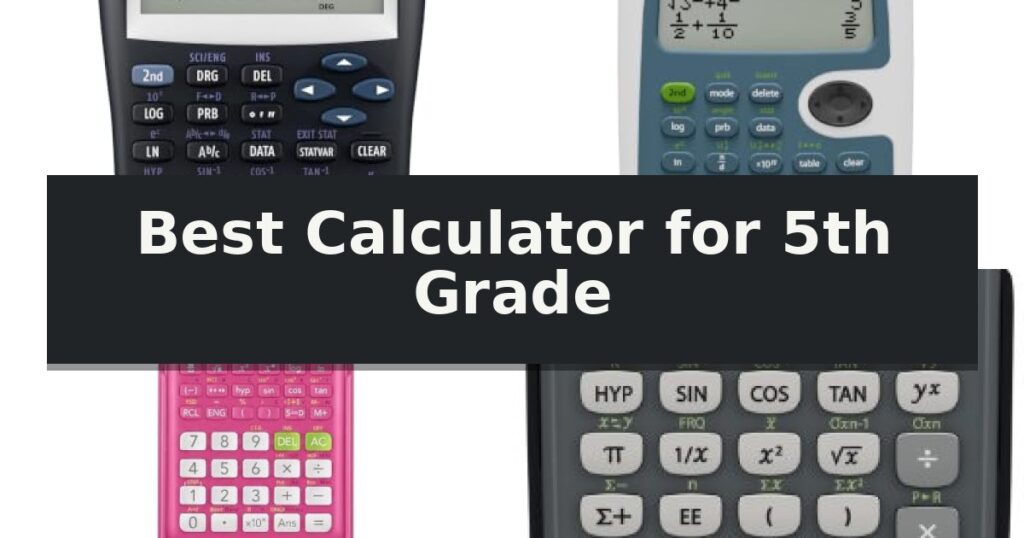
10 Best Calculator for 5th Grade in 2026 Reviews
Quick Comparison
| Product | Best For | Key Strength | Score |
|---|---|---|---|
| Texas Instruments TI-30XIIS Scientific Calculator | Best Overall | Two-line display for simultaneous entry and result viewing. | 4.9 |
| Texas Instruments TI-30XS MultiView Calculator | Displays Math Like Textbooks | Four-line display allows for simultaneous calculation comparison. | 4.7 |
| Casio FX-300ESPLSB Scientific Calculator | Intuitive Natural Textbook Display | Natural Textbook Display for intuitive formula entry | 4.9 |
| Texas Instruments TI-30Xa Scientific Calculator | Simple Fraction and Math Support | Traditional fraction entry format simplifies complex calculations. | 4.5 |
| CATIGA Desktop Calculator | Large Buttons for Easy Input | Tilted display for improved visibility and reduced glare. | 4.5 |
| CATIGA 12-Digit Desk Calculator | Clear View for Classroom Use | Huge LCD screen for high visibility. | 4.6 |
| Mr. Pen Mechanical Switch Calculator | Tactile Keys for Precision | Mechanical switches provide tactile, responsive feedback for precise data entry. | 4.6 |
| CATIGA Mechanical Switch Calculator | Satisfying Click for Math Work | Mechanical switch keys for a responsive and tactile typing experience. | 4.7 |
| Amazon Basics LCD Desktop Calculator | Reliable Basic Functionality | 8-digit LCD provides clear, high-visibility output. | 4.4 |
| Enday Basic Handheld Calculator | Portable Design for Students | Dual power source ensures functionality via solar or battery. | 4.4 |
How We Chose
Selecting the right calculator for 5th grade requires evaluating how a device handles the transition from simple arithmetic to early algebraic concepts. We assess these tools based on their display legibility, input ergonomics, and long-term classroom utility, ensuring each model provides the necessary functionality without unnecessary complexity for a developing student.
- Display clarity and line capacity for tracking multi-step operations
- Ease of input for fractions and basic scientific notation
- Durability of the chassis and button responsiveness
- Power source reliability, specifically dual solar and battery systems
- Compatibility with standard middle school curriculum requirements
1 Texas Instruments TI-30XIIS Scientific Calculator — Standard for Middle School Math
Navigating the transition to more complex math requires a reliable tool, and the Texas Instruments TI-30XIIS Scientific Calculator serves as a foundational resource for students. This device features a two-line display that allows users to view both their current entry and the calculated result simultaneously, which helps in verifying work during multi-step problems.
Designed to handle the rigors of middle school and early high school curricula, the calculator integrates statistics and advanced scientific functions alongside basic arithmetic. It includes specific fraction features and conversions, making it practical for students learning to navigate different numerical formats. The interface is straightforward, focusing on utility for math and science coursework.
The Texas Instruments TI-30XIIS Scientific Calculator is built for versatility in the classroom, utilizing both solar and battery power to ensure it remains operational throughout the school day. Its compact dimensions of 6.1 by 3.2 inches make it easy to store in a backpack or desk organizer without taking up excessive space.
Beyond daily coursework, this model is approved for use on SAT, ACT, and AP exams, providing students with a consistent tool they can rely on for standardized testing. With its combination of essential scientific functions and a durable, portable design, it remains a standard choice for students building their mathematical proficiency.
Best for: Students in middle school and early high school who need a reliable, exam-approved tool for scientific and statistical calculations.
Skip if: Students who require graphing capabilities or advanced programming features for higher-level calculus and engineering courses.
- Two-line display for simultaneous entry and result viewing.
- Approved for major standardized exams including SAT, ACT, and AP.
- Dual-power system utilizing both solar and battery energy.
- Includes advanced scientific and trigonometric functions.
- Lacks graphing capabilities required for advanced mathematics.
2 Texas Instruments TI-30XS MultiView Calculator — Displays Math Like Textbooks
Navigating the transition from basic arithmetic to more complex middle school concepts requires a tool that keeps pace with evolving curriculum needs. The Texas Instruments TI-30XS MultiView Scientific Calculator simplifies this process by utilizing a four-line display that allows students to view multiple calculations simultaneously, making it easier to compare results and identify patterns during classwork.
Designed to bridge the gap between abstract numbers and real-world application, this calculator features a MultiView display that presents math expressions, symbols, and stacked fractions exactly as they appear in standard textbooks. This design choice eliminates the need for students to interpret technical syntax, allowing them to focus entirely on the underlying mathematical logic.
Beyond standard arithmetic, the device offers robust functionality for advanced topics like Pre-Algebra, Algebra 1 and 2, and Geometry. Students can interact with an (x,y) table of values for functions, either automatically or through manual entry, which provides a practical way to visualize data sets. Additionally, the unit supports scientific notation output with proper superscripted exponents, ensuring that results are formatted clearly for science and biology assignments.
With a compact footprint of 7.25 by 3.375 inches, the calculator is portable enough for daily use in a backpack while maintaining a readable screen size. It is built for longevity with a one-year manufacturer warranty, providing a reliable foundation for students as they progress through their middle school and early high school math and science education.
Best for: Students transitioning from general math to Pre-Algebra and Algebra who need a clear, textbook-style display to visualize fractions and functions.
Skip if: Students who require graphing capabilities for advanced calculus or those who prefer a basic four-function calculator without scientific notation or multi-line display features.
- Four-line display allows for simultaneous calculation comparison.
- Textbook-style formatting for fractions and mathematical symbols.
- Automatic (x,y) table exploration for function analysis.
- Scientific notation support with clear superscripted exponents.
- Non-graphing interface may limit utility in higher-level high school courses.
- Learning curve for students accustomed to basic calculators due to advanced scientific functions.
3 Casio FX-300ESPLSB Scientific Calculator — Intuitive Natural Textbook Display
Navigating the transition from basic arithmetic to more complex algebraic concepts requires a tool that bridges the gap between abstract notation and concrete calculation. The Casio FX-300ESPLSB Scientific Calculator addresses this need by incorporating a Natural Textbook Display, which renders mathematical expressions and results exactly as they appear in standard academic textbooks. This visual alignment helps students visualize their work, reducing the cognitive load often associated with interpreting linear, non-standard calculator outputs during middle and high school coursework.
With a robust library of 262 built-in functions, this device provides the necessary computational power for a wide range of scientific and algebraic operations. The hardware is engineered for daily academic portability, measuring 7 inches in length and 3.5 inches in width. Its compact footprint ensures it fits easily into a standard student backpack or occupies minimal space on a crowded desk, making it a practical choice for students who need a reliable, dedicated device for their math classes.
Beyond its technical specifications, the calculator features a distinct pink aesthetic and is supported by a 1-year manufacturer warranty, providing coverage for the unit's build quality. The interface is designed for intuitive navigation, allowing students to focus on solving problems rather than managing complex menu systems. This straightforward layout minimizes input errors, which is a significant advantage for learners who are still developing their proficiency with scientific calculators.
While the device excels in standard scientific and algebraic tasks, it is important to note that it lacks advanced graphing capabilities. This trade-off is common in compact, entry-level scientific models, as the focus is on portability and core function accessibility rather than complex visual data plotting. For students whose curriculum requires graphing functions, this model serves as a specialized tool rather than an all-in-one solution for higher-level calculus.
Best for: Middle and high school students who need a reliable, intuitive tool for algebra and scientific math coursework.
Skip if: Users requiring advanced graphing capabilities or programmable features will find this scientific calculator insufficient for their needs.
- Natural Textbook Display for intuitive formula entry
- Comprehensive suite of 262 built-in functions
- Compact and portable design
- Includes a 1-year manufacturer warranty
- Lacks advanced graphing capabilities for higher-level calculus
4 Texas Instruments TI-30Xa Scientific Calculator — Simple Fraction and Math Support
Transitioning from basic arithmetic to more complex middle school concepts requires a tool that handles both standard operations and foundational scientific functions. The Texas Instruments TI-30Xa Scientific Calculator simplifies this shift by offering a 10-digit display and dedicated keys for trigonometric functions, logarithms, and roots, making it a capable companion for general math, pre-algebra, and algebra I and II.
Beyond standard calculations, this model excels at managing fractions. It allows students to add, subtract, multiply, and divide fractions entered in a traditional numerator/denominator format, which helps visualize the math rather than relying solely on decimal conversions. The device also supports 1-variable statistics, providing quick access to the mean and standard deviation for introductory data analysis in general science courses.
Designed for portability and ease of use, the unit is battery-powered and includes a protective slide case to prevent damage during transport in a backpack. Its compact dimensions—measuring roughly 5.9 inches by 2.9 inches—ensure it fits easily on a crowded desk without taking up excessive workspace.
The calculator also handles various conversions, including fractions to decimals, degrees to radians, and polar to rectangular coordinates. These features provide the necessary versatility for students moving through different units of study, from geometry to basic biology, without needing to upgrade to a more complex graphing device.
Best for: Students in 5th grade through early high school who need a reliable, straightforward tool for fractions, basic algebra, and introductory statistics.
Skip if: Students whose curriculum specifically requires graphing capabilities or advanced programming functions will find this model too limited.
- Traditional fraction entry format simplifies complex calculations.
- Includes 1-variable statistics for mean and standard deviation.
- Compact design with an included protective slide case.
- Versatile conversion functions for degrees, radians, and polar coordinates.
- Lacks the graphing capabilities required for advanced high school mathematics.
- Battery-powered operation requires periodic replacements.
5 CATIGA Desktop Calculator — Large Buttons for Easy Input
Finding the right tool for elementary math requires a balance of simplicity and reliability, and the CATIGA Desktop Calculator offers a straightforward solution for 5th-grade students. Its tilted and angled display is designed to minimize eye strain, making it easier to read numbers during classroom assignments or homework sessions.
The device features large responsive buttons that provide a tactile, satisfying sensation while reducing the likelihood of input errors. This physical design is particularly helpful for younger students who are still developing precision in their keystrokes. The robust plastic body ensures the unit can withstand the rigors of a school bag or daily desk use.
Functionality is tailored for basic arithmetic, including addition, subtraction, multiplication, division, and percentage calculations. The dual power source—combining solar and battery power—ensures the device remains operational in various lighting conditions. For energy efficiency, the unit includes an automatic shut-off feature that activates after six minutes of inactivity.
Measuring 6 inches by 4.25 inches, this compact tool fits easily on a crowded school desk without taking up excessive space. It arrives with a battery included, allowing for immediate use right out of the box.
Best for: Students needing a reliable, easy-to-read, and simple-to-operate calculator for basic arithmetic and classroom tasks.
Skip if: Students requiring advanced scientific functions, graphing capabilities, or programmable features for higher-level mathematics.
- Tilted display for improved visibility and reduced glare.
- Spacious, responsive buttons that minimize input errors.
- Dual power sources ensure consistent operation in different environments.
- Durable plastic construction suitable for daily use.
- Basic functionality only, lacking advanced scientific or graphing features.
- Automatic shut-off may interrupt work if the device is left idle for more than six minutes.
6 CATIGA 12-Digit Desk Calculator — Clear View for Classroom Use
Navigating math assignments requires a tool that balances simplicity with clear visibility, and the CATIGA 12-Digit Desk Calculator offers a straightforward solution for students. Its huge LCD screen ensures that numbers remain legible from a distance, reducing the likelihood of transcription errors during homework or classroom practice.
Efficiency in calculation often comes down to the interface, and this model features sensitive and big buttons designed to register inputs quickly while minimizing the risk of accidental presses. The layout is optimized for basic arithmetic, providing a tactile experience that helps students focus on the logic of their math problems rather than struggling with cramped keypads.
Versatility is built into the power system, which utilizes a dual power design combining solar energy with battery backup. This ensures the device remains operational in various lighting conditions, whether in a bright classroom or a home study space. For energy conservation, the unit includes an auto power-off feature that triggers after six minutes of inactivity.
Beyond standard addition and subtraction, the device supports essential functions including multiplication, division, backspace, and percentage calculations. With its M+/M-/MRC memory keys, it provides enough functionality for 5th-grade math requirements without the complexity of advanced scientific graphing, making it a practical choice for foundational learning.
Best for: Students requiring a large, easy-to-read display and responsive buttons for basic arithmetic and classroom math assignments.
Skip if: Students who need advanced scientific, trigonometric, or graphing functions for higher-level mathematics.
- Huge LCD screen for high visibility.
- Responsive, large buttons to reduce input errors.
- Dual power design ensures reliability.
- Auto power-off feature saves battery life.
- Lacks advanced scientific functions required for higher-level math.
- Desktop-only form factor may be bulky for some pencil cases.
7 Mr. Pen Mechanical Switch Calculator — Tactile Keys for Precision
The Mr. Pen Mechanical Switch Calculator distinguishes itself from standard office tools by incorporating mechanical switches that provide a tactile, responsive click with every keystroke. This design choice mimics the feel of a mechanical keyboard, which can assist students in developing a consistent rhythm and precision during repetitive data entry tasks.
Designed with a large 12-digit LCD display, this unit ensures that numerical results remain visible from various viewing angles, reducing the likelihood of transcription errors. Its compact footprint of 6.2 x 4.4 inches allows it to fit easily on a crowded student desk while maintaining a button size that is comfortable for frequent use.
Functionality is centered on essential mathematical needs, including memory recall and percentage calculations. The device is powered by a single AAA battery and features an automatic shutdown function that engages after 10 minutes of inactivity to preserve battery life, making it a low-maintenance option for school environments.
While the mechanical switches offer a satisfying user experience, the device requires a separate battery purchase, as one is not included in the box. Its specialized switch design is optimized for those who prefer audible and physical feedback during their calculations.
Best for: Students who benefit from tactile, mechanical key feedback to improve precision and focus during basic arithmetic and percentage tasks.
Skip if: Users who require a silent calculator for quiet testing environments or those who prefer a slim, ultra-portable device without mechanical switch height.
- Mechanical switches provide tactile, responsive feedback for precise data entry.
- Large 12-digit display enhances visibility from multiple angles.
- Automatic shutdown feature helps conserve battery life during school or home use.
- Compact dimensions save valuable desk space.
- AAA battery not included with the initial purchase.
- Mechanical switch profile adds height compared to standard membrane calculators.
8 CATIGA Mechanical Switch Calculator — Satisfying Click for Math Work
Finding a reliable tool for classroom math or home budgeting is essential for a student's academic journey. The CATIGA Mechanical Switch Calculator distinguishes itself with responsive mechanical key switches, providing a tactile typing experience that offers clear physical feedback with every entry.
Designed with a 12-digit large LCD display, this calculator ensures that complex numbers remain legible during use. Its aesthetic appeal is defined by a modern pink color scheme, paired with generously sized buttons that accommodate users of all ages, making it a practical addition to any desk or school supply kit.
The unit is built for efficiency, measuring a compact 6.2 x 4.4 inches to maximize workspace. It operates on a single AAA battery and includes an automatic 10-minute sleep mode to conserve power. This design choice ensures the device remains ready for use while minimizing energy consumption during periods of inactivity.
Whether used for classroom mathematics, home budgeting, or general office tasks, this model balances functionality with a charming aesthetic. It serves as a versatile tool for students and professionals alike, combining durable mechanical components with a portable, space-saving footprint.
Best for: Students and professionals who prefer a tactile, mechanical typing feel and a compact, aesthetic design for daily math tasks.
Skip if: Users who require advanced scientific or graphing functions for high-level mathematics, as this model is designed for standard arithmetic.
- Mechanical switch keys for a responsive and tactile typing experience.
- Oversized 12-digit LCD display for clear readability.
- Compact 6.2 x 4.4-inch footprint that saves valuable desk space.
- Energy-efficient operation with an automatic 10-minute sleep mode.
- Standard arithmetic functionality may not meet the needs of advanced scientific or graphing coursework.
9 Amazon Basics LCD Desktop Calculator — Reliable Basic Functionality
Navigating foundational math concepts requires a reliable tool that minimizes distraction while maximizing clarity. The Amazon Basics LCD Desktop Calculator is specifically engineered for straightforward operation, featuring an 8-digit LCD that provides a sharp, brightly lit output for effortless viewing during classroom assignments or homework sessions. By focusing on essential calculations, it helps students maintain concentration on their work rather than managing complex menus.
This device simplifies arithmetic tasks by offering 6 essential functions, including addition, subtraction, multiplication, division, percentage, and square root. These operations cover the core requirements of an elementary curriculum, allowing students to verify their work or solve multi-step problems with ease. The user-friendly buttons are designed to be comfortable and durable, ensuring they are well-marked for consistent use by children.
Measuring approximately 5 inches in length and 3.72 inches in height, this calculator is built for portability. Its compact, flat-sitting design allows it to remain stable on a desk or table, preventing the device from sliding during use. This physical stability is a practical advantage for younger students who may be developing their fine motor skills and need a tool that stays in place.
While this model excels at basic arithmetic, it is a dedicated, no-nonsense solution that avoids the complexity of advanced scientific or graphing models. It comes with a one-year limited workmanship warranty, providing a level of support that reinforces its role as a dependable classroom companion. The trade-off for this simplicity is that it lacks the advanced programming or algebraic capabilities required for higher-level mathematics, making it a specialized tool for its intended grade level.
Best for: Students requiring a simple, dedicated device for basic arithmetic and foundational math operations.
Skip if: Users who need advanced scientific functions, graphing capabilities, or a larger display for complex algebraic equations.
- 8-digit LCD provides clear, high-visibility output.
- User-friendly, durable buttons designed for ease of use.
- Compact, flat-sitting design ensures stability on any workspace.
- Includes essential 6-function math operations for elementary curriculum.
- Limited to basic arithmetic and lacks advanced scientific or graphing features.
10 Enday Basic Handheld Calculator — Portable Design for Students
Equipped with a dual power system that combines solar energy with a reliable battery backup, the Enday Basic Handheld Calculator ensures consistent performance for classroom assignments and homework. Its compact, pocket-sized frame is designed with easy-grip contours, making it comfortable for younger students to hold and use during extended study sessions.
The device features an 8-digit LCD display that provides clear visibility for basic arithmetic operations. With its soft-touch, non-slip plastic buttons, the calculator offers tactile feedback that helps students press keys accurately, reducing errors during addition, subtraction, multiplication, and division tasks.
Designed for portability, this unit includes a hard protective cover that shields the display and keys when stored in a backpack or desk. The even weight distribution allows for stable use on a flat surface, while the inclusion of a memory function and dedicated keys for percentages and square roots provides the necessary tools for foundational math curriculum requirements.
To conserve energy, the calculator is programmed with an automatic shut-down feature that activates when the device is not in use. Available in six distinct colors, it allows students to personalize their school supplies while maintaining a functional, lightweight tool for daily academic needs.
Best for: Students needing a portable, dual-powered calculator for basic arithmetic and classroom math assignments.
Skip if: Users requiring advanced scientific or graphing functions for higher-level mathematics will find this basic four-function model insufficient.
- Dual power source ensures functionality via solar or battery.
- Ergonomic, easy-grip design fits comfortably in smaller hands.
- Hard protective cover protects the device during transport.
- Raised, non-slip keys improve input accuracy.
- Basic four-function capability limits use to elementary math.
- Small 8-digit display may be restrictive for complex calculations.
Best Calculator for 5th Grade Buying Guide
Display Technology and Readability
A multi-line display is a significant advantage for 5th-grade students. It allows them to see their original input on the top line while viewing the calculated result on the bottom, which helps in verifying work and catching entry errors early.
Models that mimic textbook formatting, often called natural displays, can further assist students in understanding how mathematical expressions are written. This visual alignment reduces the cognitive load required to translate between paper assignments and digital inputs.
Input Ergonomics and Button Design
The physical feel of a calculator matters for students who are still developing fine motor skills. Buttons should be large enough to press accurately and provide enough tactile feedback to confirm that an input has been registered.
Mechanical switches or well-spaced rubber keys are generally preferred over flat, membrane-style buttons. A responsive keyboard prevents frustration and ensures that students can work through multi-step problems at a steady pace.
Power Management for Classroom Reliability
Classroom tools need to be ready for use at all times, making dual-power systems a practical necessity. Calculators that combine solar panels with a battery backup ensure that the device remains functional even in low-light conditions or if a battery begins to fail.
Automatic shut-off features are also vital for extending the life of the internal battery. By powering down after a period of inactivity, these devices prevent accidental drain, ensuring the calculator is ready for the next math session.
Functionality vs. Complexity
While it is tempting to purchase a high-end graphing calculator, 5th-grade math rarely requires such advanced features. A standard scientific calculator provides all the necessary tools for fractions, exponents, and basic statistics without the distraction of complex menus.
Choosing a model that is approved for standardized testing ensures that the student can use the same device throughout their middle school years. This consistency builds familiarity and confidence, which is more valuable than having extra, unused features.
Durability and Portability
School supplies face significant wear and tear, so a robust build is essential. Look for calculators that include a hard slide-on cover to protect the screen and keys when the device is stored in a backpack or desk.
The overall size should be compact enough to fit comfortably in a student's hand but large enough to remain stable on a desk surface. A balanced weight distribution helps prevent the calculator from sliding around during intensive work sessions.
Frequently Asked Questions
Do 5th graders need a scientific calculator?
While a basic calculator may suffice for simple arithmetic, a scientific model is often recommended as it supports fractions and early algebraic functions that appear in the later stages of 5th and 6th-grade math.
What is the benefit of a two-line display?
A two-line display allows the student to see their input expression on the top line and the result on the bottom, which is crucial for checking work and understanding the order of operations.
Are these calculators allowed on standardized tests?
Most standard scientific calculators, such as the TI-30 series, are widely approved for use on state and national standardized tests, though you should always check your specific school's policy.
Why choose dual-power calculators?
Dual-power calculators use solar energy as the primary source and a battery as a backup, ensuring the device does not stop working during a test or class if the light is insufficient.
How do I clean the calculator screen?
Use a soft, dry microfiber cloth to wipe the screen. Avoid using harsh chemicals or liquid cleaners, as these can damage the plastic display or seep into the button mechanisms.
Conclusion: Our Top Pick
Our top pick is Texas Instruments TI-30XIIS Scientific Calculator. Choosing the right calculator for a 5th grader is about balancing current needs with future academic growth. A reliable scientific model provides the necessary support for fractions and basic operations while keeping the interface simple enough for daily classroom use.
Prioritize models with durable builds and clear, multi-line displays to ensure the student can focus on learning math concepts. By selecting a widely recognized and approved tool, you provide the student with a consistent companion for their mathematical journey.