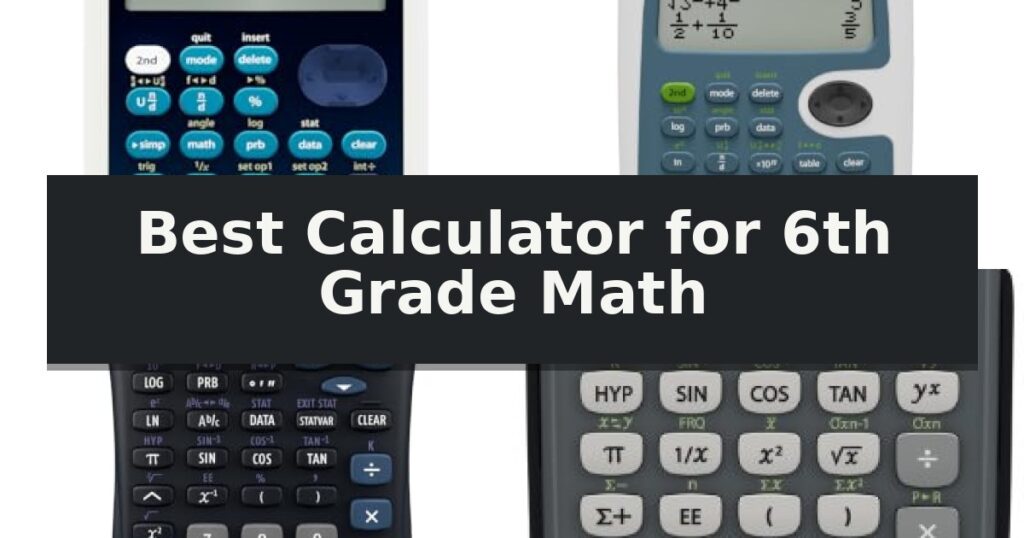
Texas Instruments TI-34 MultiView Scientific Calculator is our top choice for the Best Calculator for 6th Grade Math, offering a four-line display that makes complex fraction operations intuitive for middle schoolers. The Texas Instruments TI-30XS MultiView Scientific Calculator serves as a strong alternative for students needing textbook-style formatting, while the Texas Instruments TI-30XIIS Scientific Calculator provides a reliable, straightforward experience for those transitioning from basic arithmetic.
Selecting a calculator for this level requires balancing advanced functionality with a user interface that does not overwhelm a student. At this stage, the ability to see multiple lines of work simultaneously helps bridge the gap between simple arithmetic and the more abstract concepts introduced in pre-algebra and early geometry.
If you are looking for tools suitable for younger students, our guide on the Best Calculator for 5th Grade provides additional recommendations for earlier math levels.
10 Best Calculator for 6th Grade Math in 2026 Reviews
Quick Comparison
| Product | Best For | Key Strength | Score |
|---|---|---|---|
| Texas Instruments TI-34 MultiView Scientific Calculator | Best Overall | MathPrint feature displays stacked fractions and symbols realistically. | 4.9 |
| Texas Instruments TI-30XS MultiView Scientific Calculator | Textbook Style Math Display | Four-line MultiView display for comparing multiple calculations at once. | 4.9 |
| Texas Instruments TI-30XIIS Scientific Calculator | Reliable Two-Line Standard | Two-line display for simultaneous entry and result viewing | 4.3 |
| Texas Instruments TI-30Xa Scientific Calculator | Simple Fraction Entry | Traditional fraction entry allows for intuitive input of numerator and denominator values. | 4.9 |
| RED STAR TEC SC-216 Scientific Calculator | Budget Friendly Exam Tool | 240 pre-defined functions covering algebra, trig, and statistics. | 4.6 |
| YesBes Scientific Calculator | Value Pack for Students | 2-line display allows simultaneous viewing of inputs and results. | 4.6 |
| iPepul Scientific Calculator | Stylish Design for Students | Integrated notepad and pen for paperless note-taking and formula tracking. | 4.9 |
| Texas Instruments TI-503 SV Calculator | Large Display for Basics | Large 7-millimeter display height for improved visibility | 4.6 |
| Amazon Basics LCD Desktop Calculator | Easy to Use Buttons | 8-digit LCD provides clear, easy-to-read numerical output. | 4.3 |
| Casio SL-300SV Desktop Calculator | Compact Pocket Design | Durable hard cover protects the screen and keys during transport. | 4.4 |
How We Chose
Evaluating calculators for middle school math requires a focus on how effectively the device handles the transition from basic operations to algebraic concepts. An experienced reviewer prioritizes clear, multi-line displays that mirror textbook formatting, ensuring that students can easily verify their work and understand the relationship between different mathematical expressions.
- Display capability and readability of multi-line expressions
- Ease of fraction entry and conversion between formats
- Navigation efficiency for mode settings and menu systems
- Durability and physical build quality for daily school use
- Compatibility with standardized testing requirements
1 Texas Instruments TI-34 MultiView Scientific Calculator — Best for Middle School Math
Navigating the transition from basic arithmetic to more complex algebraic concepts requires a tool that can display mathematical notation as it appears in textbooks. The Texas Instruments TI-34 MultiView Scientific Calculator utilizes a specialized MathPrint feature to show symbols and stacked fractions, ensuring students can verify their work against their classroom materials without confusion.
Designed specifically for middle school environments, this calculator supports students through Pre-Algebra, Algebra 1 and 2, and Geometry. The four-line MultiView display allows for the simultaneous comparison of results and the identification of patterns across multiple entries. Users can easily review previous calculations to track their logic or correct errors, which is a significant aid for building foundational math skills.
Usability is enhanced through a centralized mode screen where all settings are managed, eliminating the need to hunt through complex sub-menus. The inclusion of a Table feature provides a practical way to explore (x,y) values for functions, either automatically or through manual entry. These navigation tools are modeled after those found on more advanced graphing calculators, providing a familiar interface for students as they advance in their studies.
This device is a reliable companion for standardized testing, as it is approved for use on SAT, ACT, and AP exams. Its compact design, measuring 6.6 inches by 3.3 inches, ensures it fits easily into a backpack or desk organizer. With its ability to handle scientific notation with proper superscripted exponents, it provides the necessary precision for both math and science coursework.
Best for: Middle school students needing a reliable, exam-approved calculator that displays fractions and math expressions exactly as they appear in textbooks.
Skip if: Students who require a full-color graphing interface or advanced 3D plotting capabilities for high-level calculus or engineering courses.
- MathPrint feature displays stacked fractions and symbols realistically.
- Four-line display enables easy comparison of multiple results.
- Approved for major standardized tests including SAT, ACT, and AP.
- Centralized mode screen simplifies navigation and settings management.
- Limited to scientific functions and does not support advanced graphing or plotting.
2 Texas Instruments TI-30XS MultiView Scientific Calculator — Textbook Style Math Display
Navigating the transition from basic arithmetic to more complex middle school concepts requires a tool that bridges the gap between abstract numbers and visual representation. The Texas Instruments TI-30XS MultiView Scientific Calculator simplifies this process with a four-line display, allowing students to view multiple calculations simultaneously to compare results and identify patterns directly on the screen.
Designed to mirror the structure of modern curriculum, this calculator features a textbook-style display that renders math expressions, symbols, and stacked fractions exactly as they appear in printed materials. This design choice eliminates the need for students to translate their work into complex technical syntax, facilitating a more intuitive learning experience for subjects ranging from Pre-Algebra and Algebra 1 to Geometry and Statistics.
Beyond standard calculations, the device supports advanced exploration through an (x,y) table of values feature. Students can generate these tables automatically or by manually inputting specific x-values, which is particularly useful for visualizing functions. The calculator also handles scientific notation output with proper superscripted exponents, ensuring that results are presented in a clear, readable format.
With a compact footprint measuring 7.25 inches by 3.375 inches, the unit is portable enough for daily classroom use. It is powered by a reliable interface that provides quick access to frequently used functions, making it a practical choice for students building foundational skills in general science, Biology, and Chemistry.
Best for: Students in 6th grade through high school who need a clear, textbook-style display for fractions, algebra, and scientific notation.
Skip if: Users who require a graphing calculator for advanced calculus or high-level engineering coursework will find the feature set of this scientific model insufficient.
- Four-line MultiView display for comparing multiple calculations at once.
- Textbook-style formatting for fractions and mathematical symbols.
- Automatic (x,y) table of values generation for function exploration.
- Scientific notation displayed with proper superscripted exponents.
- Non-graphing interface limits its utility for advanced high school calculus.
3 Texas Instruments TI-30XIIS Scientific Calculator — Reliable Two-Line Standard
Navigating the transition to middle school math requires a reliable tool that can handle both basic arithmetic and introductory scientific functions. The Texas Instruments TI-30XIIS Scientific Calculator is designed to support students through these requirements with a two-line display that simultaneously shows the entry and the calculated result, allowing for easier error checking during complex multi-step problems.
This calculator is equipped with a range of essential capabilities, including fraction features, conversions, and standard trigonometric functions. Its integration of statistics and advanced scientific functions makes it a versatile choice for students balancing math and science coursework. The device operates on a hybrid solar and battery power system, ensuring it remains functional throughout the school day.
Portability and ease of use are central to its design, featuring a compact build that measures approximately 6.1 inches in length and 3.2 inches in width. With a weight of about 0.39 pounds, it fits easily into a standard pencil case or backpack. Furthermore, the model is approved for use on major standardized tests, including the SAT, ACT, and AP exams, providing long-term utility beyond the 6th-grade classroom.
While this model is highly functional for academic settings, users should note that it is a scientific calculator rather than a graphing model. For students whose curriculum specifically mandates graphing capabilities for advanced algebra or calculus, a more specialized device may eventually be required. However, for the foundational needs of 6th-grade mathematics, the Texas Instruments TI-30XIIS Scientific Calculator offers a robust and straightforward interface.
Best for: Students in 6th grade and beyond who need a reliable, exam-approved calculator for general math and science coursework.
Skip if: Students whose current or upcoming curriculum specifically requires graphing functionality for advanced algebraic plotting.
- Two-line display for simultaneous entry and result viewing
- Approved for use on SAT, ACT, and AP exams
- Solar and battery powered for consistent reliability
- Includes essential fraction and scientific functions
- Lacks graphing capabilities for advanced high school math courses
4 Texas Instruments TI-30Xa Scientific Calculator — Simple Fraction Entry
Navigating the transition from basic arithmetic to more complex middle school concepts requires a tool that balances simplicity with functional depth. The Texas Instruments TI-30Xa Scientific Calculator is designed to support students through general math, pre-algebra, and algebra I and II by providing a dedicated interface for common scientific and statistical operations.
This device features a clear 10-digit display and is specifically engineered to handle fractional calculations using a traditional numerator/denominator format. Beyond basic operations, it performs trigonometric functions, logarithms, roots, powers, and factorials, making it a versatile companion for general science and biology coursework as well.
Usability is enhanced by the inclusion of a slide case for protection during transport, and the unit is battery-powered for consistent performance. It supports essential conversions, including fractions to decimals, degrees to radians, and polar to rectangular coordinates, while offering 1-variable statistics such as mean and standard deviation for data analysis tasks.
While this calculator provides a robust set of features for 6th-grade math and beyond, its design prioritizes straightforward, button-based navigation over advanced graphing capabilities. It serves as a reliable, entry-level scientific tool for students who need to perform multi-step algebraic and scientific calculations without the complexity of a graphing interface.
Best for: Students in 6th grade through high school who need a reliable, dedicated device for algebra, trigonometry, and general science coursework.
Skip if: Students who require advanced graphing capabilities or a larger, multi-line display for complex calculus or engineering coursework.
- Traditional fraction entry allows for intuitive input of numerator and denominator values.
- Includes 1-variable statistics for calculating mean and standard deviation.
- Supports a wide range of scientific functions including trigonometry, logarithms, and roots.
- Compact and portable design with an included protective slide case.
- Lacks graphing capabilities required for higher-level mathematics.
- The 10-digit display is limited compared to modern multi-line or color-screen models.
5 RED STAR TEC SC-216 Scientific Calculator — Budget Friendly Exam Tool
Navigating the transition to middle school math requires tools that can handle more than just basic arithmetic. The RED STAR TEC SC-216 Scientific Calculator is designed to bridge this gap, offering a 12-digit HD display that provides clear visibility for complex entries and results. Its 2-line display structure allows students to see both their input and the calculated outcome simultaneously, which is essential for verifying multi-step equations.
This calculator is built for versatility, featuring 240 pre-defined functions that cover the core requirements for algebra, trigonometry, and statistics. Whether calculating sine, cosine, or tangent, or working with logarithms, the device provides a dedicated interface for these operations. It supports three angle modes—degrees, radians, and grads—ensuring it remains useful as students progress into more advanced geometry and physics coursework.
Portability and reliability are central to its design. The unit is lightweight and ergonomic, making it easy to carry between classrooms, and it includes a hard cover for protection against daily wear. It is powered by 2 AAA batteries, providing a straightforward power solution that is easy to maintain. With a 6-month warranty included, the device is positioned as a dependable, non-programmable option for students needing a consistent tool for exams and daily homework.
While it is a powerful companion for academic tasks, it is important to note that this is a non-graphing calculator. It is optimized for standard scientific computations rather than visual data plotting or advanced programming. This makes it a focused choice for students who need to master fundamental scientific and algebraic functions without the distraction or complexity of graphing software.
Best for: Students in middle or high school who need a reliable, non-programmable calculator for algebra, trigonometry, and general scientific coursework.
Skip if: Students who require graphing capabilities or advanced programming features for high-level calculus or engineering courses.
- 240 pre-defined functions covering algebra, trig, and statistics.
- 2-line HD display for clear entry and result monitoring.
- Durable hard cover included for protection during transport.
- SAT exam ready and non-programmable for standardized testing.
- Non-graphing design limits utility for complex visual plotting.
- Requires AAA batteries rather than a rechargeable internal power source.
6 YesBes Scientific Calculator — Value Pack for Students
Navigating middle school math requires tools that can handle more than just basic arithmetic, and the YesBes Scientific Calculator is built to bridge that gap. Featuring a 2-line widescreen HD display, this device allows students to view both their entry and the final calculated result simultaneously, which helps minimize input errors during complex multi-step problems.
This calculator is equipped with 240 built-in functions, making it a versatile companion for subjects ranging from basic algebra to trigonometry. It supports advanced operations such as statistical calculations for 1 and 2 variables, permutations, combinatorics, and fraction handling, providing the necessary depth for 6th-grade curriculum requirements and beyond.
Designed for portability and longevity, the unit includes an ergonomic sliding cover that protects the keys and screen from dust and damage while in a backpack. The device is powered by two AAA batteries and incorporates an energy-saving automatic shut-off feature that activates after 8 minutes of inactivity to preserve battery life.
Whether working on classroom assignments or preparing for future science and engineering projects, this calculator offers a reliable balance of functionality and ease of use. Its lightweight construction ensures it remains a practical choice for students who need a consistent tool throughout their academic day.
Best for: Middle and high school students who need a reliable, multi-functional tool for algebra, trigonometry, and statistical math tasks.
Skip if: Students who require a graphing calculator for advanced calculus or specialized engineering courses that demand visual plotting capabilities.
- 2-line display allows simultaneous viewing of inputs and results.
- 240 scientific functions cover a wide range of math and science topics.
- Sliding protective cover enhances durability and portability.
- Energy-saving auto-off feature preserves battery life.
- Batteries not included with the purchase.
- Lacks graphing capabilities required for higher-level mathematics.
7 iPepul Scientific Calculator — Stylish Design for Students
Navigating the transition to more complex math requires tools that can keep up with evolving curriculum needs while maintaining ease of use. The iPepul Scientific Calculator distinguishes itself by integrating a dedicated notepad and pen function directly into its design, offering a paperless solution for students to jot down formulas or intermediate steps during their work.
Beyond its primary calculation capabilities, this device is equipped to handle a broad range of mathematical operations, including algebra, trigonometry, and calculus. This versatility ensures that it remains a relevant tool as a student progresses from 6th grade through higher-level secondary and university mathematics, providing a consistent interface for various academic requirements.
The physical design prioritizes portability, featuring a lightweight construction that allows it to fit easily into a bag, pocket, or wallet. This makes it a practical choice for students who need to move between classrooms or study environments frequently without carrying bulky equipment.
With its stylish pink exterior, the calculator offers a distinct aesthetic that sets it apart from standard, utilitarian office models. It serves as a functional, multi-purpose tool suitable for students, teachers, and professionals alike, combining basic arithmetic functions with advanced mathematical support in a compact, efficient package.
Best for: Students who need a portable, multi-functional device that combines advanced mathematical operations with an integrated notepad for scratch work.
Skip if: Users who require a high-resolution graphical display or specific programmable features found in advanced graphing calculators for specialized engineering coursework.
- Integrated notepad and pen for paperless note-taking and formula tracking.
- Supports algebra, trigonometry, and calculus for long-term academic utility.
- Lightweight and portable design for easy transport in bags or pockets.
- Stylish aesthetic that distinguishes it from standard office calculators.
- Small physical footprint may not suit users who prefer larger, full-sized desktop keypads.
8 Texas Instruments TI-503 SV Calculator — Large Display for Basics
Navigating the requirements of a 6th-grade math curriculum often necessitates a tool that balances simplicity with essential functionality. The Texas Instruments TI-503 SV Calculator is designed to meet these needs by providing a straightforward interface for fundamental arithmetic operations. Its easy-to-read 8-digit display ensures that students can clearly see their inputs and results, minimizing the risk of transcription errors during classroom tasks or homework.
A standout feature of this device is its large 7-millimeter display height, which significantly aids readability for students who may be working quickly. The calculator is built for portability, featuring a compact frame measuring 4.75 by 3 inches and weighing only 0.13 pounds. This lightweight, slim profile allows it to slide effortlessly into a pencil case or backpack, ensuring it is always available without adding unnecessary bulk to a student's daily load.
Functionality is tailored for standard middle school math, incorporating a three-key memory system that allows users to store and recall values during multi-step problems. Additionally, the inclusion of a dedicated switch key (+/-) simplifies the handling of negative numbers, a common requirement at this grade level. These features prioritize core mathematical operations over complex, distracting functions, keeping the student focused on the task at hand.
To support long-term use, the device utilizes a power-saving LCD screen that helps manage battery life effectively. While this model excels in fundamental utility, it is important to note that it lacks advanced scientific or graphing capabilities. This trade-off makes it an ideal, dedicated tool for students who require a reliable and responsive interface for basic arithmetic, rather than a device cluttered with complex features they may not yet need.
Best for: Students requiring a compact, reliable calculator for fundamental arithmetic and basic memory-based calculations.
Skip if: Students whose coursework requires advanced scientific functions, graphing capabilities, or complex algebraic solving.
- Large 7-millimeter display height for improved visibility
- Compact, pocket-size design for easy portability
- Power-saving LCD technology
- Three-key memory for tracking multiple values
- Lacks advanced scientific or graphing functions
- Limited to 8-digit display capacity
9 Amazon Basics LCD Desktop Calculator — Easy to Use Buttons
Navigating middle school mathematics requires tools that balance simplicity with essential functionality. The Amazon Basics LCD Desktop Calculator is designed to sit flat on a desk or table, providing a stable platform for students to perform daily arithmetic tasks without unnecessary complexity. Its compact footprint, measuring 5 inches in length and 3.72 inches in height, ensures it fits easily into a backpack while remaining substantial enough for dedicated desktop use.
This device features an 8-digit LCD that delivers sharp, brightly lit output for effortless viewing during lessons or homework. The clear display helps minimize input errors, allowing students to focus on their calculations rather than struggling to read the screen. It is equipped with 6 core functions, including addition, subtraction, multiplication, division, percentage, and square root, which cover the fundamental requirements for 6th-grade math curricula.
Usability is a primary focus of this model, which utilizes user-friendly buttons that are both comfortable and durable. These controls are well-marked, ensuring that students of all ages can navigate the interface without confusion. By prioritizing tactile feedback and clear labeling, the calculator supports a more efficient workflow during timed assignments or repetitive practice problems.
While this model excels at fundamental arithmetic, it is important to note that it is a specialized tool. Because it lacks advanced scientific, graphing, or programmable functions, it is best suited for students focusing on core math operations. The unit is backed by a one-year limited workmanship warranty, providing a reliable option for classroom or home study environments where basic calculation support is the priority.
Best for: 6th-grade students who need a straightforward, reliable, and easy-to-read tool for fundamental arithmetic and basic math operations.
Skip if: Students who require advanced scientific, graphing, or programmable functions for higher-level algebra or geometry coursework.
- 8-digit LCD provides clear, easy-to-read numerical output.
- User-friendly, durable buttons designed for comfortable operation.
- Compact, flat design that is portable and stable on any flat surface.
- Includes essential 6-function capability for standard math tasks.
- Limited to basic arithmetic and lacks advanced scientific or graphing features.
10 Casio SL-300SV Desktop Calculator — Compact Pocket Design
Navigating the foundational concepts of arithmetic requires a reliable tool that balances simplicity with durability. The Casio SL-300SV Desktop Calculator offers a streamlined approach to classroom math, featuring a large 8-digit display that ensures numbers remain legible during complex multi-step problems. This clear interface helps students maintain focus on their work without the distraction of unnecessary buttons or complex menus.
Designed for portability, this device features a compact and portable design measuring approximately 4.63 inches by 2.75 inches. It fits easily into a backpack or briefcase, making it a practical companion for students moving between classrooms. Its durable hard cover provides a protective shield against the daily wear and tear of a school environment, such as accidental drops or scratches inside a crowded bag, ensuring the screen and keys remain intact throughout the academic year.
Functionality is prioritized through its general purpose capabilities, which cover the essential operations needed for 6th-grade math. To ensure consistent performance regardless of lighting conditions, the unit utilizes a dual power source, combining solar energy with a reliable battery backup. This redundancy means students do not have to worry about the device failing during a test or assignment due to low light or a depleted battery.
While this model is optimized for basic arithmetic, its straightforward interface avoids the complexity of advanced scientific graphing, keeping the focus entirely on accuracy and ease of use for foundational learning. A key trade-off is that while this simplicity makes it highly accessible for younger students, those moving into higher-level algebra or trigonometry will eventually need a more advanced scientific calculator to handle complex functions.
Best for: Students needing a reliable, compact, and protected calculator for daily 6th-grade arithmetic and general math assignments.
Skip if: Students requiring advanced scientific functions, graphing capabilities, or trigonometric calculations for higher-level mathematics.
- Durable hard cover protects the screen and keys during transport.
- Dual power source ensures the device remains operational in various lighting conditions.
- Compact and portable design is ideal for students on the go.
- Large 8-digit display provides clear visibility for accurate results.
- Limited to basic math functions, lacking advanced scientific or graphing capabilities.
Best Calculator for 6th Grade Math Buying Guide
The Importance of Multi-Line Displays
A multi-line display is essential for 6th-grade students because it allows them to see both their current entry and the previous result simultaneously. This feature helps prevent errors by letting the student track their progress through multi-step problems.
Models that support four lines of text provide even greater utility, as they allow for the comparison of multiple calculations at once. This visibility is helpful when exploring patterns or checking work against a textbook example.
Fraction Handling Capabilities
Sixth-grade math often focuses heavily on fractions, making the ability to enter and manipulate them in a natural format a critical requirement. Calculators that allow for stacked fraction entry reduce the likelihood of syntax errors.
Look for devices that offer quick conversions between fractions, decimals, and mixed numbers. This functionality allows students to focus on understanding the underlying math rather than struggling with input syntax.
Navigating Menus and Settings
As students move beyond basic arithmetic, they will need to access various modes for statistics or scientific notation. A calculator with a central mode screen or intuitive pull-down menus simplifies this process significantly.
Consistency in menu navigation is key to building confidence. When all settings are located in one place, students spend less time searching for functions and more time solving problems.
Durability for Daily Classroom Use
A school calculator should be built to withstand the rigors of being carried in a backpack and used daily. Hard covers that protect the screen and keys are a standard feature that extends the life of the device.
Weight and size also play a role in usability. A compact, lightweight design is easier for younger students to manage, provided the buttons remain responsive and large enough to press accurately.
Standardized Testing Compatibility
While 6th grade is early in a student's academic career, choosing a calculator that is approved for future standardized tests like the SAT or ACT is a smart long-term investment. This ensures the student becomes familiar with a tool they will use for years.
Most scientific calculators are designed to meet these requirements, but it is always wise to verify the specific guidelines provided by the school or testing board to ensure the model is permitted.
Frequently Asked Questions
Do 6th graders need a graphing calculator?
Generally, no. A scientific calculator is sufficient for 6th-grade math, as it covers the necessary functions like fractions, exponents, and basic statistics without the added complexity and cost of a graphing model.
What is the benefit of a MathPrint display?
A MathPrint or textbook-style display allows students to see equations and fractions exactly as they appear in their textbooks. This reduces confusion and makes it easier to verify that the entry is correct.
Are these calculators allowed on all exams?
Most scientific calculators are widely accepted for middle school and high school exams, including the SAT and ACT. However, always check your specific school or district policy before an exam.
How do I know if a calculator is battery or solar powered?
Many modern scientific calculators use a dual-power system, combining solar cells for light-based operation and a battery backup for low-light conditions. Check the product specifications for details on power sources.
Is it worth upgrading to a four-line display?
Yes, for students who are frequently performing multi-step calculations, a four-line display significantly improves efficiency by allowing them to review previous entries and compare results on one screen.
Conclusion: Our Top Pick
Our top pick is Texas Instruments TI-34 MultiView Scientific Calculator. Choosing the right tool for 6th-grade math is about finding a balance between functionality and ease of use. A scientific calculator with a clear display and intuitive fraction handling will support a student's learning process as they tackle more complex algebraic concepts.
By selecting a model that aligns with both current classroom needs and future testing requirements, you provide the student with a reliable companion for their academic journey. Focus on the interface and display quality to ensure the calculator remains a helpful resource rather than a source of frustration.