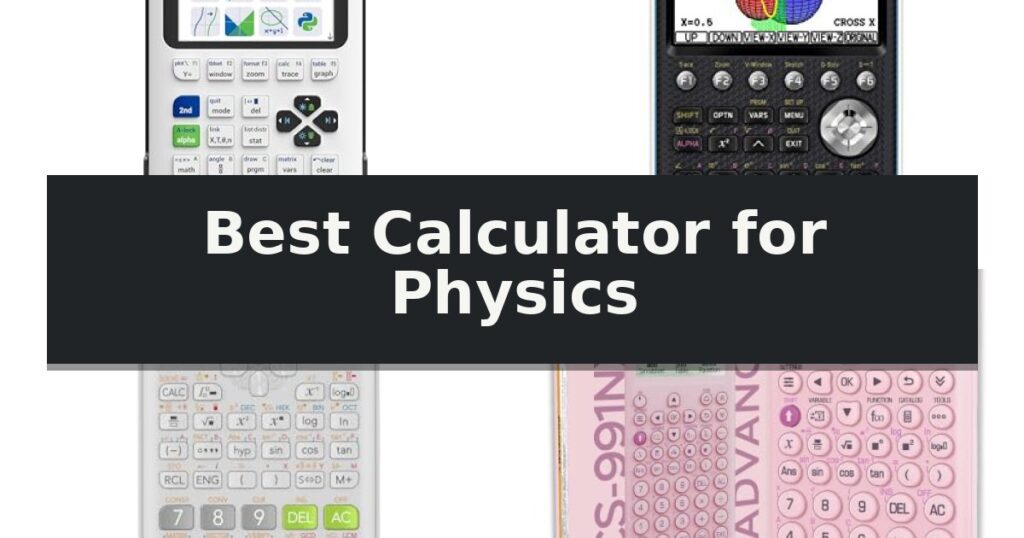
Texas Instruments TI-84 Evo Graphing Calculator is our top choice for the Best Calculator for Physics, offering a faster processor and expanded graphing space that simplifies complex data visualization. For students prioritizing 3D modeling and color-coded equations, the Casio Prizm FX-CG50 Graphing Calculator serves as a powerful alternative, while the CATIGA CS-991NX Scientific Calculator provides an extensive range of functions for those who prefer a more compact, non-graphing device.
Physics coursework often demands a balance between raw computational speed and the ability to interpret graphical relationships. While advanced graphing models are essential for visualizing wave functions or projectile motion, many students find that a high-performance scientific calculator is sufficient for standard problem sets and exam environments where graphing capabilities might be restricted.
Selecting the right tool requires considering the specific requirements of your curriculum, such as support for matrices, complex numbers, and integration. We focus on devices that offer intuitive interfaces and reliable performance, ensuring that your hardware supports your learning process rather than creating unnecessary technical hurdles during critical calculations.
If you are currently enrolled in secondary education, our guide on the Best Calculator for High School Students provides additional context on selecting models that balance performance with exam compliance. For those advancing to university-level coursework, the Best Calculator for College Students offers insights into more robust tools required for engineering and advanced physics.
10 Best Calculator for Physics in 2026 Reviews
Quick Comparison
| Product | Best For | Key Strength | Score |
|---|---|---|---|
| Texas Instruments TI-84 Evo Graphing Calculator | Best Overall | 3x faster performance for quicker calculations and smoother graphing. | 4.9 |
| Casio Prizm FX-CG50 Graphing Calculator | Visualizing 3D Physics Equations | High-resolution color display for clear 3D graph visualization. | 4.5 |
| Casio FX-115ESPLSB Scientific Calculator | Advanced Engineering and Science Tool | Natural Textbook Display for accurate expression viewing | 4.5 |
| CATIGA CS-991NX Scientific Calculator | Extensive Functionality for Physics | Textbook-style HD display for clear, accurate mathematical notation. | 4.8 |
| Texas Instruments TI-30XS MultiView Calculator | Clear Multi-Line Textbook Display | Four-line MultiView display for simultaneous calculation viewing | 4.6 |
| Texas Instruments TI-34 MultiView Calculator | Intermediate Math and Science Support | MultiView four-line display for simultaneous result comparison. | 4.4 |
| Texas Instruments TI-30XIIS Scientific Calculator | Standard Choice for Basic Physics | Two-line display for simultaneous entry and result viewing | 4.8 |
| Casio FX-300ESPLSB Scientific Calculator | Compact Design for Daily Coursework | Natural Textbook Display for intuitive formula entry | 4.3 |
| ROATEE 991ES Scientific Calculator | Integrated Notepad for Calculations | Integrated LCD writing tablet with stylus for immediate note-taking. | 4.8 |
| iPepul Scientific Calculator | Portable Note-Taking Calculator | Integrated notepad allows for simultaneous calculation and note-taking. | 4.8 |
How We Chose
When evaluating the best calculator for physics, we prioritize models that offer a seamless transition between standard arithmetic and advanced scientific applications. Our review process focuses on the practical utility of the interface, the speed of the processor during complex graphing tasks, and the overall durability of the hardware for students who rely on these tools daily.
- Processing speed for complex equation solving
- Display clarity and resolution for graphing functions
- Ease of navigation through icon-based menus
- Availability of advanced scientific and engineering functions
- Build quality and portability for daily classroom use
1 Texas Instruments TI-84 Evo Graphing Calculator — Faster Processing for Complex Physics
Navigating complex physics equations requires a tool that balances processing speed with clear data visualization. The Texas Instruments TI-84 Evo Graphing Calculator addresses this by incorporating a powerful processor that delivers 3x faster performance compared to previous iterations, ensuring that calculations and graphing tasks remain fluid during intensive study sessions.
Designed with a focus on efficiency, the device features an icon-based home screen that places essential math tools within immediate reach. This interface refinement reduces the time spent navigating menus, allowing for a more intuitive workflow. The simplified keypad design further supports this goal by utilizing larger buttons and reducing visual clutter, which helps minimize input errors during long problem-solving sessions.
Visualizing physical phenomena is made easier through the unit's bigger, clearer graphs, which provide 50% more graphing space than the TI-84 Plus CE. This expanded display area is particularly useful for identifying patterns and relationships in complex data sets. Additionally, the inclusion of USB-C charging modernizes the power management process, moving away from older connectivity standards for more convenient classroom use.
For students engaging in advanced coursework, the calculator supports Python programming, enabling users to write and execute code directly on the device. This capability bridges the gap between theoretical physics and computational application, making it a versatile instrument for both standard coursework and more technical projects.
Best for: Students and professionals requiring a high-performance graphing tool with modern connectivity and advanced programming capabilities for physics and mathematics.
Skip if: Users who prefer a basic scientific calculator without graphing functions or those who do not require Python programming and high-speed processing for their specific coursework.
- 3x faster performance for quicker calculations and smoother graphing.
- 50% more graphing space for improved data visualization.
- USB-C charging for modern and convenient power management.
- Icon-based home screen for faster, more intuitive navigation.
- Higher complexity may be unnecessary for students only needing basic scientific functions.
2 Casio Prizm FX-CG50 Graphing Calculator — Visualizing 3D Physics Equations
Visualizing complex physics equations requires more than just standard arithmetic, and the Casio Prizm FX-CG50 Color Graphing Calculator provides a high-resolution solution for students and engineers. Its large, high-res LCD screen supports over 65,000 colors, which is particularly useful for rendering 3D functions like spheres, cylinders, and planes in clear, distinct detail.
Beyond its visual capabilities, the calculator is built for advanced academic environments. It features a Natural Textbook Display that presents mathematical expressions and results exactly as they appear in textbooks, reducing the cognitive load when interpreting complex physics formulas. The device is also exam-approved for major standardized tests including the AP, SAT, ACT, and IB, ensuring students can rely on it throughout their academic progression.
For those integrating programming into their workflow, the Casio Prizm FX-CG50 Color Graphing Calculator includes Python integration. Users can write and execute MicroPython code directly on the device or transfer programs via PC connection. This functionality extends the utility of the calculator from a standard computation tool to a programmable platform for data analysis and scientific modeling.
The hardware is designed for portability and ease of use, measuring approximately 7.42 inches in width and weighing 0.8 pounds. With a comprehensive suite of advanced math functions—ranging from complex numbers and polar graphing to statistics and geometry—it serves as a versatile tool for high school and college-level physics and engineering coursework.
Best for: Students and engineers who require advanced 3D graphing capabilities and Python programming support for physics and mathematics coursework.
Skip if: Users who prefer a basic scientific calculator without graphing or programming features will find this model overly complex and unnecessary for their needs.
- High-resolution color display for clear 3D graph visualization.
- Python integration allows for custom programming and data analysis.
- Natural Textbook Display simplifies the interpretation of complex equations.
- Exam-approved for major standardized tests including AP, SAT, and ACT.
- Higher learning curve due to the advanced feature set and programming capabilities.
3 Casio FX-115ESPLSB Scientific Calculator — Advanced Engineering and Science Tool
Navigating complex physics coursework requires a reliable tool capable of handling advanced mathematical expressions with precision. The Casio FX-115ESPLSB Scientific Calculator is engineered to streamline these calculations through its Natural Textbook Display, which presents mathematical expressions exactly as they appear in standard academic textbooks.
This calculator is specifically designed for students and professionals engaged in engineering, science, and statistics coursework. Its interface is built to minimize input errors by allowing users to view fractions, derivatives, integrals, and other complex notations in a familiar format, rather than relying on linear, text-based code.
Measuring 7 inches in length and 3.5 inches in width, the device maintains a slim profile at just 0.1 inches in height. Despite its advanced functionality, it remains highly portable, weighing only 0.4 pounds. The unit is finished in a clean white color and includes a 1-year manufacturer warranty to support its long-term utility in academic settings.
By prioritizing a clear, intuitive display, this model helps reduce the cognitive load during intensive problem-solving sessions. It serves as a dedicated instrument for those who require consistent, accurate computation without the distraction of non-essential features found in more complex graphing devices.
Best for: Students and professionals in engineering, science, or statistics who require a clear, textbook-style display for complex mathematical expressions.
Skip if: Users who require advanced graphing capabilities or programmable features for high-level computer science or specialized engineering projects will find this scientific model insufficient.
- Natural Textbook Display for accurate expression viewing
- Tailored for engineering, science, and statistics coursework
- Compact and lightweight design for easy portability
- Includes a 1-year manufacturer warranty
- Lacks advanced graphing functionality for complex visual analysis
4 CATIGA CS-991NX Scientific Calculator — Extensive Functionality for Physics
Navigating complex physics equations often requires a tool that mirrors the structure of your coursework, and the CATIGA CS-991NX Scientific Calculator is built specifically for this purpose. Its textbook-style HD display utilizes 4-gradation shading to render fractions, roots, and exponents exactly as they appear in academic materials, eliminating the need to interpret cramped, single-line inputs.
Beyond its display, the device is equipped with 538 functions that span the requirements of physics, engineering, and advanced mathematics. It handles matrices, vectors, complex numbers, and regression analysis with ease, while the integrated icon menu allows for rapid switching between modes like statistics, distribution, and equation solving. This versatility ensures that students can manage multi-step problems without switching between devices.
Reliability during high-stakes testing is addressed through a dual solar and battery power system, which provides a consistent energy source and prevents unexpected shutdowns. The unit is physically designed for portability and durability, measuring just 6.38 x 3.03 x 0.42 inches and weighing only 0.21 lbs, making it an unobtrusive addition to a student's gear.
Protection is a key design consideration, as the CATIGA CS-991NX Scientific Calculator includes a magnetic hard case rather than a standard slide-on cover. This rigid housing clicks securely into place, ensuring the screen and keys remain protected inside a backpack or pencil case throughout the school year.
Best for: College and high school students in physics or engineering courses who require a high-resolution, multi-function tool for complex calculations and exam preparation.
Skip if: Users who require a graphing calculator for advanced visual plotting or those whose specific exam board prohibits calculators with advanced equation-solving or spreadsheet capabilities.
- Textbook-style HD display for clear, accurate mathematical notation.
- Comprehensive 538-function library covering physics, engineering, and advanced calculus.
- Secure magnetic hard case for superior protection compared to standard covers.
- Dual power source combining solar and battery for reliable operation.
- Compact size may be less comfortable for users with larger hands compared to full-sized desktop models.
5 Texas Instruments TI-30XS MultiView Calculator — Clear Multi-Line Textbook Display
The Texas Instruments TI-30XS MultiView Scientific Calculator simplifies complex physics equations by allowing users to view multiple calculations simultaneously on its four-line display. This design choice enables students to compare results and explore patterns directly on-screen, reducing the need to scroll through previous entries.
Engineered for clarity, the device features a MultiView display that presents math expressions, symbols, and stacked fractions exactly as they appear in textbooks. This functionality eliminates the need to adapt to technical syntax, providing quick access to frequently used functions during high-stakes problem solving.
Beyond basic arithmetic, the calculator supports advanced data analysis by allowing users to explore an (x,y) table of values for a given function. This can be performed automatically or by manually entering specific x values, which is particularly useful for plotting physical relationships or verifying experimental data points.
The unit is designed for versatility across various scientific disciplines, including general science, biology, and chemistry. It also features dedicated scientific notation output that displays exponents in the proper superscripted format, ensuring that physical constants and large-scale measurements remain easy to read and interpret.
Best for: Students requiring a clear, textbook-style display for high school physics, algebra, and general science coursework.
Skip if: Users who require advanced graphing capabilities or programmable features for college-level engineering or complex calculus.
- Four-line MultiView display for simultaneous calculation viewing
- Textbook-style formatting for fractions and symbols
- Automatic (x,y) table of values exploration
- Proper scientific notation with superscripted exponents
- Lacks advanced graphing capabilities for complex functions
6 Texas Instruments TI-34 MultiView Calculator — Intermediate Math and Science Support
The Texas Instruments TI-34 MultiView Scientific Calculator simplifies complex physics calculations by utilizing a four-line display that allows students to view multiple results simultaneously. This design choice enables users to compare entries and explore patterns directly on the screen, reducing the need to clear the display frequently during multi-step problems.
Engineered for intermediate math and science curricula, the device features the MathPrint capability, which renders mathematical expressions, symbols, and stacked fractions exactly as they appear in textbooks. This visual fidelity helps minimize transcription errors when working with complex physical formulas or scientific notation.
Usability is enhanced through a centralized mode screen where all settings are managed, paired with intuitive pull-down menus similar to those found on more advanced graphing calculators. The inclusion of a Table feature allows for the exploration of (x,y) value pairs, which is particularly useful for analyzing functional relationships in physics experiments.
This calculator is approved for use on SAT, ACT, and AP exams, making it a reliable tool for students transitioning through high school science courses. With its ability to handle scientific notation using proper superscripted exponents, it provides a clear, accurate representation of data essential for physics problem-solving.
Best for: Middle and high school students requiring a reliable, textbook-style display for algebra, geometry, and introductory physics coursework.
Skip if: Users who require advanced graphing capabilities, 3D plotting, or computer algebra systems (CAS) for university-level engineering physics will find this model insufficient.
- MultiView four-line display for simultaneous result comparison.
- MathPrint feature displays fractions and symbols in textbook format.
- Approved for major standardized exams including SAT, ACT, and AP.
- Table feature for efficient (x,y) data exploration.
- Lacks advanced graphing or complex calculus functions required for higher-level physics.
- Intermediate feature set may be limiting for students advancing to college-level engineering.
7 Texas Instruments TI-30XIIS Scientific Calculator — Standard Choice for Basic Physics
The Texas Instruments TI-30XIIS Scientific Calculator is a foundational tool for students navigating physics and mathematics coursework. Its two-line display is a significant design choice, allowing users to view their mathematical entries on the top line while simultaneously seeing the calculated result on the bottom. This layout is particularly useful for physics problems, where tracking multi-step operations is essential to avoid input errors and verify work in real-time.
Engineered for academic utility, this model integrates a comprehensive suite of statistics and advanced scientific functions. It handles essential trigonometric calculations, fraction conversions, and scientific operations without the unnecessary complexity of a graphing interface. This focus makes it a straightforward, efficient choice for high school curricula where graphing capabilities are often not required or permitted.
Reliability in a classroom or testing environment is supported by a dual-power system that combines solar energy with battery backup. This ensures the device remains operational during long study sessions or high-stakes examinations. Its compact dimensions, measuring approximately 6.1 by 3.2 inches, allow it to fit easily into standard school bags, ensuring portability for students on the move.
Compliance is a major factor for standardized testing, and this calculator is approved for use on SAT, ACT, and AP exams. This certification provides peace of mind for students who need a consistent, reliable tool that meets strict testing requirements. While it lacks advanced graphing features, its specialized design is a practical trade-off for students prioritizing core scientific and mathematical functionality over complex programming.
Best for: High school students requiring a reliable, exam-approved tool for physics and mathematics coursework.
Skip if: Students who need graphing capabilities or advanced programming features for college-level engineering or calculus.
- Two-line display for simultaneous entry and result viewing
- Dual-power system using solar and battery energy
- Approved for major standardized exams including SAT, ACT, and AP
- Includes essential scientific and trigonometric functions
- Lacks graphing capabilities required for advanced mathematics
- Basic interface may be limiting for complex engineering tasks
8 Casio FX-300ESPLSB Scientific Calculator — Compact Design for Daily Coursework
Navigating physics coursework requires a reliable tool for complex calculations, and the Casio FX-300ESPLSB Scientific Calculator is engineered specifically for this academic environment. Its standout feature is the Natural Textbook Display, which presents mathematical formulas and results exactly as they appear in standard textbooks, allowing students to verify their work intuitively without deciphering linear code.
Designed for portability and daily use, this compact scientific calculator measures just 3.5 inches in width and 7 inches in length, making it an unobtrusive addition to any backpack. Despite its small footprint, it provides the necessary functionality for middle and high school math and physics requirements, focusing on clarity and ease of use during exams or study sessions.
The device is built with a focus on educational utility, ensuring that students can transition from simple arithmetic to more advanced physics equations without navigating overly complex menus. By prioritizing a textbook-style interface, it minimizes the learning curve often associated with scientific calculators, helping users focus on the physics concepts rather than the hardware itself.
While it excels in standard classroom settings, the Casio FX-300ESPLSB Scientific Calculator is a dedicated tool for foundational coursework. It is backed by a 1-year manufacturer warranty, providing assurance for the hardware's longevity throughout the academic year.
Best for: Middle and high school students requiring a straightforward, textbook-style interface for daily physics and math coursework.
Skip if: Students enrolled in advanced university-level physics or engineering courses that necessitate programmable functions or graphing capabilities.
- Natural Textbook Display for intuitive formula entry
- Compact and lightweight design for easy portability
- 1-year manufacturer warranty included
- Optimized for middle and high school curriculum
- Lacks advanced graphing or programmable features required for higher-level physics
9 ROATEE 991ES Scientific Calculator — Integrated Notepad for Calculations
Physics students often juggle complex equations and scratch work simultaneously, a challenge addressed by the ROATEE 991ES Scientific Calculator. This device distinguishes itself by integrating a physical LCD writing tablet directly into the calculator housing, allowing users to jot down formulas or intermediate steps without needing separate paper.
Equipped with 417 functions, the ROATEE 991ES Scientific Calculator is engineered to handle a wide range of academic requirements, including matrix calculations, vector operations, and complex number systems. The 4-line Multiview display enhances efficiency by showing multiple calculations at once, reducing the need to toggle between screens during intensive problem-solving sessions.
The hardware is built for durability and convenience, featuring an anti-drop body that weighs only 5 ounces. Its power system is equally versatile, utilizing dual power through a rechargeable battery and a replaceable coin battery, ensuring the device remains functional during long study sessions or examinations.
To maintain the integrity of your notes, the tablet includes a LOCK KEY feature that prevents accidental erasure of the writing area. This combination of a high-function scientific calculator and a dedicated note-taking surface provides a streamlined workflow for students navigating chemistry, physics, and advanced mathematics.
Best for: Students who need to perform complex scientific calculations while simultaneously tracking handwritten notes or intermediate formulas.
Skip if: Users who prefer a dedicated, larger-format digital tablet for extensive note-taking or those who require a graphing calculator for advanced calculus plotting.
- Integrated LCD writing tablet with stylus for immediate note-taking.
- 417 built-in functions covering algebra, statistics, and complex number systems.
- 4-line Multiview display for improved computational visibility.
- Dual power system featuring rechargeable capability for reliability.
- Manual lock mechanism required to protect notes from accidental erasure.
- Small form factor may not suit users who prefer larger physical buttons.
10 iPepul Scientific Calculator — Portable Note-Taking Calculator
The iPepul Scientific Calculator simplifies complex workflows by integrating a dedicated, erasable notepad directly into its compact chassis. This dual-function design allows students and professionals to perform calculations while simultaneously jotting down formulas or intermediate steps, effectively reducing the need for loose scratch paper during intensive study sessions.
Engineered for portability, the device weighs only 120g and measures 1607812.8mm, making it a highly mobile solution for classroom or field use. The integrated blue matt LCD screen is specifically chosen to minimize eye strain during prolonged operation, while the notepad surface supports repeated writing and erasing via a single-button clear function, promoting a paperless environment.
The calculator features a 10-digit display and is powered by two easily replaceable button batteries, eliminating the need for complex screw-based maintenance. This user-friendly power system ensures the device remains operational without the risk of sudden power loss during critical tasks.
This tool is a practical choice for those who need to combine computational power with immediate note-taking capabilities. Its lightweight, durable construction and simple interface make it a versatile asset for middle school, high school, and college students, as well as anyone requiring a quick, reliable way to track calculations and notes in one place.
Best for: Students and professionals who need to perform calculations and jot down notes or formulas simultaneously in a portable format.
Skip if: Users who require advanced graphing capabilities, programmable functions, or a full QWERTY keyboard for complex engineering or high-level computer science coursework.
- Integrated notepad allows for simultaneous calculation and note-taking.
- Blue matt LCD screen reduces eye strain during extended use.
- Lightweight and portable design fits easily into pockets or bags.
- Tool-free battery replacement for simplified maintenance.
- Lacks advanced graphing or high-level programming features required for specialized engineering.
Best Calculator for Physics Buying Guide
Graphing vs. Scientific Models
Graphing calculators are generally necessary for physics courses that involve visualizing motion, fields, or wave patterns. These devices provide the screen real estate and processing power required to plot multiple functions simultaneously and analyze intersections or derivatives directly on the display.
Scientific calculators are more compact and often preferred for exams that prohibit graphing devices. While they lack the visual depth of a graphing model, they remain highly capable for solving complex algebraic equations, unit conversions, and statistical analysis required in introductory and intermediate physics.
The Importance of Display Technology
A high-resolution, multi-line display is critical for physics, where equations often involve complex fractions, exponents, and symbols. Textbook-style displays allow you to input expressions exactly as they appear in your course materials, which significantly reduces the likelihood of syntax-related input errors.
Color displays, found on some advanced graphing models, provide a distinct advantage when plotting multiple variables or 3D functions. Being able to differentiate between curves or planes using color can make interpreting complex physical relationships much faster and more intuitive.
Processing Speed and Efficiency
Physics problems often involve large datasets or iterative calculations that can slow down older hardware. A faster processor ensures that your calculator remains responsive, allowing you to iterate through different variables or test multiple scenarios without waiting for the device to catch up.
Efficient menu navigation is equally important. Look for icon-based interfaces that allow you to switch between modes—such as statistics, equation solving, and matrix operations—with minimal keystrokes, keeping your focus on the physics rather than the interface.
Exam Compliance and Restrictions
Before purchasing, always verify the approved equipment list for your specific exam board. Many standardized tests, including AP and college-level exams, have strict rules regarding the type of calculator allowed, specifically concerning CAS (Computer Algebra System) features.
If you are preparing for multiple levels of physics, consider a calculator that is widely accepted across different testing environments. A model that is compliant with both high school and college-level exams offers better long-term value and prevents the need to learn a new interface mid-semester.
Durability and Power Management
Physics students often carry their calculators in backpacks alongside heavy textbooks, making build quality a key consideration. Models with protective hard cases or reinforced bodies are better equipped to survive the daily wear and tear of a student's schedule.
Battery life is a non-negotiable factor for long exam sessions. Look for devices that offer dual power sources, such as solar panels paired with battery backup, to ensure your calculator does not shut down unexpectedly during a critical test.
Frequently Asked Questions
Do I need a graphing calculator for introductory physics?
It depends on your curriculum. While many introductory courses can be completed with a high-end scientific calculator, a graphing model is often required for courses that emphasize visual analysis of motion and wave functions.
Can I use these calculators on the SAT or ACT?
Most of the calculators listed are approved for major standardized tests, but you should always check the official exam board website to confirm that your specific model is permitted.
What is the benefit of a textbook-style display?
A textbook-style display allows you to see fractions, exponents, and roots exactly as they are written in your textbook, which helps prevent input errors and makes complex formulas easier to read.
Are rechargeable batteries better than standard ones?
Rechargeable models, like those with USB-C, are convenient and reduce the need for spare batteries, but ensure you have a way to charge them before important exams.
Is a CAS calculator necessary for physics?
CAS (Computer Algebra System) calculators can solve algebraic equations symbolically, which is powerful but often prohibited in many physics exams. Check your syllabus before investing in one.
Conclusion: Our Top Pick
Our top pick is Texas Instruments TI-84 Evo Graphing Calculator. Choosing the right calculator for physics depends on balancing your current course requirements with the need for long-term reliability. Whether you opt for the advanced graphing capabilities of the TI-84 Evo or the portability of a scientific model, prioritize a device that matches your specific academic needs.
By focusing on display clarity, processing speed, and exam compliance, you can select a tool that will support your studies throughout your physics education. Always verify your institution's requirements to ensure your chosen model remains a useful asset for every exam.