Apple MacBook Air 13-inch is our pick for the Best Laptop for College Students because it balances high-performance processing with an exceptionally portable design that lasts through a full day of classes.
Selecting a reliable machine for university requires prioritizing hardware that can handle multitasking and long study sessions without constant tethering to a power outlet. Students should look for a balance between weight, battery longevity, and the ability to run essential academic software smoothly.
The right device should integrate seamlessly into a student's workflow, whether they are drafting research papers, participating in video conferences, or managing complex creative projects. Evaluating these tools involves assessing how well their internal components support daily academic demands while remaining light enough to carry across campus.
When planning your hardware requirements, it is helpful to explore the Best College Laptop options to see how different form factors impact your daily study routine. For a broader view of computing needs, our guide on the Best Computers for College Students provides additional context on choosing between desktops and laptops. If you are specifically looking for a Windows-based environment, consider reviewing the Best Windows Laptop for Students to compare performance metrics across different manufacturers.
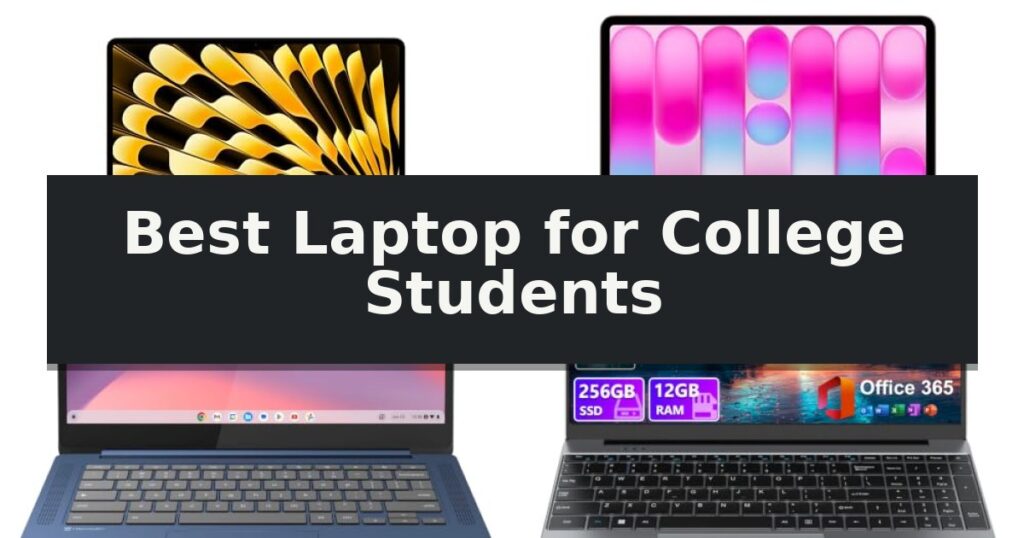
10 Best Laptop for College Students in 2026 Reviews
Quick Comparison
| Product | Best For | Key Strength | Score |
|---|---|---|---|
| Apple MacBook Air 13-inch | Best Overall | Extended 18-hour battery life for all-day campus use. | 4.9 |
| Apple MacBook Neo 13-inch | Portable Power for Daily Assignments | 16-hour battery life for all-day campus use | 4.4 |
| Lenovo Flagship Chromebook | Touchscreen Navigation for Online Classes | 14-inch Full HD touchscreen with IPS technology for clear visuals. | 4.3 |
| DRKAKO 15.6-inch Student Laptop | Lay-Flat Hinge for Group Projects | 180° lay-flat hinge for easy screen sharing. | 4.6 |
| HP 14-inch Laptop | Immersive Display for Multimedia Study | Micro-edge display maximizes screen area in a compact form factor. | 4.5 |
| HP 2027 Everyday Laptop | AI-Integrated Workflow for Students | Integrated Microsoft Copilot AI for enhanced productivity. | 4.5 |
| NIAKUN 15.6-inch Laptop | Reliable Productivity for Daily Mobility | Ultra-portable 3.53 lbs chassis for easy campus transport. | 4.9 |
| HP 14-inch Ultra-Light Laptop | Long Battery Life for Campus | Ultra-lightweight design at 3.24 pounds for easy transport. | 4.5 |
| HP Chromebook 14 | Versatile Connectivity for Remote Learning | 14-hour battery life supports full-day usage without recharging. | 4.9 |
| HP Chromebook 14a | Streamlined Design for Basic Tasks | Up to 14 hours of battery life for all-day reliability. | 4.8 |
How We Chose
To identify the best laptop for college students, we analyze the intersection of hardware performance and practical daily mobility. An experienced reviewer focuses on how these machines handle sustained academic workloads, ensuring that battery efficiency, screen clarity, and connectivity meet the specific, demanding requirements of a modern university environment.
- Battery life and power efficiency for all-day campus use
- Processing speed and memory capacity for multitasking academic applications
- Portability and weight for ease of transport between lecture halls
- Display quality and resolution for reading and research
- Connectivity options for external displays and peripherals
1 Apple MacBook Air 13-inch — Blazing Speed for Demanding Majors
The Apple MacBook Air 13-inch leverages the advanced M5 chip to integrate high-performance computing with specialized AI capabilities, providing a versatile tool for demanding academic workloads. Its thin, lightweight design is engineered for portability, while the inclusion of the Neural Engine and next-generation GPU ensures that multitasking and creative applications remain responsive throughout the day.
Efficiency is central to this model, featuring up to 18 hours of battery life that supports extended study sessions without requiring a power outlet. The 13.6-inch Liquid Retina display offers a high-contrast visual experience with support for 1 billion colors, ensuring that presentations, research documents, and media content are rendered with clarity and detail.
Connectivity and communication are streamlined through two Thunderbolt 4 ports, a MagSafe charging port, and support for Wi-Fi 7. The 12MP Center Stage camera and three-mic array are designed to maintain focus and audio quality during remote lectures or group video calls, while the integration with macOS provides built-in security and seamless synchronization with other Apple devices.
While the Apple MacBook Air 13-inch provides a robust platform for most students, the 512GB SSD and 16GB of unified memory are fixed configurations. Users requiring extensive local storage for massive datasets or specialized software that necessitates specific hardware expansion beyond external displays may need to consider these capacity constraints.
Best for: Students who require a highly portable, long-lasting laptop capable of handling intensive multitasking and AI-enhanced productivity tasks.
Skip if: Users who require user-upgradable internal storage or specialized hardware expansion slots for professional-grade peripheral connectivity.
- Extended 18-hour battery life for all-day campus use.
- M5 chip performance with dedicated AI acceleration.
- High-resolution Liquid Retina display with 1 billion colors.
- Advanced connectivity including Wi-Fi 7 and Thunderbolt 4.
- Non-upgradable memory and storage configurations.
- Limited to two external display connections.
2 Apple MacBook Neo 13-inch — Portable Power for Daily Assignments
The Apple MacBook Neo 13-inch is engineered for the modern student, featuring the advanced A18 Pro chip designed to handle demanding academic tasks and AI-driven workflows with ease. Its highly portable durable aluminum design ensures it remains a reliable companion across campus, while the 16-hour battery life supports extended study sessions without the constant need for a power outlet.
Visual clarity is prioritized through the Liquid Retina display, which supports 1 billion colors to ensure text remains crisp and media appears vibrant. Beyond its display, the device integrates a 1080p FaceTime HD camera and a dual-mic array, providing clear audio and video quality for remote lectures or collaborative group projects.
Functionality extends to the ecosystem, as the Apple MacBook Neo 13-inch works seamlessly with other devices. Users can control their iPhone directly from the laptop, enabling efficient transitions like starting an email on a phone and finishing it on the Mac. The inclusion of Apple Intelligence tools further assists with summarizing notes and managing assignments, all protected by integrated privacy features.
Constructed with sustainability in mind, the laptop utilizes a recycled aluminum enclosure that reaches 60 percent recycled content by weight. Available in four distinct colors, including Blush, the device combines a professional aesthetic with the performance required for daily coursework and creative projects.
Best for: Students who prioritize portability, long battery life, and seamless integration with the Apple ecosystem for academic assignments.
Skip if: Users who require specialized software incompatible with macOS or those who need more than 8GB of unified memory for intensive professional-grade video editing or heavy computational tasks.
- 16-hour battery life for all-day campus use
- A18 Pro chip optimized for AI and multitasking
- Portable and durable recycled aluminum construction
- Liquid Retina display with 1 billion color support
- 8GB unified memory may limit performance for highly demanding professional workflows
3 Lenovo Flagship Chromebook — Touchscreen Navigation for Online Classes
The Lenovo Flagship Chromebook prioritizes intuitive navigation for academic workflows through its 14-inch Full HD touchscreen. Designed with IPS technology, the display provides wide viewing angles and clear resolution, which is useful for managing multiple browser tabs or participating in remote learning sessions via the integrated 720p HD webcam.
Under the hood, the device is powered by the MediaTek Kompanio 520 octa-core processor. This hardware is specifically engineered to balance performance with power efficiency, aiming to provide reliable connectivity and smooth operation during daily student tasks. The system includes 4GB of RAM and 64GB of eMMC storage, facilitating quick boot-up times and efficient data management for cloud-based applications.
Portability is a key aspect of this laptop's design, measuring 13.23 by 8.7 by 0.73 inches and weighing approximately 2.86 pounds. The chassis features a versatile selection of ports, including USB-A 3.2 Gen 1 and USB-C 3.2 Gen 1, alongside a microSD card reader for expandable storage. Connectivity is supported by Wi-Fi 6 and Bluetooth 5.1, ensuring stable wireless performance in busy campus environments.
Running on Google Chrome OS, this laptop emphasizes security and simplicity. The operating system integrates built-in protection and cloud backup features, making it a straightforward choice for students who rely on web-based tools and digital classroom platforms. The inclusion of a privacy shutter on the webcam adds a practical layer of security for users concerned with digital privacy.
Best for: Students who require a lightweight, portable device for web-based research, document editing, and remote classroom participation.
Skip if: Users who need to run specialized, high-demand desktop software or require significant local storage capacity for large media files.
- 14-inch Full HD touchscreen with IPS technology for clear visuals.
- MediaTek Kompanio 520 processor optimized for battery efficiency.
- Lightweight and slim design weighing under 3 pounds.
- Wi-Fi 6 connectivity for reliable wireless performance.
- 4GB RAM may limit performance when multitasking with many heavy applications.
- 64GB eMMC storage is relatively small for extensive local file storage.
4 DRKAKO 15.6-inch Student Laptop — Lay-Flat Hinge for Group Projects
Navigating a busy academic schedule requires reliable tools, and the DRKAKO 15.6-inch Student Laptop is engineered to streamline daily tasks with its 180° lay-flat hinge design. This feature simplifies collaborative group projects and screen sharing, allowing students to present work easily in library or classroom settings.
Under the hood, this device is equipped with a J4105 quad-core processor and 12GB of DDR4 RAM, providing the necessary overhead for multitasking across web browsers, online course portals, and streaming platforms. The inclusion of a 256GB SSD ensures quick system boot times and responsive file access, with the added flexibility of expandable storage via a 2TB SSD or 1TB microSD card.
The visual experience is anchored by a 15.6-inch FHD IPS display with a 1920×1080 resolution, framed by ultra-narrow bezels to maximize the workspace. For students frequently on the move, the laptop maintains a portable profile at 3.7 lbs and 0.79 inches thin, supported by a 53.2Wh battery that provides up to 6 hours of runtime.
Connectivity is comprehensive for a modern student workflow, featuring USB 3.2, USB-C (data, video, and charging), and a Mini HDMI port for external displays. The package also includes a one-year subscription to Office 365, pre-installed with essential productivity software and an integrated AI assistant to help with drafting essays and summarizing research materials.
Best for: Students who prioritize a portable, thin design and need built-in productivity software for document management and collaborative group work.
Skip if: Users who require high-performance hardware for intensive tasks like video editing, 3D rendering, or gaming will find the J4105 processor insufficient.
- 180° lay-flat hinge for easy screen sharing.
- Includes 1-year Office 365 subscription with AI assistant.
- Expandable storage up to 2TB via SSD or 1TB microSD.
- Versatile connectivity including USB-C and Mini HDMI.
- Limited battery life of up to 6 hours may require mid-day charging.
- Entry-level processor is optimized for basic productivity rather than high-demand applications.
5 HP 14-inch Laptop — Immersive Display for Multimedia Study
Selecting the right hardware for academic success requires balancing portability with functional screen real estate. The HP 14-inch Laptop addresses this by utilizing a micro-edge HD display, which minimizes bezels to provide an expansive viewing area within a compact, 3.24-pound chassis. This design choice facilitates a more immersive experience for multimedia study sessions or managing multiple windows simultaneously.
Under the hood, the device is powered by an Intel N150 processor paired with 4 GB of RAM, engineered to handle daily academic tasks like research, word processing, and web browsing. The inclusion of 128 GB Universal Flash Storage offers faster data access speeds compared to traditional drives, contributing to the responsive nature of the pre-installed Windows 11 Home operating system.
Practicality for students is further enhanced by the HP Fast Charge capability, which restores up to 50% of battery life in approximately 45 minutes, allowing for quick transitions between lectures or study spaces. The integrated HP True Vision HD camera features advanced noise reduction and dual microphones, ensuring clarity during remote learning sessions or video calls.
To streamline productivity, the keyboard includes dedicated one-touch access to Microsoft Copilot, providing immediate assistance for creative and organizational tasks. Every unit also comes with a 1-year Microsoft 365 Personal subscription, offering immediate access to essential productivity software right out of the box.
Best for: Students who prioritize a lightweight, portable device for research, writing, and remote learning tasks.
Skip if: Users requiring high-performance computing for intensive tasks like video editing, 3D rendering, or heavy multitasking will find the 4 GB RAM and 128 GB storage capacity limiting.
- Micro-edge display maximizes screen area in a compact form factor.
- HP Fast Charge enables rapid battery replenishment during busy days.
- Includes 1-year Microsoft 365 Personal subscription for immediate productivity.
- Integrated Copilot button provides quick access to AI-assisted tools.
- Limited 4 GB RAM may restrict performance during heavy multitasking.
- 128 GB storage capacity may require external drives for large media libraries.
6 HP 2027 Everyday Laptop — AI-Integrated Workflow for Students
Balancing academic demands with a busy schedule requires reliable technology that streamlines daily tasks. The HP 2027 Everyday Laptop integrates the Intel N150 quad-core processor, providing the necessary power for web browsing, streaming, and document management. Its inclusion of Microsoft Copilot AI allows students to leverage intelligent assistance directly through a dedicated key, helping to organize research and enhance productivity during study sessions.
Designed for mobility, this laptop features a lightweight 3.24 lb chassis with a slim 0.71-inch profile, making it easy to carry between classes or to the library. The 14-inch HD micro-edge anti-glare display offers a 79% screen-to-body ratio, providing a clear workspace for assignments. With Wi-Fi 6 and Bluetooth 5.4 connectivity, users can maintain stable connections in crowded campus environments.
The device is equipped for modern communication needs, featuring an HP True Vision 720p HD camera with temporal noise reduction and an integrated dual-array microphone. These tools, combined with AI Noise Reduction, ensure clear audio and video during remote lectures or group projects. The battery supports up to 11 hours of video playback, allowing students to work throughout the day without constant access to an outlet.
Practicality is further enhanced by the inclusion of a 1-year Microsoft 365 Personal subscription, which provides essential software like Word, Excel, and PowerPoint. The laptop also offers versatile connectivity options, including a USB Type-C port with DisplayPort 1.2 and a multi-format SD card reader for expandable storage, ensuring compatibility with various peripherals and external displays.
Best for: Students and remote workers who prioritize portability, AI-assisted productivity tools, and long battery life for everyday academic tasks.
Skip if: Users requiring high-performance computing for intensive tasks like video editing, 3D rendering, or gaming, as the 4GB of RAM and entry-level processor are optimized for basic productivity.
- Integrated Microsoft Copilot AI for enhanced productivity.
- Ultra-portable design weighing only 3.24 lbs.
- Long battery life rated for up to 11 hours of video playback.
- Wi-Fi 6 connectivity for reliable wireless performance.
- Limited 4GB RAM may restrict heavy multitasking.
- 128GB UFS storage provides modest capacity for large media files.
7 NIAKUN 15.6-inch Laptop — Reliable Productivity for Daily Mobility
Balancing academic demands with daily mobility requires a machine that prioritizes portability without sacrificing essential functionality. The NIAKUN 15.6-inch Laptop addresses this need with an ultra-portable design, weighing just 3.53 lbs and measuring 0.8 inches thin, allowing it to slide into most backpacks with ease.
Out-of-the-box productivity is a core focus, as this device comes pre-equipped with Windows 11 Pro and Office 365. The hardware configuration, featuring an Intel Pentium processor paired with 8GB of RAM and a 256GB SSD, provides the necessary foundation for managing office applications, web research, and multitasking between study sessions.
Visual clarity for long study hours is supported by a 15.6-inch 1920×1080 IPS display, which offers wide viewing angles for collaborative projects or streaming media. The 180-degree hinge adds a layer of versatility, enabling the screen to lay flat for easier content sharing during group meetings or library study sessions.
Connectivity remains a priority for student workflows, with the inclusion of 2x USB 3.0 ports, a Mini HDMI output, and a Micro TF card slot for expandable storage. While the 5000mAh battery provides up to 6 hours of mixed use, users should plan for power access during extended days on campus.
The manufacturer provides a 2-year warranty and a 6-month return policy, complemented by 24/7 online support. This support structure is designed to offer peace of mind for students relying on their hardware for daily coursework and professional tasks.
Best for: Students and professionals needing a lightweight, ready-to-use laptop for office tasks, research, and collaborative study.
Skip if: Users requiring high-performance computing for video editing, 3D rendering, or gaming will find the processor and storage capacity insufficient.
- Ultra-portable 3.53 lbs chassis for easy campus transport.
- Pre-installed Windows 11 Pro and Office 365 for immediate use.
- 180-degree hinge facilitates collaborative screen sharing.
- 2-year warranty and 24/7 support included.
- 6-hour battery life may require charging during long academic days.
- Intel Pentium processor is limited to basic productivity and web tasks.
8 HP 14-inch Ultra-Light Laptop — Long Battery Life for Campus
The HP 14-inch Ultra-Light Laptop is designed for students needing a portable, entry-level device capable of handling daily academic workloads. Weighing just 3.24 pounds, it features a 14-inch micro-edge display with anti-glare technology and a 62.5% sRGB color gamut, providing a clear workspace for research and writing.
Performance is driven by an Intel Celeron N4500 processor paired with 4GB of DDR4 RAM. To assist with storage needs, the unit includes a 64GB eMMC drive supplemented by a 64GB SD card. The laptop runs on Windows 11 Home in S mode, which prioritizes security and performance, though users have the option to switch to standard Windows 11 Home.
Connectivity is a highlight for campus life, featuring Wi-Fi 6E and Bluetooth 5.4 for reliable wireless performance. The device includes a USB-C 3.2 Gen 1 port, two USB-A 3.2 Gen 1 ports, and an HDMI 1.4b output, allowing for the connection of up to two external monitors for a more expansive study setup. The integrated HP True Vision HD camera supports remote learning and video conferencing requirements.
Efficiency is managed through a battery rated for up to 12 hours of use, supported by HP fast charge technology to minimize downtime. The package includes a one-year subscription to Microsoft 365, providing access to Word, Excel, and PowerPoint. The device is backed by a one-year manufacturer warranty, with an additional three-year warranty provided by Issaquah Highlands Tech specifically for the expanded SD card storage.
Best for: Students requiring a lightweight, portable machine for basic word processing, research, and remote learning tasks.
Skip if: Users who require high-performance hardware for video editing, complex data modeling, or intensive multitasking will find the processor and RAM capacity limiting.
- Ultra-lightweight design at 3.24 pounds for easy transport.
- Extended battery life of up to 12 hours with fast charging.
- Versatile connectivity including Wi-Fi 6E and dual-monitor support.
- Included Microsoft 365 subscription for immediate academic productivity.
- Limited 4GB RAM may restrict performance during heavy multitasking.
- Entry-level Intel Celeron processor is not intended for demanding software applications.
9 HP Chromebook 14 — Versatile Connectivity for Remote Learning
Navigating a busy academic schedule requires a reliable machine that balances portability with functional workspace expansion. The HP Chromebook 14 addresses this by combining a lightweight 3.35-pound chassis with a versatile 7-in-1 USB-C hub, allowing students to transition seamlessly between lecture halls and study sessions.
At the core of this device is an Intel Celeron N4120 processor paired with 4GB of LPDDR4 RAM, providing the necessary efficiency for web-based coursework, research, and video conferencing. The inclusion of a 720p HD True Vision camera ensures clear visuals for online classes, while the Chrome OS environment offers a secure, streamlined interface for managing cloud-based assignments and applications.
Visual productivity is a key focus, as the 14-inch HD display features Micro-edge technology to maximize screen real estate. For more intensive projects, the laptop supports external connectivity to two additional monitors via HDMI and USB-C, capable of outputting up to 4K resolution at 30Hz when utilizing the included hub.
Designed for long days on campus, the unit boasts an impressive 14-hour battery life, reducing the need to carry power adapters between classes. With 128GB of total storage—comprised of 64GB eMMC and a 64GB SD card—students have sufficient local space for essential files, complemented by built-in cloud backup capabilities.
Best for: Students who prioritize long battery life and multi-monitor connectivity for web-based research and online learning.
Skip if: Users requiring high-performance local processing for intensive software like video editing or CAD, as the Celeron processor is optimized for basic tasks.
- 14-hour battery life supports full-day usage without recharging.
- Versatile connectivity includes a bundled 7-in-1 USB-C hub for multiple peripheral connections.
- Lightweight 3.35-pound design enhances portability for campus travel.
- Dual-monitor support allows for an expanded workspace via HDMI and USB-C.
- Limited 4GB RAM may restrict heavy multitasking with numerous browser tabs.
- Entry-level processor is intended for basic tasks rather than demanding professional applications.
10 HP Chromebook 14a — Streamlined Design for Basic Tasks
The HP Chromebook 14a is engineered for students who prioritize portability and long-lasting power during a busy academic schedule. Featuring a 14-inch micro-edge, anti-glare HD display, this device provides a clear workspace for assignments while remaining lightweight enough to carry between classes in a standard backpack.
Performance is driven by the quad-core Intel Celeron N4120 processor, which balances power consumption with the efficiency needed for web-based tasks and multitasking. With 4 GB of RAM and 64 GB of eMMC storage, the system is optimized for the Chrome OS environment, ensuring quick access to cloud-based applications and educational tools.
Designed to support all-day use, the laptop offers up to 14 hours of battery life. When power runs low, the integrated HP Fast Charge technology restores the battery from 0% to 50% in approximately 45 minutes, minimizing downtime during study sessions.
The device includes a full-size keyboard paired with a multi-touch touchpad that supports four-finger gestures for intuitive navigation. Connectivity is handled by an 802.11a/b/g/n/ac Wi-Fi and Bluetooth combo, ensuring stable connections for remote learning or streaming content via the Intel UHD Graphics 600.
Best for: Students who primarily use web-based applications and require a lightweight, long-battery-life device for daily campus tasks.
Skip if: Users who require high-performance hardware for intensive video editing, local software development, or heavy gaming.
- Up to 14 hours of battery life for all-day reliability.
- HP Fast Charge technology for rapid power replenishment.
- Lightweight and thin design for easy portability.
- Integrated multi-touch touchpad supporting advanced gestures.
- Limited 64 GB eMMC storage capacity.
- 4 GB RAM may constrain heavy multitasking.
Best Laptop for College Students Buying Guide
Prioritizing Battery Longevity
For students, a laptop's ability to remain powered throughout a full day of classes is often more critical than raw processing speed. Look for models that offer at least 10 to 12 hours of real-world usage to avoid the need for carrying bulky chargers.
Consider how power management features in the operating system interact with your typical software. Efficient processors and optimized software environments significantly reduce the stress of finding an available outlet in a crowded library or lecture hall.
Balancing Portability and Screen Real Estate
A 13-inch or 14-inch form factor is generally the sweet spot for students who need to balance screen space for research with the physical necessity of fitting a device into a standard backpack. These sizes offer enough room for split-screen multitasking without adding unnecessary weight.
Weight is a non-negotiable factor when you are commuting across campus. Aim for devices under three pounds to ensure that your laptop does not become a burden during long walks between buildings or while traveling to study groups.
Evaluating Multitasking Capabilities
Academic work often involves keeping dozens of browser tabs, research documents, and communication apps open simultaneously. A minimum of 8GB of memory is recommended, though 16GB is preferred for students in data-heavy or creative majors.
The processor should be capable of handling these concurrent tasks without significant lag. While entry-level chips are sufficient for basic word processing, students who engage in video editing or data analysis should prioritize higher-tier silicon to ensure long-term usability.
Connectivity and Peripheral Support
Modern college work frequently requires connecting to external monitors, projectors, or specialized peripherals. Ensure your chosen laptop has enough ports, such as USB-C or Thunderbolt, to accommodate these needs without requiring a constant array of adapters.
If you frequently present in class, check for native video output support. Having reliable wireless connectivity, such as Wi-Fi 6 or higher, is also essential for maintaining a stable connection in campus networks that may be heavily congested.
Storage and Cloud Integration
While cloud storage is standard for most students, having sufficient local storage is still important for offline access to large files and applications. A 256GB or 512GB SSD provides a good balance between speed and capacity for most academic needs.
Consider how the laptop integrates with your preferred cloud ecosystem. Seamless file syncing between your laptop and other mobile devices can save significant time when you need to access notes or drafts on the go.
Frequently Asked Questions
How much RAM do I actually need for college?
For most students, 8GB is the baseline, but 16GB is highly recommended to ensure smooth multitasking across multiple browser tabs and academic applications.
Is a Chromebook sufficient for a college student?
A Chromebook is excellent for basic tasks like web browsing, email, and document editing, but it may struggle with specialized software required for certain engineering or creative majors.
What is the ideal screen size for a student laptop?
A 13-inch to 14-inch screen provides the best balance of portability for carrying around campus and enough screen real estate for effective research and writing.
Should I prioritize battery life over processor power?
Unless you are in a major that requires heavy rendering or computation, battery life is generally more important for the daily reality of attending back-to-back classes.
Are 2-in-1 laptops worth it for students?
2-in-1 laptops can be very useful if you prefer taking handwritten notes with a stylus, but ensure the hinge design is durable enough for daily use.
Conclusion: Our Top Pick
Our top pick is Apple MacBook Air 13-inch. Choosing the right laptop for college is a significant investment that should align with your specific major and daily habits. By focusing on battery life, portability, and sufficient memory, you can select a machine that supports your academic goals throughout your degree.
Ultimately, the best device is one that disappears into your workflow, allowing you to focus on your studies rather than managing hardware limitations. Prioritize reliability and build quality to ensure your laptop remains a productive companion for years to come.