ELEGOO UNO R3 Microcontroller Board is our pick for the Best Microcontroller Development Boards because it offers a reliable, well-documented foundation for beginners and experienced makers alike to start coding and prototyping immediately.
Selecting the right board depends on your specific project requirements, such as the need for wireless connectivity, processing speed, or compatibility with existing hardware shields. While entry-level boards provide a straightforward path for learning basic electronics, advanced modules enable complex tasks like IoT integration or high-speed data processing.
Experienced users should consider the balance between ease of use and hardware capabilities. Evaluating the available I/O pins, memory capacity, and development environment support ensures that your chosen board can scale with your project's complexity without requiring frequent hardware swaps.
If you are just starting your journey into hardware, our guide on Best Microcontroller Experiment Kits provides a great way to get all the necessary components in one package.
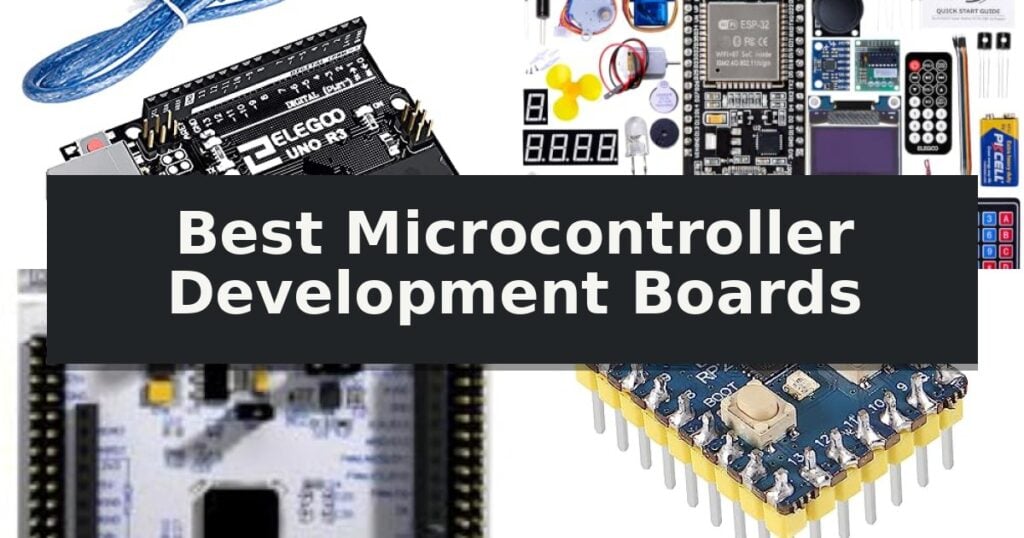
10 Best Microcontroller Development Boards in 2026 Reviews
Quick Comparison
| Product | Best For | Key Strength | Score |
|---|---|---|---|
| ELEGOO UNO R3 Microcontroller Board | Best Overall | Compatible with Arduino IDE for a seamless coding experience. | 4.9 |
| ELEGOO ESP-32 Super Starter Kit | Complete IoT Learning Bundle | Includes a powerful dual-core ESP-32 board with integrated Wi-Fi and Bluetooth. | 4.5 |
| STMicroelectronics STM32 Nucleo Development Board | High-Performance Industrial Foundation | High-performance ARM Cortex-M4 core with 180 MHz CPU speed. | 4.7 |
| DWEII RP2040-Zero Development Board | Compact Dual-Core Power | Dual-core Arm Cortex M0+ processor for high-speed computation. | 4.9 |
| Waveshare ESP32-S3 Ethernet Development Board | Advanced Networking and Vision | Integrated 10/100Mbps Ethernet with optional PoE support. | 4.4 |
| Arduino UNO Q Hybrid Board | Advanced AI and Linux Integration | Dual-brain architecture combining MPU and MCU capabilities. | 4.6 |
| AITRIP ESP32 Development Board | Modern USB-C Connectivity | Integrated USB-C connectivity for modern power and data standards. | 4.5 |
| Walfront 8051 Microcontroller Development Board | Classic Architecture for Education | Includes a standard RS232 interface for reliable computer communication. | 4.7 |
| ACEIRMC ESP32-C6 Development Board | Efficient RISC-V Performance | Equipped with a modern RISC-V 32-bit single-core processor. | 4.6 |
| hiBCTR ATmega328P Development Board | Reliable Robotics Prototyping | Full compatibility with Arduino IDE and extensive library support. | 4.9 |
How We Chose
When evaluating the best microcontroller development boards, we focus on the practical utility of the hardware for real-world prototyping. An experienced reviewer assesses each board by its core processing capabilities, the flexibility of its input and output interfaces, and the maturity of the software ecosystem required to turn a raw circuit into a functional project.
- Processor architecture and clock speed for computational efficiency.
- I/O pin count and peripheral support including PWM, ADC, and communication protocols.
- Ecosystem compatibility with standard IDEs and existing hardware shields.
- Integrated features such as Wi-Fi, Bluetooth, or specialized networking ports.
- Form factor and ease of integration into custom or breadboard-based projects.
1 ELEGOO UNO R3 Microcontroller Board — Standard Choice for Beginners
The ELEGOO UNO R3 Microcontroller Board serves as a foundational tool for electronics projects, providing a 16 MHz clock speed and 32 KB of flash memory to support diverse automation and robotics tasks. By integrating an ATmega328P core with an ATmega16U2 USB interface, this board enables direct sketch uploads and serial communication via the included USB-A to USB-B cable.
Designed for versatility, the board features 14 digital I/O pins, including 6 PWM outputs and 6 analog inputs. These connections allow users to interface with a wide range of components such as sensors, motors, displays, and buttons. The clearly labeled headers simplify the process of connecting jumper wires and expansion modules, making it a practical choice for maker desks and educational environments.
Power flexibility is a key aspect of the design, as the board can be operated via a USB connection or an external 7-12 V power supply. This allows for both tethered development and standalone project deployment. The unit is RoHS compliant, ensuring it meets specific material standards for electronics.
While the ELEGOO UNO R3 Microcontroller Board provides the necessary processing power and connectivity for most entry-level projects, it is a bare-bones development board. Users will need to source additional components like breadboards, sensors, and shields separately to complete complex automation or robotics builds.
Best for: Beginners and students seeking a reliable, standard-compatible platform for learning electronics and basic programming.
Skip if: Advanced users requiring integrated wireless connectivity, higher processing speeds, or specialized onboard sensors found in more modern development boards.
- Compatible with Arduino IDE for a seamless coding experience.
- Versatile I/O configuration with 14 digital pins and 6 analog inputs.
- Flexible power options supporting both USB and external 7-12 V supplies.
- Clear labeling on headers to simplify wiring and module integration.
- Lacks onboard wireless connectivity like Wi-Fi or Bluetooth.
- Basic accessory package requires separate purchase of sensors and breadboards.
2 ELEGOO ESP-32 Super Starter Kit — Complete IoT Learning Bundle
The ELEGOO ESP-32 Super Starter Kit centers on a high-performance dual-core microcontroller board that integrates both Wi-Fi and Bluetooth 4.2, providing a robust foundation for Internet of Things (IoT) development. This kit is designed to bridge the gap between basic circuit building and advanced connected projects, offering a comprehensive suite of hardware and instructional resources.
Beyond the core board, the package includes over 35 modules and electronic components, such as sensors, displays, and motors. This variety allows users to experiment with diverse inputs and outputs, ranging from simple LED control to complex interactive gadgets like smart home controllers or weather stations. The inclusion of an OLED screen and a servo motor provides immediate opportunities for tangible project creation.
Accessibility is a primary focus, supported by a detailed, step-by-step online tutorial that guides users through more than 30 projects. Each lesson features clear circuit diagrams and refined code, making the ELEGOO ESP-32 Super Starter Kit suitable for beginners while remaining versatile enough for engineers and hobbyists to explore intermediate IoT applications.
The hardware utilizes the CP2102 chip and supports USB-C connectivity, ensuring reliable communication with the Arduino IDE. Elegoo emphasizes quality control across all included components, backed by technical support to assist with the learning process. This bundle serves as a complete ecosystem for those looking to master microcontroller programming and connected device design.
Best for: Students, hobbyists, and engineers seeking a comprehensive, all-in-one learning bundle for IoT and microcontroller development.
Skip if: Users who require a standalone development board without additional sensors, motors, or educational components may find a single-board purchase more cost-effective.
- Includes a powerful dual-core ESP-32 board with integrated Wi-Fi and Bluetooth.
- Features over 35 modules and electronic components for diverse project exploration.
- Provides a step-by-step online tutorial with 30+ projects and code.
- Utilizes USB-C connectivity for modern, reliable programming.
- The large number of included components may be overwhelming for users only interested in a simple development board.
3 STMicroelectronics STM32 Nucleo Development Board — High-Performance Industrial Foundation
The STM32 Nucleo Development Board with STM32F446RE MCU NUCLEO-F446RE serves as a high-performance foundation for embedded systems, built around the ARM Cortex-M4 core with integrated DSP and FPU. This board is designed for developers requiring significant processing power, featuring a 180 MHz CPU and an ART Accelerator to optimize execution from internal Flash memory.
Engineered for flexibility, the board includes 512 Kbytes of Flash memory and supports dual QSPI for expanded storage needs. Its architecture is well-suited for complex tasks, providing a robust environment for prototyping industrial or high-performance applications. The board is powered directly via USB, simplifying the setup process for desktop development environments.
Usability is enhanced by the inclusion of an on-board ST-LINK/V2-1 debugger and programmer, which utilizes a standard SWD connector to facilitate seamless code deployment and debugging. The hardware interface is straightforward, featuring three user-accessible LEDs and two push-buttons for basic input and status monitoring.
Compatibility is a core strength of this platform, as it offers support for a wide range of Integrated Development Environments (IDEs), including IAR, ARM Keil, and various GCC-based tools. This broad software support allows developers to utilize their preferred toolchains without being locked into a proprietary ecosystem.
Best for: Developers and engineers who require a high-performance ARM Cortex-M4 platform for industrial-grade prototyping and complex embedded applications.
Skip if: Users seeking a low-power, entry-level board for simple hobbyist projects may find the advanced features and processing overhead of this MCU unnecessary.
- High-performance ARM Cortex-M4 core with 180 MHz CPU speed.
- Integrated ST-LINK/V2-1 debugger/programmer for efficient development.
- Broad compatibility with major IDEs like IAR and ARM Keil.
- Convenient USB power supply for streamlined connectivity.
- Advanced feature set may be overkill for basic, low-complexity projects.
- Requires familiarity with professional-grade development environments.
4 DWEII RP2040-Zero Development Board — Compact Dual-Core Power
The DWEII RP2040-Zero Development Board centers on a high-performance dual-core Arm Cortex M0+ processor capable of reaching clock speeds up to 133 MHz. This compact module is engineered for developers seeking a versatile, small-form-factor solution that integrates seamlessly into custom hardware projects via its castellated module design, which allows for direct soldering onto carrier boards.
Equipped with 264KB of SRAM and 2MB of on-board Flash memory, the board provides sufficient resources for a wide range of embedded applications. The inclusion of a USB-C connector ensures modern connectivity standards, while the board maintains broad compatibility by supporting C/C++ and MicroPython development environments, backed by a complete SDK and open-source documentation.
Usability is enhanced through drag-and-drop programming via mass storage over USB, simplifying the deployment process for rapid prototyping. The hardware also features low-power sleep and dormant modes, making it an efficient choice for battery-operated or energy-conscious designs. With USB 1.1 device and host support, the board offers flexible interface options for various peripheral connections.
This development board serves as a robust foundation for those who require a balance of processing power and physical footprint. While its pin-welded configuration aids in immediate setup, the board remains a specialized tool that prioritizes technical flexibility and integration over pre-assembled consumer-ready ecosystems.
Best for: Developers and hobbyists who need a compact, high-performance microcontroller for custom embedded applications requiring C/C++ or MicroPython support.
Skip if: Users who require a pre-assembled, plug-and-play platform with extensive onboard sensors or integrated display headers will find more utility in larger, feature-rich development kits.
- Dual-core Arm Cortex M0+ processor for high-speed computation.
- Castellated module design enables direct integration into custom PCBs.
- USB-C connectivity for modern and reliable data transfer.
- Low-power modes suitable for energy-efficient project designs.
- Compact form factor may require additional carrier boards for complex prototyping.
- Requires technical proficiency in C/C++ or MicroPython for effective implementation.
5 Waveshare ESP32-S3 Ethernet Development Board — Advanced Networking and Vision
The Waveshare ESP32-S3 Ethernet Development Board integrates a high-performance Xtensa 32-bit LX7 dual-core processor capable of 240 MHz, making it a robust choice for complex embedded projects. This board stands out by combining advanced networking capabilities with vision processing, featuring an onboard W5500 Ethernet chip for 10/100Mbps connectivity and a dedicated camera interface compatible with OV2640 and OV5640 sensors.
Engineered for versatility, the board includes 8MB PSRAM and 16MB Flash memory to handle intensive tasks. The inclusion of an optional PoE module allows for Power over Ethernet functionality, simplifying deployments by delivering power and data through a single cable. Connectivity options are further expanded with integrated 2.4GHz Wi-Fi and Bluetooth 5 (LE), alongside an onboard antenna with support for external antenna switching.
The physical design prioritizes developer convenience with an onboard USB Type-C port for power, programming, and debugging. Compatibility is a core focus, as the board features a Pico-compatible header and multiple peripheral interfaces. An integrated TF card slot provides local storage for images or files, ensuring the board is well-equipped for data-logging or multimedia applications.
As a comprehensive development platform, it offers extensive expandability for various IoT and industrial monitoring use cases. Users can leverage the official Wiki resources provided by the manufacturer to assist with setup and integration, facilitating a more streamlined development process for those working with the ESP32-S3 architecture.
Best for: Developers requiring a high-performance microcontroller with integrated Ethernet, camera support, and Power over Ethernet capabilities for IoT or vision-based projects.
Skip if: Users who need a minimalist, ultra-low-power board or those who do not require Ethernet and camera interfaces will find this model unnecessarily complex and bulky.
- Integrated 10/100Mbps Ethernet with optional PoE support.
- High-performance ESP32-S3R8 dual-core processor with 8MB PSRAM and 16MB Flash.
- Versatile camera interface compatible with mainstream sensors like the OV2640.
- Convenient USB Type-C connectivity for power and debugging.
- Larger form factor due to the inclusion of Ethernet and camera modules.
- Requires additional configuration for PoE module implementation.
6 Arduino UNO Q Hybrid Board — Advanced AI and Linux Integration
The Arduino UNO Q Hybrid Board bridges the gap between high-level processing and real-time control by integrating the Qualcomm Dragonwing QRB2210 MPU with the STM32U585 MCU. This dual-brain architecture allows developers to run Linux Debian OS for complex AI and machine learning tasks while simultaneously managing low-latency hardware interactions through the real-time microcontroller.
Designed for advanced prototyping, this board provides 4 GB of LPDDR4 RAM and 32 GB of eMMC storage, making it a capable single-board computer for robotics and IoT applications. It supports AI-powered vision and voice recognition, utilizing the Adreno GPU for hardware-accelerated processing. Connectivity is robust, featuring dual-band Wi-Fi 5, Bluetooth 5.1, and a USB-C interface for power and data.
The board maintains the classic UNO form factor, ensuring compatibility with existing shields while adding modern expansion options like a Qwiic connector for Modulino nodes. An integrated 8×13 LED matrix provides immediate visual feedback, and the unified development environment allows users to seamlessly combine Arduino Sketches with Python scripts and containerized AI models.
This hybrid approach is tailored for innovators who require the flexibility of a Linux environment alongside the reliability of a dedicated MCU. By consolidating high-level AI processing and low-level hardware control onto a single platform, the Arduino UNO Q Hybrid Board simplifies the development of complex, multi-functional autonomous systems.
Best for: Developers building complex robotics or IoT projects that require both high-level AI processing and real-time hardware control.
Skip if: Users who only need a simple, low-power microcontroller for basic automation tasks will find the hybrid MPU architecture and Linux overhead unnecessary.
- Dual-brain architecture combining MPU and MCU capabilities.
- 4 GB RAM and 32 GB eMMC storage for intensive AI and Linux-based tasks.
- Classic UNO form factor for shield compatibility.
- Integrated AI acceleration via the Adreno GPU.
- Increased complexity due to the dual-processor design and Linux OS requirements.
7 AITRIP ESP32 Development Board — Modern USB-C Connectivity
Modernizing your prototyping workflow often begins with the interface, and the AITRIP ESP32 Development Board distinguishes itself by incorporating a USB-C (Type-C) connection. This design choice simplifies cable management and aligns with contemporary hardware standards, ensuring that developers can power and program the board using the same cables common to modern peripherals.
At its core, this board utilizes the ESP32 CP2102 architecture, providing a robust foundation for wireless projects. It integrates an antenna, power amplifiers, and low-noise amplifiers directly onto the module, which supports 2.4GHz dual-mode WiFi and Bluetooth. The use of 40nm TSMC low-power technology makes it a practical choice for projects where energy efficiency is a priority.
Usability is enhanced by the inclusion of 30 pins arranged along the sides, which provide access to a wide array of interfaces including UART, SPI, I2C, PWM, DAC, and ADC. This versatility allows the board to interface with various sensors and actuators without requiring complex external circuitry. Two integrated buttons are provided for manual control: one for resetting the module and another to trigger the program mode.
For developers seeking a balance of connectivity and functionality, this board offers a straightforward platform. While it is fully compatible with Arduino, users should ensure their development environment is configured to support the specific pinout and the CP2102 USB-to-UART bridge to facilitate seamless communication between the host computer and the microcontroller.
Best for: Developers requiring a versatile, wireless-enabled microcontroller with modern USB-C connectivity for IoT or sensor-based projects.
Skip if: Users who require a form factor with more than 30 pins or those who specifically need a legacy Micro-USB interface for existing hardware setups.
- Integrated USB-C connectivity for modern power and data standards.
- Supports dual-mode WiFi and Bluetooth for flexible wireless communication.
- Broad interface support including UART, SPI, I2C, PWM, DAC, and ADC.
- Convenient 30-pin layout for easy breadboard or jumper wire integration.
- Limited to 30 pins, which may restrict complex projects requiring higher I/O counts.
- Requires specific CP2102 driver installation on some operating systems for proper serial communication.
8 Walfront 8051 Microcontroller Development Board — Classic Architecture for Education
The Walfront 8051 Microcontroller Development Board provides a dedicated platform for learning embedded systems, centered around the PIC16F877A microcontroller. This board is designed for educational environments, featuring an onboard 4M crystal oscillator that allows users to swap crystal frequencies as needed for different project requirements.
Connectivity is a primary focus of this development board, which includes a standard RS232 communication interface to facilitate direct data exchange between the microcontroller and a computer. For input and output, the board is equipped with a 4-bit independent keyboard connected to the RB0 through RB3 ports, and 8 LEDs linked to the RD port. Users can enable or disable the LEDs via the J3 jumper, which also allows for the complete release of the RD port when necessary.
Powering the board is straightforward, as it utilizes an external 5V DC power interface. The package includes a USB power cable, ensuring that the hardware is ready for use without requiring additional power supply purchases. This setup is intended to simplify the initial configuration for students and hobbyists working with classic microcontroller architectures.
By integrating essential interface components directly onto the PCB, this board minimizes the need for external breadboarding for basic tasks. It serves as a focused tool for those studying 8051-style logic and PIC-based programming, providing a stable environment for testing code and hardware interactions.
Best for: Students and hobbyists seeking a dedicated, ready-to-use platform for learning PIC16F877A microcontroller programming and RS232 communication.
Skip if: Users requiring modern high-speed processing, integrated Wi-Fi/Bluetooth connectivity, or support for advanced 32-bit microcontroller architectures.
- Includes a standard RS232 interface for reliable computer communication.
- Features a flexible crystal socket allowing for easy frequency changes.
- Comes with a USB power cable for immediate setup.
- Provides modular LED control via the J3 jumper.
- Limited to classic 8-bit architecture which may not suit modern high-performance applications.
- Requires external power source via the 5V DC interface.
9 ACEIRMC ESP32-C6 Development Board — Efficient RISC-V Performance
The ACEIRMC ESP32-C6 Development Board centers its design around the ESP32-C6FH4 chip, which integrates a RISC-V 32-bit single-core processor to provide efficient computing for embedded projects. Its compact form factor is specifically engineered to accommodate various digital interfaces, making it a versatile choice for developers looking to integrate wireless connectivity into space-constrained hardware designs.
Performance is driven by a clock frequency that reaches up to 160 MHz, supported by a memory architecture that includes 320KB ROM, 512KB HP, and 16KB LP memory. This configuration allows for responsive execution of tasks while maintaining the low-power characteristics inherent to the RISC-V architecture.
Usability is enhanced by the board's compatibility with multiple development environments, including ESP-IDF and the Arduino IDE. This flexibility allows developers to choose the workflow that best aligns with their existing project requirements. Additionally, the board is designed to support the expansion of various peripheral devices, facilitating more complex system integrations.
This development board is a practical solution for those prioritizing a modern RISC-V core and integrated wireless capabilities in a small footprint. By offering a straightforward path for programming and hardware expansion, it serves as a functional foundation for custom microcontroller applications.
Best for: Developers requiring a compact RISC-V based microcontroller with integrated wireless capabilities for custom embedded projects.
Skip if: Users who require extensive onboard sensors or a larger physical board layout for prototyping with breadboards may find the super-mini size restrictive.
- Equipped with a modern RISC-V 32-bit single-core processor.
- Supports a high clock frequency of up to 160 MHz.
- Compatible with both ESP-IDF and Arduino IDE development environments.
- Features a compact, space-saving design for integration.
- The small form factor may limit direct breadboard accessibility for some users.
- Requires external peripheral expansion for complex hardware setups.
10 hiBCTR ATmega328P Development Board — Reliable Robotics Prototyping
The hiBCTR ATmega328P Development Board provides a direct entry point for hardware prototyping, built around the reliable ATmega328P microcontroller unit running at a 16MHz clock speed. This board serves as a foundational tool for robotics and smart home projects, offering 32KB of flash memory and 2KB of SRAM to handle diverse programming tasks.
Connectivity is a primary focus, with the board featuring 14 digital input/output pins and 6 analog input pins. Notably, six of these digital pins support Pulse-Width Modulation (PWM), which allows for precise control over motors and LED brightness. Integrated communication interfaces—including UART, SPI, and I2C—ensure the board can interface effectively with a wide array of sensors and peripheral devices.
Designed for broad compatibility, the board functions seamlessly with the standard Arduino IDE, simplifying the process of uploading sketches and utilizing existing community libraries. It is also engineered to work with various Arduino Shields and maintains compatibility with common platforms like the Arduino UNO R4, Mega, Leonardo, and Raspberry Pi, making it a flexible addition to an existing electronics workbench.
Each unit arrives as a complete set, including the development board and a USB cable for immediate computer connection. The hardware supports a 7-12V input, providing flexibility for different power environments. Technical documentation and support are available through the manufacturer to assist with initial setup and troubleshooting.
Best for: This board is ideal for students, hobbyists, and engineers looking for a versatile, Arduino-compatible platform for robotics and sensor-driven automation projects.
Skip if: Users requiring high-speed processing, advanced wireless connectivity like Wi-Fi or Bluetooth, or a higher pin count for complex industrial applications should consider more powerful, specialized development boards.
- Full compatibility with Arduino IDE and extensive library support.
- Integrated PWM support on six digital pins for precise actuator control.
- Includes essential USB cable for immediate out-of-the-box connectivity.
- Versatile multi-interface support including UART, SPI, and I2C.
- Limited onboard memory (32KB Flash/2KB SRAM) compared to modern 32-bit microcontrollers.
- Requires external power supply (7-12V) for certain high-load applications.
Best Microcontroller Development Boards Buying Guide
Processor Architecture and Performance
The heart of any development board is its microcontroller unit, which dictates the speed and complexity of the tasks it can handle. Boards featuring 8-bit processors like the ATmega328P are excellent for simple automation and learning, while dual-core processors like the ESP32 or RP2040 provide the overhead necessary for multitasking and advanced logic.
Consider the clock speed and memory capacity when selecting a board for your specific application. Higher clock speeds and larger flash memory allow for more complex code, while lower-power architectures are essential for battery-operated devices that need to remain active for extended periods.
Connectivity and Peripheral Integration
Modern projects often require more than just basic digital I/O. Boards with integrated Wi-Fi and Bluetooth are essential for IoT applications, allowing your devices to communicate with smartphones or cloud services without the need for external radio modules.
For industrial or network-heavy projects, look for boards that include Ethernet ports or specialized interfaces like CAN bus. These features simplify the integration of the microcontroller into existing wired networks or complex sensor arrays, reducing the need for additional breakout boards.
Ecosystem and Software Support
The value of a development board is heavily influenced by the software tools available for it. Compatibility with the Arduino IDE is a significant advantage for many, as it provides access to a massive library of community-contributed code and simplified programming interfaces.
Advanced users may prefer boards that support professional-grade environments like ESP-IDF or C/C++ SDKs. These platforms offer deeper control over the hardware, enabling fine-tuned power management and optimized performance that standard hobbyist IDEs might not support.
Physical Form Factor and Expansion
The physical layout of a board determines how easily it can be integrated into a finished product. The classic UNO form factor is ideal for rapid prototyping with shields, but compact modules with castellated pins are better suited for permanent installation on custom carrier boards.
Check the pinout configuration to ensure it matches your project's needs. Having sufficient PWM, analog inputs, and communication interfaces like I2C or SPI on a single, conveniently sized board can save significant space and wiring complexity in your final assembly.
Power Management and Reliability
Reliable power delivery is critical for stable operation, especially in projects that drive motors or high-brightness displays. Boards with robust onboard voltage regulation allow for a wider range of external power supplies, protecting the sensitive microcontroller from fluctuations.
When planning for long-term deployment, consider the board's power consumption in sleep and dormant modes. Efficient energy management is the difference between a device that lasts for months on a battery and one that requires constant recharging or a tethered power source.
Frequently Asked Questions
What is the main difference between an 8-bit and a 32-bit microcontroller?
8-bit microcontrollers are generally simpler, lower-power, and easier to program for basic tasks. 32-bit microcontrollers offer significantly higher processing power, more memory, and advanced features like hardware floating-point units, making them better for complex applications.
Do I need Wi-Fi and Bluetooth on my development board?
Only if your project requires wireless communication. If you are building a standalone device like a simple LED controller or a motor driver, a board without wireless features is often more cost-effective and simpler to configure.
Can I use Arduino shields with any development board?
No. Arduino shields are specifically designed for the UNO form factor and pinout. While some boards are designed to be compatible with these shields, others have different pin layouts and voltage levels that may require adapters or custom wiring.
What is the benefit of a USB-C connector on a development board?
USB-C is the modern standard for power and data. It is generally more durable than older micro-USB connectors and supports higher power delivery, making it more convenient for powering boards and connected peripherals.
How do I choose between C/C++ and MicroPython?
C/C++ is the industry standard for performance-critical and resource-constrained applications. MicroPython is easier to learn and faster for rapid prototyping, but it carries a performance overhead that may not be suitable for high-speed real-time tasks.
Conclusion: Our Top Pick
Our top pick is ELEGOO UNO R3 Microcontroller Board. Selecting the right microcontroller development board comes down to matching the hardware's capabilities with your project's specific demands. Whether you need the simplicity of a classic UNO-style board or the advanced networking and processing power of an ESP32, prioritizing the right feature set is essential for a successful build.
By focusing on processor architecture, connectivity options, and software compatibility, you can ensure your chosen platform provides a stable foundation for your innovation. Take the time to evaluate your long-term goals to choose a board that supports both your current prototype and future iterations.