Epson Perfection V600 Photo Scanner is our pick for the Best 6×9 Film Scanner because it provides a dedicated transparency unit capable of handling medium-format film up to 6x22cm in a single, integrated flatbed package.
Selecting the right equipment for medium format digitization requires balancing resolution, ease of use, and your existing hardware setup. While flatbed scanners offer an all-in-one approach for digitizing negatives and prints, camera-based scanning systems provide more flexibility for photographers who already own high-resolution digital cameras and macro lenses.
When choosing between these methods, consider your workflow volume and the level of control you require over the final digital file. Flatbeds like the V600 simplify the process with built-in software for dust removal, whereas camera-based kits require more manual setup but can often yield sharper results depending on the lens and sensor used.
If you are also looking to digitize other medium format sizes, our guide on the Best 6×6 Film Scanner provides additional options for square-format enthusiasts. Similarly, for those working with larger medium format negatives, the Best 6×7 Film Scanner guide covers equipment tailored to that specific aspect ratio.
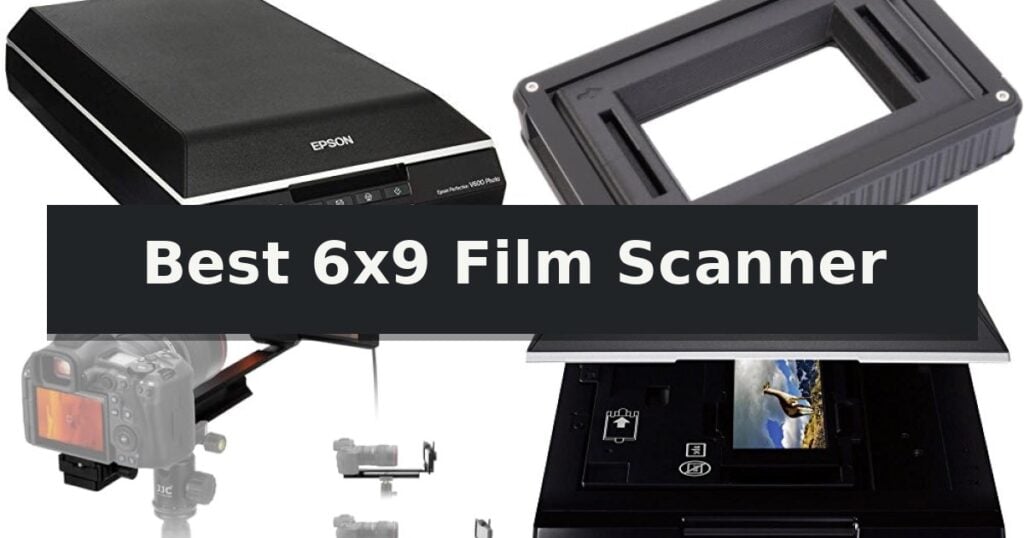
6 Best 6×9 Film Scanner in 2026 Reviews
Quick Comparison
| Product | Best For | Key Strength | Score |
|---|---|---|---|
| Epson Perfection V600 Photo Scanner | Best Overall | Integrated Transparency Unit for scanning slides and various film formats. | 4.9 |
| Negative Supply Basic Film Carrier 120 | Precision Carrier for Camera Scanning | Interchangeable masks support four common medium format sizes including 6x9cm. | 4.5 |
| JJC Film Digitizer Scanner | Complete Kit for Camera Digitization | Versatile compatibility with both 35mm and 120 medium format film. | 4.7 |
| Epson Perfection V550 Photo Scanner | Reliable Medium Format Flatbed | 6400 dpi optical resolution for high-detail enlargements | 4.3 |
| eTone 120 6×9 Film Clip | Essential Holder for Flat Scanning | Ensures film remains flat and stationary during the scanning process. | 4.6 |
| BGGJJ Negative Film Scanner | Dedicated 120 Format Support | Broad format compatibility including 35mm, 135, 120, and 4×5 film. | 4.3 |
How We Chose
To determine the best 6×9 film scanner, we evaluate the hardware's ability to maintain film flatness and ensure accurate light transmission across the medium format frame. We prioritize units that offer consistent, high-resolution output while considering the practical trade-offs between automated flatbed scanning and manual camera-digitization workflows.
- Film format compatibility and negative holder precision
- Optical resolution and dynamic range capabilities
- Software integration for dust and scratch removal
- Workflow efficiency and setup complexity
- Hardware versatility for mixed media scanning
1 Epson Perfection V600 Photo Scanner — Flatbed Versatility for Medium Format
The Epson Perfection V600 Photo Scanner is a versatile flatbed solution designed to bridge the gap between analog film archives and high-resolution digital workflows. By integrating a built-in Transparency Unit directly into the lid, it provides a dedicated space for scanning 35mm mounted slides, 12 negatives, and medium-format film up to 6 x 22cm without requiring additional external hardware.
Engineered for efficiency, the scanner utilizes ReadyScan LED technology, which eliminates the need for a warm-up period, allowing for immediate operation upon activation. This design choice not only accelerates the scanning process but also contributes to lower power consumption during use. With a maximum optical resolution of 6400 x 9600 dpi, the unit is capable of producing detailed digital files suitable for enlargements up to 17" x 22".
Usability is enhanced through four customizable buttons that streamline common tasks such as copying, emailing, and PDF creation. To ensure high-quality output, the included software suite features DIGITAL ICE technology for the automated removal of dust and scratches from film and prints, alongside Easy Photo Fix for restoring color to faded originals. The scanner connects via a high-speed USB 2.0 interface and includes all necessary film holders for immediate setup.
While the flatbed design offers significant flexibility for mixed media, users should note that the physical footprint measures 19 inches in length and 11 inches in height. This size is optimized for desktop use, providing a stable platform for both document scanning and film digitization, though it requires dedicated space in a workspace.
Best for: Photographers and archivists who need a single device to handle both standard documents and a variety of film formats including 35mm and medium-format.
Skip if: Users requiring a portable or ultra-compact scanner, as the flatbed design and integrated transparency unit result in a larger desktop footprint.
- Integrated Transparency Unit for scanning slides and various film formats.
- ReadyScan LED technology allows for instant operation with no warm-up time.
- High-resolution scanning up to 6400 x 9600 dpi for large-format enlargements.
- Comprehensive software suite including DIGITAL ICE for automatic restoration.
- Large physical footprint may occupy significant desk space.
- Wired USB 2.0 connectivity lacks modern wireless or cloud-direct options.
2 Negative Supply Basic Film Carrier 120 — Precision Carrier for Camera Scanning
Achieving high-fidelity digital captures of medium format film requires a stable, precise platform to ensure consistent alignment. The Negative Supply Basic Film Carrier 120 MK2 addresses this by utilizing a specialized double S-curve design, which helps keep film flat during the scanning process to maintain sharpness across the entire frame.
This carrier is engineered for versatility, featuring interchangeable masks that allow users to switch between 6×4.5, 6×6, 6×7, and 6x9cm formats seamlessly. Its construction from high-quality carbon fiber provides a balance of structural rigidity and weight, making it a durable tool for photographers who frequently digitize their medium format archives.
Designed as a dedicated film copier accessory, the unit integrates into existing camera scanning workflows. Its compact design, measuring 7.1 x 4.5 x 1.4 inches, ensures it remains unobtrusive on a copy stand or desk while providing a streamlined profile that simplifies handling during long scanning sessions.
Manufactured with a focus on precision, this tool reflects the brand's commitment to quality in film photography hardware. By providing a dedicated path for various medium format sizes, it minimizes the need for multiple specialized carriers, offering a comprehensive solution for enthusiasts and professionals alike.
Best for: Photographers who require a versatile, precision-engineered tool to digitize multiple medium format film sizes using a camera scanning setup.
Skip if: Users who prefer a dedicated flatbed scanner with integrated light sources and software rather than a camera-based scanning workflow.
- Interchangeable masks support four common medium format sizes including 6x9cm.
- Carbon fiber construction offers enhanced durability and a robust build.
- Double S-curve design promotes film flatness for improved scan quality.
- Compact dimensions allow for easy storage and efficient workspace management.
- Requires separate camera and light source to function as a complete scanning system.
3 JJC Film Digitizer Scanner — Complete Kit for Camera Digitization
Converting analog film to digital files requires precision, and the JJC Film Digitizer Scanner simplifies this process by leveraging your existing high-resolution digital camera and macro lens. Rather than relying on a dedicated, standalone scanner, this system uses a specialized slide rail and LED backlight panel to capture negatives with the clarity of your own camera sensor.
The core of this digitizer is its adjustable focus slider rail, which allows for precise front-to-back positioning between 10.4 and 18.5 inches. This flexibility ensures compatibility with various macro lenses. The included 11-level brightness LED backlight provides consistent, adjustable illumination, which is essential for achieving accurate exposure when digitizing 35mm film strips or 120 medium format negatives.
Constructed from durable aluminum, the unit features an Arca-Swiss base for rapid tripod mounting, alongside standard 1/4" and 3/8" threaded holes for versatile setup options. The system includes dedicated film holders for both 35mm and 120 formats, utilizing magnetic closures and anti-slip silicone pads to keep film flat and protected during the digitization process.
While this setup offers significant control over the final image quality, it is a modular system that requires a separate digital camera and macro lens to function. It is a practical solution for photographers who already own high-quality optics and prefer a camera-based workflow over traditional flatbed scanning hardware.
Best for: Photographers who own a macro lens and want to digitize 35mm or 120 film using their existing digital camera setup.
Skip if: Users who do not own a digital camera with a macro lens or those looking for an all-in-one standalone scanner that does not require external equipment.
- Versatile compatibility with both 35mm and 120 medium format film.
- Adjustable 11-level LED backlight for precise exposure control.
- Durable aluminum construction with Arca-Swiss tripod integration.
- Precise focus adjustment via the integrated slide rail system.
- Requires external equipment including a digital camera and macro lens to function.
- Not suitable for digitizing 35mm slides.
4 Epson Perfection V550 Photo Scanner — Reliable Medium Format Flatbed
Preserving analog memories requires a device capable of high-fidelity reproduction, and the Epson Perfection V550 Color Photo, Image, Film, Negative & Document Scanner addresses this with a 6400 dpi optical resolution. This high resolution allows for detailed enlargements up to 17 x 22 inches, making it a versatile tool for digitizing various media formats.
The scanner features a built-in transparency unit specifically designed to handle 35 millimeter slides, negatives, and film strips. To ensure high-quality results, it utilizes Digital ICE technology, which is engineered to remove the appearance of dust and scratches from film scans. This hardware-based restoration process is complemented by an easy photo fix feature for one-touch restoration of faded prints.
Efficiency is a core design choice, highlighted by the ReadyScan LED technology. This system eliminates warmup time and removes mercury from the light source, allowing for faster scanning cycles. Additionally, the scanner supports batch processing by scanning multiple photos at once, using auto edge detection to crop each image and save it as an individual file.
With a 48-bit color depth, the device is built to capture true-to-life colors across both reflective documents and transparent film. It connects via Hi-Speed USB 2.0 and includes ABBYY FineReader Sprint Plus OCR software, which converts scanned documents into editable text, expanding its utility beyond photography into general document management.
Best for: Photographers and archivists who need a versatile flatbed scanner capable of processing both reflective prints and 35mm film negatives with built-in dust removal.
Skip if: Users requiring support for medium or large format film, as this model is specifically limited to 35mm film and slides.
- 6400 dpi optical resolution for high-detail enlargements
- Digital ICE technology for automated film restoration
- ReadyScan LED technology for instant-on scanning
- Batch scanning with auto-crop functionality
- Limited to 35mm film and slides only
- USB 2.0 connectivity is slower than modern standards
5 eTone 120 6×9 Film Clip — Essential Holder for Flat Scanning
Achieving a perfectly flat scan requires more than just a light source; it demands precise mechanical control to prevent curling or shifting during the process. The eTone 120 6×9 Film Clip is a specialized accessory engineered specifically to secure medium format film, ensuring it remains perfectly flat and stationary while positioned on a compatible lightbox.
Constructed from durable plastic with a black surface, this holder measures 5.4in x 5.3in, providing a stable frame for 120 (6×9) film strips. Its primary function is to eliminate movement, which is critical for maintaining sharpness and consistency across your scans. By holding the film taut, it minimizes the risk of focus issues caused by the natural curvature of film stock.
This component is designed as a dedicated solution for users of eTone flipper viewer lightboxes. It is important to note that this is a standalone clip and does not include a base or the lightbox itself. It serves as a direct replacement or an additional tool for photographers who need to manage multiple film strips efficiently during a scanning session.
The eTone 120 6×9 Film Clip offers a straightforward, no-nonsense approach to film preparation. Because it is built for a specific ecosystem, it ensures a reliable fit for those already utilizing the eTone system, providing a simple, effective method to keep your negatives aligned and ready for high-quality digital capture.
Best for: Photographers using eTone flipper viewer lightboxes who need a dedicated, secure way to keep 120 (6×9) film strips flat during scanning.
Skip if: Users who do not own an eTone flipper viewer lightbox, as this clip is not designed for universal compatibility with other scanning setups.
- Ensures film remains flat and stationary during the scanning process.
- Durable plastic construction with a black finish for light management.
- Specific design tailored for 120 (6×9) film formats.
- Compatible only with eTone flipper viewer lightboxes.
- Standalone clip that requires an existing lightbox base.
6 BGGJJ Negative Film Scanner — Dedicated 120 Format Support
Digitizing analog archives requires reliable hardware, and the BGGJJ Negative Film Scanner offers a specialized solution for photographers working with diverse film stocks. This device is engineered to handle multiple formats, including 35mm, 135, 120, and 4×5 film, providing a dedicated platform for both scanning and visual inspection of developed negatives.
Designed as a standalone film scanning device, this unit functions independently without the need for integration into a camera or host computer. Its primary utility lies in its ability to facilitate the digitize copying and conversion of various negative film stocks, making it a practical tool for those looking to preserve or archive their physical film collections into digital formats.
The scanner features a specific 6×9 120 film holder, which highlights its utility for medium format enthusiasts who require precise alignment for their larger negatives. With a weight of 2.5 pounds, the unit maintains a stable footprint on a workspace while remaining manageable for storage or relocation between projects.
By serving as both a scanner and a viewer, the BGGJJ Negative Film Scanner simplifies the workflow for photographers who need to verify their negatives before committing to high-resolution digital conversion. It is backed by a 1 Year Limited Warranty, ensuring support for its intended use as a photography accessory.
Best for: Photographers who need a standalone, dedicated device for digitizing and inspecting 35mm, 120, and 4×5 film formats.
Skip if: Users who require high-speed automated batch scanning or those who prefer a camera-based scanning setup using their own digital mirrorless or DSLR equipment.
- Broad format compatibility including 35mm, 135, 120, and 4×5 film.
- Standalone operation eliminates the need for external host software or camera integration.
- Includes a dedicated 6×9 120 film holder for medium format support.
- Functions as both a scanner and a viewer for versatile negative inspection.
- Manual operation requires more time compared to automated batch scanners.
- Standalone design lacks the advanced image processing capabilities found in computer-tethered scanning systems.
Best 6×9 Film Scanner Buying Guide
Flatbed Scanners vs. Camera Digitization
Flatbed scanners are self-contained units that include their own light source and scanning software. They are generally easier to set up and ideal for users who want a straightforward, one-stop solution for digitizing various film formats and reflective documents.
Camera digitization involves using your existing digital camera and a macro lens to photograph the film. This method often produces higher resolution and sharper images, but it requires a stable tripod, a high-quality light source, and a precise film carrier to hold the negative perfectly flat.
The Importance of Film Holders
A film holder is critical for keeping your 6×9 negatives flat and correctly positioned. If the film bows or curls, the scanner or camera lens will struggle to maintain focus across the entire frame, leading to blurry edges.
When selecting a scanner or a standalone carrier, ensure it includes a specific mask for the 6×9 format. Using an incorrect mask can result in light leaks or cropping, which compromises the quality of your digital archive.
Resolution and Dynamic Range
Medium format film contains significantly more detail than 35mm, so resolution is a primary concern. Look for scanners that offer high optical resolution, which allows you to create large prints without losing clarity.
Dynamic range refers to the scanner's ability to capture detail in both the brightest highlights and the deepest shadows of your negatives. A higher dynamic range is essential for preserving the tonal depth inherent in medium format film.
Software and Restoration Tools
Many flatbed scanners come with proprietary software that includes automated dust and scratch removal, such as DIGITAL ICE. This technology uses infrared light to detect physical imperfections on the film surface and digitally repairs them during the scan.
If you choose a camera-based scanning kit, you will likely need to perform these restorations manually in post-processing software. While this provides more control, it can significantly increase the time required to process each roll of film.
Workflow and Space Considerations
Consider the physical footprint of your scanning setup. A flatbed scanner takes up a fixed amount of desk space, whereas a camera-scanning setup requires a tripod, a light panel, and a rail system, which may be more cumbersome to store.
Think about your scanning volume. If you have hundreds of negatives to digitize, an automated flatbed that can scan multiple frames at once might save you significant time compared to manually repositioning each frame for a camera setup.
Frequently Asked Questions
Can I scan 6×9 film on a standard document scanner?
No, standard document scanners lack the transparency unit required to pass light through film negatives. You must use a scanner or digitizer specifically designed for film.
Do I need a macro lens for camera-based scanning?
Yes, a macro lens is highly recommended for camera scanning to ensure you can focus closely enough on the film to capture the full frame with maximum sharpness.
Is DIGITAL ICE compatible with all film types?
DIGITAL ICE generally works well with color negative and positive film, but it is often incompatible with traditional black-and-white film due to the silver content in the emulsion.
How do I ensure my 6×9 negatives stay flat?
Always use a high-quality film carrier or mask designed for the 6×9 format. Some carriers use magnetic closures or tension systems to keep the film perfectly flat.
What is the main advantage of a flatbed scanner?
The main advantage is convenience. It is an all-in-one solution that includes the light source, the scanning hardware, and the software needed to convert film to digital files.
Conclusion: Our Top Pick
Our top pick is Epson Perfection V600 Photo Scanner. Choosing the right tool for your 6×9 negatives depends on whether you value the convenience of an all-in-one flatbed or the potential for higher image quality through a camera-based system. For most users, the Epson Perfection V600 offers the best balance of ease and performance.
Evaluate your current photography gear and the time you are willing to invest in post-processing. Regardless of your choice, investing in a high-quality film holder will always be the most important step in ensuring your digital archives remain sharp and clear.